Laminating Adhesives for Solar Panel Encapsulation: EVA & POE Chemistry
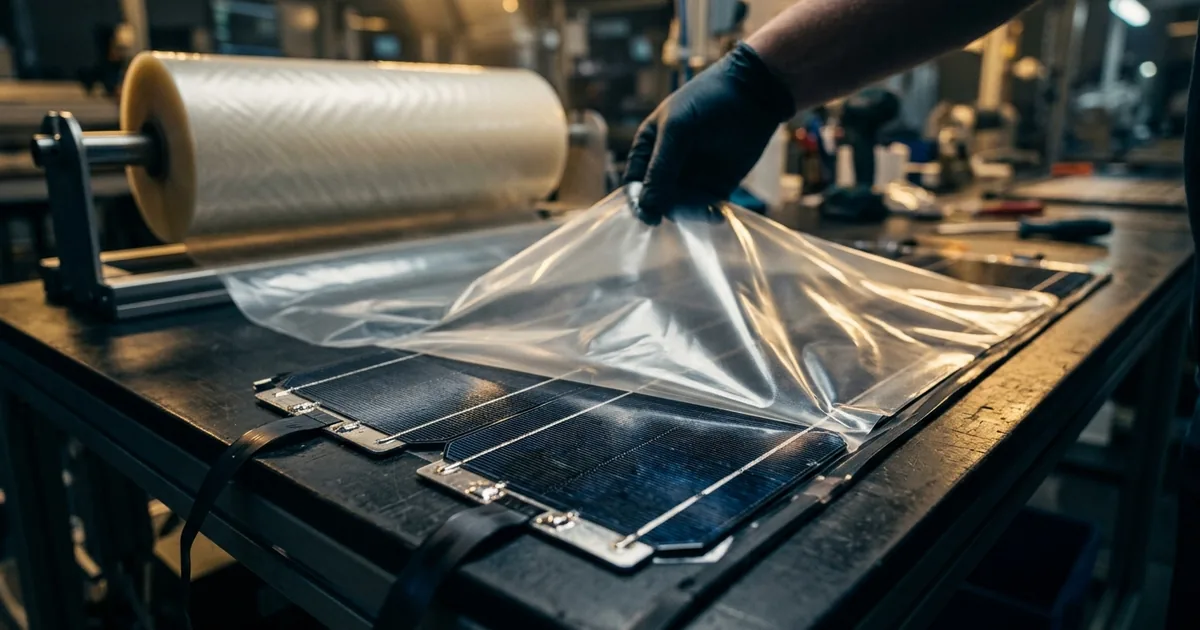
A solar module that fails inside its 25-year warranty period rarely fails because a cell cracked — it fails because the layer holding everything together let moisture in. Encapsulant delamination, yellowing, and moisture ingress account for a well-documented share of field failures reported across large PV fleets, and the industry has spent two decades refining the solar panel encapsulation adhesive at the center of that problem. Get the chemistry wrong and a manufacturer inherits warranty claims, insurance disputes, and reputational damage years after the panels ship. This guide explains how ethylene-vinyl acetate (EVA) and polyolefin elastomer (POE) encapsulants actually work, why the industry is shifting toward POE for bifacial and high-voltage modules, and what happens chemically during lamination that turns loose sheets into a sealed, decades-long bond. It draws on the same materials-selection discipline we apply across our adhesives and sealants consulting work, written for engineers and entrepreneurs specifying PV module lines rather than academics studying polymer chemistry in isolation.
Why Encapsulation Chemistry Determines Panel Lifespan
Every crystalline-silicon solar module is built as a laminated sandwich: tempered glass on top, an encapsulant sheet, solar cells and interconnects, a second encapsulant sheet, and a backsheet or second glass pane underneath. The encapsulant does the most invisible work in that stack, and it carries several distinct jobs at once rather than just one. It has to stay optically clear enough for the cells beneath it to keep capturing usable sunlight, electrically insulating enough to prevent leakage current between the cells and the grounded frame, and mechanically compliant enough to absorb thermal expansion without cracking the cells it surrounds. Get any one of those jobs wrong and the module either underperforms from day one or degrades faster than its warranty assumes.
- Optical coupling — stays highly transparent across the usable solar spectrum for the module's full service life
- Electrical insulation — separates conductive cell circuitry from the grounded frame and glass
- Mechanical bonding — holds glass, cells, and backsheet together as one rigid laminate under thermal cycling
- Moisture barrier — blocks water vapor ingress that corrodes cell metallization and interconnects
Every failure mode covered in this guide — yellowing, delamination, potential-induced degradation — traces back to one of these four functions breaking down. That is why encapsulant selection belongs in a module's reliability engineering, not just its bill-of-materials cost line.
EVA Encapsulant Chemistry: Crosslinking and Its Trade-offs
Ethylene-vinyl acetate has been the default PV encapsulant since crystalline-silicon modules became commercially standard, and its chemistry explains both that dominance and its known weaknesses. EVA sheet arrives at the laminator uncrosslinked, pre-blended with an organic peroxide curing agent, UV stabilizers, and adhesion promoters. Heat and pressure during lamination decompose the peroxide into free radicals, which stitch adjacent EVA polymer chains into a three-dimensional crosslinked network. That reaction is what converts a soft, tacky sheet into the rigid, optically clear structural layer a finished module depends on for decades.
The same vinyl acetate group that gives EVA its flexibility and cost advantage is also its long-term liability. Under sustained UV exposure, heat, and residual moisture, vinyl acetate groups slowly hydrolyze and release acetic acid inside the laminate. That acetic acid corrodes the silver and aluminum metallization on the cell surface over years of field exposure, a degradation pathway well documented in EVA durability research. The same chemistry is implicated in the yellowing and browning some older modules display after a decade or more in hot, humid climates, since acetic acid formation runs in parallel with UV-driven chromophore development inside the resin.
None of this makes EVA obsolete — it remains the lowest-cost, best-understood option for standard monofacial residential and commercial modules. But the same acetic-acid pathway that limits EVA's ceiling is exactly what a newer encapsulant chemistry was designed to eliminate.
POE Encapsulant Chemistry: Why the Industry Is Shifting
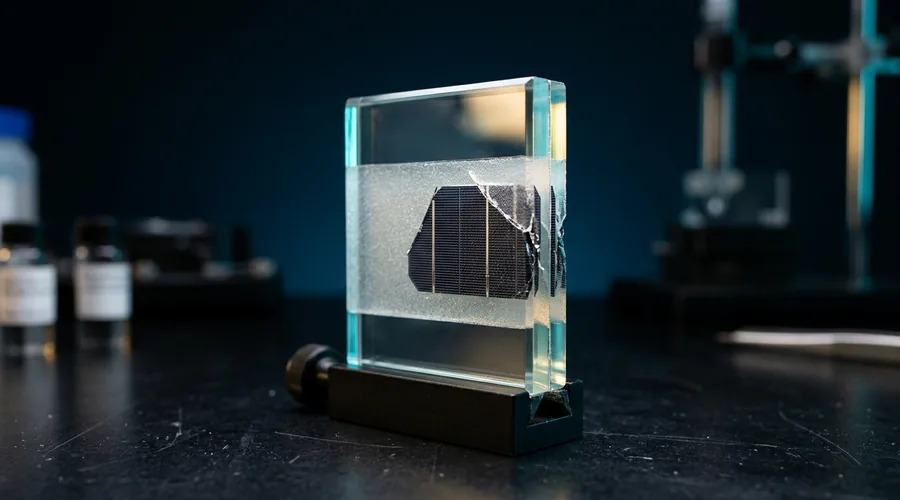
Polyolefin elastomer encapsulant is built from a copolymer of ethylene and a higher alpha-olefin, most commonly octene, produced with metallocene catalyst technology rather than the vinyl acetate chemistry behind EVA. That structural difference is the entire story: POE has no acetate groups anywhere in its backbone, so it cannot hydrolyze into acetic acid the way EVA does under UV and heat. The polymer's non-polar hydrocarbon structure also gives it a substantially lower water vapor transmission rate than EVA, meaning less moisture reaches the cells and interconnects over the module's service life.
POE's second major advantage shows up in electrical resistivity rather than moisture resistance alone. Its non-polar backbone carries far fewer mobile ionic impurities than EVA, giving POE sheet significantly higher volume resistivity. That property directly addresses potential-induced degradation, a well-documented failure mode in which sodium ions migrate from the glass superstrate through the encapsulant to the cell surface under sustained high system voltage, progressively degrading output. Bifacial modules and utility-scale arrays running 1500-volt system architecture are particularly exposed to this mechanism, which is exactly why POE adoption concentrated in those segments first.
POE is not a universal replacement for EVA — its higher material cost and more demanding process window mean EVA still makes commercial sense for standard-voltage monofacial modules. Choosing between them becomes far clearer once the two chemistries sit side by side.
EVA vs POE: Choosing the Right Encapsulant
Neither chemistry is categorically superior — each optimizes for a different combination of module architecture, voltage class, and cost target. The comparison below reflects the general chemistry and performance differences reported across PV materials literature and standards testing, though specific supplier grades vary and should be validated against a manufacturer's own qualification data before a sourcing decision is finalized.
| Parameter | EVA Encapsulant | POE Encapsulant |
|---|---|---|
| Base chemistry | Ethylene-vinyl acetate copolymer | Ethylene-octene (alpha-olefin) copolymer |
| Curing mechanism | Peroxide-initiated crosslinking during lamination | Typically non-crosslinking or lightly crosslinked |
| Acetic acid formation | Yes, from vinyl acetate hydrolysis | None — no acetate groups present |
| Moisture barrier | Moderate water vapor transmission rate | Lower water vapor transmission rate |
| Electrical resistivity | Lower | Higher — improved PID resistance |
| Best-fit module type | Standard monofacial residential/commercial | Bifacial, high-voltage utility-scale |
| Relative material cost | Lower | Higher |
The practical selection rule that follows is straightforward: default to EVA unless the module's voltage architecture, bifacial design, or target climate specifically calls for POE's moisture and PID advantages. Getting that decision right at the design stage is far cheaper than discovering it was wrong after a decade in the field.
Inside the Lamination Process
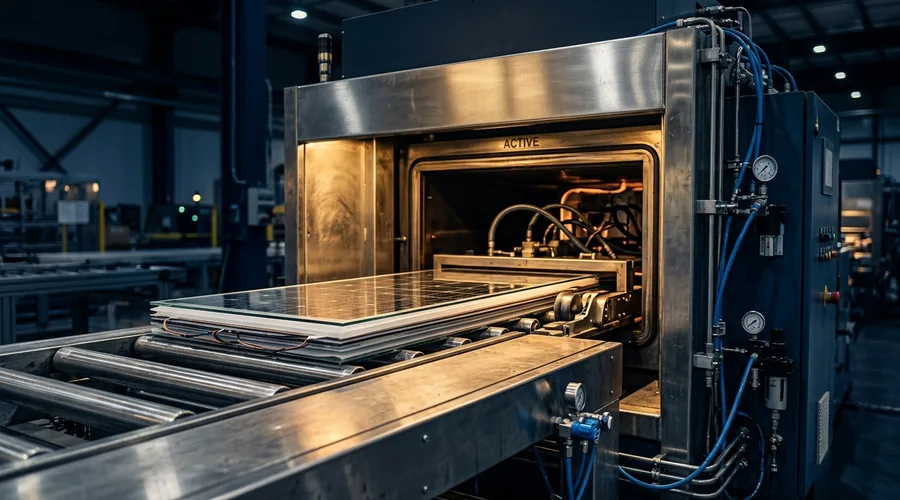
Encapsulant chemistry only delivers on its design intent if the lamination process activates it correctly, which makes lamination as much a chemical engineering step as an assembly one. A vacuum laminator layers glass, encapsulant, the interconnected cell string, encapsulant, and backsheet, then pulls a vacuum to remove trapped air before applying heat and mechanical pressure. That combination melts the encapsulant into a continuous, bubble-free layer while simultaneously driving the peroxide crosslinking reaction that locks the laminate together.
Unlike UV-initiated cure chemistries used elsewhere in adhesives manufacturing — the kind covered in our guide to UV-cure adhesives for electronics and medical devices — EVA and POE lamination relies entirely on heat and pressure rather than light-triggered curing, which is why PV manufacturing lines are built around vacuum laminators rather than UV curing stations. Chamber temperature, dwell time, and vacuum hold are tuned against the specific encapsulant grade's cure kinetics, and getting that tuning wrong shows up as incomplete crosslinking, trapped air bubbles, or scorched encapsulant at the panel edges. Gel content, the standard metric for how much of the encapsulant has actually crosslinked, is measured after lamination to confirm the cure reached completion rather than assumed from process time alone.
- Under-cure — insufficient gel content leaves the laminate soft and prone to delamination under thermal cycling
- Trapped air — inadequate vacuum hold produces visible bubbles that concentrate stress and moisture-ingress points
- Edge scorching — excess dwell time or temperature degrades encapsulant at the panel perimeter first
- Backsheet disbond — weak adhesion-promoter chemistry or a contaminated surface causes backsheet peel-back over time
The same bubble-free, fully-cured bonding discipline shows up across other multilayer bonded products; the underlying adhesion chemistry parallels what we cover in our guide to flexible packaging lamination adhesives, where a different substrate stack faces the same structural requirement. A correctly executed lamination cycle looks identical to a poorly-tuned one straight off the line — the difference only becomes visible years later, which is exactly why qualification testing exists before a module design ever ships.
Qualification Standards and Durability Testing
Because encapsulant failure modes take years to appear in the field, the PV industry relies on accelerated qualification testing rather than waiting for real-world data before certifying a module design. IEC 61215 and IEC 61730, maintained by the International Electrotechnical Commission, define the module-level test sequences manufacturers must pass, while IEC 62788 covers encapsulant-specific material properties including gel content and adhesion strength. These standards exist precisely because encapsulant chemistry problems stay invisible at the factory and become expensive once discovered in the field.
Damp heat testing is the single most encapsulant-relevant test in that sequence, exposing a finished module to sustained high temperature and high humidity to accelerate the same hydrolysis and moisture-ingress mechanisms that play out over a module's real service life. A module that passes damp heat testing has demonstrated that its encapsulant, backsheet adhesion, and edge seal resist accelerated moisture ingress without measurable power loss — a result the industry treats as reasonably predictive of long-term field performance. Manufacturers entering the PV component space also need to track raw-material compliance for the peroxides, silanes, and stabilizer packages used in encapsulant formulation, an obligation that runs alongside the adhesive-chemistry compliance work we cover for EV battery pack adhesives and thermal gap fillers in other energy-sector applications.
Passing qualification testing is a floor, not a ceiling. It confirms an encapsulant system meets the industry's minimum accelerated-aging bar, not that it matches the best-performing chemistry available for a given module's specific voltage class and climate exposure.
Frequently Asked Questions
What's the difference between EVA and POE encapsulants for solar panels?
EVA (ethylene-vinyl acetate) is a peroxide-crosslinked copolymer that contains vinyl acetate groups, which give it flexibility and low cost but also let it hydrolyze into acetic acid under prolonged UV and moisture exposure. POE (polyolefin elastomer) is built from ethylene and a higher alpha-olefin with no acetate groups at all, giving it a lower water vapor transmission rate and significantly higher electrical resistivity than EVA.
In practical terms, EVA remains the default for standard monofacial residential and commercial modules, while POE has become the preferred choice for bifacial and high-voltage utility-scale designs where moisture ingress and potential-induced degradation carry a bigger performance penalty.
Why does EVA encapsulant turn yellow over time?
EVA's vinyl acetate groups slowly hydrolyze under sustained heat, UV exposure, and residual moisture inside the laminate, releasing acetic acid as a byproduct. That same degradation pathway runs alongside UV-driven chromophore formation in the resin, and together they produce the browning or yellowing some older modules develop after a decade or more in hot, humid climates.
Yellowing does not necessarily mean the module has failed outright, but it does reduce light transmission to the cells and is generally treated as an early warning sign of encapsulant degradation rather than a cosmetic issue alone.
What is potential-induced degradation and how does encapsulant chemistry cause it?
Potential-induced degradation, or PID, is a well-documented failure mode in which sodium ions migrate from the glass superstrate through the encapsulant to the cell surface under sustained high system voltage, progressively degrading cell performance. Encapsulant chemistry plays a direct role because a lower-resistivity material like standard EVA offers less resistance to that ion migration pathway than a higher-resistivity material like POE.
Bifacial modules and utility-scale arrays running 1500-volt system architecture are especially exposed to PID, which is one of the main reasons POE adoption concentrated in those segments first.
Why are POE encapsulants used in bifacial solar modules?
Bifacial modules are typically built with glass on both sides rather than a polymer backsheet, and they are increasingly deployed in high-voltage 1500-volt system architectures to reduce balance-of-system costs at utility scale. Both design choices raise the stakes on encapsulant performance: glass-glass construction demands a strong, moisture-resistant bond on both faces, and higher system voltage increases the risk of potential-induced degradation.
POE's lower water vapor transmission rate and higher electrical resistivity directly address both pressures, which is why it has become the standard encapsulant choice for most new bifacial module designs.
What happens during the vacuum lamination process?
A vacuum laminator layers tempered glass, encapsulant sheet, the interconnected cell string, a second encapsulant sheet, and a backsheet or second glass pane, then pulls a vacuum to remove trapped air before applying heat and mechanical pressure. That heat and pressure melts the encapsulant into a continuous, bubble-free layer while simultaneously triggering the peroxide crosslinking reaction that locks the laminate into its final structural form.
Gel content, the standard metric for how much of the encapsulant has actually crosslinked, is measured afterward to confirm the cure reached completion rather than assumed from process time alone.
Do POE encapsulants cost more than EVA?
Yes, POE sheet generally carries a higher material cost than standard EVA, and it also demands more careful process control because its low-polarity backbone is inherently harder to bond to glass and backsheet without engineered adhesion promoters.
That said, total cost of ownership is a different calculation for modules exposed to high moisture, high voltage, or bifacial design requirements, where POE's resistance to potential-induced degradation and moisture ingress can prevent far more expensive field failures and warranty claims over the module's service life.
What testing standards do solar panel encapsulants have to pass?
Finished modules are qualified against IEC 61215 and IEC 61730, which define the test sequences a module design must pass before certification, while IEC 62788 covers encapsulant-specific material properties including gel content and adhesion strength. Damp heat testing, which exposes a finished module to sustained high temperature and high humidity, is the single most encapsulant-relevant test in that sequence because it accelerates the same hydrolysis and moisture-ingress mechanisms that play out over a module's real-world service life.
Passing this testing confirms an encapsulant system meets the industry's minimum accelerated-aging bar, not that it matches the best-performing chemistry available for a given voltage class and climate.
Developing or Sourcing PV Encapsulant Systems?
Global Formulation provides adhesives and materials consultancy — encapsulant selection, lamination process engineering, and qualification support for solar module manufacturers.
Talk to Our Formulation Team