Walk into any supermarket, pharmacy, or convenience store and the air freshener aisle tells the same story everywhere — a handful of multinational brands controlling premium shelf space while dozens of regional names compete on price and fragrance variety just below them. That gap is exactly where a new air freshener aerosol manufacturing business can enter profitably, because the barriers are operational rather than financial: the equipment is compact, the raw materials are widely available, and the real competitive edge comes from fragrance selection and consistent can quality, not massive capital. This guide walks through the complete startup roadmap — the filling equipment and capital you actually need, propellant and fragrance sourcing, the production and can-safety process, licensing, pricing, and how to land your first retail or distributor accounts. Everything here reflects real industry practice, the operational detail a founder needs before committing capital, not textbook theory.
Market Overview & Opportunity
The global air freshener market is a multi-billion dollar consumer goods category, and aerosol formats remain the single largest sub-segment within it despite growing competition from gel, plug-in, and diffuser alternatives, because aerosols deliver instant, controllable fragrance intensity that other formats cannot match. Household and institutional demand for odor control has only grown as urban living density increases and commercial spaces — offices, hotels, restrooms, vehicles — compete on presenting a clean, pleasant environment to visitors and customers.
Primary customer segments split three ways: retail consumers buying through general trade kirana stores, pharmacies, and modern retail chains; institutional buyers such as hotels, hospitals, offices, and cleaning contractors who purchase in bulk for facility maintenance; and B2B private-label buyers who want a contract manufacturer to produce a branded air freshener line for their own retail distribution. Demand drivers include rising urbanisation, growth in organised retail and modern trade across South Asia, the Middle East, and Southeast Asia, and a steady institutional cleaning and hospitality sector that treats air freshener as a recurring consumable rather than a discretionary purchase. The WHO's guidance on indoor air quality and general consumer aerosol standards referenced by bodies like the technical aerosol spray literature both confirm that fragrance-delivery aerosols remain a mainstream, well-understood consumer product category rather than a niche or declining one.
Competition comes from multinational brands with strong shelf presence in modern retail, but they rarely compete aggressively on price or on regional fragrance preference, leaving genuine room for a local manufacturer who can offer competitive pricing, faster replenishment to general trade, and fragrance profiles tuned to local taste. As detailed on our aerosols resource page, a new entrant differentiates most effectively on local supply reliability and fragrance variety rather than trying to out-brand an established multinational on marketing spend alone.
Investment Breakdown: Starting on Minimum Capital
Capital requirements in this category depend heavily on whether you outsource filling to a contract aerosol filler or invest in your own filling and crimping line from day one. Contract filling is by far the more accessible entry point for a capital-constrained founder, since it lets you launch with just fragrance concentrate development, branding, and a first purchase order, deferring the larger equipment investment until your sales volume justifies it.
| Cost Category | Estimated Range (USD) | Notes |
|---|---|---|
| Fragrance concentrate development | $800 – $2,500 | Working with a fragrance house on 2–4 initial scent profiles |
| First production run (contract filled) | $3,000 – $8,000 | Typical minimum order for 10,000–20,000 units through a contract filler |
| Semi-automatic filling line (if in-house) | $4,000 – $10,000 | Filling head, gassing/crimping unit, leak-test tank |
| Cans, valves and actuators (first batch) | $2,000 – $5,000 | Tinplate or aluminium cans; MOQ-driven pricing |
| Propellant supply (LPG/DME) — first batch | $500 – $1,500 | Bulk propellant cylinder or tote, depending on volume |
| Labelling and packaging | $800 – $2,000 | Printed shrink sleeves or self-adhesive labels, shrink film |
| Licensing & hazardous goods registration | $1,000 – $3,000 | Varies significantly by country |
| Working capital (3 months operating expenses) | $1,500 – $4,000 | Utilities, labour, overhead while building first customer base |
| Total Minimum | $12,000 – $35,000 | Before first sale; contract-filled entry point at the lower end |
The lower end of this range reflects a founder who outsources filling entirely and focuses capital on fragrance development, branding, and a first production order, while the upper end reflects a founder building an in-house semi-automatic filling line from the outset. Filling heads, gassing units, and leak-test tanks are frequently available second-hand from aerosol contract fillers upgrading their lines, which can meaningfully lower the equipment threshold if you choose to bring filling in-house later. Deferring your own filling line until you have validated demand through a contract-filled first batch is the lower-risk path most successful founders in this category follow.
Minimum Equipment List for a Small-Scale Unit
Aerosol filling equipment is more specialised than typical liquid product filling because it involves handling pressurised propellant and verifying can integrity before product ever reaches a shelf. Even at contract-filled scale, you should understand this equipment intimately, since you will eventually either negotiate with a contract filler from an informed position or invest in your own line as volume grows.
| Equipment | Minimum Spec | Approx. Cost |
|---|---|---|
| Concentrate mixing vessel | Stainless steel, 100–300 L, with agitator | $800 – $2,000 |
| Semi-automatic filling head | Volumetric or piston-fill; food/chemical grade contact parts | $1,500 – $3,500 |
| Propellant gassing and crimping unit | Under-cap gassing; pneumatic crimping head rated for aerosol valve seaming | $2,000 – $4,500 |
| Leak-test water bath | Heated tank, 45–55°C, for 100% batch leak verification | $600 – $1,500 |
| Pressure test gauge and rig | Calibrated gauge for spot-check pressure verification | $300 – $700 |
| Labelling / shrink-sleeve applicator | Semi-automatic sleeve applicator with heat tunnel | $1,000 – $2,500 |
| Fragrance and solvent storage | Ventilated, fire-rated cabinet for flammable liquids | $500 – $1,200 |
| Propellant storage cage | Fire-rated, ventilated outdoor or dedicated indoor cage | $800 – $2,000 |
| Analytical balance and pH meter | 0–2,000 g resolution balance; bench pH meter for QC | $300 – $700 |
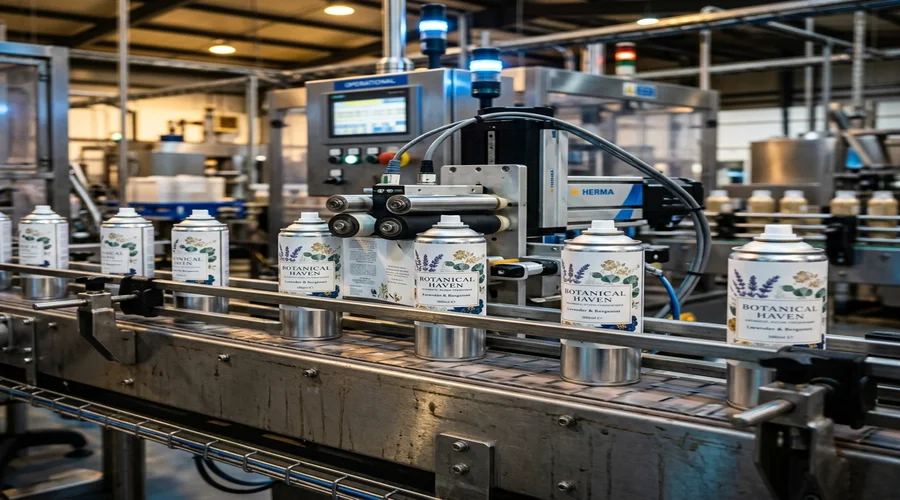
The gassing and crimping unit and the leak-test water bath deserve the largest share of your equipment budget attention, since they are the two stations that directly determine whether a can is safe to ship. A founder who skips the leak-test bath to save capital is not actually saving money — a field failure or recall costs far more than the equipment itself.
Space, Utilities & Infrastructure Requirements
A functional air freshener aerosol filling unit needs a minimum floor area of roughly 600 to 900 square feet, divided into a concentrate preparation area, a separated and ventilated filling and crimping bay, a leak-test station, and a fire-rated propellant storage cage positioned away from the main filling activity. Zone separation matters here specifically because propellant handling introduces a flammability risk that general FMCG filling operations do not carry, and regulators typically inspect exactly this separation during licensing.
Power requirements are modest — the filling, gassing, and crimping equipment typically runs on single-phase power, though a compressed air supply is needed for pneumatic crimping heads. Ventilation in the filling bay is the single most safety-critical infrastructure item, since propellant vapour and solvent fumes must not accumulate; explosion-proof electrical fittings and lighting are standard requirements in the filling and propellant storage zones in most jurisdictions, not optional upgrades. Water supply needs are minimal, limited mainly to the leak-test water bath and general cleaning.
Proximity to a propellant supplier matters more in this category than in most FMCG segments, since LPG and DME propellant cylinders are bulky and regulated during transport, and a facility located near an industrial gas distributor shortens both your supply chain and your logistics cost per batch.
Best Products to Start With: Low Capital, High Demand
Not every air freshener format is equally accessible to a new manufacturer, and choosing the right entry point determines how quickly you reach positive cash flow while you are still building fragrance and can-safety competence. The three starter categories below are ranked by ease of entry, raw material and equipment requirements, and how quickly a founder can build a defensible fragrance portfolio.
- Standard room air freshener spray — a solvent/ethanol-based fragrance aerosol in a classic 200–300 mL can, the most widely purchased format across general trade and modern retail. This is the most accessible entry point because the formulation is straightforward, propellant ratios are well established, and demand spans every customer segment.
- Bathroom and toilet spray — typically a more concentrated, fast-evaporating formulation with malodour-counteracting fragrance notes, sold in smaller cans at a price point that supports strong per-unit margin. This category benefits from steady institutional demand from hotels, hospitals, and offices alongside retail sales.
- Car and fabric freshener aerosol — a niche-format variant using milder solvent systems suitable for enclosed vehicle spaces or fabric contact, commanding a price premium over standard room sprays. This line requires slightly more careful solvent selection to avoid staining fabric or vehicle interiors, but it opens a distinct retail channel through automotive accessory outlets.
As detailed on our aerosols formulation resources, sequencing your launch — starting with standard room spray, then adding bathroom spray, then car freshener as your fragrance library and distribution network grow — is the standard path successful founders in this category follow rather than launching a full range simultaneously.
Raw Material Sourcing Strategy
Raw material sourcing for air freshener aerosols spans three distinct categories — fragrance concentrate, solvent carrier, and propellant — each with different supplier types and evaluation criteria. Getting fragrance sourcing right matters most, since fragrance is the single input customers actually notice and remember, while propellant and solvent sourcing matter most for safety and regulatory compliance.
Fragrance concentrates are sourced from specialist fragrance houses rather than generic chemical distributors, since fragrance development requires blending expertise and stability testing that a general distributor cannot provide. Solvent carriers — typically ethanol, isopropyl alcohol, or odourless mineral spirit blends depending on your target market's VOC regulations — are available from industrial chemical distributors, while propellants such as LPG (liquefied petroleum gas) blends or DME (dimethyl ether) are sourced from industrial gas suppliers who handle the regulatory documentation for hazardous goods transport. Cans, valves, and actuators are sourced from aerosol packaging manufacturers, and minimum order quantities here are often the binding constraint for a new founder — typically 10,000 to 50,000 units per SKU depending on the supplier.
Evaluating a fragrance house means requesting stability data showing the fragrance holds its scent profile and doesn't discolour or destabilise the formulation over the product's intended shelf life, not just an appealing scent sample. The International Fragrance Association (IFRA) standards govern permissible fragrance ingredient concentrations and are a mandatory reference point when evaluating any fragrance house's compliance practices.
- Fragrance concentrate — source from an established fragrance house with documented IFRA compliance and stability data, not a generic essential oil supplier
- Solvent carrier — VOC content directly affects regulatory classification in many markets, so confirm your solvent choice against your target market's VOC limits before formulating
- Propellant — LPG blends are generally the lower-cost option; DME offers better fragrance solvency for some formulations but typically costs more and requires compatible can linings
- Cans and valves — always request corrosion compatibility data between your can lining and your specific fragrance/solvent blend, since incompatible combinations can cause internal can corrosion over shelf life
Manufacturing Process Overview
The manufacturing process for air freshener aerosols is a batch concentrate preparation step followed by a pressurised filling and sealing sequence, and process discipline around propellant ratio and can sealing integrity matters more than complex chemistry. The key skill is process control — consistent fragrance-to-solvent ratio, accurate propellant dosing, and verified can seaming — not formulation complexity.
Concentrate Preparation
Production begins with blending the fragrance concentrate into the solvent carrier in the mixing vessel under gentle agitation, at a ratio validated during formulation development to deliver the target fragrance intensity without exceeding solubility limits. The blended concentrate is filtered to remove any particulate before filling, since particulate contamination can clog the valve's spray orifice and cause inconsistent spray pattern on the finished product.
Filling, Gassing and Crimping
The filtered concentrate is dosed into each can by the semi-automatic filling head at a precise fill volume, after which the valve is placed and the can moves to the gassing and crimping station. Propellant is injected under the valve — either through-the-valve or under-cap gassing depending on your equipment — immediately followed by crimping, which mechanically seals the valve to the can rim to create the pressure-tight seal that holds the product for its entire shelf life.
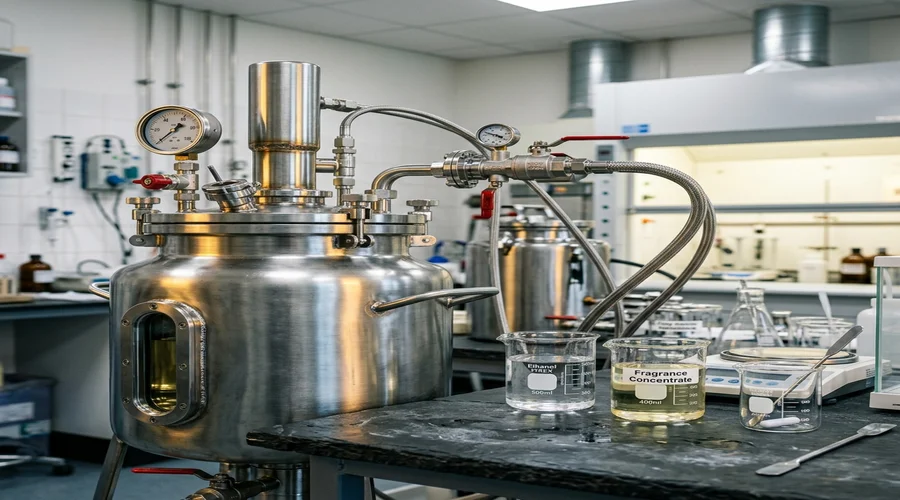
The most common mistake beginners make is under-dosing propellant to save cost, which produces a weak, unsatisfying spray pattern that customers notice immediately and blame on product quality rather than dosing. Getting crimping tension right is equally critical — too loose and the can leaks over time, too tight and the valve can be damaged during seaming — which is exactly why every single batch needs verification before it ships.
Quality Control & Testing for Small Manufacturers
Quality control in aerosol manufacturing carries a safety dimension that most consumer product categories do not, because a pressurised can that leaks or ruptures is not just a quality defect — it is a genuine hazard to the retailer, distributor, and end consumer. Your ability to guarantee every can passes pressure and leak verification is what separates a manufacturer buyers and regulators trust from one that gets pulled off shelves after a single incident.
| Test | What It Measures | Equipment Needed | Pass/Fail Criterion |
|---|---|---|---|
| Leak test (100% of batch) | Seal integrity at the valve crimp | Heated water bath, 45–55°C | No visible bubbling or gas escape within test duration |
| Internal pressure check (sample) | Propellant dosing accuracy | Calibrated pressure gauge rig | Within formulation-specified pressure range |
| Spray pattern and rate | Actuator and valve function, fragrance delivery | Timed discharge onto weighing balance | Consistent spray weight and pattern per specification |
| Fill weight verification | Concentrate dosing accuracy | Calibrated filling-line check-weigher or bench scale | Within declared net weight tolerance |
The 100% leak test is non-negotiable and the single most important quality gate in this entire process, since it is your last checkpoint before a defective can reaches a shelf. Retaining dated batch records showing leak-test pass rates and pressure verification data gives you the documentation retailers and hazardous-goods regulators will eventually ask for, and it is also the fastest way to demonstrate credibility to a new distributor evaluating you as a supplier. Reference frameworks such as the EU's Aerosol Dispensers Directive provide a useful structure for building your internal pressure and leak testing protocol even outside the EU market.
Setting up a manufacturing unit involves more than equipment and raw materials — getting the formulation right, scaling production safely, and meeting regulatory requirements are where most startups lose time and money. If you need hands-on guidance at any stage, the Global Formulation team works directly with chemical startups on formulation development, process setup, and compliance — from first batch to commercial scale.
Packaging & Branding on a Budget
Air freshener aerosols are sold almost exclusively in tinplate or aluminium cans of 150–400 mL, and the can itself doubles as your primary branding surface since there is no secondary box or carton in most retail formats. Choosing a can supplier who can print or accept shrink sleeves at reasonably low minimum order quantities is more important for a new brand than chasing the cheapest per-unit can price, because label flexibility lets you launch multiple fragrance variants without committing to large print runs for each.
Label and can markings are stringent because aerosols are regulated hazardous consumer products. Every can must show: product name and fragrance variant, net contents, full ingredient or hazard-relevant composition where required, propellant identification, hazard pictograms and warning statements (flammability, pressurised container warnings), batch number and manufacturing date, usage and storage instructions, and manufacturer contact details. Omitting flammability warnings or propellant hazard pictograms is both a regulatory violation and a genuine safety risk that most markets actively enforce.
Branding in this sector benefits from clean, simple can design that clearly signals the fragrance variant at a glance, since air freshener is frequently an impulse or repeat-recognition purchase where shoppers scan quickly for a familiar scent name or color cue. Building a small, recognisable fragrance-naming convention across your range — rather than generic descriptions — helps repeat customers find their preferred variant quickly on a crowded shelf.
Licensing, Registration & Regulatory Compliance
Regulatory compliance for aerosol manufacturing touches standard business and product registration, hazardous goods handling and storage permits for propellant, and pressurised container safety standards, and understanding these requirements before production begins avoids costly delays later. Because aerosols are pressurised, flammable consumer products, most regulators apply a stricter compliance layer than for non-pressurised FMCG categories.
In Pakistan, aerosol products fall under PSQCA product conformity requirements alongside provincial explosives or hazardous goods licensing for propellant storage and handling; in the GCC, GSO technical regulations govern aerosol product conformity and labelling; in the EU, the Aerosol Dispensers Directive sets mandatory pressure, flammability classification, and labelling requirements before any commercial sale. Beginning any required hazardous goods storage licensing early is essential, since propellant storage permits often involve a physical facility inspection that can delay your production start if your site isn't compliant from the outset.
Beyond registration, Good Manufacturing Practice is not universally mandatory for this category at small scale, but maintaining GMP-aligned batch documentation from day one — particularly pressure and leak test records — significantly strengthens your position with retailers, distributors, and any future export customer who will expect to see this documentation during vendor evaluation.
Pricing Strategy & Margin Expectations
Raw material and packaging cost — fragrance, solvent, propellant, can, valve, and actuator combined — typically represents 35–50% of the finished retail price in aerosol air fresheners, with the can and valve often forming the single largest cost component at small production volumes before volume discounts kick in. Gross margins for small-scale manufacturers selling through distributors typically range from 30–45% on a cost-plus basis, with direct institutional and private-label contracts sometimes commanding tighter margins in exchange for larger, more predictable volume.
Cost-plus pricing is standard for general trade and distributor channels, where price sensitivity is high and multinational brands set a visible reference point you must price near or meaningfully below. Institutional and private-label buyers respond better to value-based conversations anchored on consistent supply reliability and fragrance consistency rather than the lowest unit price, since a hotel or facility management contractor cares more about not running out of stock than shaving a few cents per can.
Resist underpricing dramatically below established multinational brands to win your first few accounts, since unusually cheap aerosol products can raise safety and quality doubts in a category where consumers already associate cheap pricing with weak spray performance or inconsistent fragrance. Price competitively but credibly, differentiate on fragrance variety and consistent availability, and let repeat purchase behaviour — not your price alone — build your distributor relationships.
Finding Your First 20 Customers
Air freshener aerosols move primarily through distributor and wholesaler networks into general trade, alongside direct institutional sales to hotels, hospitals, offices, and cleaning contractors, and your customer acquisition approach should reflect both channels from the outset. General trade distributors who already carry FMCG cleaning and personal care products are typically the fastest channel to meaningful volume, since they have existing retail relationships and simply need a competitively priced, reliably supplied fragrance range to add to their portfolio.
The fastest path to your first paying accounts is approaching two or three regional FMCG distributors directly with sample cans and a clear price list, since distributors decide quickly once fragrance quality, can performance, and price are demonstrated side by side against what they already stock. Offering a small trial order with flexible minimum quantities for your first distributor relationship removes the biggest objection a cautious buyer has about an unproven new brand.
- Approach FMCG and cleaning-product distributors who already serve general trade retailers in your target region — they need less convincing than retailers approached cold
- Contact facility management companies and hotel procurement teams directly, since institutional buyers value consistent supply and bulk pricing over brand recognition
- Attend regional trade fairs and FMCG exhibitions where distributors actively scout new supplier lines to add to their catalogue
- Offer private-label contract manufacturing to smaller regional brands who want an air freshener line without building their own production capability
- Document consistent fragrance and spray performance across batches and use this reliability record in every subsequent distributor conversation
Your first distributor relationship — one that reorders consistently because your fragrance and can quality hold up batch after batch — becomes your most valuable reference for every subsequent conversation. For guidance on structuring these early technical and supply relationships, our resource on choosing the right product consultant is a useful companion reference as you build out your production credibility.
When and How to Scale Up Your Production
Scaling in this category is primarily a question of moving from contract filling to an in-house automatic filling line, and expanding your fragrance range, rather than fundamentally changing your process. The right signal to scale is when your monthly order volume consistently exceeds what your contract filler can reliably turn around within your delivery commitments, or when per-unit contract filling cost begins exceeding what an in-house line would cost at your current volume.
The first scale-up step is typically investing in your own semi-automatic or fully automatic filling and crimping line, which lowers your per-unit cost and gives you direct control over lead times for reorders. The second step is expanding your fragrance portfolio and packaging formats — larger institutional-size cans, travel-size variants, or scented gel companion products — since a broader range increases average order value from existing distributor relationships without requiring entirely new customer acquisition.
Larger institutional and export-oriented contracts — hotel chain procurement, government facility contracts, and export distributors — represent the biggest volume opportunity in this sector but typically require demonstrated batch consistency over an extended period and, for export markets, compliance with the destination market's specific aerosol regulations. Building toward this tier over 18 to 24 months is realistic for a founder who has proven consistent quality and reliable supply at the general trade and regional distributor level first. Our broader guide on manufacturing without a factory explores capacity models worth considering as you plan this growth phase.
Frequently Asked Questions
How much capital is really needed to start an air freshener aerosol business?
Do I need a chemistry degree to start this business?
Can I start from home or do I need a factory?
What is the biggest mistake to avoid when starting this business?
How long before I make my first sale?
Do I need ISO or GMP certification from day one?
How do I get a formulation for the product?
What is the first licence I need to get?
Ready to Take the Next Step?
Starting a chemical manufacturing business is one of the most rewarding paths an entrepreneur can take — but it demands the right technical foundation from day one. Whether you need a validated formulation, help setting up your first production unit, guidance on regulatory compliance, or a structured scale-up plan, the Global Formulation team is here to support you.
Reach out to us at globalformulation.com/contact — we work with founders at every stage, from concept to commercial production.