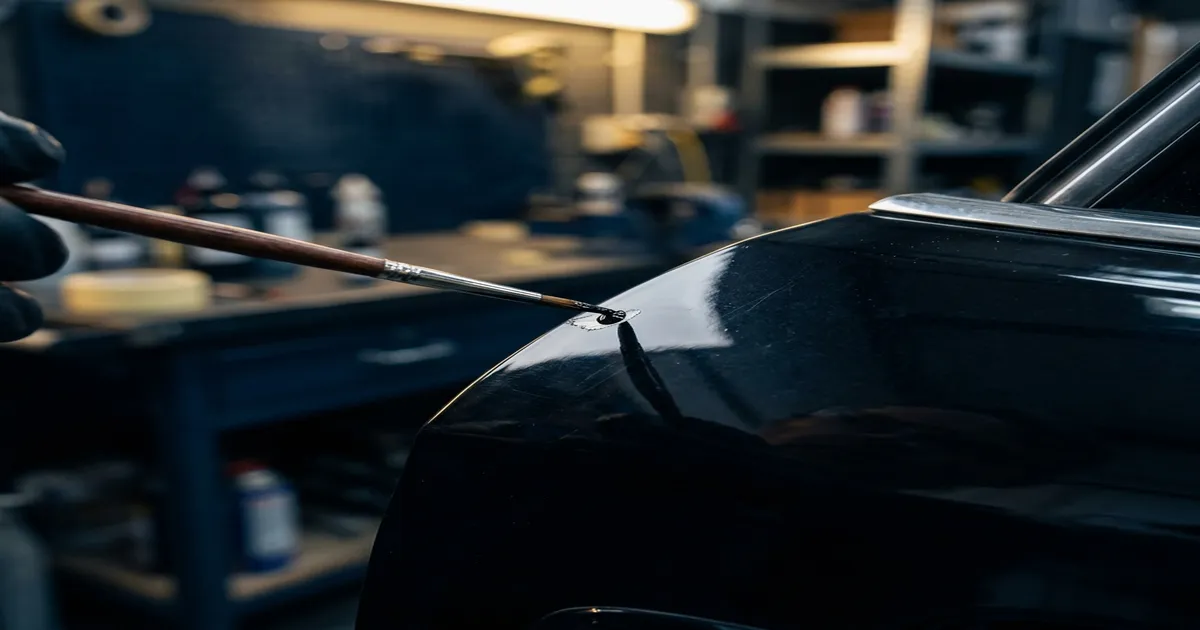
Every fender-bender, door ding, and stone chip that doesn't total a car still needs a matching dab of paint, and that unglamorous repair need has quietly built one of the most durable niches in the coatings industry. A single wrong-shade touch-up bottle can turn a small repair into a visible mismatch that costs a body shop its customer's trust, which is exactly why precision colour matching — not raw production volume — is the real barrier to entry in an automotive touch up paint manufacturing business. Success in this category comes from owning a library of accurately matched OEM colours and delivering them in a format installers and consumers can apply without a spray booth, and the equipment required to do that reliably is far more compact and affordable than a conventional paint plant. This guide walks through the complete startup roadmap — the colour-matching and filling equipment you actually need, raw material sourcing, the production and quality-control process, licensing, pricing, and how to land your first body-shop and retail accounts. Everything here reflects real refinish-industry practice, the operational detail a founder needs before committing capital, not textbook theory.
Market Overview & Opportunity
The global automotive refinish coatings market is a multi-billion dollar segment of the broader paints and coatings industry, and touch-up paint — while a small fraction of total refinish volume — carries disproportionately high margins because customers pay for precision and convenience rather than litres. Every vehicle on the road eventually needs a small cosmetic repair, and that steady, non-cyclical repair demand makes touch-up paint one of the more resilient product categories a new manufacturer can enter.
Primary customer segments split three ways: collision repair and auto body shops that need fast, accurately matched touch-up stock for minor spot repairs between full refinish jobs; retail buyers purchasing directly through auto parts stores or online by entering their vehicle's paint code; and B2B private-label buyers such as dealership service departments and fleet management companies who want a branded touch-up line for their own service counters. Demand drivers include a growing global vehicle parc, rising urban driving density that increases minor collision and chip frequency, and the steady churn of new OEM colour codes released with every model year, which keeps the addressable colour library — and therefore repeat manufacturing demand — permanently expanding. Regional opportunity is strong across South Asia, the Middle East, and Southeast Asia, where vehicle ownership is climbing quickly and organised auto parts retail is still consolidating, leaving room for a regional manufacturer to build distribution before multinational touch-up brands dominate the shelf. The technical fundamentals of how automotive paint systems are layered and cured are well documented and worth understanding before you formulate your first colour-matched batch.
Competition comes primarily from a small number of established touch-up paint brands with broad OEM colour libraries and strong placement in auto parts retail, but their colour coverage is skewed toward North American and European models, leaving regional and Asian OEM colour codes underserved in many markets. As detailed on our paints and coatings resource page, a new entrant differentiates most effectively by building deep, accurate colour coverage for the specific vehicle makes and models popular in their target region rather than trying to match a multinational's global colour catalogue on day one.
Investment Breakdown: Starting on Minimum Capital
Capital requirements in this category hinge on one decision more than any other: how many OEM colour codes you formulate and stock from day one. A lean launch built around 20 to 30 of the highest-volume colours in your target market requires far less working capital tied up in pigment paste inventory than an ambitious full-catalogue launch, and most successful founders start narrow and expand their colour library as reorder data comes in.
| Cost Category | Estimated Range (USD) | Notes |
|---|---|---|
| Colour-matching spectrophotometer & software | $3,000 – $8,000 | Single largest fixed-cost item; leasing available in some markets |
| Tinting / dispensing machine | $2,500 – $6,000 | Manual dispensing head lowers this substantially at very small scale |
| Filling & packaging equipment | $1,500 – $4,000 | Aerosol filling line adds $3,000–$6,000 if offering spray cans |
| Initial pigment paste & resin inventory | $2,000 – $5,000 | Covers first 20–30 colour formulations |
| Bottles, pens, caps and labels (first batch) | $1,000 – $2,500 | MOQ-driven; local suppliers reduce minimums |
| Licensing & hazardous goods registration | $800 – $2,500 | Varies significantly by country |
| Working capital (3 months operating expenses) | $1,500 – $3,500 | Utilities, labour, overhead while building first accounts |
| Total Minimum | $12,000 – $32,000 | Before first sale; manual dispensing at the lower end |
The lower end of this range reflects a founder running a manual tinting setup focused on a narrow, high-demand colour library, while the upper end reflects a founder investing in an automatic dispensing machine and a broader catalogue from launch. Tinting machines and spectrophotometers are frequently available second-hand from refinish equipment suppliers and body shops upgrading their systems, which can meaningfully lower the equipment threshold. Deferring the aerosol spray-can format until bottle and pen sales validate demand for specific colours is the lower-risk path most successful founders in this category follow.
Minimum Equipment List for a Small-Scale Unit
Touch-up paint equipment is fundamentally a precision colour-science toolkit rather than a bulk-production line, which is exactly what keeps the capital requirement low compared to conventional paint manufacturing. Every piece below exists to answer one question reliably — does this batch match the target colour — before it ever reaches a customer's car.
| Equipment | Minimum Spec | Approx. Cost |
|---|---|---|
| Spectrophotometer with colour-matching software | Handheld or benchtop; multi-angle read for metallic/pearl finishes | $3,000 – $7,000 |
| Tinting / pigment dispensing machine | Manual canister rack or automatic gravimetric dispenser | $1,500 – $5,000 |
| Paint shaker | Bench-mount, suitable for small bottles, pens and tins | $300 – $800 |
| Small batch mixing vessel with disperser | Stainless steel, 20–50 L, variable-speed high-shear disperser | $800 – $2,000 |
| D65 standardised light booth | Colour-viewing booth with D65 and TL84 light sources | $500 – $1,500 |
| Viscosity cup and drawdown/spray-out gear | Ford or Zahn cup; drawdown cards, mini spray gun for panel tests | $150 – $400 |
| Bottle / pen filling equipment | Semi-automatic volumetric filler for small containers | $1,000 – $2,500 |
| Ventilated flammable storage cabinet | Fire-rated cabinet for solvents and resins | $500 – $1,200 |
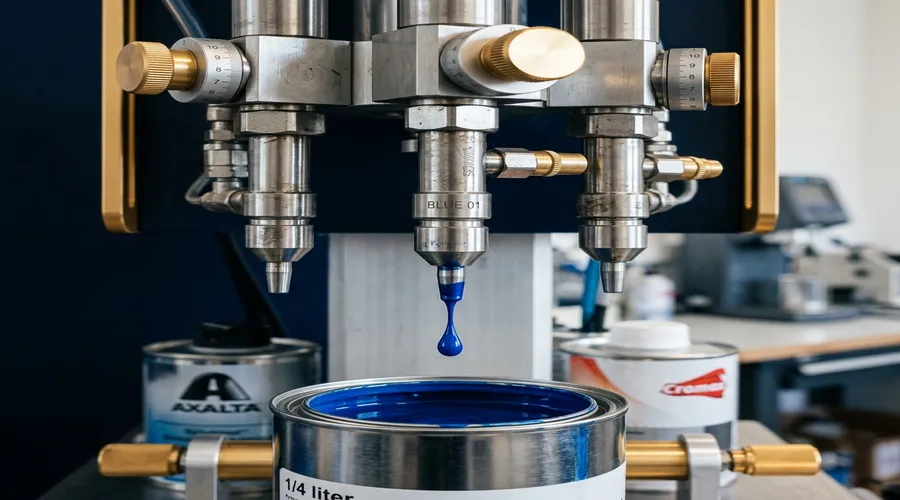
The spectrophotometer and the D65 light booth deserve the largest share of your attention and budget, since together they are what let you promise — and actually deliver — an accurate colour match batch after batch. Basic mixing and filling equipment can often be fabricated or sourced locally at lower cost, but colour-verification instruments are not an area to economise on when your entire value proposition depends on precision.
Space, Utilities & Infrastructure Requirements
A functional touch-up paint unit needs a minimum floor area of roughly 500 to 800 square feet, divided into a controlled-lighting colour lab for matching and verification, a separately ventilated mixing and filling bay, and a fire-rated storage area for solvents and pigment concentrates. Keeping the colour lab physically separated from the mixing bay matters because solvent vapour and dust can interfere with both worker comfort and the accuracy of visual colour comparisons.
Power requirements are modest — spectrophotometers, dispensing machines, and fillers typically run on single-phase power — but the colour lab specifically needs consistent, glare-free ambient lighting alongside its standardised light booth, since inconsistent room lighting undermines even a good light booth's usefulness. Ventilation in the mixing and filling bay is safety-critical for solvent-borne formulations, and explosion-proof electrical fittings are a standard requirement in the solvent handling and storage zones in most jurisdictions. Water supply needs are minimal, limited mainly to cleaning and equipment maintenance.
Best Products to Start With: Low Capital, High Demand
Not every touch-up format is equally accessible to a new manufacturer, and choosing the right entry point determines how quickly you reach positive cash flow while you are still building your colour-matching competence and reputation. The three starter categories below are ranked by ease of entry, equipment requirements, and how quickly a founder can build a defensible colour library.
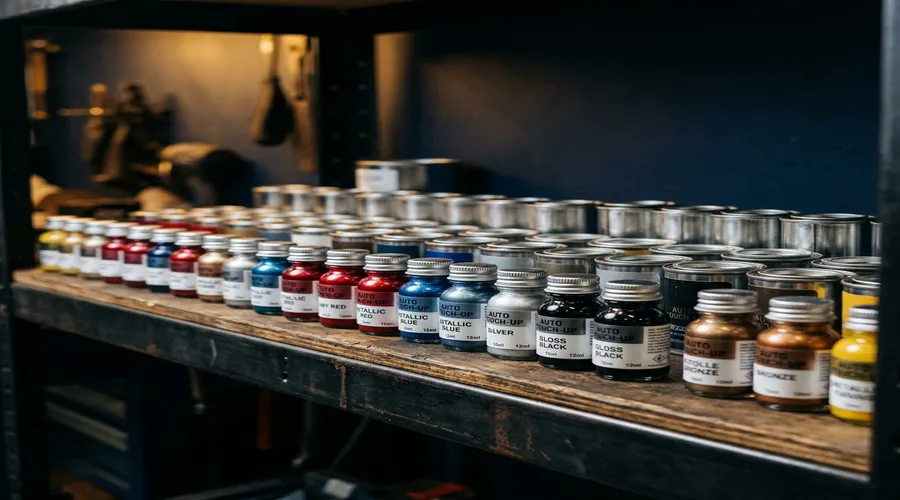
- Universal high-volume touch-up bottles — brush-cap bottles covering the 15 to 20 most common vehicle colours (white, black, and the most popular silver and grey shades), which together account for a large share of vehicles on the road. This is the most accessible entry point because a small colour library covers a disproportionate share of repair demand across almost every make and model.
- OEM-specific touch-up pens — paint-code-keyed pens with a fine ball-tip applicator for the specific makes and models most popular in your target region, sold by matching the buyer's vehicle paint code rather than a generic shade name. This category commands a price premium over universal colours because it solves a precision problem retail buyers cannot solve themselves.
- Aerosol touch-up spray cans — a larger-coverage format for bumper corners and panel-size repairs, requiring propellant handling and aerosol filling equipment that adds meaningful equipment cost. This format is best sequenced last, once your colour library and bottle/pen sales have validated which colours justify the extra investment.
As detailed on our paints and coatings formulation resources, sequencing your launch — starting with universal bottles, adding OEM-specific pens as your colour database grows, then introducing aerosol cans for validated high-demand colours — is the standard path successful founders in this category follow rather than launching a full multi-format catalogue simultaneously.
Raw Material Sourcing Strategy
Raw material sourcing for touch-up paint spans four distinct categories — resin binder systems, solvents, pigment paste concentrates, and packaging — each with different supplier types and evaluation criteria. Getting your pigment paste system right matters most, since colour concentrates are the one input that directly determines whether your finished product actually matches, while resin and solvent selection determine compliance, durability, and application behaviour.
Pigment paste and colour concentrate systems are sourced from specialist refinish coatings raw material suppliers rather than generic pigment distributors, because the concentrate must be formulated for compatibility with your specific tinting machine and resin base. Resin binders — typically acrylic lacquer or acrylic enamel systems for basecoat, with a compatible clearcoat resin — and solvents are available from industrial coatings chemical distributors, while bottles, pens, caps, and applicator tips are sourced from small-container packaging manufacturers who serve the cosmetics and specialty chemical sectors as well.
Evaluating a pigment concentrate supplier means requesting compatibility data confirming their colourants disperse cleanly and remain stable in your chosen resin system, not just a swatch card of available shades. Cost-saving strategies include buying resin and solvent in shared bulk with other small refinish or coatings manufacturers to reach better pricing tiers, and negotiating smaller minimum order quantities on pigment paste until your colour library and reorder volume are established.
- Pigment paste concentrates — source from a specialist coatings colourant supplier with documented dispersion stability and compatibility data for your resin system
- Resin binders — acrylic lacquer systems are the most common entry point for touch-up due to fast dry time and easy blending; confirm VOC content against your target market's automotive refinish limits
- Solvents — solvent choice directly affects both VOC classification and dry time; balance flash-off speed against workshop safety requirements
- Packaging — always confirm chemical compatibility between your solvent system and your bottle, cap, or pen materials, since incompatible plastics can soften or leach over shelf life
Manufacturing Process Overview
The manufacturing process for touch-up paint is a colour formulation and verification step followed by a small-batch mixing and filling sequence, and process discipline around colour matching matters far more than production complexity. The key skill is measurement and verification — accurate pigment dosing, correct viscosity, and independently verified colour match — not batch size or mixing speed.
Colour Formulation & Matching
Production begins with the spectrophotometer reading either an OEM colour reference chip or, when matching an existing vehicle, the actual panel surface, after which the colour-matching software calculates a formula from your stored pigment paste recipe database. The tinting machine then dispenses each pigment paste in precisely measured amounts into the resin base according to that formula, and the batch is let down with solvent to the correct application viscosity.
Verification, Mixing and Filling
Before any batch is approved, a drawdown card or small spray-out panel is prepared and compared against the master standard both instrumentally, using the spectrophotometer's delta-E reading, and visually, under the standardised D65 light booth. Only once both checks pass does the batch move to filling — into brush-cap bottles, ball-tip pens, or the gassing and crimping station if producing an aerosol format — followed by capping, labelling, and batch documentation.
The most common mistake beginners make is approving a colour match based only on how it looks under the mixing room's ordinary lighting, which allows metamerism — where two colours appear to match under one light source but diverge under another — to slip an incorrect batch through to a customer. Recording the exact pigment paste ratio for every approved colour in a permanent formulation log is equally important, since it is what lets you reproduce an identical match on every reorder rather than re-matching from scratch each time.
Quality Control & Testing for Small Manufacturers
Quality control in touch-up paint manufacturing is almost entirely about proving colour accuracy and application performance batch after batch, since a body shop's willingness to reorder depends entirely on your consistency, not on any single impressive sample. Skipping instrumental verification in favour of a quick visual glance is the fastest way to erode the trust this business is built on.
| Test | What It Measures | Equipment Needed | Pass/Fail Criterion |
|---|---|---|---|
| Colour match (delta-E) | Instrumental deviation from master standard | Spectrophotometer | Within formulation-specified delta-E tolerance |
| Visual colour verification | Human-eye match under standardised light | D65 light booth | No visible mismatch under D65 and TL84 sources |
| Viscosity | Flow and application consistency | Ford or Zahn flow cup | Within formulation-specified efflux time range |
| Adhesion and dry time | Film bonding and cure performance | Cross-hatch tape test kit; drawdown panel | No visible flaking; dry-to-touch within specified time |
The paired instrumental-and-visual colour check is non-negotiable and the single most important quality gate in this entire process, since it is your last checkpoint before a mismatched colour reaches a shelf or a technician's hand. Retaining a dated formulation and QC record for every approved colour gives you the documentation retailers and dealership accounts will eventually ask for during vendor onboarding, and it is also the fastest way to guarantee an identical reorder months later.
Setting up a manufacturing unit involves more than equipment and raw materials — getting the formulation right, scaling production safely, and meeting regulatory requirements are where most startups lose time and money. If you need hands-on guidance at any stage, the Global Formulation team works directly with chemical startups on formulation development, process setup, and compliance — from first batch to commercial scale.
Packaging & Branding on a Budget
Touch-up paint is sold almost exclusively in small formats — 10 to 30 mL brush-cap bottles, ball-tip applicator pens, and, for the aerosol line, 150 to 300 mL spray cans — and container choice should prioritise a secure, drip-free applicator over decorative packaging, since precision application is what the customer is actually paying for. A supplier who can handle small print runs and low minimum order quantities on labels matters more for a new brand than the cheapest per-unit container price, since it lets you launch and expand your colour catalogue without committing to large print runs for every individual shade.
Label and container markings are strict because these are solvent-based, often flammable consumer and trade products. Every container must show: the colour name and OEM paint code it matches, the vehicle makes it is validated against where applicable, net contents, hazard pictograms and warning statements for flammable solvents, batch number and manufacturing date, basic application instructions, and manufacturer contact details. Because OEM paint codes are used for cross-reference rather than owned exclusively by any manufacturer, referencing them factually on your label is standard industry practice — but reproducing an OEM's trademarked brand name or logo on your packaging in a way that implies official affiliation is a genuine trademark risk worth avoiding from day one.
Branding in this sector benefits from a clear, consistent colour-code and naming system across your range, since body-shop buyers reorder by code far more often than by descriptive colour name. Building a simple, legible label format that stays identical across every colour — varying only the code and swatch — helps repeat customers and counter staff find the right product quickly on a crowded shelf.
Licensing, Registration & Regulatory Compliance
Regulatory compliance for touch-up paint manufacturing touches standard business and product registration, volatile organic compound content limits specific to automotive refinish coatings, and — if you offer an aerosol format — hazardous goods handling and storage permits for propellant. Automotive refinish products are frequently regulated more strictly on VOC content than general industrial coatings, which makes checking your target market's specific limit an early, non-negotiable step rather than an afterthought.
In Pakistan, coatings products fall under PSQCA product conformity requirements; in the GCC, GSO technical regulations govern coating product conformity and labelling; in the EU, Directive 2004/42/EC sets VOC limits specifically for vehicle refinishing products, separate from its architectural coatings limits. Confirming your resin and solvent selection against your target market's automotive refinish VOC limit before you finalise your formulation avoids a costly reformulation later.
Beyond registration, Good Manufacturing Practice is not universally mandatory for this category at small scale, but maintaining GMP-aligned batch and colour-formulation documentation from day one significantly strengthens your position with dealership accounts, retail chains, and any future export customer who will expect to see this documentation during vendor evaluation.
Pricing Strategy & Margin Expectations
Raw material cost — pigment paste, resin, solvent, and packaging combined — typically represents 20–35% of the finished retail price in touch-up paint, noticeably lower than bulk refinish paint, because customers are paying primarily for colour-matching precision and small-format convenience rather than volume. Gross margins for small-scale manufacturers selling through body-shop and retail distribution typically range from 45–60% on a cost-plus basis, reflecting the premium nature of the format.
Cost-plus pricing anchored to per-unit rather than per-litre economics is standard in this category, since your real cost driver is colour-formulation and changeover complexity across many small SKUs rather than raw material volume. Private-label and dealership contracts respond better to value-based conversations anchored on colour library depth and match accuracy rather than the lowest unit price, since a service department cares more about a technician never having to explain a visible mismatch to a customer than about shaving a few cents off a bottle.
Resist competing purely on price against established touch-up brands when approaching your first body-shop accounts, since unusually cheap touch-up product can raise doubts about colour accuracy in a category where buyers already associate low price with poor match quality. Price competitively but credibly, differentiate on regional colour coverage and consistent match accuracy, and let repeat reorder behaviour — not your price alone — build your distributor relationships.
Finding Your First 20 Customers
Touch-up paint moves primarily through direct sales to collision repair and auto body shops, alongside retail distribution through auto parts stores and online direct-to-consumer sales by paint code, and your customer acquisition approach should reflect both channels from the outset. Local body shops are typically the fastest channel to a first paying account, since they can evaluate your colour accuracy immediately on a real repair job rather than waiting for a shelf-listing decision.
The fastest path to your first paying accounts is approaching two or three local collision repair shops directly with free sample bottles matched to their most frequently repaired colours, since a body shop decides quickly once match accuracy and application behaviour are demonstrated on an actual job. Offering flexible minimum order quantities for your first few retail and dealership relationships removes the biggest objection a cautious buyer has about an unproven new colour library. For guidance on structuring these early technical and supply relationships, our resource on choosing the right product consultant is a useful companion reference as you build out your production credibility.
- Approach local collision repair and auto body shops directly with sample bottles matched to their most common repair colours — they can validate quality faster than any retailer
- Contact regional auto parts retailers about stocking your most popular universal colours alongside their existing paint section
- Build a simple online paint-code lookup page so retail buyers can find and order their exact match directly
- Offer private-label touch-up programmes to dealership service departments who want a branded line for their own service counters
- Document reorder rates by colour code and use this reliability record in every subsequent distributor or retailer conversation
Your first body shop that reorders consistently because your colour match holds up job after job becomes your most valuable reference for every subsequent conversation — proof that your library performs, not just a sample that looked good once.
When and How to Scale Up Your Production
Scaling in this category is primarily a question of expanding your colour library and upgrading from manual to automatic dispensing, rather than fundamentally changing your process. The right signal to scale is when reorder frequency across your existing colours consistently outpaces your manual dispensing throughput, or when a retail or dealership account asks you to cover additional makes and models beyond your current library.
The first scale-up step is typically investing in an automatic gravimetric dispensing machine, which lowers per-batch labour cost and colour-changeover time as your SKU count grows. The second step is expanding into the aerosol spray-can format for your highest-demand colours and pursuing private-label or export contracts, since a broader format range and geographic reach increase average order value from existing body-shop and retail relationships without requiring entirely new customer acquisition. Our broader guide on manufacturing without a factory explores capacity models worth considering as you plan this growth phase.
Frequently Asked Questions
How much capital is really needed to start an automotive touch-up paint manufacturing business?
Do I need a chemistry degree to start this business?
Can I start from home or do I need a factory?
What is the biggest mistake to avoid when starting this business?
How long before I make my first sale?
Do I need ISO or GMP certification from day one?
How do I get a formulation for the product?
What is the first licence I need to get?
Ready to Take the Next Step?
Starting a chemical manufacturing business is one of the most rewarding paths an entrepreneur can take — but it demands the right technical foundation from day one. Whether you need a validated formulation, help setting up your first production unit, guidance on regulatory compliance, or a structured scale-up plan, the Global Formulation team is here to support you.
Reach out to us at globalformulation.com/contact — we work with founders at every stage, from concept to commercial production.