Farmers across every major growing region are under mounting pressure to cut chemical pesticide residues while regulators tighten maximum residue limits on export crops, and that squeeze has turned biological crop inputs into one of the fastest-growing segments in agriculture — which is exactly why a bio pesticide manufacturing business is one of the most defensible chemical-adjacent startups available to a new founder today. Unlike synthetic agrochemicals, where multinational manufacturers dominate through economies of scale, biological products reward local production because live microbial cultures degrade during long-distance shipping, giving domestic manufacturers a genuine freshness and viability advantage over imports. This guide walks through the complete startup roadmap: the fermentation equipment and capital you actually need, how to source and maintain a validated microbial strain, the production process, quality control for a living product, licensing, pricing, and how to land your first farmer and distributor accounts. Everything here reflects real industry practice — the operational detail a founder needs before committing capital, not textbook theory.
Market Overview & Opportunity
The global biological crop input market — spanning biopesticides, biofertilizers, and biostimulants — is a multi-billion dollar category growing at a materially faster rate than conventional agrochemicals, driven by tightening pesticide residue regulations, rising input costs for synthetic fertilizer, and growing farmer awareness of soil health. Unlike many industrial chemical categories dominated by a handful of large players, biological inputs remain fragmented regionally, since strain-specific products, local soil conditions, and crop-specific application needs create genuine room for smaller manufacturers who understand their local agricultural context.
Demand is driven by three converging forces: export-oriented farmers needing to meet strict maximum residue limits set by importing countries for fruits, vegetables, and rice; rising synthetic fertilizer prices pushing smallholder farmers toward lower-cost biological alternatives that also rebuild long-term soil fertility; and government-backed organic and sustainable agriculture programmes across South Asia, Southeast Asia, and parts of Africa that actively subsidise biological input adoption. Primary customer segments split across three groups — individual progressive farmers and farmer cooperatives buying directly or through local dealers, agricultural input distributors stocking biological products alongside conventional agrochemicals, and government extension programmes procuring biological inputs for subsidised distribution schemes. The FAO's pest and pesticide management programme and the biopesticide technical literature both confirm that biological crop protection is now a mainstream component of integrated pest management strategy, not a niche organic-farming product.
Competitive dynamics favour local manufacturers because live microbial products have a limited shelf life and degrade in potency during long international shipping and storage, meaning imported biopesticides frequently arrive with reduced viable cell counts. A local manufacturer who controls strain freshness, cold-chain handling, and rapid distribution can consistently outperform imported alternatives on actual field efficacy — a technical advantage that is difficult for importers to overcome. As detailed on our agro chemicals resource page, this biological sub-category rewards founders who invest in genuine microbiological competence over those simply repackaging imported concentrate.
Investment Breakdown: Starting on Minimum Capital
Capital requirements in this category depend heavily on which production method you start with — solid-state fermentation using tray or bag culture, or submerged liquid fermentation in a bioreactor. Solid-state fermentation of fungal biopesticides like Trichoderma or Beauveria on a grain or agro-waste substrate is the more accessible entry point for a capital-constrained founder, since it requires simpler equipment than liquid fermentation and is well suited to producing both biopesticides and carrier-based bio-fertilizer inoculants from the same core infrastructure.
| Cost Category | Estimated Range (USD) | Notes |
|---|---|---|
| Autoclave / substrate steriliser | $2,500 – $6,000 | Vertical autoclave; 100–200 L capacity for substrate and media sterilisation |
| Incubation chamber / culture room | $2,000 – $5,000 | Temperature and humidity controlled; 25–30°C range for most agriculturally useful strains |
| Laminar flow cabinet | $1,500 – $3,500 | Essential for aseptic inoculation and contamination control |
| Small submerged fermenter (optional, Phase 2) | $3,000 – $8,000 | 50–200 L stirred-tank bioreactor for liquid bacterial inoculants |
| Drying and packaging equipment | $1,500 – $3,500 | Tray dryer or fluid-bed dryer; semi-automatic pouch/bottle filling |
| QC microscopy and counting equipment | $1,500 – $3,500 | Compound microscope, colony counter, incubator for viability testing |
| Facility fit-out (clean room, drainage) | $2,000 – $5,000 | Positive-pressure inoculation area, washable surfaces, segregated zones |
| Strain culture and raw materials (first batches) | $1,500 – $4,000 | Certified starter cultures, carrier material, growth media |
| Licensing & biological product registration | $1,500 – $4,000 | Varies significantly by country and product category |
| Working capital (3 months operating expenses) | $2,000 – $5,000 | Utilities, labour, overhead while building first customer base |
| Total Minimum | $18,000 – $48,000 | Before first sale; solid-state fermentation entry point |
The lower end of this range reflects a single-strain solid-state fermentation operation using second-hand or locally fabricated trays and a modest incubation room, while the upper end reflects a facility equipped to run both solid-state and small submerged fermentation lines with expanded QC capability from launch. Autoclaves, incubators, and even laminar flow cabinets are frequently available second-hand from decommissioned laboratories or university surplus at 40–50% of new cost, which meaningfully lowers the entry threshold. The submerged fermenter is genuinely a Phase 2 investment — deferring it until your solid-state product line has proven demand avoids tying up capital in equipment you are not yet ready to fully utilise.
Minimum Equipment List for a Small-Scale Unit
Biological manufacturing has a fundamentally different equipment profile than conventional chemical formulation, because the core challenge is maintaining a living organism through every stage of production rather than blending stable chemical inputs. Contamination control equipment carries as much weight as production equipment itself, since a single contaminated batch does not just fail — it can compromise your entire culture stock if handled carelessly.
| Equipment | Minimum Spec | Approx. Cost |
|---|---|---|
| Autoclave / steriliser | Vertical, 100–200 L; 121°C, 15 psi rated | $2,500 – $6,000 |
| Laminar flow cabinet | Horizontal or vertical; HEPA-filtered; UV sterilisation lamp | $1,500 – $3,500 |
| Incubation / culture room | 25–30°C controlled; humidity 60–80% RH; shelving for trays | $2,000 – $5,000 |
| Solid-state fermentation trays / bags | Perforated polypropylene trays or breathable culture bags; 500–1,000 unit capacity | $400 – $1,000 |
| Compound microscope | 1000x magnification; for spore and cell morphology verification | $400 – $900 |
| Colony counter and incubator | Digital colony counter; benchtop incubator for CFU plate counts | $600 – $1,500 |
| Tray or fluid-bed dryer | Low-temperature drying; below 40°C to preserve organism viability | $1,200 – $2,800 |
| Powder blending and filling line | Ribbon blender or drum mixer; semi-auto pouch/bottle filler | $1,000 – $2,500 |
| Analytical balance | 0–500 g; 0.01 g resolution | $300 – $600 |
| Cold storage unit | 2–8°C refrigeration; for master culture and finished liquid product storage | $600 – $1,500 |
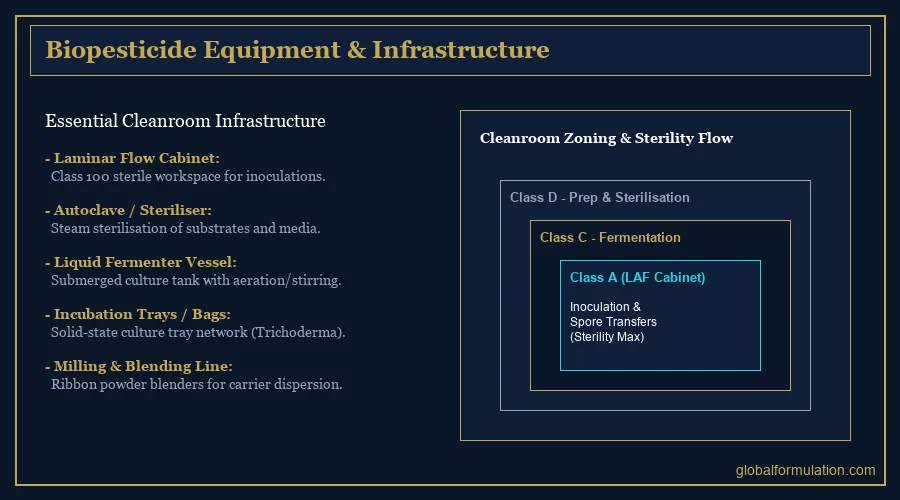
The laminar flow cabinet and autoclave deserve particular budget priority, since they are the two pieces of equipment that most directly determine whether your production stays contamination-free. A founder who under-invests here will spend far more money later discarding failed batches than they saved on cheaper equipment upfront — contamination control is where this category punishes shortcuts hardest.
Space, Utilities & Infrastructure Requirements
A functional bio-pesticide and bio-fertilizer production unit needs a minimum floor area of roughly 800 to 1,200 square feet, divided into distinct zones: a positive-pressure aseptic inoculation room, a climate-controlled incubation area, a separate drying and packaging zone, and cold storage for master cultures and finished liquid products. Zone separation matters more in this category than in conventional chemical manufacturing, because cross-contamination between the aseptic inoculation area and the general production floor is the single most common cause of batch failure.
Power requirements are modest but continuity matters — incubation chambers and cold storage both depend on uninterrupted temperature control, so a backup generator or UPS system sized for these critical loads is a sound early investment rather than a luxury. Water supply should be consistent and ideally filtered or treated, since water is used both in growth media preparation and cleaning, and inconsistent water quality can introduce unwanted microbial contamination into your process. Ventilation in the inoculation and incubation zones should minimise airborne particulate and microbial load, with the aseptic room ideally maintained under slight positive air pressure relative to adjacent areas.
Proximity to your raw material and substrate suppliers also matters more here than in many chemical categories, since agricultural waste substrates like rice bran, wheat bran, or bagasse used in solid-state fermentation are bulky, low-value materials that do not justify long-distance transport economically. Locating your unit within reasonable distance of an agricultural processing region both reduces substrate cost and shortens your supply chain for perishable growth media components.
Best Products to Start With: Low Capital, High Demand
Not every biological product is equally accessible to a new manufacturer, and choosing the right entry point determines how quickly you reach positive cash flow while building the microbiological competence this category demands. The three starter categories below are ranked by ease of entry, raw material and equipment requirements, and how quickly a founder can demonstrate credible field results to farmers — the single hardest currency to earn in biological agriculture.
- Trichoderma-based biofungicide and biofertilizer — a solid-state fermented product on a grain or agro-waste carrier, used both as a soil-borne disease suppressant and a general soil health amendment. This is the most accessible entry point because Trichoderma is one of the most widely studied and robust agricultural fungi, tolerant of moderate process variation, and in strong demand across nearly every crop type.
- Rhizobium-based legume inoculant — a carrier-based bacterial inoculant that fixes atmospheric nitrogen for legume crops like soybean, chickpea, and groundnut. This category has a smaller crop-specific customer base than Trichoderma but commands strong loyalty once farmers see yield improvement, and carrier inoculation is a relatively simple, low-equipment production process once you have a validated bacterial culture.
- Beauveria bassiana or Metarhizium anisopliae bioinsecticide — entomopathogenic fungal spores formulated as a wettable powder or liquid suspension for insect pest control. This category commands strong demand from export-oriented vegetable and fruit growers needing to reduce chemical residue, though it requires slightly more rigorous spore viability testing than the bacterial inoculant lines.
As detailed on our agro chemicals formulation resources, sequencing your launch — starting with Trichoderma, then adding Rhizobium inoculant, then bioinsecticide lines as fermentation competence and cash flow build — is the standard path successful founders in this category follow rather than launching all three simultaneously.
Strain & Raw Material Sourcing Strategy
Strain sourcing is the single most consequential decision in this business, because your entire product's field performance depends on starting with an authenticated, high-potency microbial culture rather than an unverified isolate of uncertain origin. Unlike conventional agrochemical raw materials, which are commodity chemicals available from many distributors, agriculturally validated microbial strains are a specialised input that must be sourced carefully to avoid building a business on a weak or contaminated founder culture.
Key sourcing categories include certified starter cultures from accredited national or international culture collections, which provide documented strain identity and typically a certificate of deposit; carrier materials such as talc, lignite, or peat for bacterial inoculants, and agricultural waste substrates like rice bran or wheat bran for solid-state fungal fermentation, both sourced locally from agricultural processing operations; and growth media components including molasses, yeast extract, and mineral salts, available from food-grade or industrial chemical distributors. Minimum order quantities for certified starter cultures are typically small — a single culture vial is often sufficient to establish a master culture bank that supplies production for years, provided it is maintained correctly through periodic sub-culturing and cryopreservation.
Evaluating a strain source means verifying more than availability: request documented strain identity confirmation, ideally including molecular identification data, and confirm the source can supply a fresh master culture if your working culture ever becomes contaminated or loses vigour through repeated sub-culturing. The US EPA's biopesticide overview and equivalent national biological product frameworks govern which microbial species are approved for agricultural use — confirm your target strain has established regulatory precedent in your market before committing to it.
- Master cultures should always be cryopreserved or maintained on slants in duplicate at separate storage locations — losing your only culture stock to contamination or equipment failure can halt production entirely
- Carrier materials like peat and lignite may carry import restrictions or duties depending on your country — talc and rice bran are frequently more accessible local alternatives
- Growth media components sourced from food-grade suppliers reduce contamination risk compared to industrial-grade equivalents, even at a modest cost premium
- Always request and retain a certificate of strain identity for every new culture batch — distributors and government extension programmes increasingly require this documentation during vendor evaluation
Manufacturing Process Overview
The manufacturing process for biopesticides and bio-fertilizers is a controlled biological cultivation process rather than a chemical reaction, which means process discipline around sterility, temperature, and timing matters far more than precise chemical dosing. The key skill is not chemistry but microbiological process control — maintaining strain purity, achieving consistent viable cell or spore counts, and formulating a carrier system that keeps the organism alive through drying, packaging, and eventual field storage.
Solid-State Fermentation Process (Trichoderma / Beauveria)
Production begins with substrate preparation — moistening and sterilising the grain or agro-waste substrate in the autoclave to eliminate competing microorganisms. Once cooled, the sterile substrate is aseptically inoculated with a working culture derived from the master stock, using the laminar flow cabinet to maintain sterility during this critical step. Inoculated trays or bags are then incubated at the strain's optimal temperature, typically 25–28°C, for a period ranging from 7 to 14 days depending on the target organism, with periodic mixing to ensure even colonisation and sporulation. Once sporulation is visually and microscopically confirmed, the substrate is dried at low temperature, below 40°C, to halt further growth while preserving spore viability, then milled and blended with a carrier material to the target concentration.
Carrier-Based Liquid Inoculation Process (Rhizobium)
Bacterial inoculant production follows a broth fermentation process — a sterile liquid growth medium is inoculated with the working bacterial culture and incubated with gentle agitation until the target cell density is reached, verified by optical density or plate count. The resulting broth culture is then mixed into a sterilised carrier material, typically finely milled peat, lignite, or talc, at a ratio calibrated to deliver the target viable count per gram at the point of sale, accounting for expected viability decline during storage.
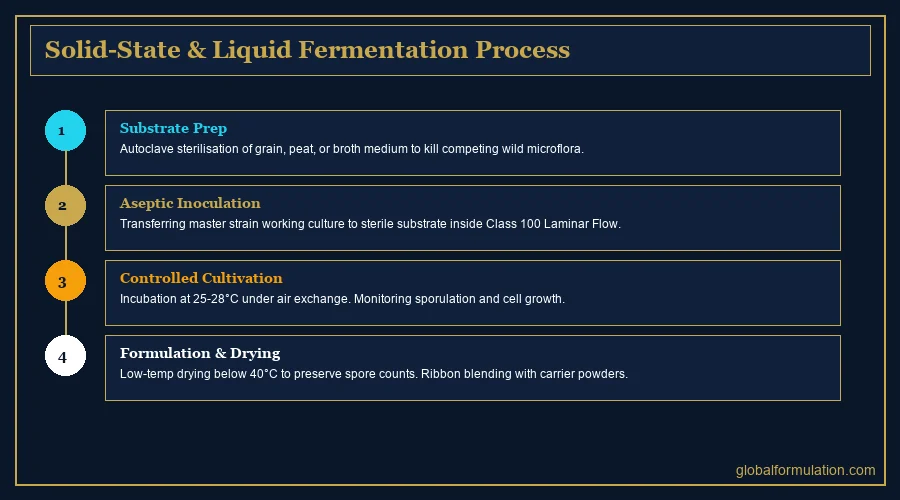
The most common mistake beginners make is rushing the incubation period or handling sterile transfers outside the laminar flow cabinet, both of which introduce contamination risk that may not become visually apparent until the batch has already been packaged and shipped. Discipline around aseptic technique, incubation timing, and low-temperature drying resolves the vast majority of quality issues before they ever reach a farmer's field — which naturally raises the question of how you verify that discipline actually worked before release.
Quality Control & Testing for Small Manufacturers
Quality control in biological manufacturing serves a purpose conventional chemical QC does not: verifying that a living organism is present, pure, and viable at a commercially meaningful concentration, since a biopesticide with an inadequate viable count is simply inert filler dressed up as a functional product. Because farmers judge biological products on visible field results, your ability to guarantee a consistent viable count is what separates a manufacturer buyers trust from one whose products earn a reputation for unreliability.
| Test | What It Measures | Equipment Needed | Pass/Fail Criterion |
|---|---|---|---|
| Viable colony count (CFU/g or CFU/mL) | Live cell or spore concentration | Incubator, colony counter, sterile dilution plates | Meets or exceeds label-claimed CFU count |
| Strain purity check | Absence of contaminant microorganisms | Compound microscope, selective culture media | No visible contaminant colonies on selective plates |
| Moisture content (carrier products) | Carrier powder moisture level | Moisture analyser or oven-dry method | Below 12–15% depending on carrier type |
| pH of carrier / formulation | Compatibility with target organism survival | Bench pH meter | Within strain-specific tolerance range, typically 6.5–7.5 |
The viable colony count test is your single most important quality gate and the most persuasive sales tool available to you, since it lets you show a prospective distributor or farmer cooperative objective proof of product potency rather than asking them to take your formulation on faith. Building a routine of testing every batch before release, and retaining samples with dated test records, gives your sales conversations a technical credibility that undercapitalised competitors — who frequently skip this step — cannot match. The FAO's biological control agent quality guidelines provide a useful reference framework for structuring your internal QC protocol.
Setting up a manufacturing unit involves more than equipment and raw materials — getting the formulation right, scaling production safely, and meeting regulatory requirements are where most startups lose time and money. If you need hands-on guidance at any stage, the Global Formulation team works directly with chemical startups on formulation development, process setup, and compliance — from first batch to commercial scale.
Packaging & Branding on a Budget
Biological products are sold in packaging formats driven by shelf-life protection rather than shelf appeal — moisture-barrier laminated pouches or HDPE bottles for carrier-based powders, and amber or opaque bottles for liquid formulations, since both moisture and UV exposure accelerate viability loss. Choosing packaging that genuinely protects viability matters more in this category than in almost any conventional chemical product, because a farmer who buys a product that has lost potency during shelf storage will blame your brand, not the packaging.
Label requirements are stringent because biological crop inputs are regulated products with defined claims. Every container must show: product name and target organism or crop use, guaranteed minimum viable count (CFU/g or CFU/mL) and its expiry-linked validity period, batch number and manufacturing date, storage instructions including temperature and shelf-life limitations, application dosage and method, manufacturer contact details, and any relevant national biological product registration number. Overstating viable count or omitting an honest expiry-linked potency guarantee is both a regulatory violation and a fast way to destroy farmer trust once field results fail to match label claims.
Branding in this sector should emphasise scientific credibility over visual polish. A clear label showing your guaranteed viable count, a simple technical sheet explaining the target pest or crop benefit, and visible batch testing documentation carry far more weight with a progressive farmer or agricultural extension officer than premium packaging design. Building a cold-chain distribution relationship with local dealers — even a simple insulated transport box — signals that you understand the product's biological nature in a way that differentiates you from lower-effort competitors.
Licensing, Registration & Regulatory Compliance
Regulatory compliance in biological crop input manufacturing touches biological product registration, agricultural input licensing, and — for certain export-oriented products — organic certification, and understanding these requirements before production begins avoids costly delays later. Standard business registration alongside biological or bio-pesticide product registration with your national agricultural or plant protection authority forms the baseline requirement in nearly every jurisdiction, since most countries regulate microbial crop inputs as a distinct category from synthetic pesticides but still require formal registration before commercial sale.
In Pakistan, biopesticide and biofertilizer products fall under registration with the Department of Plant Protection and provincial agriculture departments; in India, the Central Insecticides Board and Registration Committee governs biopesticide approval alongside state-level biofertilizer quality standards; in the EU, biological control agents follow the plant protection product approval pathway under REACH-adjacent biological input frameworks. Beginning any required registration process early is essential, since biological product approvals can take longer than conventional chemical registrations due to the additional efficacy and non-target organism safety data typically required.
Beyond registration, if you intend to target export-oriented farmers or premium organic markets, pursuing organic input certification from a recognised certifying body — even without formal ISO or GMP certification, which is not mandatory for this product category at small scale — significantly strengthens your market access and often commands a price premium that justifies the certification cost.
Pricing Strategy & Margin Expectations
Raw material cost typically represents only 25–40% of the finished product cost in biological manufacturing, notably lower than in conventional agrochemicals, because the technical competence, quality control infrastructure, and strain maintenance capability embedded in the product justify a stronger margin position. Gross margins for small-scale biological manufacturers typically range from 35–55% on a cost-plus basis, with export-oriented and organic-certified product lines commanding the higher end of that range due to premium market positioning and lower local competition.
Cost-plus pricing works well for standard Trichoderma and Rhizobium products sold to price-sensitive smallholder farmers through dealer networks, while value-based pricing — anchored to the synthetic fertilizer or pesticide cost your product displaces, or the yield improvement it delivers — is appropriate for progressive farmers and export-oriented growers who can quantify the economic benefit directly. Framing your pricing conversation around demonstrated yield or residue-reduction outcomes, not just cost per kilogram, is a genuinely persuasive sales approach because biological product economics are increasingly well documented in agricultural extension literature farmers already trust.
Resist underpricing to win your first few accounts, since unusually cheap biological products raise legitimate doubts about viable count integrity in a market where farmers have been burned before by weak or expired product. Price near the established market rate for your target crop segment, differentiate through visible batch testing documentation and consistent field performance, and let demonstrated results — not your price — build your reputation.
Finding Your First 20 Customers
This market moves through trusted relationships more than any conventional chemical category, and your customer acquisition approach must reflect that from the outset. Progressive farmers, farmer cooperative leaders, agricultural input dealers, and government extension officers are your primary buyers, and they are reached through demonstration plots, farmer field days, cooperative meetings, and increasingly through WhatsApp groups that agricultural communities already use to share information.
The fastest path to your first paying accounts is running free or low-cost demonstration plots with a small number of progressive farmers willing to try a new input, since visible side-by-side comparison against untreated or chemically-treated plots is the single most persuasive sales tool in this category. Offer a trial quantity alongside clear application instructions and a follow-up visit to document results — the cost of a handful of demonstration plots is minimal compared to the multi-season account value and word-of-mouth referral it can unlock if the results are strong.
- Partner with agricultural extension officers and NGOs running sustainable farming programmes — they have existing farmer trust and are often actively seeking credible biological input suppliers to recommend
- Approach input dealers who already stock conventional agrochemicals and offer to place your product alongside theirs with a demonstration support package
- Register with government subsidised biological input procurement programmes where available — these can provide meaningful early-stage volume even at modest margins
- Target farmer cooperatives and contract farming operations supplying export-oriented processors, since residue compliance pressure makes them highly receptive to biological alternatives
- Document every demonstration plot with photos and yield or disease-incidence data, and use this evidence library in every subsequent sales conversation
Your first cooperative or extension-programme relationship — one where documented field results confirm your product's genuine performance — becomes your most valuable sales asset for every subsequent conversation. For guidance on structuring these early technical relationships, our resource on choosing the right product consultant is a useful companion reference as you build out your technical credibility.
When and How to Scale Up Your Production
Scaling in this category is primarily a question of expanding fermentation capacity and adding complementary strains rather than dramatically increasing process complexity, since the core cultivation discipline does not change fundamentally as volumes grow. The right signal to scale is when you are consistently operating above 70% of your current incubation capacity for three or more consecutive production cycles, and when you have documented, repeatable field results across enough farmer accounts to support expansion into a new crop segment or geographic region.
The first scale-up step is typically adding a small submerged fermenter alongside your solid-state fermentation line, which allows you to add bacterial inoculant products and increases batch consistency for existing lines. The second step is building a dedicated field demonstration and technical support team — agronomists or trained field staff who visit farmer sites, monitor demonstration plots, and provide application guidance, since this technical service layer is what builds the sustained farmer trust that defends your market position against lower-priced but less credible competitors.
Larger institutional and export-oriented contracts — government subsidised distribution programmes, agricultural input companies seeking a biological product partner, and export-crop contract farming operations — represent the biggest volume opportunity in this sector but typically require organic or biological product certification, a demonstrated multi-season track record, and the operational capacity to guarantee consistent supply. Building toward this tier over 18 to 30 months is a realistic goal for a founder who has proven consistent quality and field performance at the smallholder and cooperative level first. Our broader guide on manufacturing without a factory explores capacity models worth considering as you plan this growth phase.
Frequently Asked Questions
How much capital is really needed to start a bio-pesticide manufacturing business?
Do I need a microbiology or chemistry degree to start this business?
Can I start this business from home or do I need a dedicated facility?
What is the biggest mistake to avoid when starting a bio-pesticide business?
How long before I make my first sale?
Do I need ISO or GMP certification from day one?
How do I get a validated strain and formulation for my biopesticide or bio-fertilizer?
What is the first licence I need to get?
Ready to Take the Next Step?
Starting a chemical manufacturing business is one of the most rewarding paths an entrepreneur can take — but it demands the right technical foundation from day one. Whether you need a validated formulation, help setting up your first production unit, guidance on regulatory compliance, or a structured scale-up plan, the Global Formulation team is here to support you.
Reach out to us at globalformulation.com/contact — we work with founders at every stage, from concept to commercial production.