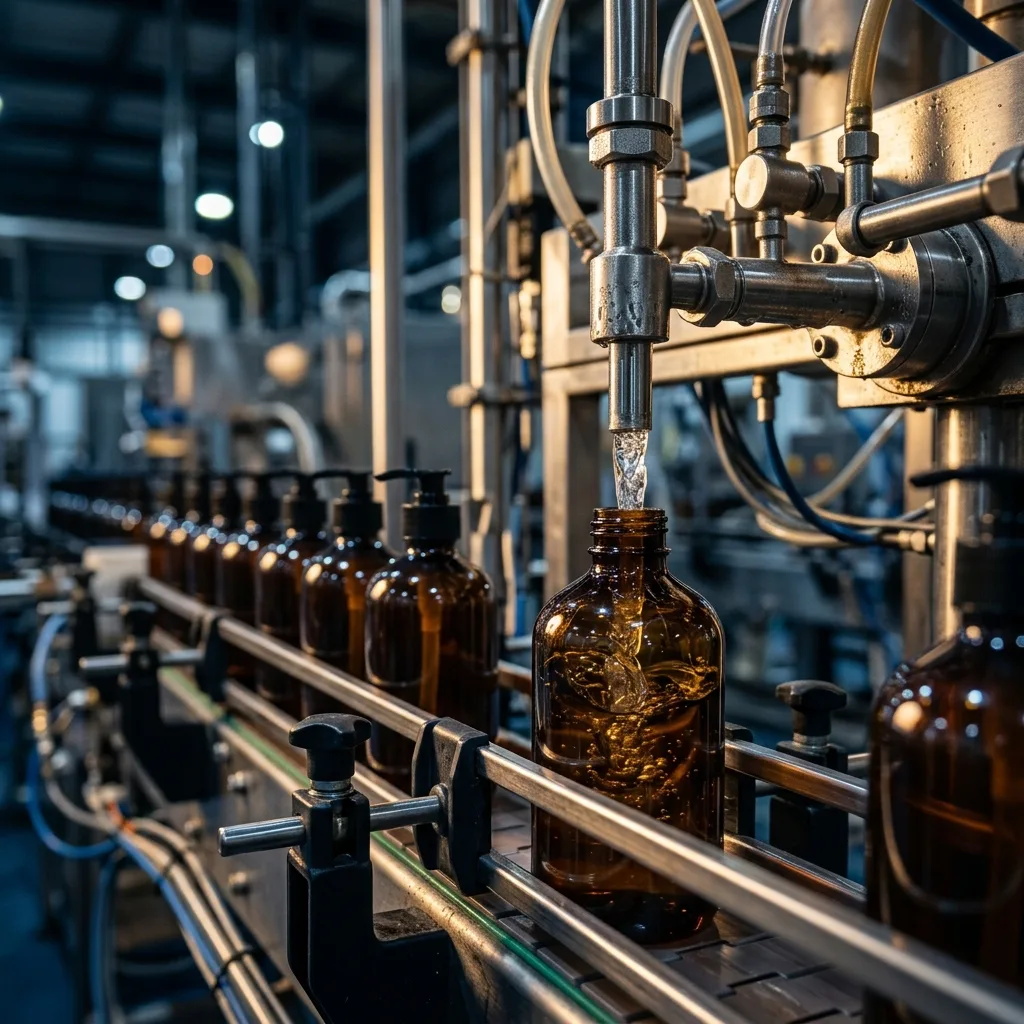
Demand for hand sanitizer and surface disinfectant did not vanish once the pandemic-era surge passed — it settled into a permanent, structurally higher baseline across hospitals, schools, offices, food service, and retail, and starting a hand sanitizer manufacturing business today means competing for durable institutional demand rather than chasing a temporary spike. The category rewards founders who treat alcohol content verification and regulatory compliance as seriously as any pharmaceutical product, because that discipline is exactly what separates a business that survives its first regulatory inspection from one that doesn't. Unlike many chemical categories, the core formulations here are public-domain and well-documented, which lowers the technical barrier considerably while the regulatory and quality control barrier remains genuinely demanding. This guide walks you through the complete roadmap: startup costs, equipment, WHO-formula-based raw material sourcing, the manufacturing process, quality control, licensing, pricing, and how to land your first institutional and retail customers.
Market Overview & Opportunity
The global hand sanitizer and disinfectant market is a multi-billion dollar category that expanded dramatically during the pandemic years and has since stabilized at a meaningfully higher baseline than pre-2020 levels, driven by permanent shifts in institutional hygiene protocols rather than temporary panic buying. A handful of large consumer health brands dominate retail shelf space, but the institutional, industrial, and private label segments remain fragmented and accessible to regional manufacturers.
Primary customer segments include hospitals and healthcare facilities with continuous, high-volume demand, schools and educational institutions, office and commercial real estate management companies, food service and hospitality businesses subject to hygiene regulation, and retail and pharmacy chains seeking both branded and private label supply. Government and institutional procurement tenders represent a particularly stable demand channel, since public health facilities maintain sanitizer and disinfectant purchasing as a standing operational requirement rather than a discretionary spend.
Demand drivers include permanently elevated institutional hygiene standards following the pandemic, ongoing regulatory requirements for hand hygiene compliance in healthcare and food service settings, and steady population growth expanding the institutional customer base. Regional opportunity is particularly strong across South Asia, the Middle East, and Africa, where institutional infrastructure is expanding and where the World Health Organization's hand hygiene guidance is widely referenced by both regulators and institutional buyers as a formulation and efficacy benchmark.
Competitive landscape at the small-manufacturer level includes established regional producers who scaled up during the pandemic and a wave of newer entrants, meaning your differentiation as a startup rests on reliable alcohol content consistency, competitive institutional pricing, and the ability to serve smaller distributor and private label orders that larger manufacturers deprioritize.
Investment Breakdown: Starting on Minimum Capital
Hand sanitizer and disinfectant manufacturing has a moderate capital floor within the pharmaceutical and healthcare category, higher than cosmetics-adjacent products but lower than sterile or injectable manufacturing, because the process itself is a relatively straightforward blending operation once your facility and licensing are in place. Your primary capital investment goes toward flammable-liquid-compliant facility setup, mixing and filling equipment, and working capital to carry you through licensing.
| Cost Category | Estimated Range (USD) | Notes |
|---|---|---|
| Facility Fit-Out (flammable storage compliant) | $3,000 – $8,000 | Fire-rated storage, wash-down surfaces for an 600–1,200 sq ft unit |
| Mixing & Filling Equipment | $3,500 – $9,000 | Stainless steel mixing vessel, semi-automatic filling and capping line |
| Raw Materials (first batches) | $1,200 – $3,500 | Denatured alcohol, gelling agents, glycerin, packaging for launch batches |
| Packaging (bottles, pumps, cartons, labels) | $700 – $1,800 | PET bottles, pump/flip-top caps, printed labels, secondary cartons |
| Licensing, Registration & Excise | $1,500 – $4,000 | Drug/biocide registration, alcohol excise licence, testing |
| Workspace & Utilities (3 months) | $700 – $1,700 | Lease, power, water for initial operating period |
| Working Capital Buffer | $800 – $2,000 | Covers licensing and excise registration lead time before first sale |
| Total Minimum | $8,000 – $20,000 | Before first commercial sale; lean scenario leases facility and equipment where possible |
The lean end of this range assumes a leased facility, a manual or semi-automatic filling line rather than fully automated, and a single alcohol-based gel product to start rather than a broad range spanning gels, liquids, and surface disinfectants. Mixing vessels and filling equipment can frequently be sourced second-hand from manufacturers who scaled down after the pandemic-era demand surge, at meaningful savings over new equipment. Budget carefully for the excise and alcohol control registration process — this is the single most commonly underbudgeted line item in this category, since founders often assume general business licensing covers bulk denatured alcohol handling when it does not.
Want the full financial workup? The Hand Sanitiser Standard Project Report is a complete India-basis feasibility and financial study — three independently costed investment configurations, a five-year projected P&L with IRR, payback and break-even, an itemised plant & machinery schedule, raw materials by functional class, and the full statutory and environmental roadmap. It is a costing and feasibility document; it does not include a formulation.
Minimum Equipment List for a Small-Scale Unit
Sanitizer and disinfectant manufacturing equipment needs are moderate compared to other pharmaceutical categories, since the process is fundamentally a controlled blending operation. What matters most is accurate alcohol dosing, contamination-free mixing, and safe handling of a flammable primary raw material.
| Equipment | Minimum Spec | Approx. Cost (USD) |
|---|---|---|
| Stainless Steel Mixing Vessel | 100–500 litre, 316L stainless, explosion-proof agitator motor | $1,800–$5,000 |
| Semi-Automatic Filling & Capping Line | Volumetric dosing, adjustable for 50ml–5L containers | $1,500–$4,000 |
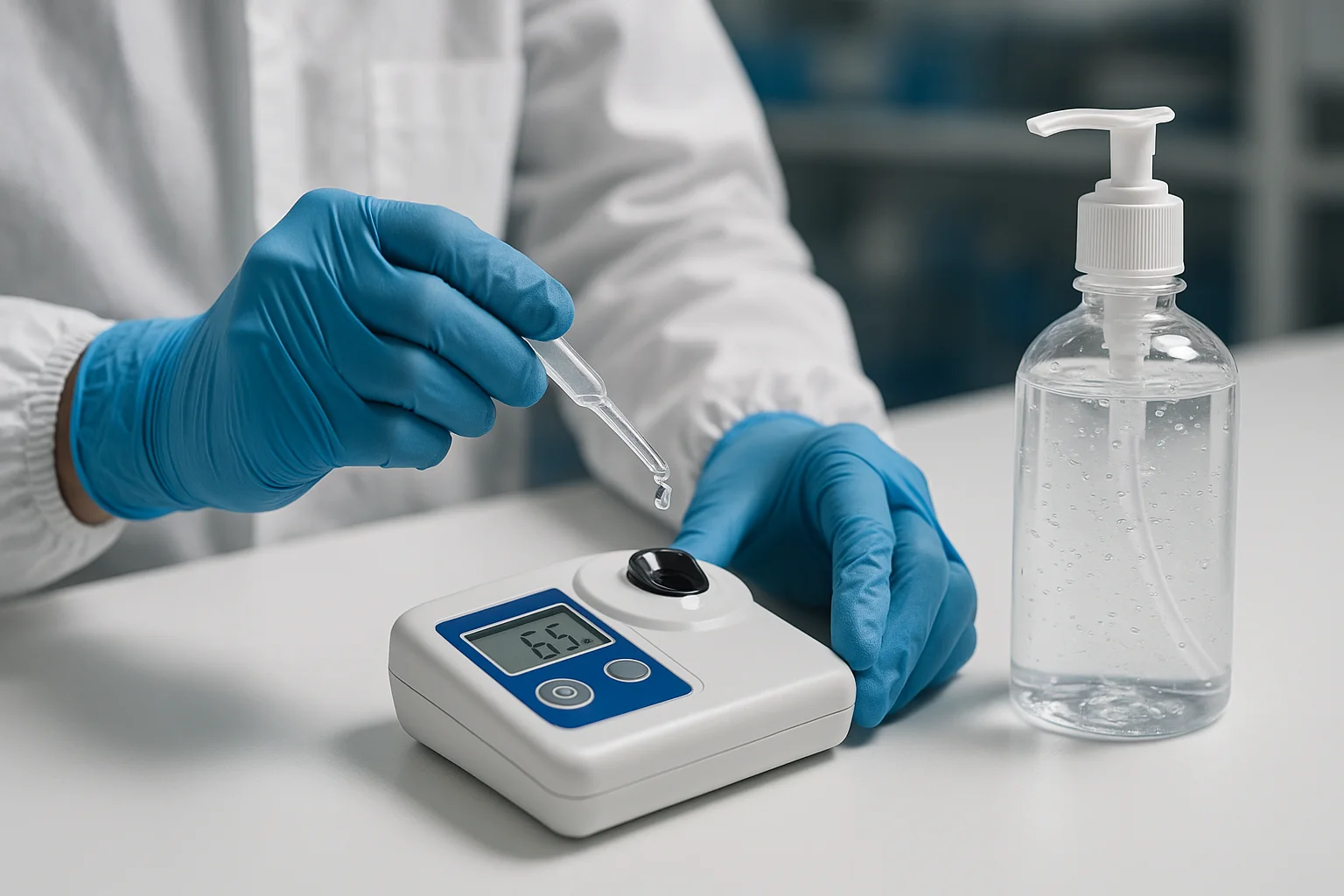
| Digital Alcoholmeter / Refractometer | Accurate alcohol-by-volume verification, ±0.5% precision | $150–$500 |
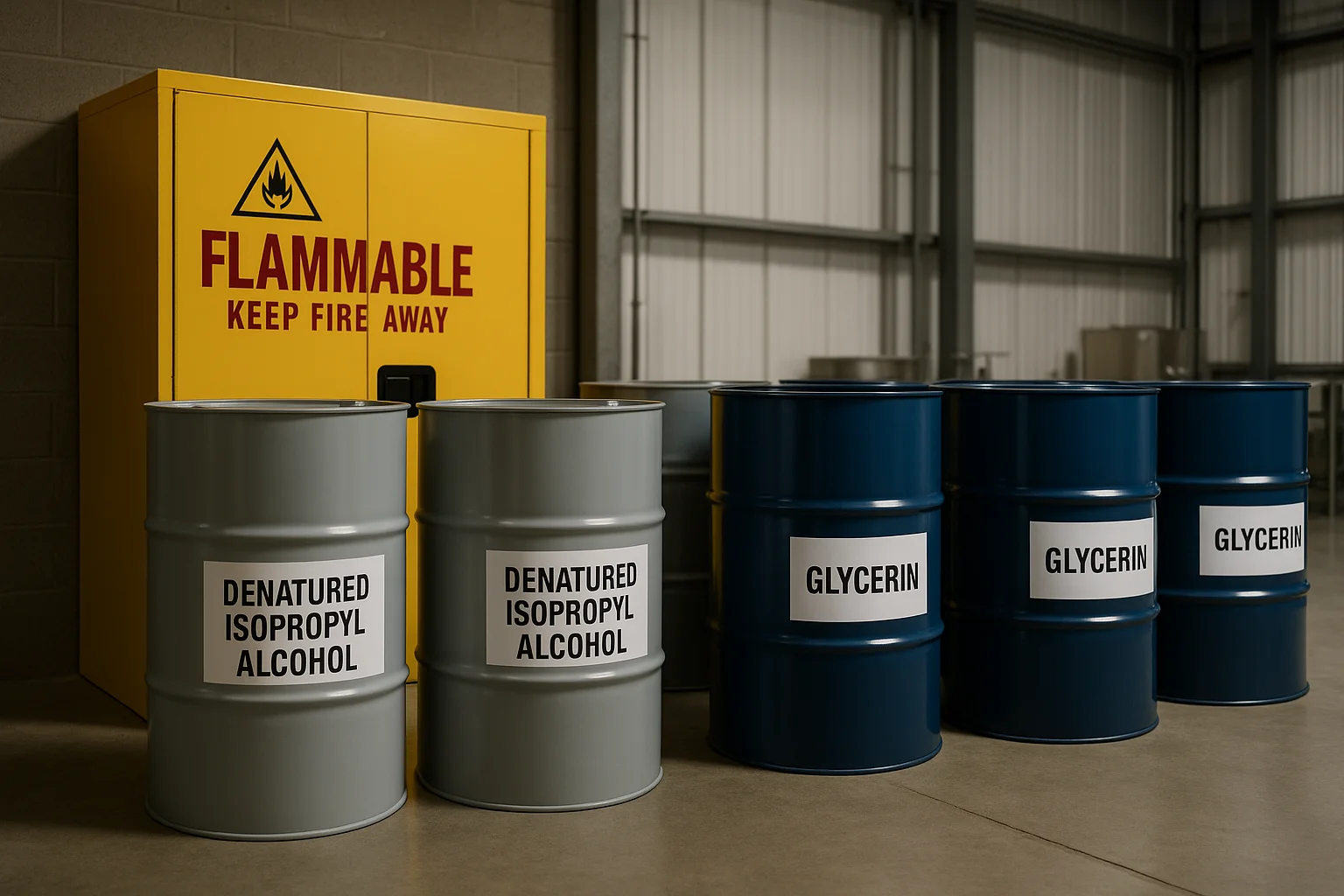
| Fire-Rated Alcohol Storage Cabinet | Flammable liquid storage meeting local fire code | $400–$1,200 |
| Graduated Mixing Tanks & Dosing Pumps | Chemical-resistant, accurate volumetric dosing | $500–$1,500 |
| Explosion-Proof Ventilation Fan | Spark-safe extraction for alcohol vapor control | $300–$900 |
Locally fabricated stainless steel vessels and filling lines are widely available across South Asia, the Middle East, and Africa at accessible cost, provided the fabricator can certify explosion-proof electrical fittings for any equipment operating near bulk alcohol. The alcoholmeter is the one instrument worth buying accurate and new — a sanitizer batch with alcohol content even a few percentage points below specification can fail efficacy testing outright, and inconsistent verification is the fastest way to produce an entire batch that cannot legally be sold.
Space, Utilities & Infrastructure Requirements
Facility infrastructure in this category is shaped almost entirely by one factor: safe handling and storage of bulk flammable alcohol. Get fire safety and ventilation right and the rest of the facility requirement is genuinely modest.
A minimum functional unit needs approximately 600 to 1,200 square feet, covering a dedicated mixing and filling area, a separate fire-rated bulk alcohol storage room physically isolated from the main production floor, and a small packaging and dispatch space. Power requirements are moderate, with most equipment running on standard single-phase or light three-phase supply, though any electrical fitting located near bulk alcohol storage must be explosion-proof rated. Water supply needs are minimal for alcohol-based products but become more significant if you add water-based surface disinfectant lines, which require a reliable purified water source.
Ventilation is the single most important infrastructure factor, since alcohol vapor buildup in an enclosed space creates both a fire hazard and a worker safety issue — explosion-proof extraction fans and adequate air exchange near mixing and filling stations are non-negotiable, not optional upgrades. Temperature control matters for storage stability, since alcohol-based products are sensitive to significant heat exposure, though standard ambient conditions are generally acceptable for short-term production storage. Zoning almost universally requires commercial or light industrial classification given the bulk flammable liquid storage involved, with fire department sign-off typically required as part of your facility approval before a manufacturing licence is granted.
Best Products to Start With: Low Capital, High Demand
Not every product format in this category suits a first-time manufacturer equally, since formulation complexity, regulatory classification, and packaging requirements vary meaningfully between gel, liquid, and surface disinfectant formats. A new entrant should start with the format offering the fastest path to a validated, sellable product.
- Alcohol-Based Hand Sanitizer Gel — the most accessible starting product, built on well-documented WHO-recommended formulations, with strong and durable institutional and retail demand across hospitals, schools, and offices.
- Alcohol-Based Liquid Hand Sanitizer — a natural companion product to gel, using largely the same raw material base with a simpler viscosity profile, useful for bulk institutional refill formats and dispenser systems common in hospitals and offices.
- Surface Disinfectant Sprays and Wipes — a strong second-stage product line once your alcohol-based process is validated, though it typically requires separate biocidal product registration and efficacy testing against surface pathogens, adding regulatory complexity beyond hand sanitizer alone.
Sequencing your line this way — gel and liquid hand sanitizer first, surface disinfectant second — lets you build regulatory track record and production discipline with a single, well-established product category before tackling the additional biocidal registration requirements that surface disinfectants typically carry. As detailed on the Global Formulation Pharmaceuticals & Health Care page, building a hygiene product portfolio around a validated core formulation creates the strongest foundation for institutional supply contracts.
Raw Material Sourcing Strategy
The raw material supply chain for hand sanitizer centers on three categories: the alcohol base (ethanol or isopropyl alcohol, typically denatured for non-beverage use), gelling and humectant agents (carbomer or cellulose-based gelling systems, glycerin), and packaging components. Understanding how to source and qualify each category directly determines your product's efficacy and regulatory compliance.
Denatured alcohol is best sourced from licensed industrial alcohol suppliers or distilleries who can provide documentation confirming denaturant composition and alcohol concentration, since regulators require traceable sourcing given alcohol's dual status as both an industrial input and an excise-controlled substance. Regional chemical distributors across South Asia and the Middle East carry both ethanol and isopropyl alcohol suited to sanitizer manufacturing; buying directly from a distillery or petrochemical producer only becomes cost-effective once your monthly volume justifies the higher minimum order quantities involved.
Gelling agents, glycerin, and packaging components are generally available locally at accessible minimum order quantities, though pharmaceutical or cosmetic-grade specification matters for any component that contacts the finished product. Evaluate any alcohol supplier on three criteria: consistency of denaturant composition and concentration between batches, willingness to provide Certificates of Analysis, and reliability of supply given that alcohol availability can be affected by excise quota systems in some markets.
Cost-saving strategies include negotiating volume-based alcohol pricing once your production scale justifies it, and forming informal buying groups with other small manufacturers to access better packaging pricing on shared bottle and pump-cap orders. Flag denatured alcohol for excise duty classification and quota restrictions early, since several markets cap the volume of duty-exempt denatured alcohol a manufacturer can purchase annually, directly affecting your maximum production capacity.
Manufacturing Process Overview
The manufacturing process for hand sanitizer is a controlled blending operation built around achieving and verifying a precise final alcohol concentration, rather than a complex chemical synthesis. Your job as the manufacturer is to combine alcohol, gelling or thickening agents, and humectants at the correct ratio while maintaining strict contamination control and accurate concentration verification.
Production for gel formulations typically begins with pre-dispersing the gelling agent in water under controlled agitation, followed by careful addition of the alcohol base while maintaining mixing speed low enough to avoid excessive foaming or vapor loss, then incorporation of glycerin and any remaining excipients. Liquid formulations follow a similar but simpler sequence without the gelling agent dispersion step. Both processes require immediate in-process alcohol content verification using a calibrated alcoholmeter or refractometer before the batch proceeds to filling, since alcohol evaporation during mixing can measurably reduce final concentration if the process runs too long or too warm.
Key process parameters to control include mixing speed and duration, batch temperature, and precise raw material addition sequence, since alcohol added too quickly or under excessive agitation increases evaporative loss and can produce a batch below target concentration. Batch size for a starting operation typically runs 100 to 500 litres per cycle. Where most beginners make mistakes in the process is failing to verify alcohol content immediately after mixing and again after any hold period before filling, since concentration can drift measurably even during short delays if storage conditions are not tightly controlled.
Basic process safety centers entirely on flammable liquid handling — no open flame, spark sources, or non-rated electrical equipment near the mixing area, explosion-proof ventilation, and strict adherence to your local fire code storage limits for both raw material and finished product inventory.
Setting up a manufacturing unit involves more than equipment and raw materials — getting the formulation right, scaling production safely, and meeting regulatory requirements are where most startups lose time and money. If you need hands-on guidance at any stage, the Global Formulation team works directly with chemical startups on formulation development, process setup, and compliance — from first batch to commercial scale.
Quality Control & Testing for Small Manufacturers
Quality control in hand sanitizer manufacturing centers overwhelmingly on one non-negotiable parameter — verified alcohol concentration — but a complete QC program also confirms physical consistency and microbial safety before any batch ships.
| Test | What It Measures | Equipment Needed | Pass/Fail Criterion |
|---|---|---|---|
| Alcohol Content (ABV) | Final concentration of ethanol or isopropyl alcohol in the batch | Digital alcoholmeter or refractometer | Meets target specification, typically 60–80% ABV depending on formulation |
| Viscosity | Gel consistency and dispensing performance | Brookfield or cone-plate viscometer | Within validated specification range for product type |
| pH | Formulation stability and skin compatibility | Calibrated digital pH meter | Within validated specification range, typically skin-compatible pH |
| Microbial Limit Test | Confirms product is within acceptable bioburden limits | Microbiology lab (in-house or third-party) | Meets pharmacopeial or biocidal product microbial limit specification |
Alcohol content, viscosity, and pH testing can and should be performed in-house for every single batch, since they require only calibrated instruments and disciplined process control rather than specialized lab equipment. Microbial limit testing is generally outsourced to a third-party lab on a periodic basis for alcohol-based products, since the alcohol concentration itself provides substantial inherent antimicrobial protection, though it remains a required release test in most regulatory frameworks. A basic in-house QC setup covering an alcoholmeter, viscometer, and pH meter can be established for under $1,000.
Batch records are a regulatory requirement in this category, not optional documentation — log raw material lot numbers, mixing parameters, in-process and release alcohol content readings, and QC sign-off for every batch, since this traceability is exactly what regulators and institutional buyers request during audits or tender qualification. The most common QC failure mode is alcohol concentration drift from evaporative loss during extended mixing or holding periods, which is precisely why verification immediately before filling — not just immediately after mixing — is a critical control point.
Packaging & Branding on a Budget
Packaging in this category must balance institutional bulk formats with retail-ready consumer packaging, since your customer base spans hospitals ordering bulk refills and retail chains wanting shelf-ready pump bottles. Getting both formats right without overinvesting is entirely achievable.
- Container formats — small pump or flip-top bottles (50ml–500ml) for retail and personal use, larger jerry cans or bulk containers (1L–5L) for institutional dispenser refill, both widely available at low minimum order quantities from regional plastics packaging suppliers.
- Label requirements — mandatory information typically includes product name, active ingredient and alcohol percentage, directions for use, warnings including flammability and keep-away-from-flame statements, batch or lot code, manufacturer name and address, and manufacturing/expiry dates.
- Budget label design — Canva or similar design tools combined with a local small-run printer can produce compliant, professional labels at low unit cost; ensure your printer understands the mandatory flammability warning and alcohol percentage disclosure requirements specific to this product category.
- Private label vs. own brand — private label manufacturing for institutional buyers, distributors, and retail chains can generate faster and more stable initial cash flow than building a consumer brand from scratch, given how heavily this category's demand runs through B2B and institutional channels.
A Safety Data Sheet is mandatory for this product category given its flammable liquid classification, required for any B2B, institutional, or export sale and good practice even for direct retail sale. Sourcing packaging locally at low minimum order quantities keeps upfront investment manageable while you validate demand across both institutional bulk and retail formats before committing to larger production runs.
Licensing, Registration & Regulatory Compliance
Hand sanitizer and disinfectant occupy a distinctive regulatory position — classified as an OTC drug or biocidal product in most markets rather than a general cosmetic, with the added complexity of excise regulation given its reliance on bulk alcohol as the primary active ingredient.
Regulatory bodies governing this category vary by market — Pakistan's DRAP oversees drug and biocidal product registration, India's CDSCO and State Licensing Authorities govern manufacturing and marketing approval, the GCC's GSO and SASO standards apply across Gulf markets, and the EU's Biocidal Products Regulation governs disinfectant products intended for European export. Mandatory steps before legal sale include business entity registration, a drug or biocidal product manufacturing licence contingent on facility inspection, and product registration confirming your formulation meets the applicable monograph or efficacy standard.
Because virtually all effective sanitizer formulations rely on denatured or specially denatured alcohol, a separate registration with your local excise or alcohol control authority is required in nearly every jurisdiction — this is regulated independently from drug or cosmetic product registration and is frequently the step first-time founders overlook entirely, assuming general business licensing is sufficient. Timeline for combined drug/biocide and excise registration typically runs 8 to 16 weeks depending on jurisdiction, with excise registration sometimes running as the longer of the two processes.
GMP-equivalent manufacturing discipline is expected from day one in most markets given this category's OTC drug or biocide classification, even where formal third-party certification is not separately mandated. Export compliance adds requirements like efficacy testing against specific pathogen panels for surface disinfectants and, for many markets, formal biocidal product authorization distinct from your domestic registration.
Pricing Strategy & Margin Expectations
Hand sanitizer pricing has normalized considerably since the pandemic-era price spikes, settling into a more competitive, margin-disciplined structure where institutional volume and consistent quality matter more than brand premium for the bulk of demand in this category.
Calculate your cost-plus baseline by summing alcohol cost (typically your largest single input), gelling agents and humectants, packaging, labor, and amortized equipment and facility cost, then apply your target margin on top. Gross margins for small manufacturers in this category typically run in the range of 25 to 40% at the manufacturer level, notably tighter than cosmetics or perfume categories, reflecting both intensified post-pandemic competition and alcohol's significant share of total input cost. Large consumer health brands price primarily on retail brand recognition, while regional manufacturers competing on institutional and private label supply typically win on reliable pricing and consistent quality rather than brand premium.
Price your first institutional and distributor customers competitively but sustainably, since this category's buyers — particularly government and hospital procurement — are highly price-sensitive and often bound by tender processes that make future price increases difficult to implement mid-contract. As your production efficiency and supplier relationships mature, you can improve margin through better alcohol procurement pricing rather than raising unit prices with existing institutional customers. When distributors or large institutional buyers push for lower pricing, protect your margin by negotiating minimum order volume commitments or longer contract terms rather than cutting your base price on an already tight-margin product.
Finding Your First 20 Customers
Customer acquisition in this category runs heavily through institutional procurement and B2B distribution channels, since your highest-volume and most stable demand comes from hospitals, schools, and government facilities rather than individual retail consumers.
B2B sales channels include pharmaceutical and FMCG distributors who supply the broader retail and institutional network, direct sales to hospital and healthcare facility procurement departments, government and NGO procurement tenders for public health facilities, and private label partnerships with retail chains and corporate hygiene supply companies. Direct sales through facility management companies and corporate procurement teams work well for the office and commercial real estate segment, which maintains steady ongoing sanitizer demand independent of seasonal or news-driven demand spikes. Online channels — B2B platforms, industry directories, and direct outreach via LinkedIn — are useful for reaching institutional and distributor buyers, though relationship-driven direct sales typically convert faster than cold digital outreach in this B2B-dominant category.
Product samples and third-party test certificates matter enormously here, since institutional buyers — particularly hospitals and government tenders — will not commit to a purchase order without verified alcohol content documentation and often a formal quality certificate. Building your first three institutional reference customers is especially valuable, since a hospital or government facility relationship, once established with reliable supply and consistent quality, tends to generate durable recurring volume through standing purchase orders. Common mistakes founders make include underpricing aggressively to win a first institutional contract without accounting for the tight margin this category already carries, and failing to prepare tender-required documentation — registration certificates, test reports, manufacturing licence — before actively pursuing government procurement opportunities.
When and How to Scale Up Your Production
Scaling a hand sanitizer and disinfectant business involves expanding both production capacity and your regulatory registration portfolio, since surface disinfectant and export market expansion each typically require additional registration even as your core sanitizer product line grows in volume.
The clearest signal you are ready to scale is consistent institutional or distributor order volume that outpaces your current batch capacity, combined with genuine tender or export inquiries you currently have to decline. At that point, the next equipment investments typically include a larger-capacity mixing vessel, a fully automated filling and capping line to reduce per-unit labor cost on high-volume institutional orders, and expanded fire-rated bulk alcohol storage sized to your confirmed local fire code limit. Hiring usually starts with a dedicated QC technician focused on alcohol content verification and a production operator, freeing the founder to focus on institutional sales relationships and regulatory expansion.
Quality systems worth formalizing at this stage include a documented Quality Management System aligned with your regulator's applicable GMP or biocidal product manufacturing guideline, a formal internal audit schedule ahead of tender qualification reviews, and — if pursuing surface disinfectant or export expansion — a structured path toward biocidal product efficacy testing and additional market registration. As detailed on the Global Formulation guide to choosing the right product consultant, bringing in outside regulatory expertise at the scale-up stage often prevents the compliance missteps that are most costly to correct after a facility is already operating at scale.
Frequently Asked Questions
How much capital is really needed to start a hand sanitizer manufacturing business?
Do I need a chemistry degree to start a sanitizer business?
Can I start a sanitizer business from home or do I need a dedicated facility?
What is the biggest mistake to avoid when starting this business?
How long before I make my first sale in a sanitizer business?
Do I need ISO or GMP certification from day one?
How do I get a validated formulation for my sanitizer product line?
What is the first licence I need to get to start selling hand sanitizer?
Ready to Take the Next Step?
Starting a chemical manufacturing business is one of the most rewarding paths an entrepreneur can take — but it demands the right technical foundation from day one. Whether you need a validated formulation, help setting up your first production unit, guidance on regulatory compliance, or a structured scale-up plan, the Global Formulation team is here to support you.
Reach out to us at globalformulation.com/contact — we work with founders at every stage, from concept to commercial production.