
Every hectare of cotton, rice, wheat, and vegetable cropland under commercial cultivation runs on a recurring, non-discretionary purchase of herbicides, insecticides, and fungicides — and a pesticide formulation unit startup taps into one of the most consistently demanded, if also most tightly regulated, categories in industrial chemistry. Crop losses to pests and weeds remain a direct threat to yield and farmer income across every major growing region, which is why this category shows remarkably durable demand even as broader consumer spending fluctuates. What makes this business different from nearly everything else in this series is the regulatory path: you are not expected to invent a new molecule, since almost every founder entering this space formulates well-established, off-patent active ingredients rather than developing novel chemistry. The real skill is validating a compliant, stable formulation and successfully navigating product registration — a process that runs longer here than in any other category covered in this series. This guide walks you through the complete roadmap: startup costs, equipment, active ingredient sourcing, the formulation process, quality control, registration and licensing, pricing, and how to land your first distributor and institutional customers.
Market Overview & Opportunity
The global crop protection chemicals market is a multi-billion dollar category dominated by a small group of multinational originator companies, but the off-patent generic segment — where most new formulators compete — is large, fragmented, and open to regional entrants who can source technical actives reliably. As patents on older herbicide and insecticide chemistries continue to expire, more of the market's volume shifts toward generic formulation rather than proprietary molecules, widening the door for a new pesticide formulation unit startup.
Primary customer segments include agri-input distributors and dealer networks who serve the bulk of the farming population, large commercial farms and plantations buying directly at volume, government procurement for public health vector control and locust or pest outbreak programs, and export buyers in neighboring agricultural markets. Distributor and dealer relationships matter more here than almost any other category in this series, since most farmers still purchase pesticides through a trusted local dealer rather than direct from a manufacturer.
Demand drivers include population growth pushing intensification of existing farmland, resistance management that requires rotating between different chemical classes and driving repeat purchase cycles, and expanding commercial and export-oriented agriculture across South Asia, the Middle East, and parts of Africa. Regional opportunity is particularly strong across Pakistan, India, and the broader agro chemicals supply chain in South Asia, where cotton, rice, and horticultural production sustain year-round herbicide and insecticide demand.
Competitive landscape at the formulator level includes dozens of regional generic producers competing primarily on price, dealer relationships, and consistent supply rather than brand recognition, since the underlying active ingredients are frequently identical across competing products. Differentiation for a new entrant comes from formulation stability that holds up on the shelf and in the spray tank, and from building trust with dealers through consistent quality rather than the lowest price alone.
Investment Breakdown: Starting on Minimum Capital
Pesticide formulation carries a moderate capital floor for equipment, but this category is unusual in that registration and compliance costs often exceed equipment costs over your first two years of operation. Budget deliberately for both, since underfunding the registration process is a far more common cause of early failure here than underfunding the production line.
| Cost Category | Estimated Range (USD) | Notes |
|---|---|---|
| Facility Fit-Out (hazmat storage compliant) | $6,000 – $15,000 | Bunded flooring, segregated raw material storage for a 1,500–3,000 sq ft unit |
| Blending & Filling Line (liquid formulations) | $5,000 – $14,000 | Corrosion-resistant mixing tanks, homogenizer, and filling line for EC/SL products |
| Technical Active Ingredient (first batches) | $4,000 – $10,000 | Certificate-of-Analysis-backed technical actives for launch formulations |
| Packaging (bottles, drums, labels) | $1,500 – $4,000 | HDPE containers, GHS-compliant hazard labeling and closures |
| Registration & Licensing Fees | $5,000 – $15,000 | Manufacturing license, product registration data package, label approval |
| Working Capital Buffer | $3,500 – $8,000 | Covers the extended registration timeline before first legal sale |
| Total Minimum | $25,000 – $60,000 | Before first commercial sale; excludes potential efficacy trial costs some authorities require |
The lean end of this range assumes a leased facility, a mechanical blending and filling line rather than a fully automated system, and a launch focused on one or two liquid products built on off-patent actives with an existing registration precedent in your market. Blending tanks and filling equipment can often be sourced from regional industrial equipment fabricators at lower cost than importing specialized agrochemical machinery, provided materials are corrosion-resistant and chemically compatible with your solvent and active ingredient system. Budget carefully for registration: unlike most categories in this series, the data package, testing, and approval timeline for a pesticide formulation are a genuine second major cost center, not a minor administrative step.
Minimum Equipment List for a Small-Scale Unit
Pesticide formulation equipment splits into two broad paths: liquid formulation lines for EC, SL, and SC products, and dry formulation lines for WP and WG products, each with distinct process and containment requirements. Starting with liquid formulation equipment gives most new entrants the fastest, lowest-complexity route to a first registered product.
| Equipment | Purpose | Minimum Spec | New Cost Range | Alternative |
|---|---|---|---|---|
| Corrosion-Resistant Blending Tank | Mixing active ingredient with solvent, emulsifier, or carrier | 200–1,000 litre, stainless steel or lined vessel | $2,000–$6,000 | Regional fabricator custom build |
| High-Shear Homogenizer | Emulsification and dispersion for EC and SC formulations | Variable-speed, chemical-resistant wetted parts | $1,500–$4,500 | Rent for initial trial batches |
| Wet Bead Mill | Particle size reduction for suspension concentrates | Recirculating mill, target fine particle output | $3,000–$9,000 | Add in phase two, not required for EC/SL launch |
| Automated Filling & Capping Line | Liquid product filling into finished containers | Chemical-resistant components, adjustable fill volume | $1,500–$4,000 | Semi-manual filling for early volumes |
| Closed-Transfer / Dosing System | Minimizes operator exposure during active ingredient handling | Sealed transfer lines, drum pumps | $800–$2,500 | Not recommended to skip given exposure risk |
| Dust-Controlled Milling Room | Micronization for WP/WG formulations (phase two) | Ventilated, explosion-rated for dry powder handling | $4,000–$10,000 | Defer until dry formulations are added |
Blending tanks and filling equipment are widely available from regional industrial fabricators across South Asia, but insist on chemical-resistant wetted surfaces rated for solvent and active ingredient contact, since standard mild steel degrades quickly in this service and can contaminate product. The closed-transfer dosing system is the single most important safety investment on this list — it is what most beginners are tempted to skip to save capital, and it is precisely the equipment that protects your operators from direct contact with concentrated technical actives during charging.
Space, Utilities & Infrastructure Requirements
Facility infrastructure in this category is shaped primarily by hazardous material storage segregation and operator exposure control, both of which your registering authority will inspect before granting a manufacturing license. Layout decisions made early save significant rework once your facility inspection is scheduled.
A minimum functional unit needs approximately 1,500 to 3,000 square feet, divided into segregated technical active ingredient storage isolated from finished product, a liquid blending and filling area, a separate dry powder handling room if you add WP or WG production, and a packaging and dispatch space. Power requirements are moderate, typically single-phase or light three-phase depending on your mixing and milling motor sizes. Water supply needs are modest, mainly for equipment cleaning and formulation of water-based SC and SL products, and consistent water quality affects formulation stability.
Ventilation requirements center on solvent vapor and dust control, with corrosion-resistant exhaust systems for solvent-based EC production and dedicated dust collection for any dry powder milling, since fine agrochemical dust presents both an inhalation hazard and, in some cases, an explosion risk if not properly grounded and ventilated. Temperature control matters for formulation stability, particularly for suspension concentrates prone to settling or crystallization at temperature extremes. Bunded, impermeable flooring throughout storage and production areas protects against groundwater contamination in the event of a spill, and zoning almost universally requires industrial classification given the hazardous material storage this business demands.
Best Products to Start With: Low Capital, High Demand
Not every formulation type suits a first-time entrant equally, since equipment complexity, registration precedent, and dealer demand vary significantly across the category. A new formulator should start with the product offering the fastest realistic path to a registered, sellable product.
- Soluble Liquid (SL) Herbicide — built on a well-established off-patent herbicide active, SL formulations require comparatively simple blending equipment and have the most registration precedent in most markets, making this the lowest-friction entry point for a first product.
- Emulsifiable Concentrate (EC) Insecticide — moderate formulation complexity involving solvent and emulsifier selection, with consistently strong dealer demand across row-crop and horticultural markets, and a natural second product once your blending process is validated.
- Wettable Powder (WP) or WDG Fungicide — higher formulation complexity given dry powder milling and dust control requirements, but strong recurring demand in fruit and vegetable disease management; best sequenced as a phase-two addition once your liquid line and registration pathway are proven.
Sequencing your line this way — an SL herbicide first to validate blending and registration, an EC insecticide as your second registered product, and a WP or WDG fungicide once dry powder handling infrastructure is justified by volume — lets you generate revenue and registration experience before your highest-complexity product line comes online. This mirrors the broader chemistry classes covered on the Global Formulation Agro Chemicals page, where formulation strategy is treated as a sequencing decision, not a one-time product launch.
Raw Material Sourcing Strategy
The raw material supply chain for pesticide formulation centers on three categories: technical grade active ingredients, formulation additives such as emulsifiers, dispersants, and solvents, and packaging components rated for hazardous material storage and transport. Getting each category right determines both your product's field performance and your ability to pass registration review.
Technical grade active ingredients should be sourced only from qualified basic manufacturers who can supply a Certificate of Analysis confirming purity and impurity profile, since regulators and dealers alike will scrutinize this documentation closely and your registration dossier typically references the technical supplier's own data. Regional and international chemical distributors across South Asia carry a broad range of off-patent herbicide, insecticide, and fungicide technicals suited to formulation-stage manufacturing; importing directly from a primary producer becomes cost-effective once your monthly volume justifies higher minimum order quantities.
Emulsifiers, dispersants, and solvents are generally available locally or regionally, though grade selection materially affects both formulation stability and worker exposure — lower-toxicity, reduced-aromatic solvents are increasingly preferred given tightening occupational exposure and VOC-related expectations, a theme explored further in the Global Formulation guide to pollution caused by VOCs. Evaluate any technical active supplier on three criteria: willingness to provide full Certificates of Analysis and toxicological summaries, batch-to-batch purity consistency, and dangerous goods shipping competence, since a supplier who mishandles hazardous transport creates liability exposure for your business as the receiving party.
Cost-saving strategies include qualifying two suppliers for your primary technical active to avoid single-source risk, and forming informal buying groups with other small formulators to access better bulk pricing on shared raw material orders. Flag technical active ingredients for import permitting early — most plant protection authorities require an import permit for scheduled agrochemical actives before customs clearance, and this step routinely adds weeks of lead time that catches unprepared founders off guard.
Manufacturing Process Overview
The formulation process differs meaningfully by product type, but every pathway shares the same underlying discipline: precise addition sequence, controlled particle size or droplet size, and strict material compatibility given the toxicity and reactivity of the active ingredients involved.
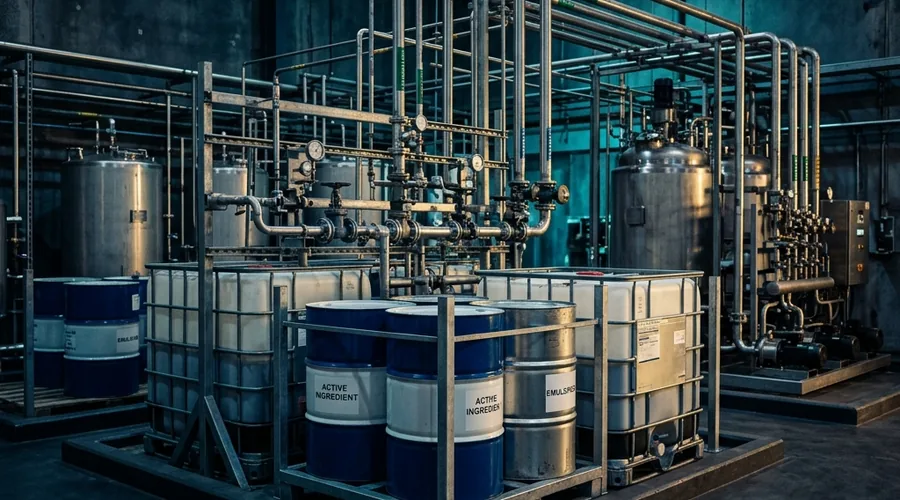
For EC and SL liquid formulations, the process begins with dissolving the technical active in the selected solvent or carrier, followed by controlled addition of emulsifiers or surfactants under moderate agitation, then filtration and standardization before filling. For suspension concentrates, the technical active is wet-milled with dispersant and water to a controlled fine particle size, since particle size distribution directly determines suspensibility and spray-tank performance, followed by addition of thickener and anti-foam agents. Wettable powder and water-dispersible granule production follows a dry-blending and micronization sequence, combining active ingredient with carrier and wetting agents before air-classifying or jet milling to target fineness.
Key process parameters to control include addition sequence to avoid unwanted reactions between incompatible components, particle size distribution for suspension and dry formulations, mixing time and agitation speed, and ambient humidity where hygroscopic actives or carriers are involved. Batch size for a starting operation typically runs several hundred litres of liquid product or several hundred kilograms of dry product per cycle depending on equipment capacity. Where most beginners make mistakes is underestimating how sensitive suspension and emulsion stability are to milling and mixing parameters — a formulation that looks correct at filling can separate or settle within weeks if particle size or emulsifier selection was not properly validated.
Basic process safety centers on closed-transfer systems during active ingredient charging, respiratory and dermal protection matched to the toxicity classification of the specific active in use, and grounding or bonding of equipment to prevent static ignition during solvent handling or dry powder milling.
Setting up a manufacturing unit involves more than equipment and raw materials — getting the formulation right, scaling production safely, and meeting regulatory requirements are where most startups lose time and money. If you need hands-on guidance at any stage, the Global Formulation team works directly with chemical startups on formulation development, process setup, and compliance — from first batch to commercial scale.
Quality Control & Testing for Small Manufacturers
Quality control in pesticide formulation centers on verified active ingredient content and physical formulation stability, since these factors directly determine whether your product performs in the field and survives storage, transport, and dilution in the spray tank. Testing here follows internationally recognized methods published by the Collaborative International Pesticides Analytical Council (CIPAC), which most regulators reference directly in their approval criteria.
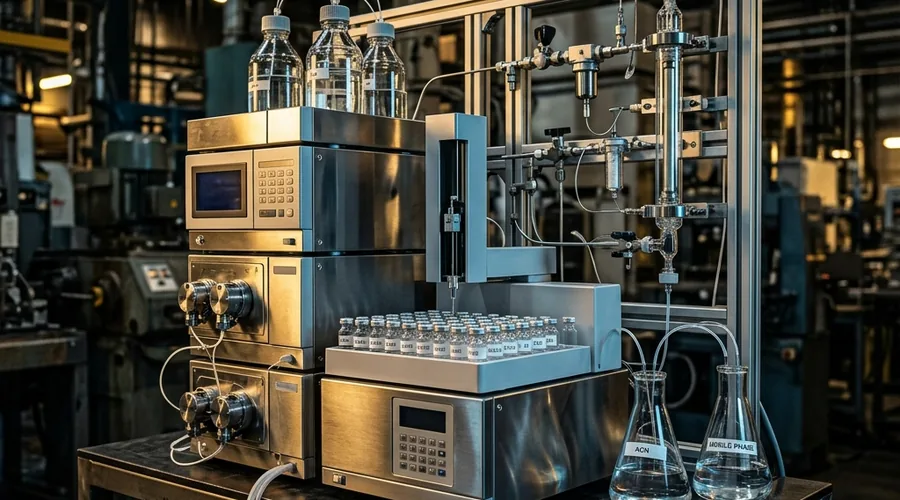
| Test | What It Measures | Equipment Needed | Pass/Fail Criterion |
|---|---|---|---|
| Active Ingredient Content | Confirms active ingredient assay against label claim | HPLC or GC with reference standard | Within specified tolerance of label claim |
| Suspensibility (SC/WP) | Confirms the formulation remains evenly suspended after dilution | CIPAC suspensibility test apparatus | Meets minimum suspensibility percentage after standing time |
| Emulsion Stability (EC) | Confirms no separation after dilution in spray water | CIPAC emulsion stability test setup | No visible separation within specified holding time |
| Wet Sieve / Particle Size | Confirms fineness and absence of coarse residue in dry and SC products | Sieve test kit or particle size analyzer | Residue below specified threshold on test sieve |
| Accelerated Storage Stability | Predicts shelf-life behavior under elevated temperature | Controlled-temperature storage chamber | No significant assay loss or physical change after test period |
Active ingredient assay and basic physical tests can be performed in-house with a modest instrument investment, though HPLC or GC analysis often requires either a dedicated instrument or a third-party analytical lab relationship, particularly for a startup not yet ready to invest in chromatography equipment. Suspensibility, emulsion stability, and wet sieve testing are achievable in-house for well under the typical $2,000 baseline this series uses for small QC labs, since these rely on standardized CIPAC glassware and procedure rather than expensive instrumentation.
Batch records matter enormously in this category, capturing raw material lot numbers, in-process particle size or emulsion checks, and release test results for every batch, since this documentation is exactly what your registering authority and larger institutional buyers will request during inspection or tender qualification. The most common QC failure mode is inadequate milling or emulsifier selection producing a formulation that fails suspensibility or emulsion stability testing after the fact, which is precisely why in-process particle size verification during formulation saves far more cost than retesting a finished, failed batch.
Packaging & Branding on a Budget
Packaging in this category must satisfy hazardous material labeling requirements that are stricter and more standardized than almost any other category in this series, since pesticide labels are themselves part of the regulatory approval, not just a marketing surface.
- Container formats — HDPE bottles and drums (1L–200L) for liquid formulations, laminated pouches or HDPE containers (250g–25kg) for dry formulations, all rated for chemical resistance and hazardous material transport.
- Label requirements — mandatory information typically includes the active ingredient name and formulation type, registration or approval number, GHS hazard pictograms and signal word matched to the product's toxicity classification, directions for use and target pests, pre-harvest interval, first aid statements, batch code, and manufacturer details.
- Budget label design — because pesticide labels are part of your registration approval, work with a printer experienced in agrochemical labeling rather than a generic commercial printer, since an approved label text or hazard pictogram error is a compliance failure, not a cosmetic one.
- Private label vs. own brand — private label formulation for established distributors can generate faster initial cash flow with lower marketing spend, while building your own brand for direct dealer network sales captures higher margin once quality consistency and registration credibility are established.
A Safety Data Sheet is mandatory for every pesticide product without exception, required for commercial sale, dangerous goods transport documentation, and distributor due diligence alike. Sourcing hazard-compliant packaging locally at accessible minimum order quantities keeps upfront investment manageable while you validate demand across your initial registered product range.
Licensing, Registration & Regulatory Compliance
Pesticide formulation is the most heavily regulated category in this entire series, since active ingredients and finished products are classified as scheduled hazardous agricultural chemicals in virtually every jurisdiction, and product registration is required for each specific active-and-formulation combination before it can legally be sold.
Regulatory bodies governing pesticide registration vary by market — Pakistan's Department of Plant Protection administers registration under the Agricultural Pesticides Ordinance while provincial environmental authorities oversee hazardous chemical storage, India's Central Insecticides Board and Registration Committee governs registration under the Insecticides Act, and the GCC's GSO and SASO standards apply across Gulf markets. Internationally, the FAO/WHO Joint Meeting on Pesticide Specifications publishes reference physicochemical specifications that many national authorities draw on when evaluating a formulation's technical dossier, and the U.S. EPA's pesticide registration framework under FIFRA is a widely referenced model for how formulation-stage data requirements are structured even outside the United States.
Mandatory steps before legal sale include business entity registration, a manufacturing or formulation license contingent on facility inspection, and product registration confirming your specific formulation meets composition, stability, and — in many markets — bio-efficacy trial requirements. Timeline for product registration typically runs 6 to 14 months for an off-patent active with existing regulatory precedent, and considerably longer for a formulation without prior approval history in your market, making this consistently the longest single lead-time item in this entire business-startup series.
What happens if you formulate or sell pesticide products without proper registration ranges from product seizure and facility closure to significant financial and, in many jurisdictions, criminal penalties, since regulators treat unregistered pesticide sale as a direct public health and environmental risk rather than a minor licensing lapse. Good manufacturing discipline — batch records, in-process testing, documented segregated storage — is expected from day one even where formal third-party certification is not separately mandated. Export compliance adds a further layer, since a formulation registered in one country is not automatically valid for sale in another, requiring separate destination-market registration and dangerous goods transport documentation.
Pricing Strategy & Margin Expectations
Pesticide pricing is shaped by commodity input cost volatility for technical actives, intense generic competition once a molecule is off-patent, and a distribution chain where dealers and wholesalers exert real influence over what a formulator can charge.
Calculate your cost-plus baseline by summing technical active ingredient cost — typically the dominant line item and the figure most exposed to global commodity price swings — packaging, labor, and amortized equipment and registration cost, then apply your target margin on top. Gross margins for small generic formulators typically run in the range of 20 to 35% at the manufacturer level, thinner than in less regulated categories precisely because generic active ingredients compete heavily on price. Large multinational originator brands price on proprietary chemistry and marketing spend, while regional generic formulators win primarily through reliable dealer supply and consistent formulation quality rather than brand premium.
Price your first distributor and institutional customers with awareness of seasonal cropping cycles, since demand for a given herbicide or insecticide often concentrates tightly around planting and pest-pressure windows, and missing that window with a stockout costs more in lost dealer trust than a modest price concession would. As your production volume grows, improve margin through better bulk technical active procurement rather than raising unit prices with established dealer accounts. When distributors push for lower pricing on a commodity active, protect your margin by negotiating seasonal volume commitments rather than cutting your base price outright.
Finding Your First 20 Customers
Customer acquisition in this category runs almost entirely through B2B agricultural distribution channels, since dealer networks, not individual farmers buying single units, control the vast majority of pesticide sales volume in most markets.
B2B sales channels include agri-input distributors and dealer networks who serve the broader farming community, direct sales to large commercial farms and plantations who purchase at volume, government procurement tenders for pest outbreak or public health vector control programs, and export relationships with distributors in neighboring agricultural markets. Direct outreach through agricultural trade associations and dealer conventions works well for reaching distributors who value supply reliability and registration credibility over an unfamiliar brand name. Online channels — agrochemical trade directories and direct distributor outreach — function mainly as discovery tools rather than primary sales channels in this heavily relationship-driven category.
Field trial samples and third-party efficacy data matter significantly for winning larger distributor and institutional accounts, since serious buyers will request proof of field performance alongside your registration documentation before committing to a supply agreement. Building your first three distributor relationships is especially valuable, since a dealer network, once confident in your formulation's consistency and your registration standing, tends to generate durable recurring seasonal orders rather than one-off purchases. Common mistakes founders make include pursuing dealer relationships before product registration is finalized, which damages credibility when a promised product cannot yet legally ship, and underestimating how much seasonal cash flow timing matters when raw material purchasing must happen well ahead of a narrow planting-season sales window.
When and How to Scale Up Your Production
Scaling a pesticide formulation business involves expanding both production capacity ahead of seasonal demand peaks and your registered product portfolio, since in this category each new active-and-formulation combination requires its own separate registration rather than a simple product-line extension.
The clearest signal you are ready to scale is consistent distributor order volume that outpaces your current blending and filling capacity, particularly if you are turning down orders during peak planting-season demand. At that point, the next equipment investments typically include higher-throughput blending and wet-milling capacity, dedicated dry powder handling infrastructure if you have not already added it, and continued investment in registering additional off-patent actives to round out a broader product range. Hiring usually starts with a dedicated production operator trained in hazardous material handling and a QC technician focused on active ingredient assay and stability testing, freeing the founder to focus on distributor relationships and the next registration filing.
Quality systems worth formalizing at this stage include a documented Quality Management System covering hazardous material handling and batch traceability, a formal seasonal production and raw material procurement plan to avoid peak-season shortages, and — if pursuing export markets — destination-country product registration and dangerous goods transport certification. As detailed on the Global Formulation guide to choosing the right product consultant, bringing in outside regulatory and process expertise at the scale-up stage often prevents the registration missteps that are most costly to correct once a facility is already operating at higher volume.
Frequently Asked Questions
How much capital is really needed to start a pesticide formulation unit?
Do I need a chemistry degree to start a pesticide business?
Can I start a pesticide formulation business from home or do I need a factory?
What is the biggest mistake to avoid when starting this business?
How long before I make my first sale in a pesticide formulation business?
Do I need ISO or GMP certification from day one?
How do I get a formulation for my pesticide product line?
What is the first licence I need to get to start a pesticide formulation unit?
Ready to Take the Next Step?
Starting a chemical manufacturing business is one of the most rewarding paths an entrepreneur can take — but it demands the right technical foundation from day one. Whether you need a validated formulation, help setting up your first production unit, guidance on regulatory compliance, or a structured scale-up plan, the Global Formulation team is here to support you.
Reach out to us at globalformulation.com/contact — we work with founders at every stage, from concept to commercial production.