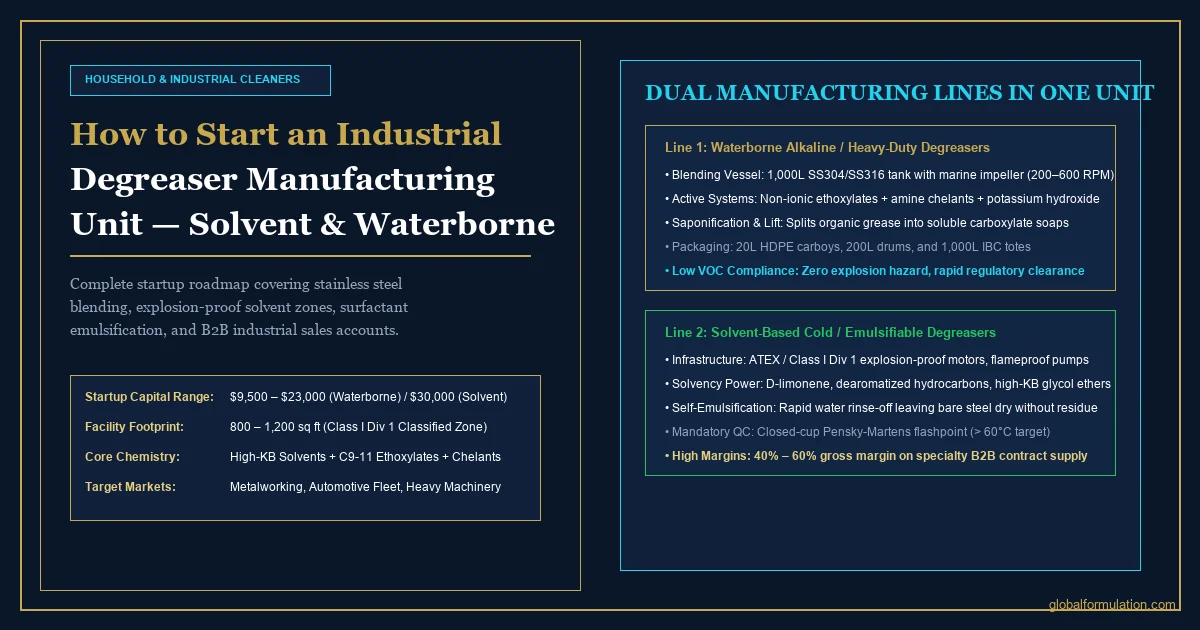
Every factory floor, machine shop, and vehicle maintenance bay generates grease, oil residue, and metalworking soil that has to come off before the next process step can begin, and that unavoidable industrial reality makes an industrial degreaser manufacturing business one of the steadiest recurring-demand categories a chemical entrepreneur can enter. Unlike consumer cleaning products where brand loyalty is soft and price-driven, industrial buyers reorder a degreaser almost entirely on whether it actually cuts their specific grease load without damaging the substrate underneath — a technical bar a well-formulated small manufacturer can meet just as reliably as a multinational. This guide walks through the complete startup roadmap for both waterborne and solvent-based degreaser lines — blending equipment, fire-safety infrastructure, raw material sourcing, the production and quality-control process, licensing, pricing, and how to land your first industrial accounts. Everything here reflects real degreasing-industry practice, the operational detail a founder needs before committing capital, not textbook theory.
Market Overview & Opportunity
The global industrial cleaning chemicals market is a multi-billion dollar segment, and degreasers specifically sit inside one of its most durable subcategories because grease and oil contamination is a constant byproduct of manufacturing, transport, and maintenance work rather than a seasonal or discretionary need. A handful of large industrial chemical suppliers dominate the branded end of this market, but that leaves meaningful room for regional manufacturers who can supply consistent quality at competitive pricing with faster local delivery.
Primary customer segments split across metalworking and machine shops that need cutting-fluid and swarf residue removed between operations, automotive and fleet maintenance workshops cleaning engine and undercarriage components, and general manufacturing and food-processing facilities with recurring equipment cleaning contracts. Demand drivers include continued industrialisation, expanding vehicle fleets requiring maintenance, and tightening workplace safety standards that push facilities toward documented, SDS-backed cleaning chemicals rather than informal solvent use. The underlying chemistry of industrial degreasing — surfactant emulsification for waterborne systems and direct solvency for solvent-based systems — is well documented and worth understanding thoroughly before you formulate your first batch.
Competition comes primarily from established industrial chemical distributors carrying multinational brands, but local machine shops and maintenance workshops consistently report that faster delivery, smaller minimum order quantities, and a manufacturer willing to tune a formulation to their specific grease load matter more than brand recognition. As detailed on our household and industrial cleaners resource page, a new entrant differentiates most effectively by winning local industrial accounts on responsiveness and formulation fit rather than competing on national distribution scale.
Investment Breakdown: Starting on Minimum Capital
Capital requirements in this category hinge on one decision more than any other: whether you launch with a waterborne-only line or add a solvent-based line from day one. Waterborne degreasers need only standard blending and filling equipment, while solvent-based formulations require explosion-proof electrical fittings, closed-drum handling, and fire-rated storage — a meaningfully larger capital and compliance commitment that most founders defer until their waterborne line is generating stable revenue.
| Cost Category | Estimated Range (USD) | Notes |
|---|---|---|
| Stainless blending tank & agitator | $1,800 – $4,500 | Waterborne line; larger tank for higher batch volume |
| Drum & jerrycan filling line | $1,200 – $3,000 | Manual filling lowers this substantially at small scale |
| Initial raw material inventory | $2,500 – $5,500 | Surfactants, builders, and solvent for first production run |
| Packaging, drums and labels | $900 – $2,200 | Reusable steel drums lower long-run cost vs. one-way plastic |
| Explosion-proof fittings & fire-rated storage | $0 – $6,000 | Required only if launching a solvent-based line |
| Licensing, environmental clearance & lab testing | $700 – $2,000 | Hazmat permit adds cost if solvent line is included |
| Working capital (3 months operating expenses) | $1,400 – $2,800 | Utilities, labour, overhead while building first accounts |
| Total Minimum | $9,500 – $30,000 | Before first sale; range spans waterborne-only to dual-line launch |
The lower end of this range reflects a founder launching waterborne-only with manual drum filling, while the upper end reflects a founder investing in explosion-proof fittings and closed-drum handling to launch both lines simultaneously. Blending tanks and filling equipment are frequently available second-hand from cleaning-chemical manufacturers upgrading capacity, which can meaningfully lower the equipment threshold. Deferring the solvent-based line until your waterborne degreaser has validated demand and generated working capital is the path most successful founders in this category follow.
Minimum Equipment List for a Small-Scale Unit
Degreaser manufacturing equipment centres on a blending vessel, a filling line, and — critically for a solvent-based operation — fire-safety infrastructure that is not optional. Every piece below exists to answer one question reliably: does this batch cut grease to specification and meet its flashpoint or pH declaration before it reaches a customer's shop floor.
| Equipment | Minimum Spec | Approx. Cost |
|---|---|---|
| Stainless steel blending tank with agitator | 500–1,000 L, variable-speed mixer | $1,800 – $4,500 |
| Drum & jerrycan filling line | Semi-automatic volumetric filler | $1,200 – $3,000 |
| Raw material weighing & dosing scales | Platform scale plus precision bench scale | $300 – $800 |
| Digital pH meter & refractometer | Bench-top pH meter, hand-held refractometer | $300 – $700 |
| Flashpoint tester | Closed-cup tester, mandatory for solvent products | $1,000 – $2,500 |
| Explosion-proof electrical fittings & ventilation | Class I Division 1-rated fittings for solvent zone | $2,500 – $6,000 |
| Fire-rated solvent storage cabinet | Steel, self-closing, vented | $800 – $2,000 |
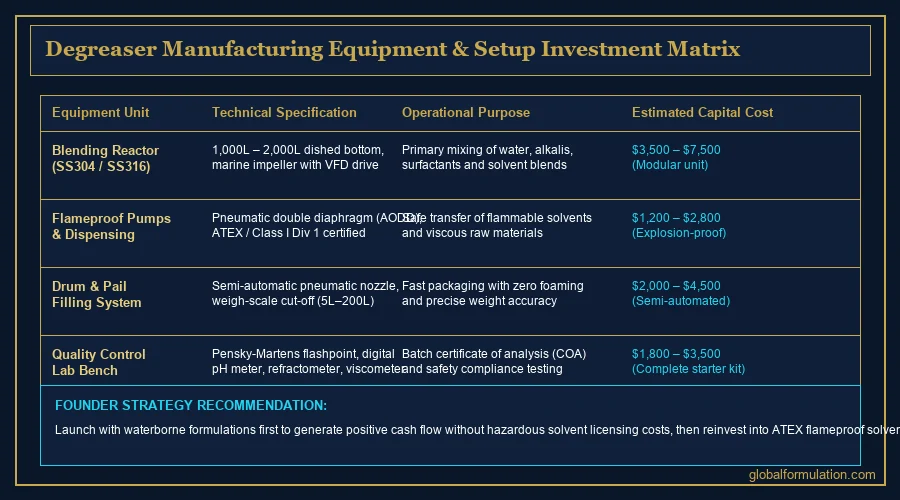
The flashpoint tester and explosion-proof fittings deserve real budget priority the moment a solvent line enters your plan, since skipping either is both a regulatory violation and a genuine fire risk, not a cost you can defer. Filling hardware can often be sourced locally at lower cost, but pH and refractometer testing is not an area to economise on, since it is your fastest in-house check that a waterborne batch is actually within its declared active-content specification.
Space, Utilities & Infrastructure Requirements
A functional degreaser unit needs a minimum floor area of roughly 800 to 1,200 square feet, divided into a waterborne blending and filling zone, a separate fire-rated solvent storage and blending zone if that line is included, and a raw material receiving area with adequate drainage. Keeping solvent storage physically isolated from any ignition source — including standard electrical switches — is not a suggestion; it is the single infrastructure requirement regulators check first during inspection.
Power requirements are modest for waterborne blending, but a solvent line requires explosion-proof electrical fittings throughout the storage and blending zone specifically, which is a distinct wiring specification from standard industrial power and typically needs a qualified electrical contractor familiar with hazardous-location wiring. Ventilation matters for both lines but is non-negotiable for solvent handling, where continuous mechanical extraction keeps vapour concentration below its lower explosive limit. Effluent handling from equipment cleaning is a documented regulatory requirement in most jurisdictions, since surfactant- and solvent-laden rinse water is not suitable for uncontrolled discharge.
Best Products to Start With: Low Capital, High Demand
Not every degreaser format is equally accessible to a new manufacturer, and the right entry point determines how quickly you reach positive cash flow while you are still building formulation consistency and industrial buyer relationships. The three starter categories below are ranked by capital requirement, regulatory complexity, and how quickly a founder can build a defensible customer base.
- Waterborne alkaline degreaser — the lowest-capital, lowest-regulatory-complexity entry point in this entire category, since it needs no explosion-proof fittings or fire-safety infrastructure at all. It suits general workshop and machine-shop cleaning and is the fastest format to reformulate once you start collecting buyer feedback.
- Citrus or terpene-based low-VOC degreaser — a waterborne-adjacent format using d-limonene or similar bio-based solvents that cuts grease more aggressively than a pure surfactant system while avoiding the flammability and permitting burden of a traditional hydrocarbon solvent product. This format commands a price premium with buyers under tightening VOC restrictions.
- Solvent-based heavy-duty degreaser — the traditional hydrocarbon or oxygenated-solvent format for the toughest cutting-fluid and undercarriage grease loads. This format is best sequenced once your waterborne sales have validated demand and funded the fire-safety infrastructure it requires.
As detailed on our household and industrial cleaners formulation resources, sequencing your launch — starting waterborne, adding a low-VOC citrus formulation for buyers seeking a compliance edge, then introducing a solvent-based line once volume justifies the infrastructure investment — is the standard path successful founders in this category follow.
Raw Material Sourcing Strategy
Raw material sourcing for degreasers spans three core categories — surfactants and builders for waterborne formats, solvents for solvent-based formats, and packaging — each with distinct supplier types and evaluation criteria. Getting your surfactant-builder ratio or solvent blend right matters most, since it directly determines grease-cutting performance and substrate compatibility.
Surfactants — typically non-ionic ethoxylates blended with an anionic co-surfactant for waterborne systems — are sourced from surfactant manufacturers or specialty chemical distributors, alongside alkaline builders such as sodium metasilicate or potassium hydroxide for heavier soil loads. Solvents for solvent-based lines range from aliphatic hydrocarbons to oxygenated solvents like glycol ethers, sourced from petrochemical distributors who can also supply the flashpoint and vapour pressure data your SDS requires. Bio-based alternatives like d-limonene are sourced from citrus-processing byproduct suppliers.
Evaluating a solvent supplier means requesting their flashpoint, vapour pressure, and material safety data on every batch, not just a price quote, since solvent variability directly affects your finished product's flashpoint classification and regulatory labelling. Cost-saving strategies include buying surfactants and solvents in shared bulk with other small industrial-chemical manufacturers to reach better distributor pricing tiers, and confirming which solvents can be sourced locally versus which specialty oxygenated solvents require import.
- Surfactants & builders — non-ionic ethoxylates plus an alkaline builder form the core waterborne system; confirm active content on every delivery
- Hydrocarbon & oxygenated solvents — request flashpoint and vapour pressure data on every batch, not just the first shipment
- Bio-based solvents — d-limonene and similar terpenes support a low-VOC product line and typically carry a supply premium worth passing through in pricing
- Packaging — confirm drum and jerrycan materials are chemically compatible with your solvent system over the product's declared shelf life
Blending Process Overview
The manufacturing process for both formats is a controlled blending operation rather than a complex chemical synthesis, but the sequencing and safety protocol differ meaningfully between waterborne and solvent-based lines. Waterborne batches are considerably more forgiving of addition order, while solvent batches demand a documented safety protocol at every stage.
Waterborne Alkaline Degreaser Blending
Production begins with water and the alkaline builder blended under moderate agitation until fully dissolved, followed by the surfactant package added slowly to avoid excessive foam generation. pH is adjusted to the target range, and fragrance or corrosion inhibitor — where the formulation calls for one — is added last under gentle mixing once the base is confirmed stable.
Solvent-Based Degreaser Blending
Solvent blending happens in a closed or vapour-controlled vessel with continuous mechanical extraction running throughout, since even brief vapour accumulation near an ignition source is a genuine hazard. Solvents are pre-blended to their target ratio first, and any surfactant or corrosion-inhibitor package is introduced only after solvent blending is complete and homogeneity is confirmed by sampling from multiple points in the vessel.
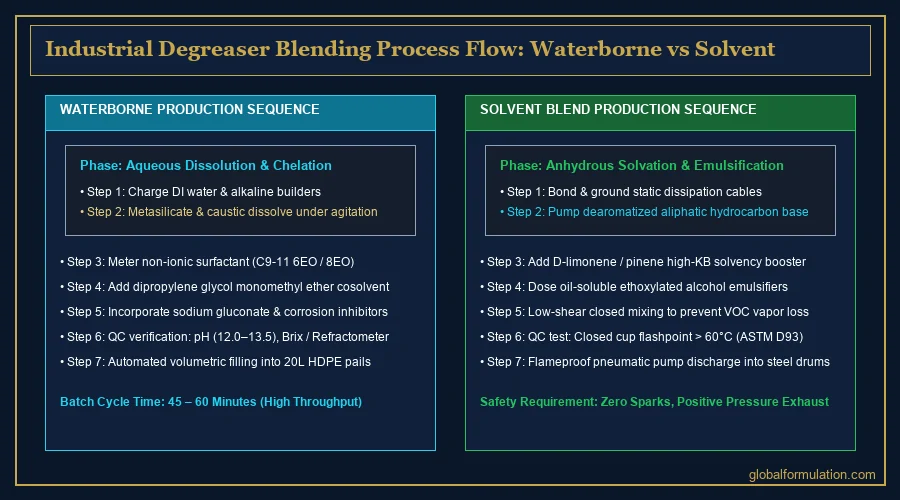
The most common mistake beginners make is underestimating foam generation when adding surfactant too quickly to a waterborne batch, which can overflow a tank sized without foam headspace in mind — and on the solvent side, the most common and far more serious mistake is running any blending step without active ventilation confirmed operational first. Recording the exact addition sequence, batch temperature, and ventilation status for every production run in a permanent batch log is what lets you both reproduce performance and demonstrate safety compliance if ever audited.
Quality Control & Testing for Small Manufacturers
Quality control in degreaser manufacturing is almost entirely about proving that every batch delivers its declared cleaning performance and safety specification, since an industrial buyer's willingness to reorder depends on consistent grease-cutting performance and, for solvent products, an accurate flashpoint declaration that protects both the buyer and your own liability exposure. Skipping flashpoint verification on a solvent batch is not just a quality shortcut — it is a regulatory and safety failure.
| Test | What It Measures | Equipment Needed | Pass/Fail Criterion |
|---|---|---|---|
| pH (waterborne) | Alkalinity driving grease emulsification | Digital pH meter | Within formulation-specified range, typically pH 9–13 |
| Flashpoint (solvent) | Fire hazard classification for SDS and transport | Closed-cup flashpoint tester | Matches declared SDS flashpoint classification |
| Active content / refractive index | Surfactant or solvent concentration | Refractometer or titration kit | Within formulation-specified target |
| Grease-cutting performance | Real-world cleaning efficacy on a soiled panel | Standard oiled steel test panel | Removes reference grease load within specified time |
Flashpoint testing is your most important checkpoint on the solvent line, since it directly confirms your SDS declaration and transport classification are accurate — an error here is both a safety and a legal liability issue. Retaining a dated batch record for every approved formulation gives you the documentation industrial accounts will eventually ask for during vendor onboarding, and it is also the fastest way to trace a customer complaint back to a specific production run.
Setting up a manufacturing unit involves more than equipment and raw materials — getting the formulation right, scaling production safely, and meeting regulatory requirements are where most startups lose time and money. If you need hands-on guidance at any stage, the Global Formulation team works directly with chemical startups on formulation development, process setup, and compliance — from first batch to commercial scale.
Packaging & Branding on a Budget
Industrial degreasers are sold predominantly in 5 L to 25 L jerrycans and 200 L steel drums depending on customer volume, with waterborne products also suited to trigger-spray bottles for smaller maintenance accounts. Drum and jerrycan choice should prioritise chemical compatibility over cost, since a solvent that degrades a low-grade plastic container is both a leak hazard and an immediate credibility failure with an industrial buyer.
Label markings are strict because degreasers are hazardous or potentially hazardous chemical products subject to workplace safety regulation. Every container must show: the product name and net contents, hazard pictograms and warning statements consistent with GHS classification, dilution and usage instructions, batch number and manufacturing date, and manufacturer contact and registration details — alongside a Safety Data Sheet made available to every industrial buyer, not just on request. Contract manufacturing opportunities are meaningful in this category, since larger distributors and OEMs frequently look for a reliable regional producer rather than importing.
Branding in this sector benefits from a clear, consistent visual identity across your product range, since maintenance staff reorder by recognising the drum label at a glance far more often than by reading fine print. A simple, legible label format that stays identical across your waterborne and solvent formats, varying only the hazard pictograms and format callout, helps repeat buyers find the right product quickly.
Licensing, Registration & Regulatory Compliance
Regulatory compliance for degreaser manufacturing touches standard business and product registration, mandatory GHS hazard labelling backed by a compliant Safety Data Sheet, and, for solvent-based lines specifically, hazardous-material storage and handling permits. Industrial cleaning chemicals are frequently subject to environmental clearance requirements before legal production, which makes checking your target market's specific requirement an early, non-negotiable step rather than an afterthought.
In Pakistan, degreaser manufacturing falls under EPA environmental clearance alongside PSQCA product conformity; in India, State Pollution Control Board consent to operate is required alongside relevant BIS conformity where applicable; in the GCC, GSO conformity marking applies to industrial cleaning formulations. Solvent-based products intended for export into markets under REACH also face specific VOC content and classification requirements worth confirming before finalising your solvent system.
Beyond registration, formal Good Manufacturing Practice certification is not universally mandatory for this category at small scale, but maintaining GMP-aligned batch and flashpoint test documentation from day one significantly strengthens your position with industrial distributors, OEM maintenance contracts, and any future export opportunity that will expect to see this documentation during vendor evaluation.
Pricing Strategy & Margin Expectations
Raw material cost — surfactant or solvent, builder, and packaging combined — typically represents 45–60% of the finished price for industrial degreasers, a somewhat lower share than in commodity detergent categories, because buyers pay a meaningful premium for documented performance and safety compliance rather than treating the product as a pure commodity. Gross margins for small-scale manufacturers selling through direct industrial accounts typically range from 30–45% on waterborne formats, with solvent-based and low-VOC specialty formulations commanding the higher end of that range.
Cost-plus pricing anchored to cost-per-litre-of-active-cleaning-capacity rather than cost-per-container is the mental model sophisticated industrial buyers use, so building your pricing around demonstrated grease-cutting performance from day one supports a stronger price position than competing purely on container price. Direct industrial accounts respond well to volume-based contract pricing once a formulation is validated on their specific equipment, since a maintenance manager values a supplier who documents consistent performance batch after batch over one offering a marginally lower price with unproven consistency.
Resist underpricing a solvent-based product relative to its actual compliance and safety-documentation burden, since a buyer who sees a suspiciously cheap solvent degreaser may reasonably question whether your SDS and flashpoint data are genuinely accurate. Price to reflect the real compliance cost you carry, differentiate on formulation fit and documented performance, and let repeat reorder behaviour build your industrial account base over time.
Finding Your First 20 Customers
Industrial degreasers move primarily through direct sales to machine shops, automotive and fleet maintenance workshops, and manufacturing facilities with recurring equipment-cleaning needs, alongside distribution through industrial chemical wholesalers. Local machine shops and fleet maintenance workshops are typically the fastest channel to a first paying account, since a maintenance technician can evaluate grease-cutting performance on a real dirty part within a single trial application.
The fastest path to your first paying accounts is approaching two or three local machine shops or fleet maintenance workshops directly with free trial jerrycans of your primary formulation, since a buyer decides quickly once cutting performance and substrate safety are demonstrated on their own parts. Offering to tune a formulation slightly for a demanding account's specific grease load is a differentiator a national distributor structurally cannot match at the local level. For guidance on structuring these early technical and supply relationships, our resource on choosing the right product consultant is a useful companion reference as you build out your production credibility.
- Approach local machine shops and fleet maintenance workshops directly with trial jerrycans of your primary formulation
- Contact manufacturing facilities and food-processing plants about standing-order equipment-cleaning contracts
- Pitch contract manufacturing agreements to industrial chemical distributors seeking a regional supply partner
- Offer volume-based rebates to accounts that commit to your formulation for a defined maintenance schedule
- Document reorder rates and grease-cutting feedback by account and use this reliability record in every subsequent conversation
Your first machine shop that reorders consistently because your degreaser cuts their specific grease load reliably becomes your most valuable reference for every subsequent conversation — proof that your formulation holds up under real industrial use, not just in a single trial batch.
When and How to Scale Up Your Production
Scaling in this category is primarily a question of adding the solvent-based line if you launched waterborne-only, and expanding batch capacity, rather than fundamentally redesigning your blending process. The right signal to scale is when reorder frequency across your existing accounts consistently outpaces your batch throughput, or when a prospective account specifically requests a solvent-based formulation you don't yet offer.
The first scale-up step is typically investing in explosion-proof fittings and fire-rated storage to add the solvent line, which opens access to the heavy-duty cutting-fluid and undercarriage-cleaning segment your waterborne line cannot serve. The second step is pursuing formal contract manufacturing agreements with industrial distributors, since a broader format range and distributor relationships increase order volume from existing and adjacent markets without requiring entirely new customer acquisition. Our broader guide on manufacturing without a factory explores capacity models worth considering as you plan this growth phase.
Frequently Asked Questions
How much capital is really needed to start an industrial degreaser manufacturing business?
Do I need a chemistry degree to start this business?
Can I start from home or do I need a factory?
What is the biggest mistake to avoid when starting this business?
How long before I make my first sale?
Do I need ISO or GMP certification from day one?
How do I get a formulation for the product?
What is the first licence I need to get?
Ready to Take the Next Step?
Starting a chemical manufacturing business is one of the most rewarding paths an entrepreneur can take — but it demands the right technical foundation from day one. Whether you need a validated formulation, help setting up your first production unit, guidance on regulatory compliance, or a structured scale-up plan, the Global Formulation team is here to support you.
Reach out to us at globalformulation.com/contact — we work with founders at every stage, from concept to commercial production.