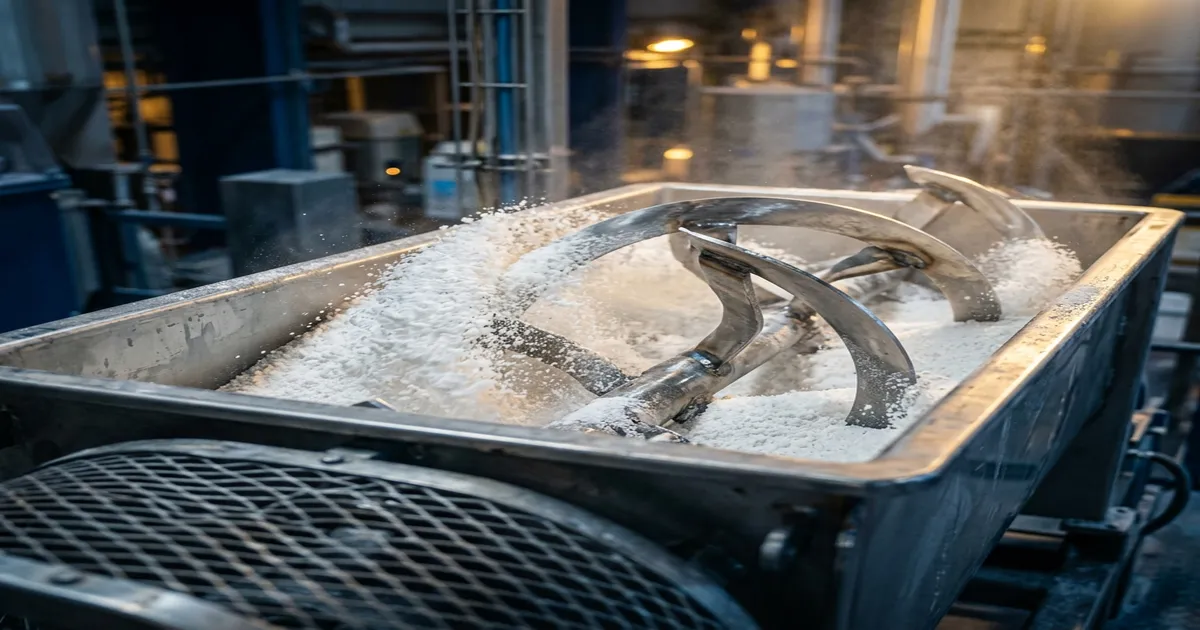
Every household on earth washes clothes, and that universal, non-discretionary chore makes laundry detergent one of the largest and most durable product categories any chemical entrepreneur can enter. Multinational giants dominate branded shelf space, but a laundry detergent manufacturing business built on private-label and wholesale supply remains genuinely accessible, because the core formulation chemistry is well understood and small-batch blending equipment costs a fraction of what a full spray-drying tower demands. The real skill in this category is disciplined cost-plus pricing and consistent batch quality, not exotic formulation — retailers and institutional buyers reorder on reliability, not novelty. This guide walks through the complete startup roadmap — blending equipment for both liquid and dry-mixed powder formats, raw material sourcing, the production and quality-control process, licensing, pricing, and how to land your first wholesale and institutional accounts. Everything here reflects real detergent-industry practice, the operational detail a founder needs before committing capital, not textbook theory.
Market Overview & Opportunity
The global laundry detergent market is a multi-billion dollar segment of the broader household and industrial cleaners industry, and it is one of the most recession-resistant categories in all of FMCG because laundry is a non-negotiable household task regardless of economic conditions. Unlike discretionary personal care purchases, detergent demand tracks population and household formation almost directly, which gives a new manufacturer a remarkably stable demand floor to build against.
Primary customer segments split three ways: wholesale and retail distribution through general trade shops and supermarkets, institutional buyers such as hotels, hospitals, and commercial laundries that need bulk supply on standing contracts, and private-label buyers — retail chains and smaller FMCG brands that want a manufacturer to produce under their own brand name. Demand drivers include population growth, urbanisation that shifts households from hand-washing to detergent-and-machine washing, and steady institutional demand from a growing hospitality and healthcare sector. The underlying chemistry of detergent formulation — surfactants, builders, and functional additives working together — is well documented and worth understanding thoroughly before you blend your first batch.
Competition comes primarily from a small number of multinational brands with enormous marketing budgets and full spray-drying infrastructure, but the private-label and regional wholesale segment — supplying supermarkets' own-brand detergent, hotel laundry contracts, and general trade shops — is large, fragmented, and structurally difficult for a multinational to serve at thin regional margins. As detailed on our household and industrial cleaners resource page, a new entrant differentiates most effectively by winning private-label and institutional contracts on consistent quality and reliable supply rather than competing head-on for brand shelf space.
Investment Breakdown: Starting on Minimum Capital
Capital requirements in this category hinge on one decision more than any other: whether you produce powder detergent through a full spray-drying tower or through dry-mixing pre-formed ingredient granules. Spray drying can cost hundreds of thousands of dollars and is entirely out of reach for a first-time founder, while dry-mix and agglomeration blending — combined with a liquid detergent line — brings the entry point down to a genuinely achievable range.
| Cost Category | Estimated Range (USD) | Notes |
|---|---|---|
| Liquid blending tank & agitator | $1,500 – $4,000 | Larger tank needed if launching multiple liquid grades |
| Ribbon or paddle powder blender | $2,000 – $5,000 | Dry-mix/agglomeration route; no spray tower required |
| Bottle filling & capping line (liquid) | $1,200 – $3,000 | Manual filling lowers this substantially at very small scale |
| Pouch/sachet filling & sealing machine (powder) | $1,500 – $4,000 | Sachet format suits low-income retail markets |
| Initial raw material inventory | $2,500 – $6,000 | Surfactants, builders and fillers for first production run |
| Packaging, labels and cartons | $1,000 – $2,500 | MOQ-driven; local suppliers reduce minimums |
| Licensing, environmental clearance & lab testing | $600 – $1,800 | Varies significantly by country |
| Working capital (3 months operating expenses) | $1,200 – $2,500 | Utilities, labour, overhead while building first accounts |
| Total Minimum | $11,500 – $28,800 | Before first sale; dry-mix powder route, no spray tower |
The lower end of this range reflects a founder launching with a single liquid detergent grade and manual pouch filling for powder, while the upper end reflects a founder investing in a proper ribbon blender and semi-automatic filling across both formats from launch. Blending tanks and filling equipment are frequently available second-hand from FMCG manufacturers upgrading capacity, which can meaningfully lower the equipment threshold. Deferring a spray-drying investment until your dry-mix powder and liquid sales volume genuinely justifies it is the path virtually every successful founder in this category follows.
Want the full financial workup? The Detergent Powder Standard Project Report is a complete India-basis feasibility and financial study — three independently costed investment configurations, a five-year projected P&L with IRR, payback and break-even, an itemised plant & machinery schedule, raw materials by functional class, and the full statutory and environmental roadmap. It is a costing and feasibility document; it does not include a formulation.
Minimum Equipment List for a Small-Scale Unit
Detergent manufacturing equipment splits cleanly into a liquid blending line and a dry-powder blending line, and a small startup can run both from the same facility without the capital-intensive spray-drying infrastructure that defines large-scale powder plants. Every piece below exists to answer one question reliably — does this batch meet its declared active matter content and physical specification — before it reaches a wholesaler's shelf.
| Equipment | Minimum Spec | Approx. Cost |
|---|---|---|
| Liquid blending tank with variable-speed agitator | Stainless steel, 500–1,000 L | $1,500 – $4,000 |
| Ribbon or paddle powder blender | 100–300 kg batch capacity, dry-mix/agglomeration | $2,000 – $5,000 |
| Bottle filling & capping machine | Semi-automatic volumetric filler | $1,200 – $3,000 |
| Pouch/sachet filling & sealing machine | Vertical form-fill-seal for single-dose sachets | $1,500 – $4,000 |
| Raw material weighing & dosing scales | Platform scale plus precision bench scale | $300 – $800 |
| Brookfield viscometer | Spindle-type, for liquid detergent viscosity | $600 – $1,500 |
| Digital pH meter & active matter titration kit | Bench-top pH meter, two-phase titration kit | $300 – $800 |
| Dust extraction / local exhaust ventilation | Filtered extraction unit for the powder blending line | $800 – $2,000 |
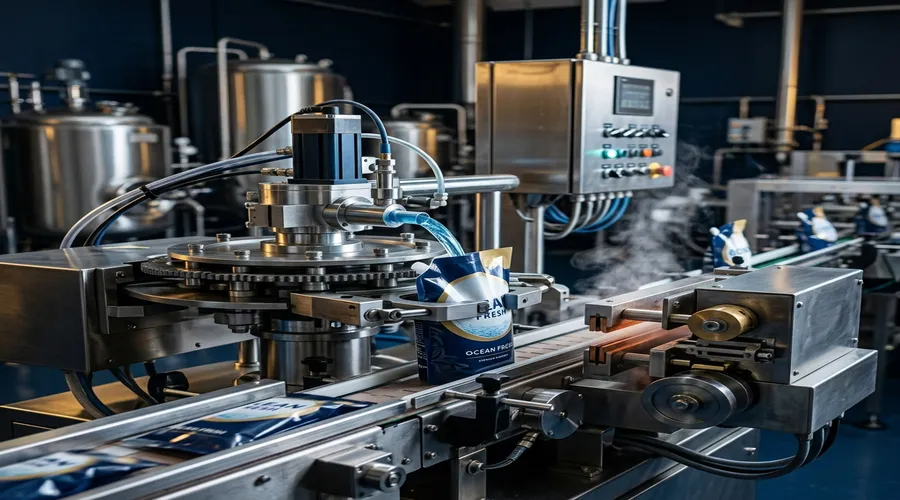
The ribbon blender and dust extraction system deserve real budget priority on the powder line, since fine surfactant and builder dust is both a housekeeping problem and a genuine respiratory hazard if left uncontrolled. Filling hardware can often be sourced locally at lower cost, but active matter titration is not an area to economise on, since it is your only reliable check that a batch actually delivers the cleaning performance printed on the label.
Space, Utilities & Infrastructure Requirements
A functional dual-format detergent unit needs a minimum floor area of roughly 1,000 to 1,500 square feet, divided into a dry-powder blending and packing zone with dust control, a separate liquid blending and filling zone, and a raw material storage area. Keeping the powder and liquid lines physically separated matters because airborne detergent dust can contaminate liquid batches and interfere with foam and clarity specifications.
Power requirements are modest for both blending lines, though the powder blender's motor and dust extraction fan are the largest loads and may require light three-phase power depending on batch size. Water supply is a genuine consideration for the liquid line specifically, since large-volume liquid detergent needs consistent water quality — hard water containing calcium and magnesium ions can react with anionic surfactants and cause cloudiness or reduced performance, making a basic water softening step worth budgeting for. Effluent handling from equipment cleaning is a documented regulatory requirement in most jurisdictions, since detergent-laden rinse water is not suitable for uncontrolled discharge.
Best Products to Start With: Low Capital, High Demand
Not every detergent format is equally accessible to a new manufacturer, and the right entry point determines how quickly you reach positive cash flow while you are still building blending consistency and buyer relationships. The three starter categories below are ranked by capital requirement, equipment complexity, and how quickly a founder can build a defensible customer base.
- Liquid laundry detergent — the lowest-capital entry point in this entire category, since it needs only a blending tank and a bottle filler with no dry-powder handling or dust control at all. It is also the fastest format to reformulate and adjust once you start collecting buyer feedback.
- Single-dose powder sachets — small, low-cost pouches that suit price-sensitive retail markets where consumers buy detergent for a single wash rather than a full box. This format uses the dry-mix/agglomeration route and commands strong volume in general trade shops because the low unit price removes a purchase barrier for budget-conscious households.
- Budget dry-mixed powder in bags or boxes — the traditional multi-wash powder format, blended from pre-formed surfactant and builder granules rather than spray-dried from a slurry. This format is best sequenced once your sachet and liquid sales have validated demand, since it requires the largest raw material inventory commitment of the three.
As detailed on our household and industrial cleaners formulation resources, sequencing your launch — starting with liquid detergent, adding single-dose powder sachets for retail reach, then introducing full-size powder packs once volume justifies the inventory commitment — is the standard path successful founders in this category follow rather than launching a full multi-format catalogue simultaneously.
Raw Material Sourcing Strategy
Raw material sourcing for laundry detergent spans four core categories — surfactants, builders and fillers, functional additives, and packaging — each with distinct supplier types and evaluation criteria. Getting your surfactant and builder ratio right matters most, since together they determine cleaning performance and active matter content, while functional additives shape secondary performance like whitening, foam, and fragrance.
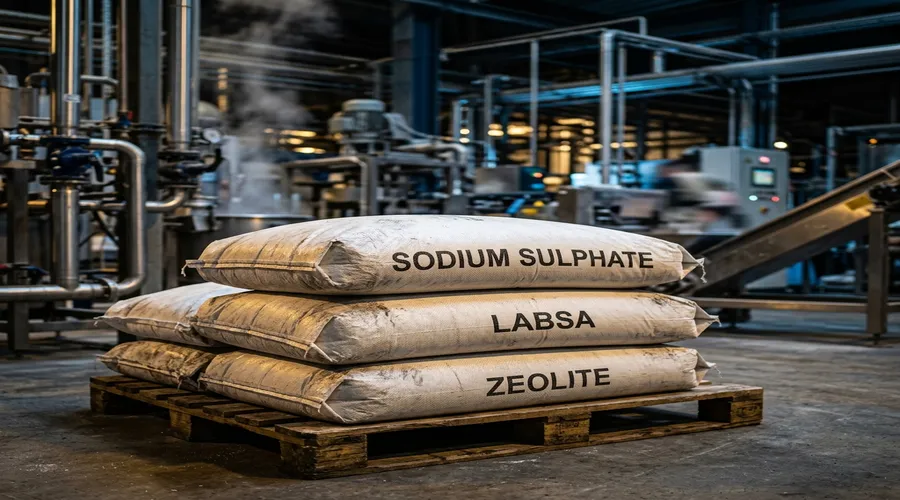
Surfactants — typically linear alkylbenzene sulphonic acid (LABSA) neutralised to sodium LAS for powder, or a blend of LABSA and ethoxylated alcohols for liquid — are sourced from surfactant manufacturers or specialty chemical distributors. Builders such as zeolite and sodium carbonate (the standard phosphate-free system in most markets today) and fillers like sodium sulphate are available from industrial mineral distributors, while functional additives — enzymes, optical brighteners, carboxymethyl cellulose for anti-redeposition, and fragrance — are sourced from specialty FMCG ingredient suppliers who can provide compatibility and dosing guidance.
Evaluating a surfactant supplier means requesting their active matter concentration and consistency data, not just a price quote, since active matter variability between drums directly throws off your finished product's cleaning performance and cost calculations. Cost-saving strategies include buying surfactants and builders in shared bulk with other small FMCG manufacturers to reach better distributor pricing tiers, and negotiating smaller minimum order quantities on enzymes and fragrance until your format mix stabilises.
- Surfactants — LABSA is the workhorse anionic surfactant for both formats; confirm active matter concentration on every delivery, not just the first
- Builders & fillers — zeolite and sodium carbonate are the standard phosphate-free builder system; sodium sulphate is the primary powder filler and flow aid
- Functional additives — enzymes and optical brighteners are heat- and pH-sensitive; always confirm supplier-recommended addition stage and temperature
- Packaging — confirm bottle and pouch materials are chemically compatible with your surfactant system over the product's declared shelf life
Blending Process Overview
The manufacturing process for both formats is a controlled blending and additive-sequencing operation rather than a complex chemical synthesis, and the order in which ingredients are added matters as much as the ratios themselves. Heat- and pH-sensitive functional additives — enzymes, optical brighteners, fragrance — always go in last, after the base surfactant and builder blend has stabilised.
Liquid Detergent Blending
Production begins with water and surfactant blended under moderate agitation, followed by builders and any thickening agent, with viscosity typically fine-tuned using a small, carefully dosed amount of salt — a standard technique in surfactant systems where salt concentration directly affects thickness. pH is adjusted to the target range, and only once the base is stable are enzymes, optical brighteners, fragrance, and dye added under gentle mixing to avoid shear damage to enzyme structures.
Powder Dry-Mixing & Agglomeration
For the powder line, pre-formed surfactant granules, builder powder, and filler are dry-blended in the ribbon or paddle mixer until visually homogeneous, with batch uniformity confirmed by sampling from multiple points in the mixer. Enzymes, optical brighteners, and fragrance are dusted in during a final short mixing stage at ambient temperature to avoid the heat generated by extended high-speed blending, then the batch moves to sachet or bag filling.
The most common mistake beginners make is adding enzymes or fragrance too early in a still-hot or still-alkaline batch, which degrades enzyme activity and can even volatilise part of the fragrance before the product ever reaches the customer. Recording the exact addition sequence, mixing time, and temperature for every approved formulation in a permanent batch log is equally important, since it is what lets you reproduce identical cleaning performance on every future production run.
Quality Control & Testing for Small Manufacturers
Quality control in detergent manufacturing is almost entirely about proving that every batch delivers its declared active matter content and physical specification, since a wholesaler or institutional buyer's willingness to reorder depends on consistent cleaning performance and foam behaviour across every batch, not any single good sample. Skipping active matter verification in favour of a quick visual check is the fastest way to erode a buyer's trust.
| Test | What It Measures | Equipment Needed | Pass/Fail Criterion |
|---|---|---|---|
| pH | Alkalinity or acidity of the finished product | Digital pH meter | Within formulation-specified range, typically pH 7–10 |
| Viscosity (liquid) | Flow consistency and pourability | Brookfield viscometer | Within declared range for the product format |
| Bulk density (powder) | Fill consistency and packaging accuracy | Graduated cylinder tap-density test | Within declared range, typically 0.3–0.6 g/mL |
| Active matter content | Surfactant concentration driving cleaning performance | Two-phase titration | Meets formulation-specified target |
Active matter titration is your most important checkpoint, since it directly confirms the batch will actually clean as intended rather than just look and smell correct. Retaining a dated batch record for every approved formulation gives you the documentation retailers and institutional accounts will eventually ask for during vendor onboarding, and it is also the fastest way to trace a customer complaint back to a specific production run.
Setting up a manufacturing unit involves more than equipment and raw materials — getting the formulation right, scaling production safely, and meeting regulatory requirements are where most startups lose time and money. If you need hands-on guidance at any stage, the Global Formulation team works directly with chemical startups on formulation development, process setup, and compliance — from first batch to commercial scale.
Packaging & Branding on a Budget
Liquid detergent is sold predominantly in 500 mL to 5 L bottles depending on household versus institutional use, while powder moves through single-dose sachets of roughly 20–50 g for price-sensitive retail and multi-wash bags or boxes of 500 g to 5 kg for regular households and institutional bulk buyers. Container and pouch choice should prioritise a secure seal and moisture barrier over decorative packaging, since powder that clumps from moisture ingress is an immediate quality failure a buyer will notice on the very first use.
Label markings are strict because detergents are household chemical products subject to consumer safety regulation. Every container must show: the product name and net contents, ingredient category disclosure, usage and dosage instructions, hazard and warning statements for skin and eye contact, batch number and manufacturing date, and manufacturer contact and registration details. Private-label opportunities are unusually strong in this category — many retail chains and smaller FMCG brands actively look for a reliable contract manufacturer rather than building their own production line, which is a meaningful revenue channel worth pursuing early.
Branding in this sector benefits from a clear, consistent visual identity across your format lineup, since wholesale buyers and retail shelf staff reorder by recognising the pack at a glance far more often than by reading ingredient fine print. A simple, legible label format that stays identical across your liquid and powder formats, varying only the format callout and size, helps repeat buyers find the right product quickly.
Licensing, Registration & Regulatory Compliance
Regulatory compliance for detergent manufacturing touches standard business and product registration, mandatory ingredient and hazard labelling, and, increasingly, effluent discharge requirements as your production volume grows. Household cleaning products are frequently subject to quality-mark certification requirements before legal sale, which makes checking your target market's specific requirement an early, non-negotiable step rather than an afterthought.
In Pakistan, detergent products fall under PSQCA product registration requirements; in India, products must meet the relevant IS detergent specification under BIS certification; in the GCC, GSO conformity marking applies to cleaning product formulations. Many markets, including the EU under REACH, also regulate phosphate content and biodegradability of surfactants specifically, which is worth confirming before finalising your builder system if export is part of your plan.
Beyond registration, formal Good Manufacturing Practice certification is not universally mandatory for this category at small scale, but maintaining GMP-aligned batch and active-matter test documentation from day one significantly strengthens your position with retail chains, institutional buyers, and any future private-label contract that will expect to see this documentation during vendor evaluation.
Pricing Strategy & Margin Expectations
Raw material cost — surfactant, builder, filler, and packaging combined — typically represents 55–70% of the finished price for commodity powder and liquid detergent, a notably higher share than in specialty adhesive or coatings categories, because detergent is a high-volume, price-transparent commodity where buyers compare cost-per-wash closely. Gross margins for small-scale manufacturers selling through wholesale and general trade channels typically range from 15–25% on commodity powder, rising to 25–35% on liquid and private-label formats where quality perception and contract relationships carry more pricing power.
Cost-plus pricing anchored to cost-per-wash rather than cost-per-unit is the standard mental model buyers use in this category, so building your pricing around that comparison from day one avoids an awkward repricing conversation later. Institutional and private-label relationships respond better to consistent supply reliability and contract-based pricing than to aggressive one-time discounting, since a hotel laundry department or retail chain values a manufacturer who never misses a delivery date over one offering a marginally lower price with inconsistent supply.
Resist competing purely on price against established multinational brands when approaching your first wholesale accounts, since detergent buyers are highly price-literate and unusually cheap product can raise doubts about active matter content in a category where cleaning performance is easy to compare directly. Price competitively but credibly, differentiate on consistent quality and reliable delivery, and let repeat reorder behaviour build your wholesale and institutional relationships over time.
Finding Your First 20 Customers
Laundry detergent moves primarily through wholesale distribution to general trade shops, direct institutional contracts with hotels and commercial laundries, and increasingly through private-label supply agreements with retail chains. Local wholesalers and institutional laundry departments are typically the fastest channel to a first paying account, since they can evaluate cleaning performance and cost-per-wash on a real batch of laundry within days.
The fastest path to your first paying accounts is approaching two or three local wholesalers or hotel laundry departments directly with free trial units of your primary format, since a buyer decides quickly once cleaning performance and consistent supply are demonstrated over a few weeks. Offering flexible minimum order quantities and reliable delivery scheduling for your first few wholesale relationships removes the biggest objection a cautious buyer has about an unproven new brand. For guidance on structuring these early technical and supply relationships, our resource on choosing the right product consultant is a useful companion reference as you build out your production credibility.
- Approach local wholesalers and general trade distributors directly with trial units of your primary format
- Contact hotel and commercial laundry departments about standing-order contracts for bulk liquid or powder supply
- Pitch private-label supply agreements to smaller retail chains and FMCG brands without their own production line
- Offer volume-based rebates to wholesalers who commit to your brand for a given format
- Document reorder rates by account and use this reliability record in every subsequent distributor or retail conversation
Your first wholesaler that reorders consistently because your detergent performs reliably batch after batch becomes your most valuable reference for every subsequent conversation — proof that your quality holds up at scale, not just in a single trial batch.
When and How to Scale Up Your Production
Scaling in this category is primarily a question of expanding your format range and, eventually, evaluating whether spray-drying investment makes sense, rather than fundamentally redesigning your dry-mix or liquid blending process. The right signal to scale is when reorder frequency across your existing formats consistently outpaces your batch throughput, or when a retail chain proposes a private-label contract that requires higher volume than your current line can support.
The first scale-up step is typically investing in a larger ribbon blender and semi-automatic filling across both formats, which lowers per-batch labour cost as your production volume grows. The second step is pursuing formal private-label contracts and, only once volume genuinely justifies it, evaluating a spray-drying tower for full-scale powder production, since a broader format range and larger institutional contracts increase average order value from existing relationships without requiring entirely new customer acquisition. Our broader guide on manufacturing without a factory explores capacity models worth considering as you plan this growth phase.
Frequently Asked Questions
How much capital is really needed to start a laundry detergent manufacturing business?
Do I need a chemistry degree to start this business?
Can I start from home or do I need a factory?
What is the biggest mistake to avoid when starting this business?
How long before I make my first sale?
Do I need ISO or GMP certification from day one?
How do I get a formulation for the product?
What is the first licence I need to get?
Ready to Take the Next Step?
Starting a chemical manufacturing business is one of the most rewarding paths an entrepreneur can take — but it demands the right technical foundation from day one. Whether you need a validated formulation, help setting up your first production unit, guidance on regulatory compliance, or a structured scale-up plan, the Global Formulation team is here to support you.
Reach out to us at globalformulation.com/contact — we work with founders at every stage, from concept to commercial production.