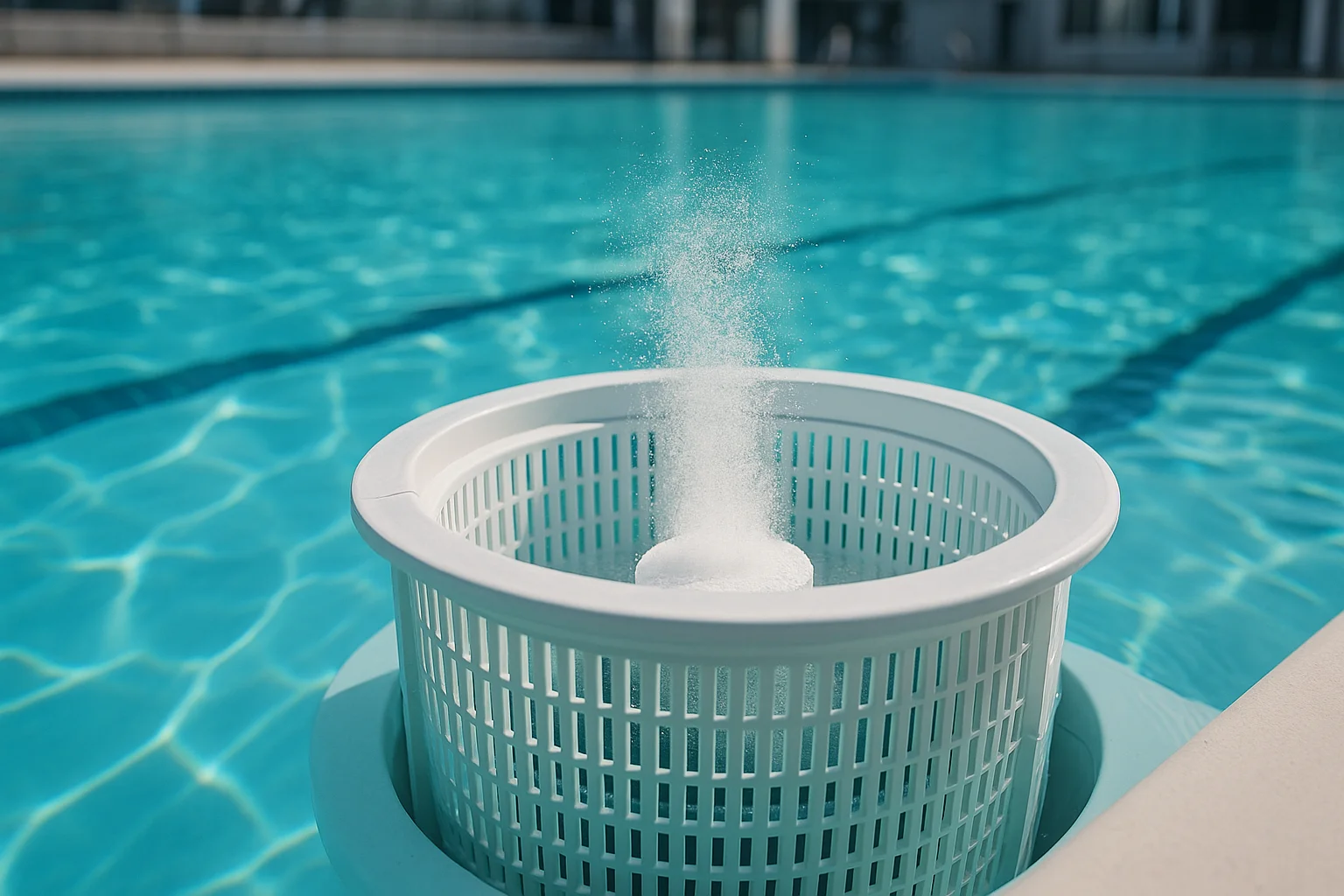
Every hotel, apartment complex, water park, and public pool in a hot climate runs through a steady, non-discretionary supply of chlorine tablets, algaecides, and pH balancers — and starting a swimming pool chemical manufacturing business means tapping into one of the more recession-resistant consumption categories in industrial chemistry, since a pool that isn't sanitized simply cannot stay open. This is a category where respect for the chemistry is not optional: chlorine-based oxidizers are hazardous materials, and the founders who succeed here are the ones who treat process safety and moisture control as core operating discipline from day one, not an afterthought. The barrier to entry is real but navigable, since core formulations for trichlor tablets, calcium hypochlorite granules, and pool algaecides are well-established industrial chemistry rather than proprietary secrets. This guide walks you through the complete roadmap: startup costs, equipment, hazardous materials compliance, raw material sourcing, the manufacturing process, quality control, licensing, pricing, and how to land your first pool service company and distributor customers.
Market Overview & Opportunity
The global pool and spa water treatment chemical market is a multi-billion dollar category with remarkably stable, weather- and season-linked demand rather than cyclical economic exposure, since pool operators must maintain sanitation regardless of broader economic conditions to keep facilities legally open. A small number of large multinational chemical companies dominate branded retail packaging, but regional manufacturers supply the majority of institutional, commercial, and private-label volume in most markets.
Primary customer segments include commercial pool operators — hotels, resorts, water parks, and fitness clubs — who consume chemicals continuously and in bulk, residential pool service companies who purchase in mid-volume for their client routes, government and municipal aquatic facilities procuring through formal tenders, and pool equipment and supply retailers seeking private label or wholesale product. Distributor and wholesale channels matter significantly here, particularly for reaching the fragmented residential pool service market.
Demand drivers include growing residential and commercial pool construction in warm-climate and tourism-driven economies, expanding hospitality and hotel infrastructure, and consistent regulatory requirements for public pool water quality that make chemical treatment non-negotiable rather than discretionary. Regional opportunity is particularly strong across the Middle East, South Asia, and parts of Africa, where pool construction is expanding alongside tourism and hospitality investment, and where standards referenced by the World Health Organization's guidelines for safe recreational water environments inform national pool water quality requirements.
Competitive landscape at the small-manufacturer level includes established regional producers and a handful of multinational brands with strong retail presence, meaning your differentiation as a startup rests on reliable local supply, competitive institutional and distributor pricing, and the ability to serve mid-volume commercial and pool service customers that large brands often underserve at the wholesale level.
Investment Breakdown: Starting on Minimum Capital
Pool chemical manufacturing carries a moderate-to-high capital floor within this series, driven primarily by the specialized equipment needed for chlorine tablet compression and the hazardous materials storage infrastructure required for oxidizer handling. Your primary capital investment goes toward a tablet press or granulation line, hazardous-materials-compliant facility fit-out, and working capital to carry you through licensing.
| Cost Category | Estimated Range (USD) | Notes |
|---|---|---|
| Facility Fit-Out (hazmat storage compliant) | $4,000 – $10,000 | Segregated oxidizer storage, corrosion-resistant flooring for a 1,000–2,000 sq ft unit |
| Tablet Press / Granulation Equipment | $4,500 – $12,000 | Mechanical or hydraulic tablet press sized for trichlor compression |
| Liquid Blending & Filling Equipment | $2,000 – $5,500 | Corrosion-resistant mixing tanks and filling line for algaecides, pH products |
| Raw Materials (first batches) | $1,500 – $4,000 | Trichloroisocyanuric acid, stabilizers, algaecide actives for launch batches |
| Packaging (buckets, bottles, drums, labels) | $800 – $2,200 | HDPE containers, hazard-compliant labeling |
| Licensing, Hazmat Permits & Registration | $1,800 – $4,500 | Manufacturing licence, hazardous chemical storage permit, product registration |
| Working Capital Buffer | $1,200 – $2,800 | Covers licensing and permitting lead time before first sale |
| Total Minimum | $15,000 – $35,000 | Before first commercial sale; lean scenario leases facility and starts with fewer product lines |
The lean end of this range assumes a leased rather than purchased facility, a mechanical rather than fully automated hydraulic tablet press, and a focused launch of trichlor tablets plus one or two liquid products rather than a full multi-chemistry range. Tablet presses can often be sourced from regional pharmaceutical or agricultural equipment fabricators at lower cost than importing specialized pool chemical machinery, provided the equipment is corrosion-resistant and rated for oxidizer contact. Budget carefully for hazardous materials storage and permitting — this is consistently the most underbudgeted line item in this category, since founders often plan for production equipment cost without fully pricing the segregated storage infrastructure regulators require.
Minimum Equipment List for a Small-Scale Unit
Pool chemical manufacturing equipment needs split between solid-dose tablet production and liquid product blending, each with distinct requirements. What matters most across both lines is corrosion resistance, moisture control, and strict material compatibility given the oxidizing nature of the core active ingredients.
| Equipment | Minimum Spec | Approx. Cost (USD) |
|---|---|---|
| Tablet Compression Press | Mechanical or hydraulic, corrosion-resistant tooling for trichlor compression | $3,500–$9,000 |
| Dehumidified Production Room / Dry Room | Controlled humidity below 40% RH for hygroscopic powder handling | $1,500–$4,000 |
| Corrosion-Resistant Blending Tanks | HDPE or PVC-lined, 200–1,000 litre for liquid product lines | $1,200–$3,500 |
| Automated Filling & Capping Line | Chemical-resistant components for liquid product filling | $1,000–$3,000 |
| Available Chlorine Titration Kit | Iodometric titration setup for active chlorine verification | $150–$500 |
| Segregated Oxidizer Storage Racking | Non-combustible, isolated from organics and reducing agents | $800–$2,200 |
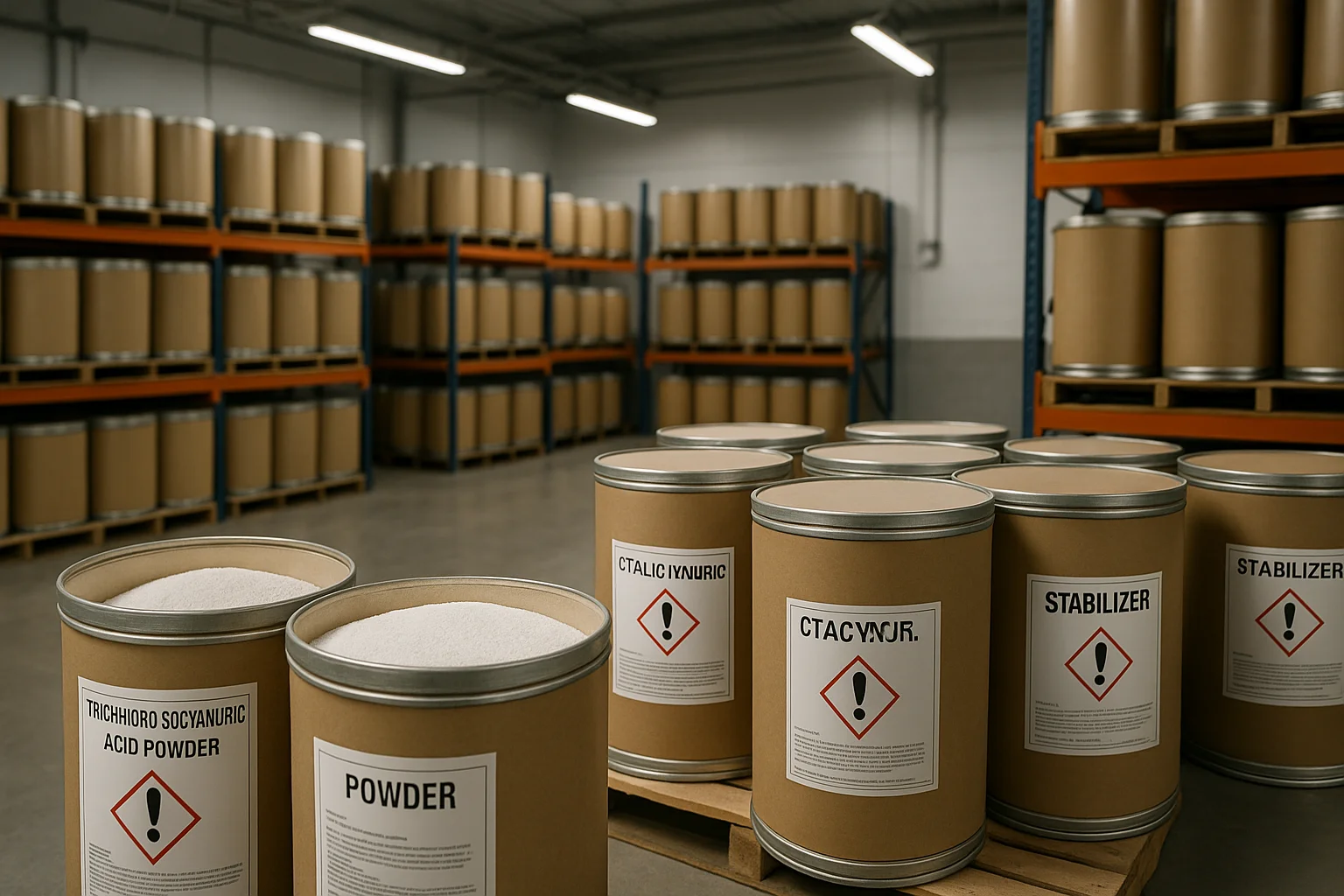
Tablet presses and blending tanks are widely available from regional industrial equipment fabricators across South Asia and the Middle East, but insist on corrosion-resistant materials rated for oxidizer contact, since standard carbon steel equipment degrades quickly and can contaminate product. The dehumidified production room is the equipment investment most beginners underestimate — trichlor and calcium hypochlorite powders are highly hygroscopic, and compressing tablets in an uncontrolled-humidity environment produces inconsistent hardness and shortened shelf life even when the formulation itself is correct.
Space, Utilities & Infrastructure Requirements
Facility infrastructure in this category is dominated by two factors: humidity control for hygroscopic powder handling and segregated storage for hazardous oxidizing chemicals. Both drive facility layout and cost more than any single piece of production equipment.
A minimum functional unit needs approximately 1,000 to 2,000 square feet, divided into a dehumidified tablet production room, a separate liquid blending area, physically segregated hazardous material storage isolated from combustible or organic materials, and a packaging and dispatch space. Power requirements are moderate, typically single-phase or light three-phase depending on your tablet press motor size, with reliable power important since the dehumidification system must run continuously to protect both raw material and in-process product. Water supply needs are modest for solid-dose production but more significant for liquid product blending, where consistent water quality affects product clarity and stability.
Ventilation requirements center on preventing chlorine gas or vapor accumulation, particularly in liquid chlorine or hypochlorite handling areas, with corrosion-resistant exhaust systems since standard ventilation equipment degrades rapidly in a chlorine-exposed environment. Temperature control matters for both product stability and worker safety, since oxidizer decomposition accelerates at elevated temperature. Proximity to reliable raw material distributors and to your commercial pool and distributor customer base reduces logistics friction, and zoning almost universally requires industrial classification given hazardous materials storage — this is not a business that can operate from a commercial or residential-zoned space.
Best Products to Start With: Low Capital, High Demand
Not every pool chemical product suits a first-time manufacturer equally, since equipment complexity, hazard classification, and market demand vary significantly across the category. A new entrant should start with the product offering the most direct path to consistent revenue while process discipline is still being established.
- Trichlor Tablets (3-inch and 1-inch) — the highest-volume, most consistently demanded product in the category, though it requires the most process control given tablet compression and humidity sensitivity; typically worth the investment given its central role in nearly every commercial pool's sanitation program.
- pH Increaser and Decreaser — a straightforward liquid or granular product with simple blending requirements and steady companion demand alongside chlorine products, making it an accessible complementary line with lower equipment complexity than tablet production.
- Algaecides and Pool Clarifiers — liquid products with moderate formulation complexity, valuable both as standalone sales and as a natural upsell alongside your core sanitizer line, particularly to commercial operators managing algae control proactively.
Sequencing your line this way — pH adjusters and clarifiers first while establishing basic liquid blending discipline, trichlor tablets as your core investment once dry-room humidity control is validated, and algaecides rounding out a complete product range — lets you generate revenue earlier while your highest-complexity product line comes online. As detailed on the Global Formulation Water Treatment page, a complete pool chemistry portfolio built around a validated core sanitizer product creates the strongest foundation for commercial and distributor relationships.
Raw Material Sourcing Strategy
The raw material supply chain for pool chemicals centers on three categories: chlorine-based oxidizers (trichloroisocyanuric acid, calcium hypochlorite, or sodium dichloroisocyanurate), functional additives (stabilizers, algaecide actives, pH adjusters), and packaging components rated for hazardous material transport and storage. Understanding how to source and qualify each category directly determines both product performance and your ability to pass regulatory review.
Chlorine-based oxidizers should be sourced only from established industrial chemical distributors or manufacturers who can provide a Certificate of Analysis confirming available chlorine content and impurity profile, since active chlorine content directly determines sanitization performance and is the primary specification regulators and customers will scrutinize. Regional chemical distributors across South Asia and the Middle East carry trichlor and calcium hypochlorite suited to pool chemical manufacturing; importing directly from a primary producer only becomes cost-effective once your monthly volume justifies the higher minimum order quantities typically required.
Stabilizers, algaecide actives, and packaging components are generally available locally or regionally at accessible minimum order quantities, though grade and purity matter significantly since impurities in oxidizer raw material can accelerate decomposition or create off-specification tablets. Evaluate any supplier on three criteria: willingness to provide full Certificates of Analysis and Safety Data Sheets, consistency of available chlorine content between lots, and dangerous goods shipping and handling competence, since a supplier who mishandles hazardous material transport creates liability exposure for your business as the receiving party.
Cost-saving strategies include qualifying two suppliers for your primary oxidizer to avoid single-source risk during peak season demand, and forming informal buying groups with other small pool chemical manufacturers to access better bulk pricing on shared raw material orders. Flag chlorine-based raw materials for dangerous goods import documentation and transport classification early, since these compounds carry specific hazard class shipping requirements that can add meaningful lead time if not planned for in advance.
Manufacturing Process Overview
The manufacturing process for pool chemicals splits into two distinct operations — solid-dose tablet compression and liquid product blending — each with its own critical process parameters, but both demanding strict material compatibility and moisture control given the oxidizing chemistry involved.
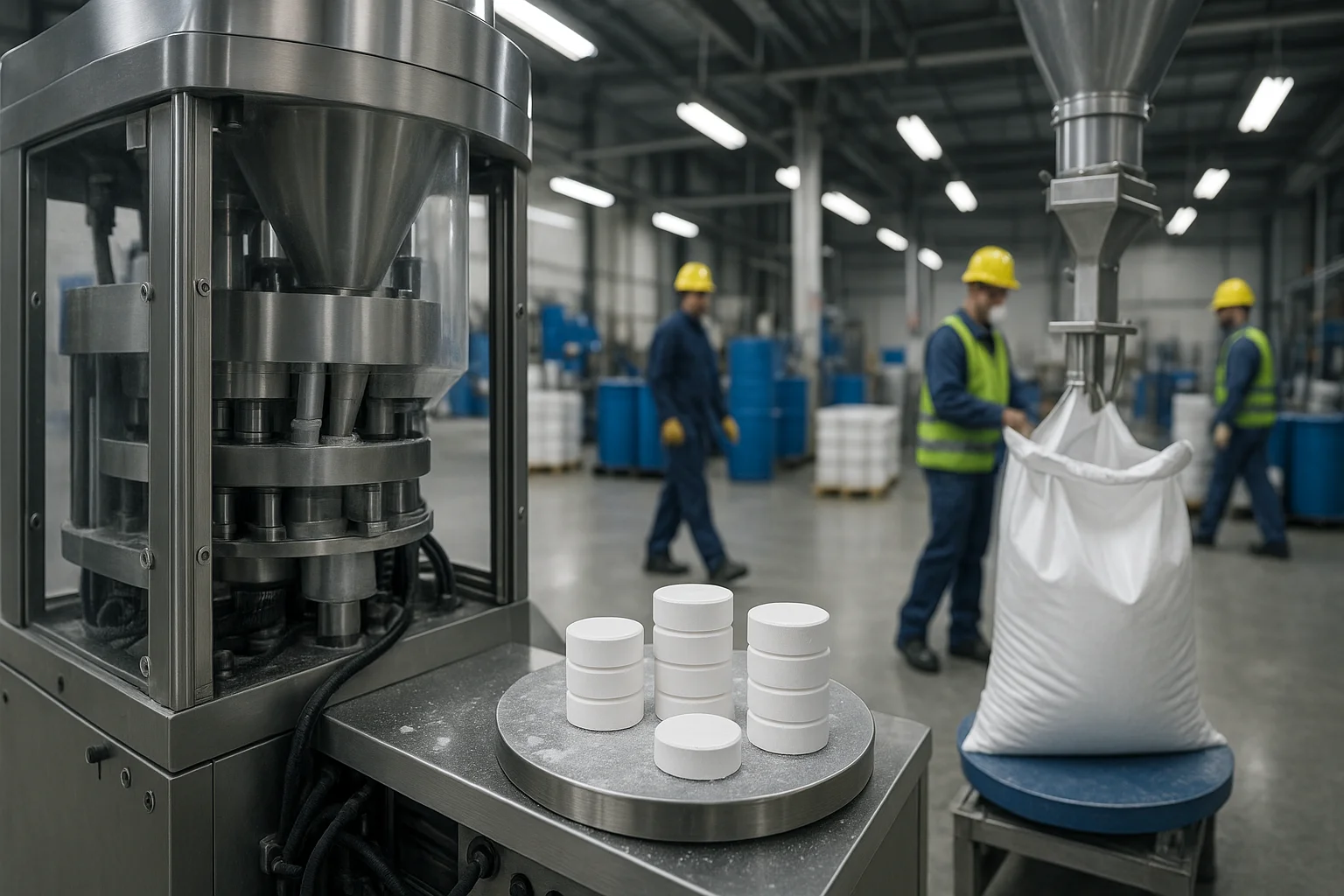
Trichlor tablet production begins with precise blending of trichloroisocyanuric acid powder with any stabilizer or binder components under tightly controlled humidity conditions, since moisture uptake during this stage directly affects tablet hardness and dissolution rate. The blended powder then moves to tablet compression, where controlled pressure forms it into uniform tablets, followed by curing and moisture-controlled storage before packaging. Liquid product manufacturing follows a more conventional blending sequence — combining actives, pH adjusters, and water in a corrosion-resistant vessel under controlled mixing, then filling directly into finished containers.
Key process parameters to control include ambient humidity during powder handling and compression, compression pressure and tablet dwell time, and mixing sequence for liquid products to avoid unwanted reactions between incompatible components. Batch size for a starting operation typically runs several hundred kilograms of tablets or several hundred litres of liquid product per cycle depending on equipment capacity. Where most beginners make mistakes in the process is underestimating how quickly hygroscopic oxidizer powders absorb ambient moisture during handling, producing soft, poorly-formed tablets even when the compression equipment itself is functioning correctly.
Basic process safety centers on strict material segregation to prevent accidental mixing of incompatible chemicals, proper personal protective equipment for oxidizer dust and vapor exposure, and controlled handling procedures that prevent contamination of chlorine-based products with organic material, which can trigger a dangerous exothermic reaction.
Setting up a manufacturing unit involves more than equipment and raw materials — getting the formulation right, scaling production safely, and meeting regulatory requirements are where most startups lose time and money. If you need hands-on guidance at any stage, the Global Formulation team works directly with chemical startups on formulation development, process setup, and compliance — from first batch to commercial scale.
Quality Control & Testing for Small Manufacturers
Quality control in pool chemical manufacturing centers on verified active chlorine content and physical tablet integrity, since these two factors directly determine whether your product actually sanitizes pool water effectively and holds up during storage and shipping.
| Test | What It Measures | Equipment Needed | Pass/Fail Criterion |
|---|---|---|---|
| Available Chlorine Content | Active sanitizing chlorine concentration in tablets or liquid product | Iodometric titration kit | Meets label claim specification, typically within ±2% of target |
| Tablet Hardness | Physical integrity and controlled dissolution rate | Tablet hardness tester or crush strength gauge | Within validated hardness range for product type |
| Dissolution Rate | Confirms tablet dissolves at the intended controlled rate in water | Dissolution testing apparatus or timed immersion test | Within specified dissolution time window |
| Moisture Content | Confirms powder or tablet moisture is within safe storage limits | Moisture analyzer or loss-on-drying method | Below specified maximum moisture threshold |
Available chlorine titration and moisture content testing can be performed in-house with modest instrument investment, since both rely on straightforward wet chemistry or gravimetric methods rather than specialized lab equipment. Tablet hardness and dissolution testing require slightly more specialized instruments but remain achievable for an in-house QC setup under $2,000, well within this category's cost baseline. More advanced testing, such as full impurity profiling, is generally only necessary for export markets or specific institutional tender requirements and can be outsourced to a third-party analytical lab when needed.
Batch records matter significantly in this category, capturing raw material lot numbers, production humidity readings, compression parameters, and release test results for every batch, since this documentation is exactly what hazardous materials regulators and large institutional buyers request during inspection or tender qualification. The most common QC failure mode is moisture-related tablet softening from inadequate humidity control during production or storage, making dry-room discipline the single highest-leverage quality investment in this category.
Packaging & Branding on a Budget
Packaging in this category must satisfy hazardous materials labeling requirements alongside standard commercial packaging needs, since chlorine-based products carry mandatory hazard communication requirements that a generic packaging approach will not meet.
- Container formats — HDPE buckets and pails (1kg–25kg) for tablets and granular products, HDPE bottles and drums (1L–200L) for liquid products, all requiring chemical-resistant material rated for oxidizer contact.
- Label requirements — mandatory information typically includes product name, active ingredient and available chlorine percentage, GHS hazard pictograms and signal words, precautionary statements, batch or lot code, manufacturer name and address, and net weight or volume, per your market's hazardous chemical labeling regulation.
- Budget label design — hazard-compliant labels require correct GHS pictogram placement and specific warning language; a local industrial label printer familiar with hazardous chemical labeling is worth the modest premium over a generic commercial printer, since a missing or incorrect hazard pictogram is a compliance failure a generic printer will not catch.
- Private label vs. own brand — private label manufacturing for pool equipment retailers and distributors can generate faster initial cash flow with lower marketing investment, while building your own brand for direct commercial pool operator sales captures higher margin once trust and supply reliability are established.
A Safety Data Sheet is mandatory for every product in this category given its hazardous material classification, required for any commercial sale and essential for both distributor relationships and dangerous goods transport documentation. Sourcing hazard-compliant packaging locally at accessible minimum order quantities keeps upfront investment manageable while you validate demand across your initial product range.
Licensing, Registration & Regulatory Compliance
Pool chemicals occupy a distinctive regulatory position — chlorine-based oxidizers are classified as hazardous or dangerous goods in virtually every jurisdiction, placing this category under stricter storage, handling, and transport regulation than most consumer chemical products even though the finished products themselves are not classified as drugs.
Regulatory bodies governing hazardous chemical manufacturing and pool water treatment products vary by market — Pakistan's EPA and provincial industrial safety authorities oversee hazardous chemical storage and manufacturing permits, India's Petroleum and Explosives Safety Organisation and state pollution control boards govern oxidizer handling, the GCC's GSO and SASO standards apply across Gulf markets, and product-specific water treatment chemical standards apply in most jurisdictions for pool sanitizer registration. Mandatory steps before legal sale include business entity registration, a hazardous chemical manufacturing and storage permit contingent on facility inspection, and product registration confirming your formulation meets applicable water treatment chemical standards.
Timeline for hazardous chemical manufacturing licensing typically runs 8 to 16 weeks depending on jurisdiction, often longer than standard trade licensing given the additional safety inspection requirements specific to oxidizer storage and handling. What happens if you manufacture or store hazardous oxidizers without proper permitting ranges from facility closure and product seizure to significant financial penalties, since regulators treat improperly stored oxidizing chemicals as a genuine public safety risk given their fire and reactive hazard potential.
Good manufacturing discipline — batch records, in-process moisture and chlorine content monitoring, documented segregated storage — is expected from day one even where formal third-party certification is not separately mandated. Export compliance adds requirements like dangerous goods transport documentation and, for many markets, product registration specific to the destination country's water treatment chemical standards.
Pricing Strategy & Margin Expectations
Pool chemical pricing is shaped by seasonal demand patterns, commodity input cost volatility for chlorine raw materials, and the split between price-sensitive institutional buyers and less price-sensitive premium residential customers, requiring a pricing approach that accounts for all three factors.
Calculate your cost-plus baseline by summing raw material cost (chlorine-based oxidizer typically dominates this figure), packaging, labor, and amortized equipment and facility cost, then apply your target margin on top. Gross margins for small pool chemical manufacturers typically run in the range of 30 to 45% at the manufacturer level, with liquid products generally carrying higher margin than trichlor tablets due to lower raw material cost intensity and equipment complexity. Large multinational brands price primarily on retail brand recognition and marketing spend, while regional manufacturers competing on institutional and distributor supply typically win through reliable seasonal availability and competitive bulk pricing rather than brand premium.
Price your first commercial and distributor customers with awareness of seasonal demand swings — many markets see sharp summer demand spikes, and building supply reliability during peak season is often more valuable for customer retention than aggressive off-season discounting. As your production volume and raw material purchasing power grow, you can improve margin through better bulk oxidizer procurement pricing rather than raising unit prices with established institutional customers. When distributors push for lower pricing, protect your margin by negotiating seasonal volume commitments or advance-order terms rather than cutting your base price on a raw-material-cost-sensitive product.
Finding Your First 20 Customers
Customer acquisition in this category runs primarily through B2B commercial and institutional channels, since your highest-volume, most stable demand comes from commercial pool operators and pool service companies rather than individual residential consumers buying single containers.
B2B sales channels include pool equipment and supply distributors who serve the broader retail and service company network, direct sales to hotel, resort, and water park facility management, government and municipal aquatic facility procurement tenders, and pool service company partnerships who purchase in recurring mid-volume for their client routes. Direct sales through hospitality industry associations and facility management networks work well for reaching commercial pool operators who value supply reliability over brand name. Online channels — industry directories, pool trade association listings, and direct distributor outreach — serve mainly as discovery and relationship-building tools rather than primary sales channels in this B2B-dominant category.
Product samples and third-party test certificates matter for winning larger institutional and distributor accounts, since serious commercial buyers will request available chlorine content verification and safety documentation before committing to a supply agreement. Building your first three commercial reference customers is especially valuable, since a hotel chain or pool service company relationship, once established with reliable seasonal supply and consistent chlorine content, tends to generate durable recurring volume through standing purchase orders rather than one-off transactions. Common mistakes founders make include underestimating seasonal cash flow timing, since raw material purchasing often needs to happen ahead of peak summer demand while payment from customers lags, and failing to secure hazardous materials permitting before actively pursuing commercial distributor relationships that require documented compliance.
When and How to Scale Up Your Production
Scaling a pool chemical manufacturing business involves expanding both production capacity ahead of seasonal demand peaks and your product range to capture more of a commercial customer's total pool chemistry spend, rather than simply increasing volume of a single product line.
The clearest signal you are ready to scale is consistent order volume from commercial and distributor relationships that outpaces your current tablet press and blending capacity, particularly if you are turning down orders during peak season demand. At that point, the next equipment investments typically include a higher-throughput hydraulic tablet press, expanded dehumidified storage and production space, and additional liquid blending capacity to round out a fuller product range spanning shock treatments, specialty algaecides, and water balancers. Hiring usually starts with a dedicated production operator trained in hazardous materials handling and a QC technician focused on chlorine content verification, freeing the founder to focus on distributor relationships and seasonal capacity planning.
Quality systems worth formalizing at this stage include a documented Quality Management System covering hazardous materials handling procedures, a formal seasonal capacity and raw material procurement plan to avoid peak-season shortages, and — if pursuing export or larger institutional tenders — dangerous goods transport certification and destination-market product registration. As detailed on the Global Formulation guide to choosing the right product consultant, bringing in outside process safety and regulatory expertise at the scale-up stage often prevents the hazardous materials compliance missteps that are most costly to correct after a facility is already operating at higher volume.
Frequently Asked Questions
How much capital is really needed to start a swimming pool chemical manufacturing business?
Do I need a chemistry degree to start a pool chemical business?
Can I start a pool chemical business from home or do I need a factory?
What is the biggest mistake to avoid when starting this business?
How long before I make my first sale in a pool chemical business?
Do I need ISO or GMP certification from day one?
How do I get a validated formulation for my pool chemical product line?
What is the first licence I need to get to start selling pool chemicals?
Ready to Take the Next Step?
Starting a chemical manufacturing business is one of the most rewarding paths an entrepreneur can take — but it demands the right technical foundation from day one. Whether you need a validated formulation, help setting up your first production unit, guidance on regulatory compliance, or a structured scale-up plan, the Global Formulation team is here to support you.
Reach out to us at globalformulation.com/contact — we work with founders at every stage, from concept to commercial production.