Sunscreen Filter Photostability: UVA/UVB Protection and Formulation Challenges
A sunscreen that certifies at SPF 50 in a testing lab can deliver considerably less by mid-afternoon on a beach. The gap is rarely a manufacturing fault or a dosing error. It is sunscreen filter photostability — the tendency of certain UV filters to break down under the very radiation they exist to absorb. For a brand, this produces a product that passes every release specification and still fails the consumer, with label-claim and reputational exposure attached to it. This article covers how the major filters degrade, which combinations destroy each other, the stabilisation strategies that genuinely work, and how photostability is measured under ISO and FDA frameworks. Global Formulation supports skincare brands and contract manufacturers through sun care development, and the sequence below mirrors how these decisions get resolved in the lab.
Why Photostability Decides Real-World SPF
An SPF value describes how a product performed at one moment, at a fixed application density, under a defined dose of simulated sunlight. It says nothing on its own about what happens to the filter system over three hours of continuous exposure. A formula built purely to hit a number can therefore test beautifully and still leave the wearer under-protected long before the reapplication interval on the label. Photostability is what closes that gap, and it is a property of the filter combination rather than of any single ingredient.
The failure is also uneven, which makes it harder to spot. UVA filters are chemically the most fragile part of most organic filter systems, so protection degrades asymmetrically across the spectrum.
- UVA protection collapses first — the deep-penetrating wavelengths linked to photoageing and pigmentation lose coverage while the UVB-driven SPF number still looks respectable.
- Radical generation increases — degrading filters and uncoated photocatalytic minerals both produce reactive species that attack the rest of the formula.
- Formula quality drifts — those radicals oxidise emollients and fragrance, showing up as rancidity, odour change, or discolouration well inside the stated shelf life.
- Claim risk becomes real — broad-spectrum and UVA claims are assessed on irradiated samples, so an unstable system fails the test that actually matters.
If the difference between organic and mineral filter classes is unfamiliar territory, our companion guide to physical versus chemical sunscreen filters covers that ground in full. This article assumes it and goes one level deeper, into what happens to those filters after the photon arrives.
Sunscreen Filter Photostability: How UV Filters Actually Degrade
Every organic UV filter works by absorbing a photon and jumping to an excited electronic state. What separates a stable filter from an unstable one is what happens next. A photostable molecule sheds that energy harmlessly, usually as heat, and drops back to its ground state ready to absorb again. An unstable molecule instead uses the energy to rearrange or break a bond, and each such event permanently removes one absorbing molecule from the film.
Avobenzone is the clearest example because it is also the most widely used UVA filter in the world. It sits in equilibrium between an enol form, which absorbs strongly around 357 nm, and a keto form that absorbs far more weakly there. UV exposure shifts the balance and opens a route to bond cleavage, so the molecule that provides the UVA coverage is steadily consumed. This behaviour is documented in detail in general references on avobenzone chemistry.
| Filter | Spectral Role | Behaviour Under UV |
|---|---|---|
| Avobenzone (BMDBM) | UVA I | Unstable alone; tautomerises and cleaves, losing UVA absorbance |
| Octinoxate (EHMC) | UVB | Photoisomerises trans to cis, reducing absorbance |
| Octocrylene | UVB / UVA II | Photostable; also quenches excited avobenzone |
| Bemotrizinol (BEMT) | Broad spectrum | Inherently photostable; stabilises avobenzone |
| Bisoctrizole (MBBT) | Broad spectrum, particulate | Inherently photostable; absorbs and scatters |
| Zinc oxide | Broad spectrum, mineral | Does not photodegrade; low photocatalytic activity |
| Titanium dioxide | UVB / UVA II, mineral | Does not photodegrade, but photocatalytic unless surface-coated |
The pattern in that table is the useful takeaway. Photostability is not a property of the organic or mineral class as a whole, but of individual molecules, and the modern broad-spectrum filters were specifically engineered to be stable. Which filters a formulator can reach for, however, depends heavily on the market — and on what the other filters in the formula do to them.
Filter Combinations That Destroy Each Other
Filters do not degrade in isolation. They share a thin film on the skin, and an excited filter molecule can react with whatever sits next to it. The best-documented case in sun care is avobenzone combined with octinoxate, a pairing that appeared widely before the interaction was properly understood. Excited avobenzone reacts with the cinnamate double bond in octinoxate, consuming both molecules and leaving photoproducts with no useful absorbance.
That reaction is destructive in both directions, which is what makes it so costly. The formula loses UVA and UVB protection simultaneously, and neither loss is visible in an unirradiated spectral scan at release.
- Mutual destruction — avobenzone with octinoxate, where a cycloaddition consumes both filters under UV exposure.
- Self-isomerisation — octinoxate converting from its trans form to a lower-absorbing cis form even without a partner filter.
- Catalytic attack — uncoated titanium dioxide generating reactive oxygen species that degrade organic filters sharing the film.
- Solubility-driven loss — crystalline filters recrystallising out of an over-saturated oil phase during storage, removing absorbance without any chemistry at all.
Recognising an incompatible pair is straightforward once the mechanisms are known. Building a system that stays intact under real exposure is the harder engineering problem, and it rests on three distinct levers.
Photostabilisation: Quenchers, Solvents, and Encapsulation
Photostabilisation works by interrupting the degradation pathway at one of three points. A formulator can drain the excess energy from the excited molecule, or change the molecular environment so the destructive route is less favourable. A third option is to physically separate the reactive partners so they never meet. Most commercially successful sun care formulas use more than one of these levers together rather than relying on a single fix.
- Triplet-state quenching — a quencher such as octocrylene accepts energy from the excited filter and releases it as heat, letting the filter return intact to absorb again.
- Stabilising co-filters — modern broad-spectrum filters such as bemotrizinol are photostable themselves and additionally stabilise avobenzone where regulations permit their use.
- Solvent and emollient selection — the polarity of the oil phase influences the tautomeric balance of avobenzone. The choice of emollient is therefore a photostability decision, not only a sensory one.
- Encapsulation — sol-gel or silica encapsulation physically isolates a filter from incompatible partners and from the skin, allowing pairings that would otherwise be impossible.
- Coated mineral grades — silica, alumina, or dimethicone coatings on titanium dioxide suppress its surface photocatalysis and protect the organic filters around it.
Each lever also carries a cost. Octocrylene brings a tacky skin feel that is hard to mask. Encapsulated filters raise unit cost and complicate processing, and the most elegant photostable filters are unavailable in the largest single market. Those trade-offs are why filter selection and spectral targets have to be settled together rather than in sequence.
Balancing UVA and UVB: Critical Wavelength and Broad Spectrum
UVA balance and photostability are the same problem viewed from two angles. The filters that cover the long-wavelength UVA region are chemically the most fragile, so a formula's UVA performance is the first thing photodegradation takes away. Regulators recognised this and built the requirement around irradiated samples specifically, which is why a broad-spectrum claim is effectively a photostability claim. Meeting it means holding UVA absorbance after exposure, not simply including a UVA filter in the ingredient list.
| Market | UVA Requirement | How It Is Assessed |
|---|---|---|
| United States (FDA) | Critical wavelength at least 370 nm for a broad spectrum claim | In vitro spectral scan on a pre-irradiated sample |
| European Union | UVA protection factor at least one third of the labelled SPF, plus critical wavelength at least 370 nm | In vitro UVA method with pre-irradiation, against in vivo SPF |
| Australia / New Zealand | Broad spectrum criteria defined in the national sunscreen standard | Spectral transmittance after defined UV exposure |
Critical wavelength itself is a simple concept with real diagnostic value. It marks the point below which ninety per cent of the area under the absorbance curve falls. A formula weighted toward UVB alone produces a low value regardless of how high its SPF climbs. Pushing that number upward means adding genuine long-wave UVA coverage that survives irradiation, which loops directly back to filter choice and stabilisation. The methods used to prove it deserve their own look.
Testing Photostability: Pre-Irradiation and Release Specifications
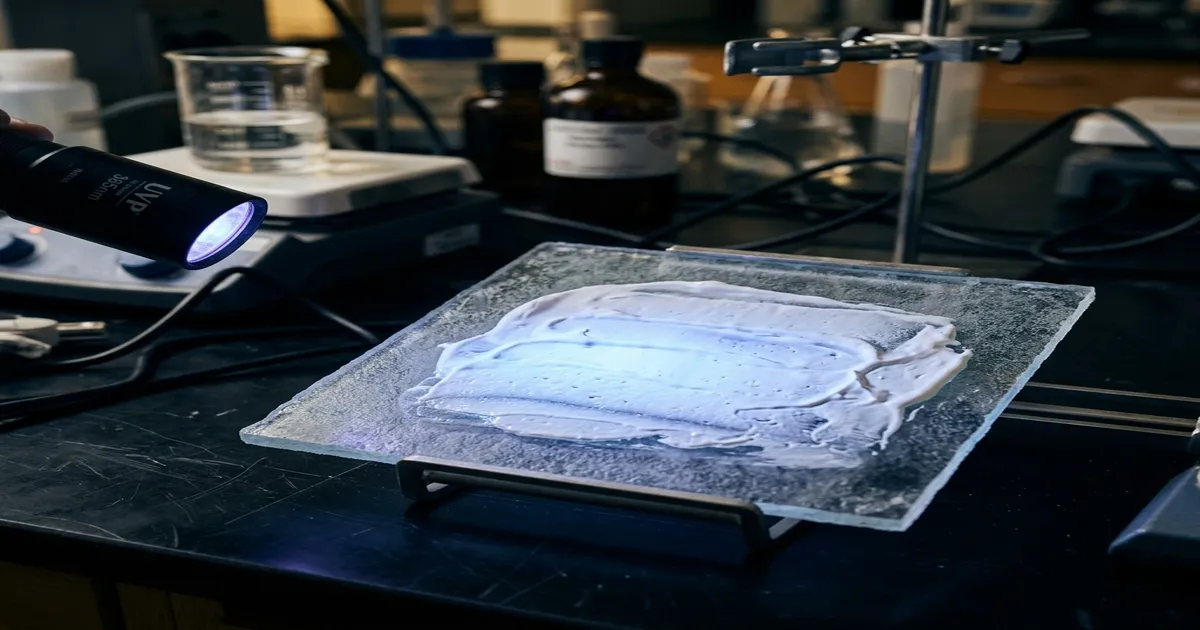
Photostability is rarely reported as a standalone figure on a certificate of analysis. It is embedded inside the UVA test methods through a pre-irradiation step, and that step is precisely what gives those methods their authority. A product is spread on a roughened substrate plate, scanned for UV transmission, exposed to a controlled dose from a solar simulator, then scanned again. The difference between the two curves is the photostability result, whether or not anyone labels it that way.
- In vitro UVA determination — the ISO 24443 approach, which measures UVA protection factor on a pre-irradiated plate and exposes unstable systems directly.
- In vivo SPF determination — the ISO 24444 human panel method that establishes the labelled SPF against which UVA performance is judged.
- Broad spectrum testing — the FDA critical wavelength procedure, which likewise requires the sample to be irradiated before measurement.
- Water resistance testing — immersion protocols that reveal film integrity problems photostability testing alone will not surface.
- Accelerated and real-time stability — storage studies that catch filter recrystallisation, emulsion failure, and oxidative changes over shelf life.
Method standards for these procedures are maintained by the International Organization for Standardization, while US labelling and broad-spectrum requirements sit with the FDA sunscreen framework. Testing early on prototype systems, rather than at the end on a finished formula, is what keeps a failed UVA result from costing an entire development cycle. That principle extends into how the product is actually made.
Formulation and Scale-Up Challenges in Sun Care
Sun care is among the most demanding categories in personal care to manufacture consistently. The filter system usually occupies a large share of the formula, which constrains the emulsion design before sensory work even begins. Processing choices then feed straight back into measured SPF, so a change that looks purely operational can move a regulated performance claim. This is the point where laboratory success and factory success most often diverge.
Formulation Constraints
Most organic UV filters are crystalline solids that must be fully dissolved in the oil phase and stay dissolved for the product's entire shelf life. A supersaturated oil phase looks perfect on day one and quietly drops crystals months later, taking measurable absorbance with it. Every solubiliser added to prevent that outcome also changes the emulsion's balance and its skin feel.
- Filter solubility — solubilisers such as alkyl benzoates or salicylate esters keep crystalline filters in solution, but each one shifts the oil phase character.
- Emulsion architecture — a heavy oil phase narrows emulsifier options and makes long-term stability harder to achieve.
- Sensory penalties — mineral filters bring whitening, octocrylene brings tack, and both need deliberate correction rather than apology.
- Film formation — a uniform, continuous film across skin topography is what delivers laboratory SPF in real use, which makes film formers functional rather than cosmetic.
Scale-Up Constraints
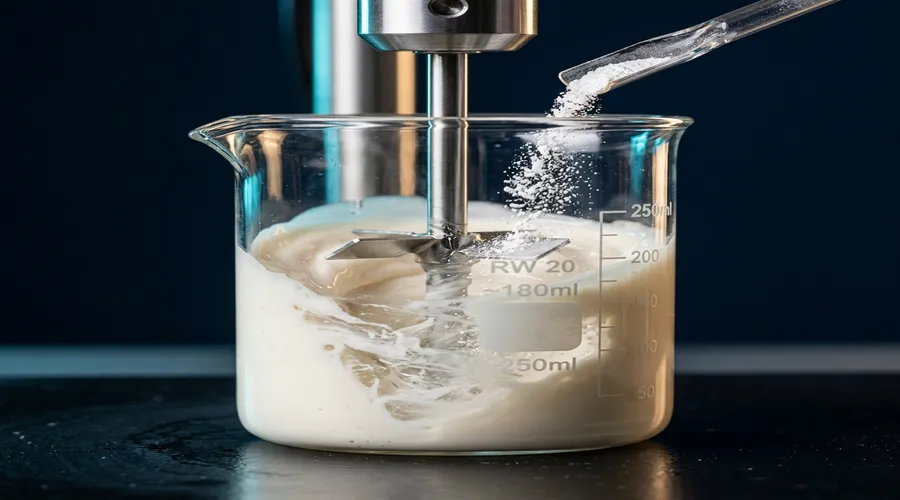
Transferring a sun care formula to production is not a neutral step for performance. Mineral dispersions are especially sensitive, because the particle size distribution that governs UV attenuation is set by the shear the batch actually receives. A pilot homogeniser and a production line rarely deliver the same energy input, so SPF can move between scales without a single ingredient changing.
- Shear and particle size — homogenisation conditions determine mineral dispersion quality and therefore attenuation efficiency.
- Thermal history — prolonged heating during larger batch cycles can affect filter solubility and emulsion structure.
- Batch-to-batch SPF verification — in vitro screening across scale-up batches catches drift before it reaches a regulated claim.
- Packaging compatibility — filter systems interact with pack materials, and light-protective packaging supports the stability engineered into the formula.

Emulsion design sits underneath all of this, and the emulsifier decisions involved are covered in our guide to cosmetic emulsifier selection and HLB stability engineering. Brands moving into spray formats face a further layer of constraints, addressed in our aerosol sunscreen production guide. Propellant and valve choices interact with both film formation and filter solubility.
The decision framework reduces to three questions, asked in this order. Which filters does the target market actually permit? Does the chosen combination hold its UVA absorbance after irradiation, tested on a prototype rather than assumed? Does the manufacturing process preserve the dispersion and film quality the laboratory result depended on? Brands working through those questions early with a formulation consultant avoid the worst outcome in this category: a finished, packed product that cannot support its own label claim. Sun care rewards teams who treat photostability as a design input rather than a test result. The wider cosmetics and personal care discipline behind that mindset applies well beyond sunscreen.
Frequently Asked Questions
Why does avobenzone lose its UVA protection during sun exposure?
Avobenzone exists as an equilibrium between two tautomeric forms, and only one of them does the protective work. The enol form absorbs strongly in the UVA region around 357 nm, which is exactly why avobenzone became the dominant UVA filter in most markets. When it absorbs a photon, the molecule can shift toward the keto form, which absorbs far more weakly in that region. The excited keto form is also chemically reactive and can undergo bond cleavage that destroys the molecule permanently rather than reversibly. The practical result is that unstabilised avobenzone loses a substantial share of its UVA absorbance during sustained irradiation, so the product's UVA protection falls away faster than its UVB protection. This is the single most important reason a sunscreen needs a deliberate photostabilisation strategy rather than just a filter list that adds up to the target SPF on paper.
Why should avobenzone and octinoxate not be combined in the same sunscreen?
The two filters actively destroy each other under UV exposure, which is one of the best-documented incompatibilities in sun care chemistry. Octinoxate, or ethylhexyl methoxycinnamate, carries a reactive carbon-carbon double bond in its cinnamate structure. When avobenzone is raised to an excited state by absorbing UV, it can react with that double bond in a cycloaddition. This consumes both molecules and produces photoproducts that offer no meaningful protection. Octinoxate is separately unstable on its own, since it photoisomerises from the trans form to a cis form with lower absorbance. Combining them therefore accelerates the loss of both the UVA and UVB halves of the protection profile at once. Where regulations permit alternatives, formulators pair avobenzone with a compatible UVB filter and a dedicated quencher instead.
How does octocrylene stabilise avobenzone, and is it a complete solution?
Octocrylene works as a triplet-state quencher, which means it accepts excess energy from the excited avobenzone molecule and dissipates it harmlessly as heat. Because the energy is removed before avobenzone can undergo destructive bond cleavage, the filter returns to its ground state intact and continues absorbing UVA. This mechanism is genuine and is the reason octocrylene appears in so many avobenzone-containing formulas, particularly in the United States where the approved filter list is narrow. It is not a complete solution for two reasons. Quenching is not perfect, so significant avobenzone loss can still occur over extended exposure, and octocrylene contributes a tacky sensory profile that is difficult to mask. Peer-reviewed work has also documented benzophenone accumulating in octocrylene-containing products over storage. That finding has prompted some brands to move toward alternative stabilisers or inherently photostable filters where their market allows it.
Are mineral filters like zinc oxide and titanium dioxide automatically photostable?
Mineral filters do not photodegrade the way organic filters do, because they are inorganic oxides rather than molecules with breakable bonds, so their absorbance is effectively stable across exposure. That is a genuine advantage, but it is not the whole story. Titanium dioxide is a semiconductor and is photocatalytic under UV, meaning it can generate reactive oxygen species at its surface that attack other ingredients in the formula. Those radicals can degrade emollients, fragrance, and any organic filters present, causing rancidity, discolouration, or loss of protection over time. This is why cosmetic-grade titanium dioxide is supplied with inert surface coatings such as silica, alumina, or dimethicone that suppress the catalytic activity. Specifying an uncoated grade to save cost is a recurring and expensive formulation error in mineral sun care.
Do antioxidants such as vitamin E make a sunscreen photostable?
Antioxidants and photostabilisers solve different problems, and treating them as interchangeable is a common mistake in sun care development. A triplet-state quencher intercepts the excited filter molecule before it can react, preventing the degradation event from happening at all. An antioxidant works after the fact by scavenging free radicals that have already formed. That limits collateral damage to the rest of the formula, but it does not restore the filter that was destroyed. Antioxidants are worth including for their effect on formula shelf life and on skin, and some can offer modest secondary benefit to filter stability. They are not a substitute for a quencher, a compatible filter pairing, or encapsulation, and a formula that relies on them alone will still fail a pre-irradiated UVA test.
How is sunscreen photostability actually tested?
Photostability is not usually measured as a standalone number. It is built into the UVA test methods through a pre-irradiation step, which is what makes those methods meaningful. In the in vitro UVA method described by ISO 24443, the product is spread on a roughened substrate plate and its UV transmission is measured. It is then exposed to a controlled dose from a solar simulator and measured again. A photostable formula shows little change between the two readings, while an unstable one shows UVA absorbance collapsing after irradiation. The FDA broad spectrum test in the United States follows the same logic, requiring the sample to be irradiated before the critical wavelength is determined. Because both frameworks test the product after UV exposure rather than before it, a formula cannot pass on its initial spectral curve alone.
Why do European sunscreens often achieve better UVA protection than US products, and what does that mean for a brand launching in both markets?
The difference is regulatory rather than technical, and it comes down to which filters each market permits. Sunscreens are regulated as over-the-counter drugs in the United States, so the approved filter list changes slowly. It does not include several modern, inherently photostable broad-spectrum filters available in Europe and much of Asia. European formulators can therefore reach a high UVA protection factor with filters that need little or no stabilisation. US formulators typically build around avobenzone instead, and must engineer photostability into the system. For a brand selling in both markets, the practical consequence is that one formula rarely serves both. The realistic approach is a shared sensory and emulsion platform carrying two distinct filter systems, each validated separately against its own market's test methods. That dual-track development should be planned from the start, not discovered after the first market launch.
Developing a Photostable Sun Care Range?
Filter system design, photostability screening, market-specific regulatory strategy, and scale-up verification. Global Formulation provides sunscreen product development services and stability testing partnership from first brief to production batch.
Discuss Your Project