Oral Liquid Suspension & Emulsion Formulation Guide

A pediatric antibiotic suspension that cakes at the bottom of the bottle after two weeks on a pharmacy shelf isn't just an inconvenience — it's a dosing accuracy failure that can under-dose or over-dose a child depending on how hard the caregiver shakes it. Liquid dosage forms carry physical-stability risks that tablets and capsules never face, because a suspension or emulsion is, by definition, a thermodynamically unstable system fighting against gravity and phase separation from the moment it's manufactured. Getting oral liquid pharmaceutical suspension formulation right means engineering deliberate, controlled instability — a sediment that redisperses easily rather than one that never settles at all, or an emulsion that resists coalescence through shipping and storage rather than one that looks stable only in a fresh sample. This guide walks through how suspensions and emulsions are formulated to survive real-world distribution and dosing conditions, from flocculation chemistry to emulsifier selection to the viscosity systems that hold everything together. Whether the product is a pediatric antibiotic, a geriatric multivitamin, or an oral suspension replacing a hard-to-swallow tablet, the same underlying physics governs whether it performs consistently from the first dose to the last.
Why Liquid Dosage Forms Demand Different Engineering
Solid oral dosage forms like tablets and capsules are chemically and physically static once manufactured — the drug is locked in place and stays there until the patient swallows it. Liquid suspensions and emulsions are the opposite: they are dynamic systems in constant, slow motion from the moment of manufacture, with particles settling and droplets drifting toward coalescence throughout the entire shelf life. That constant motion is exactly why liquid dosage forms require a formulation discipline solid dosage forms simply don't need.
- Dose uniformity risk — if solids settle unevenly or an emulsion partially separates, the first dose from a bottle can deliver a meaningfully different amount of drug than the last dose
- Physical instability as the primary failure mode — unlike a tablet, where chemical degradation is usually the main stability concern, a liquid's physical state (sedimentation, caking, creaming, coalescence) often fails before the chemistry does
- Patient-specific advantages — liquids allow flexible, weight-based dosing and easier swallowing for children, geriatric patients, and anyone with dysphagia
- Higher microbial risk — the aqueous continuous phase common to most oral liquids is a more permissive environment for microbial growth than a dry solid dosage form
Suspensions and emulsions solve the same underlying dosing-flexibility problem but through entirely different physical mechanisms, and understanding which mechanism applies changes almost every formulation decision that follows.
Suspension Formulation: Flocculation & Sedimentation Control
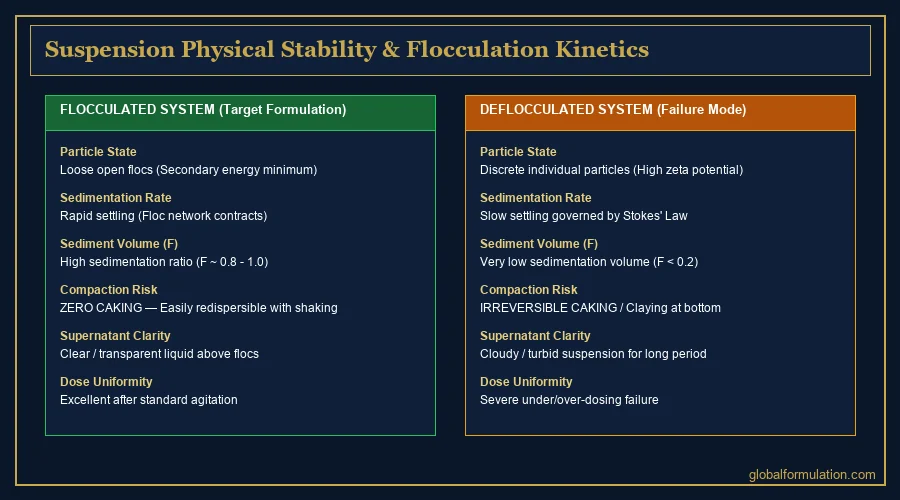
A pharmaceutical suspension disperses solid, water-insoluble drug particles throughout a liquid vehicle, and every particle in that system is under constant gravitational pull toward the bottom of the container. The formulator's job isn't to stop that settling — Stokes' law makes that physically impossible for any particle with mass — it's to control how the particles settle and whether they redisperse easily when the patient shakes the bottle. That control starts with a deliberate choice about particle-particle interaction known as flocculation state.
- Deflocculated systems — particles repel each other and settle individually into a dense, closely packed sediment (cake) that resists redispersion, sometimes permanently, even with vigorous shaking
- Flocculated systems — particles are encouraged to form loose, open aggregates called flocs that settle faster in volume but produce a loose sediment that redisperses easily with moderate shaking
- Flocculating agents — electrolytes, surfactants, and certain hydrophilic polymers are used deliberately to induce controlled flocculation rather than leave particle interaction to chance
- Particle size control — milling or micronization sets the initial particle size distribution, which directly affects both settling rate under Stokes' law and the risk of caking
Getting the flocculation state right solves half the physical-stability problem; the other half belongs to emulsions, which face an entirely different kind of instability rooted in immiscible liquid phases rather than solid particles.
Emulsion Formulation: Phase Stability & Emulsifier Selection
An oral emulsion disperses one liquid phase as droplets within another immiscible liquid phase — almost always an oil phase dispersed within a continuous water phase for oral products — and that dispersion is inherently unstable without an emulsifier holding the interface together. Where a suspension fights gravity acting on solid particles, an emulsion fights the natural thermodynamic drive of two immiscible liquids to separate back into distinct layers. Selecting the right emulsifier system is the single decision that determines whether that drive is controlled or not.
| Emulsifier class | Typical HLB range | Best suited for |
|---|---|---|
| Polysorbates (e.g. polysorbate 80) | High HLB (~15) | Oil-in-water emulsions with polar oil phases |
| Sorbitan esters (e.g. sorbitan monooleate) | Low HLB (~4–5) | Water-in-oil systems or as a co-emulsifier blended with a high-HLB partner |
| Lecithin | Amphoteric, moderate HLB | Naturally derived emulsifier for cleaner-label liquid formulations |
An emulsifier chosen without matching its hydrophilic-lipophilic balance (HLB) to the specific oil phase in the formula rarely produces a stable emulsion, regardless of how much emulsifier is used — concentration cannot compensate for a fundamentally mismatched HLB value, which is why HLB matching is one of the first calculations in any oral emulsion development program.
Viscosity Modifiers & Rheology Control
Viscosity is the mechanical brake that slows both particle sedimentation in a suspension and droplet creaming in an emulsion, and it does double duty by also giving the product an acceptable mouthfeel and pour characteristic for the patient or caregiver administering it. A vehicle that's too thin lets particles and droplets separate quickly; one that's too thick becomes difficult to pour accurately from a bottle or draw into a dosing syringe. Balancing those two competing needs is a rheology-engineering problem, not a simple thickener-selection exercise.
- Suspending/viscosity-building polymers — xanthan gum, microcrystalline cellulose/carboxymethylcellulose combinations, and methylcellulose derivatives are common choices for oral liquid vehicles
- Shear-thinning behavior — an ideal suspension vehicle is thick enough at rest to slow settling but thins under the shear of pouring or drawing into a syringe, then recovers viscosity once shear stops
- Pourability and dose-accuracy trade-off — excessively high viscosity can cause under-dosing if a caregiver can't fully draw the prescribed volume into a syringe or measuring cup
- Temperature sensitivity — some cellulose-derivative thickeners show viscosity changes across the temperature range a product may experience in transit or home storage, which must be characterized during development
Once the vehicle's rheology is set, the formulation still has to survive the population it's actually designed for, and pediatric and geriatric patients bring constraints that go well beyond viscosity and settling behavior.
Pediatric & Geriatric Formulation Considerations
Liquid dosage forms exist largely to serve patients who cannot reliably take solid oral medicine, and pediatric and geriatric populations make up the majority of that need. Formulating for these groups adds constraints that a standard adult liquid product doesn't have to satisfy, starting with the fact that a child's willingness to accept a dose is itself a formulation variable, not just a clinical one.
- Taste-masking strategy — sweeteners, flavoring systems, and, for genuinely bitter actives, ion-exchange resin complexation or microencapsulation are used to make the dose acceptable to a young patient
- Weight-based dosing accuracy — pediatric dosing is frequently calculated per kilogram of body weight, which makes uniform drug distribution throughout the liquid non-negotiable rather than a nice-to-have
- Excipient safety by age group — certain excipients acceptable in adult formulations, including some sweeteners and preservatives, carry age-specific restrictions or warnings that must be checked against current regulatory guidance
- Swallowing and administration ease — for geriatric patients with dysphagia, viscosity and mouthfeel become clinical considerations affecting aspiration risk, not just sensory preferences
These patient-centered constraints shape the formula on paper, but the formula still has to prove it holds up under real storage and distribution conditions before it can reach either population — which is where stability testing and the regulatory pathway take over. A startup team weighing whether to build this expertise in-house or bring in outside support can find that decision framework in our guide to choosing a pharmaceutical formulation consultant.
Stability Testing & Regulatory Pathway
A suspension or emulsion that performs well in a fresh bench-scale batch tells a formulator very little about how it will behave after months in a warehouse, a delivery truck, or a patient's medicine cabinet. Physical stability testing for liquid dosage forms has to go well beyond the chemical assay and degradation-product testing used for solids, because sedimentation, creaming, and phase separation are failure modes that chemical stability data alone will never catch.
- ICH Q1A(R2) framework — provides the core long-term, intermediate, and accelerated stability testing conditions applied across dosage forms, adapted for liquid-specific endpoints, as published by the International Council for Harmonisation
- Physical stability endpoints — sedimentation volume, redispersibility, viscosity drift over time, and, for emulsions, creaming or coalescence must all be tracked alongside standard assay and impurity testing
- Freeze-thaw cycling — added to many liquid-product stability protocols because a single freeze event can irreversibly break certain emulsion and suspension systems, particularly during uncontrolled cold-chain logistics
- Preservative efficacy testing — required under USP or Ph. Eur. antimicrobial effectiveness protocols to confirm the preservative system remains effective in the finished formula, not just at its nominal concentration
The takeaway across suspension and emulsion development is consistent: engineer the instability deliberately, validate it against real dosing and storage conditions rather than a single bench measurement, and confirm every physical and microbial endpoint before scale-up — not after a complaint arrives. Our guide to topical semisolid formulation covers the related rheology and stability principles for creams and gels, our oral disintegrating tablet guide explores an alternative pediatric-friendly dosage form, and our pharmaceutical and healthcare practice page shows how Global Formulation structures liquid dosage development projects end to end.
Frequently Asked Questions
Why do pharmaceutical suspensions need to be flocculated on purpose?
A deflocculated suspension looks appealing on the shelf because particles stay dispersed and the liquid looks clear at first, but those free particles settle slowly into a dense, compacted layer that resists redispersion even with vigorous shaking.
Deliberately flocculating the suspension — causing particles to form loose, open clusters — makes the product sediment faster but into a loose, high-volume layer that redisperses easily with a moderate shake. That trade-off is why flocculated systems are the standard target for most pharmaceutical suspensions despite faster visible settling.
What causes an oral emulsion to crack or separate on the shelf?
Emulsion cracking happens when the dispersed droplets coalesce faster than the emulsifier system can stabilize the interface, usually triggered by temperature extremes, mechanical shock during shipping, or a mismatched emulsifier HLB value for the oil phase in use.
Once droplets merge past a critical point the two phases separate irreversibly and the emulsion cannot be restored by shaking. Formulators prevent this by selecting an emulsifier blend matched to the oil phase's required HLB and validating that match through accelerated stability testing before scale-up.
How is suspension particle size controlled during manufacturing?
Particle size is set primarily through milling or micronization of the active ingredient before it's incorporated into the suspension vehicle, using equipment such as a colloid mill, ball mill, or jet mill depending on the target particle size range and the drug's physical properties.
Smaller, more uniform particles settle more slowly under Stokes' law and generally improve dose uniformity, though very fine particles can also increase caking risk if the suspension isn't properly flocculated. Particle size distribution is verified with laser diffraction or microscopy as a routine in-process control.
Why are liquid dosage forms so common in pediatric medicine?
Young children often cannot swallow tablets or capsules safely, and a liquid suspension or emulsion allows a caregiver to measure a dose scaled precisely to the child's body weight using a calibrated oral syringe or dosing cup, which a fixed-strength solid dosage form cannot offer.
Liquid formulations also allow taste-masking strategies — sweeteners, flavoring agents, and sometimes ion-exchange resin complexation for genuinely bitter actives — that make the medicine easier for a child to accept and improve adherence to the prescribed regimen.
What's the difference between a suspending agent and an emulsifier?
A suspending agent is a viscosity-building polymer or gum that slows the settling of solid drug particles dispersed in a liquid vehicle without changing the fundamental fact that the particles are insoluble solids surrounded by liquid.
An emulsifier, by contrast, is a surface-active molecule that stabilizes the interface between two immiscible liquid phases — typically oil and water — allowing one to disperse as droplets within the other. Some complex liquid formulations use both together: an emulsifier to form the emulsion base and a suspending agent to keep any additional solid particles from settling out.
How do formulators test whether a suspension will redisperse properly?
The standard evaluation is a sedimentation-volume and redispersibility test: the suspension is allowed to settle under controlled conditions for a defined period, the sediment volume is measured against the original volume to calculate the sedimentation ratio, and then the container is shaken using a standardized number of inversions or shakes to see whether the sediment fully redisperses into a uniform suspension.
A well-flocculated suspension should redisperse with minimal effort and show a sedimentation ratio close to one, meaning little compaction occurred during settling.
Can preservatives interact negatively with suspension or emulsion excipients?
Yes, and this is one of the most common late-stage formulation failures in liquid dosage development. Nonionic surfactants and certain polymers can bind or partition preservative molecules like parabens away from the aqueous phase where they're needed to control microbial growth, effectively reducing the preservative's available concentration below its effective level even though the labeled amount was added correctly.
Preservative efficacy must be confirmed with a full USP or Ph. Eur. antimicrobial effectiveness test on the finished formula, not assumed from the raw preservative's nominal potency.
What regulatory guidance governs oral liquid suspension and emulsion stability testing?
Stability testing for oral liquid dosage forms follows the same International Council for Harmonisation framework applied to other dosage forms, primarily ICH Q1A(R2) for the core long-term and accelerated testing protocol, but liquids require additional attention to physical stability endpoints that solids don't need — sedimentation behavior, redispersibility, viscosity drift, and, for emulsions, phase separation or creaming.
Freeze-thaw cycling is also commonly added to the protocol for liquid products distributed through cold-chain-uncontrolled logistics, since a single freeze event can irreversibly break some emulsion and suspension systems.
Developing an Oral Liquid Pharmaceutical Product?
Global Formulation provides oral liquid formulation consultancy — suspension and emulsion stability engineering, viscosity system design, and manufacturing handoff for pharmaceutical and healthcare manufacturers.
Talk to Our Formulation Team