Sustainable Cosmetic Product Development: Green Chemistry and Packaging in Practice

A founder sketches a clean beauty brand, picks a beautiful glass jar, and hands a "natural and eco-friendly" brief to a lab. Then the problems surface: the preservative system will not hold in that jar, the plant oil goes rancid without a synthetic antioxidant, and the recycler will not take the pump. This is the normal way sustainable cosmetic product development goes wrong. The environmental intentions are real, but they arrive as slogans instead of specifications, and they arrive too late to shape the formula. The cost is not trivial. Reworking a formula and its packaging after a first production run can wipe out a small brand's launch budget and push the release past its retail window. This article lays out how to do it the other way round. It covers how green chemistry principles translate into formulation choices, how to judge whether an ingredient is genuinely biodegradable, what recyclable and refillable packaging demand from the product inside, how to measure a carbon footprint before claiming one is low, and how to keep every claim defensible. It is written for entrepreneurs and product developers building a range, not for a marketing team writing back-of-pack copy afterwards.
Why Sustainable Cosmetic Product Development Is Now a Commercial Requirement
Sustainable cosmetic product development has moved from a niche positioning to a baseline expectation, driven by three forces that a new brand cannot ignore. Regulators in the EU and elsewhere are tightening rules on both packaging waste and unsubstantiated environmental claims, so a vague "eco-friendly" label is now a legal exposure rather than a free marketing benefit. Retailers, particularly the larger chains, increasingly impose their own ingredient and packaging standards as a condition of listing. And the customers this segment targets read ingredient lists and check certifications, so a claim that does not survive scrutiny damages the brand faster than making no claim at all. Treating sustainability as a technical discipline, defined in the brief and verified in the lab, is what separates a durable brand from one that gets called out.
- Regulatory pressure — the EU Packaging and Packaging Waste Regulation sets recyclability and recycled-content requirements, and the proposed Green Claims rules require environmental claims to be evidenced before they are made.
- Retailer gatekeeping — major retailers publish restricted-substance lists and packaging targets that a supplier must meet to be stocked.
- Informed customers — the core audience for this segment actively verifies claims against ingredient databases and certification registers.
- Investor and supply-chain scrutiny — contract manufacturers and investors increasingly ask for a documented sustainability position before committing.
The practical consequence is that sustainability decisions belong at the concept stage, alongside the target price and the hero claim. The rest of this article works through those decisions in the order a development project meets them, starting with the formula itself. For a broader view of where the whole industry is heading, the overview of the future of eco-friendly chemical products sets the wider context.
Green Chemistry Principles Applied to Formulation
Green chemistry, as codified by Paul Anastas and John Warner in their twelve principles, is a framework for designing chemical products and processes that reduce or eliminate hazardous substances. Most of the principles were written for synthesis chemists, but a formulator can apply a subset of them directly to how a cosmetic is built and made. The useful move is to treat the principles as a set of questions to ask of every raw material and every process step, rather than as a scoring system. Applied consistently, they push a formula toward lower energy, safer solvents, and ingredients that break down after use.

- Prevent waste — design the process so batch changeovers, rejected material and rinse water are minimised; a formula that is robust to small raw-material variation produces fewer failed batches.
- Use safer solvents and auxiliaries — favour water and glycerine as carriers over volatile hydrocarbons and high levels of volatile silicones, which reduces both worker exposure and volatile organic compound release.
- Design for energy efficiency — cold-process or low-energy emulsification systems remove the heating and cooling steps, cutting manufacturing energy per batch.
- Use renewable feedstocks — choose plant-derived emollients, bio-based glycols and fermentation-derived actives over petrochemical equivalents where they meet the performance target.
- Design for degradation — select surfactants, emulsifiers and film-formers with ester or polysaccharide backbones that micro-organisms can break down, rather than persistent synthetic polymers.
- Reduce derivatisation — prefer ingredients used close to their natural form over those requiring multiple protecting-group or modification steps upstream.
The principle that bites hardest in practice is designing for degradation, because it constrains the surfactant and polymer choices at the heart of most formulas. That leads directly into how biodegradability is actually assessed.
Biodegradable Ingredients and Responsible Sourcing
Biodegradable cosmetic ingredient sourcing rests on two separate questions: does the molecule break down after it goes down the drain, and was it produced without unacceptable environmental or social cost. The first is answerable with standard tests — chiefly the ready biodegradability protocols in the OECD guidelines — while the second requires supply-chain traceability and, usually, third-party certification. Rinse-off products such as shampoo, shower gel and facial cleanser send almost their entire mass into wastewater within minutes of use, so surfactant and polymer biodegradability is the dominant environmental factor for that category. Leave-on products contribute less to the aquatic load, but the same sourcing logic applies to every ingredient in the bill of materials.
| Test / scheme | What it measures | Why it matters to a formulator |
|---|---|---|
| OECD 301 series (A–F) | Ready biodegradability — percentage of carbon mineralised in 28 days | A pass classes the ingredient as readily biodegradable; the reference standard for surfactant claims |
| OECD 302 series | Inherent biodegradability — slower degradation over a longer window | Relevant for ingredients that degrade but not fast enough to pass OECD 301 |
| OECD 306 / marine tests | Degradation in seawater | Important for sunscreens and any product with significant wash-off at the coast |
| RSPO certification | Sustainable palm oil and palm-kernel derivatives | Most surfactants and emollients are palm-derived; RSPO addresses deforestation in that chain |
| COSMOS / NATRUE | Natural and organic ingredient origin and permitted processing | Defines which ingredients and processing routes qualify as natural or organic for on-pack claims |
- Ask for the test report, not the adjective — a credible supplier provides an OECD method number and a percentage degradation figure, not just the word "biodegradable" on a sales sheet.
- Check the whole molecule — an ethoxylated surfactant may have a biodegradable fatty tail but a more persistent ethylene-oxide chain; the classification applies to the finished structure.
- Trace palm derivatives — ingredients such as glycerin, cetyl alcohol and many surfactants are palm-based even when the name does not say so; RSPO mass-balance or segregated supply covers this.
- Consider the growing footprint — a plant-derived ingredient farmed with heavy irrigation and land conversion is not automatically better than a well-run synthetic route.
- Document provenance — keep supplier declarations, certificates and specification sheets on file so any sourcing claim can be evidenced on request.
Sourcing choices also interact with formulation performance: readily biodegradable surfactant systems and preservative-light formulas can be less tolerant of contamination, which is exactly the stress that a refill package puts on a product. That connection is the reason packaging cannot be chosen in isolation.
Sustainable Packaging: Recyclable, Refillable, and Reduced
Packaging is where most of a personal-care product's material impact sits, and it is also where the loudest sustainability claims are made, so it deserves careful engineering rather than a swap to a nicer-looking material. The three levers, in rough order of reliability, are reducing the amount of packaging per use, making what remains genuinely recyclable, and enabling refill so a durable container is reused many times. Each lever imposes a requirement on the formula: a concentrate needs a different rheology, a mono-material recyclable pack limits the barrier options, and a refillable format demands a product that survives repeated opening. Sustainable packaging product development works only when the package specification and the formula specification are written together.
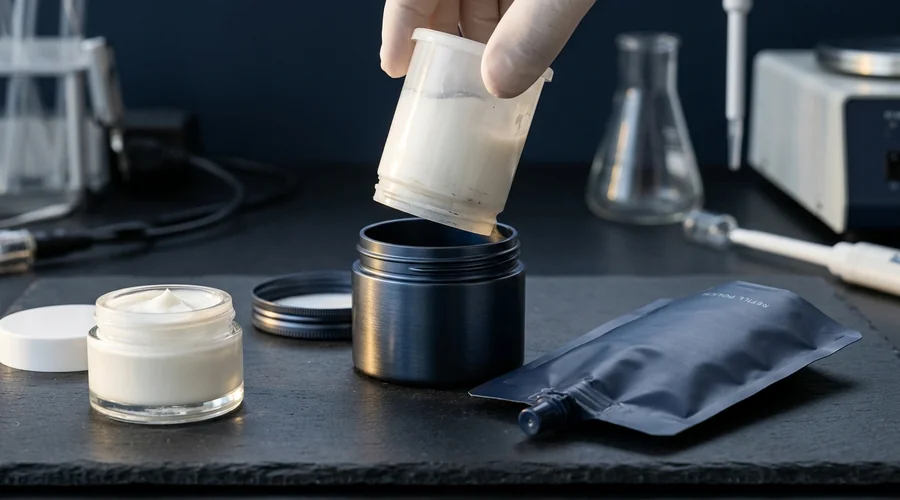
Reduce: less material per use
Cutting the mass of packaging that each application carries is the most dependable gain because it needs no change in consumer behaviour and no recycling infrastructure. Concentrated formats, solid bars, and tablet or powder products that the user rehydrates all move mass out of the package and out of the freight. The formulation work is real: a shampoo bar needs a different surfactant and binder system from a liquid, and a concentrate needs a viscosity that dilutes predictably.
- Solid formats — shampoo, conditioner and cleanser bars eliminate the bottle entirely and cut shipping weight sharply.
- Concentrates — a small bottle of concentrate the user dilutes at home replaces several full-size bottles over its life.
- Lightweighting — thinner wall sections, smaller closures and removed secondary packaging reduce mass without changing the format.
- Right-sizing — matching pack volume to a realistic use period avoids oversized packs that ship air.
Recycle: mono-material and real end-of-life
A pack is only recyclable if the local system actually collects, sorts and reprocesses it, which in practice means designing to a single dominant polymer and avoiding features that defeat sorting. Multi-layer laminates, dark carbon-black pigments that near-infrared sorters cannot see, metallised films and permanently bonded dissimilar materials all break recyclability even when each component is theoretically recyclable. The trade-off is that mono-material packs give up some barrier performance, which the formula and the antioxidant system have to compensate for.
- Single polymer — build the bottle, closure and label from one polymer family, or use a label that separates cleanly in the wash step.
- Detectable colour — avoid carbon-black; use sorting-detectable pigments or clear material.
- Post-consumer recycled content — specify a defined percentage of PCR resin, verifying it meets cosmetic contact requirements.
- Barrier compromise — expect a mono-material pack to admit more oxygen and light, and strengthen the antioxidant and preservation strategy accordingly.
Refill and reuse: durable outer, minimal refill
Refill systems keep a well-made outer container in service across many cycles, with the customer buying only a lightweight refill each time. Published life-cycle assessments show these systems beat single-use recyclable packaging once the container has been refilled a handful of times, but the maths depends entirely on the refill being genuinely minimal and on customers actually refilling. The formulation constraint is contamination: an open-and-pour refill exposes the product to air and hands repeatedly, so the preservative system and the physical stability have to tolerate that.
The unifying point across all three levers is that packaging decisions rewrite the formulation brief. That is why a credible sustainability programme needs a way to compare options objectively rather than by intuition — which is what carbon footprinting provides.
Measuring and Cutting the Carbon Footprint
A carbon footprint claim is only meaningful if it comes from a measurement, and the standard tool is life-cycle assessment following ISO 14040 and ISO 14044, which tracks environmental impact from raw material extraction through manufacture, distribution, use and disposal. For most personal-care products the footprint concentrates in two stages: the packaging, and — for anything used with hot water — the consumer use phase. Knowing which stage dominates for a specific product tells the developer which changes will move the number and which are cosmetic. A screening-level assessment is enough to find that out and is well within reach of a small brand working with a consultant or a specialist tool.
| Life-cycle stage | Typical contribution | Main reduction levers |
|---|---|---|
| Raw materials | Moderate; higher for energy-intensive synthetics | Renewable feedstocks, RSPO palm, suppliers using efficient processes |
| Manufacturing | Usually small for cold-process; larger with heavy heating | Cold-process emulsification, renewable electricity, batch-size optimisation |
| Packaging | Often the single largest share for leave-on products | Lightweighting, PCR and bio-based materials, refill, mono-material design |
| Distribution | Small to moderate; rises with water content and air freight | Concentrates and solids, regional sourcing, sea over air freight |
| Use phase | Dominant for rinse-off products used with hot water | Cool-water performance, faster-rinsing formulas, concentrated dosing |
| End of life | Small in carbon terms but high in waste and litter terms | Recyclable or compostable packaging, take-back and refill schemes |
- Measure before you claim — run at least a screening life-cycle assessment so any "low carbon" statement rests on data and can be defended.
- Target the dominant stage — for a rinse-off product, a formula that performs in cooler water can outweigh every packaging change combined.
- Cut water weight — shipping concentrated or solid products removes both packaging and freight emissions in one move.
- Choose the make process deliberately — cold-process emulsification avoids the energy of heating and cooling every batch.
- Re-run the assessment after reformulation — verify that the intended reduction actually materialised rather than assuming it did.
Once a footprint is measured and reduced, the temptation is to communicate it loudly. That is precisely where sustainable brands get into trouble, so the claims themselves need the same rigour as the measurement. The chemistry behind the numbers, including the metrics suppliers use upstream, is covered in the piece on green chemistry metrics such as atom economy and E-factor.
Certification, Claims, and Greenwashing Risk
Environmental claims on a cosmetic are regulated marketing statements, and the enforcement environment has tightened sharply. The EU's Unfair Commercial Practices rules and the proposed Green Claims Directive require that any environmental claim be substantiated with evidence before it is published. National regulators have already acted against vague terms like "eco" and "climate neutral". The safe approach is to make only claims that are specific, measurable and backed by a document on file. Certification schemes help because they outsource the substantiation to an audited standard, but each scheme covers a defined scope and none covers everything, so brands typically hold several.
| Scheme | Scope | What it does not cover |
|---|---|---|
| COSMOS | Natural and organic ingredient content, processing, and packaging rules | Carbon footprint, cruelty-free status, recyclability of every component |
| NATRUE | Natural and organic classification with defined ingredient tiers | Biodegradability testing, supply-chain labour standards |
| RSPO | Sustainable palm oil and palm-kernel derivatives in the supply chain | Non-palm ingredients, packaging, energy use |
| Leaping Bunny / cruelty-free | No animal testing across the supply chain | Ingredient origin, environmental impact, vegan status |
| Recyclability / on-pack recycling labels | Whether the pack is collected and reprocessed in a given market | The formula, ingredient sourcing, carbon footprint |
- Claim narrowly — "bottle made with 50% post-consumer recycled PET" is defensible; "sustainable packaging" alone is not.
- Keep certificates current — an expired certificate behind a live on-pack claim is a compliance failure even if the underlying practice has not changed.
- Match the claim to the scope — a COSMOS certificate does not entitle a brand to make a carbon or recyclability claim.
- Avoid absolute terms — "climate neutral", "zero impact" and "plastic free" invite challenge unless every word is independently verified.
- Document the evidence chain — for every claim, keep the test report, certificate or life-cycle assessment that supports it accessible.
Getting claims right is partly a legal exercise and partly a formulation one, because a claim you cannot keep is often a sign the formula or package was not designed to deliver it. That is the argument for building the whole thing in the right order.
A Development Roadmap for a Sustainable Range
The projects that succeed treat sustainability as a constraint set fixed at the start, the same way a target cost or a regulatory market is fixed. The ones that struggle bolt it on after the formula and the pack are chosen and then fight incompatibilities for months. A workable sequence puts the environmental decisions where they can still shape everything downstream, and it uses measurement rather than intuition at each checkpoint. This is also where a cosmetics and personal care formulation partner earns their fee, by turning ambitions into specifications a contract manufacturer can execute.
- Define the sustainability brief — decide the non-negotiables (for example: readily biodegradable surfactant system, mono-material recyclable pack, no palm without RSPO) before any bench work starts.
- Screen the ingredient palette — assemble a shortlist of raw materials that meet the biodegradability and sourcing rules and still hit the performance target, checking test reports as you go.
- Choose the packaging format in parallel — settle reduce/recycle/refill direction early, and feed its barrier and contamination constraints back into the formula brief.
- Formulate and stress-test — develop the formula, then challenge-test the preservative system under the conditions the chosen pack imposes, especially for refill.
- Run a screening life-cycle assessment — identify the dominant impact stage and confirm the design choices actually reduce it.
- Lock claims to evidence — write only the claims each document on file supports, and file the evidence against each one.
- Transfer to manufacture with the constraints intact — make sure the contract manufacturer's process, materials and suppliers preserve the sustainability specification through scale-up.
Followed in this order, sustainable cosmetic product development becomes a design discipline with checkpoints rather than a series of expensive surprises. The decision framework is simple to state: fix the environmental constraints first, choose ingredients and packaging together, measure before claiming, and keep every claim tied to a document. Brands that work this way ship products that hold up to scrutiny; brands that reverse the order end up reformulating after launch.
Frequently Asked Questions
What does sustainable cosmetic product development actually involve?
It means making deliberate environmental and social choices at every stage a product passes through, not adding a recycled cap at the end. In formulation, that covers ingredient origin and biodegradability, the water and energy the recipe needs to make and to use, and whether the actives are readily biodegradable under OECD test methods. In packaging, it covers the material, its recycled content, whether it is designed for recycling or refill, and how much of it there is per use.
It also covers the supply chain: where raw materials come from, how they are grown or synthesised, and the certifications that back up any claim. A credible programme sets targets against a measured baseline and reports progress against them, rather than relying on a single marketing story.
How do the twelve principles of green chemistry apply to a cosmetic formula?
Several of the principles map directly onto formulation decisions. Preventing waste and using safer solvents point toward cold-process emulsification and water-based systems that cut energy and volatile organic compound use. Designing for degradation favours esters and sugar-derived surfactants that break down in wastewater over persistent synthetic structures.
Using renewable feedstocks favours plant-derived emollients and bio-based glycols over petrochemical equivalents where performance allows. Atom economy and catalysis matter more to the ingredient suppliers than to the formulator, but choosing suppliers who apply them lowers the upstream footprint of your bill of materials. The principles are a checklist for asking better questions of every raw material, not a rigid recipe.
Is refillable packaging genuinely better for the environment than recyclable packaging?
It can be, but only past a break-even number of reuse cycles, because a durable refillable container and its refill pouch together carry more material and manufacturing impact than a single recyclable bottle. Published life-cycle assessments generally show refill systems come out ahead once a container is refilled several times, with the exact figure depending on the container material, the refill format, and the transport distances involved.
The environmental case collapses if customers buy the durable container and never refill it, or if the refill itself is a small rigid bottle rather than a lightweight pouch or a bulk station. Refill works best when the formula is stable enough to tolerate repeated opening and topping up without contamination or separation. That stability requirement is a formulation problem the development team has to solve up front.
What does 'biodegradable' mean for a cosmetic ingredient, and how is it proven?
Biodegradable means micro-organisms can break the molecule down into carbon dioxide, water and biomass, and the meaningful test is ready biodegradability under the OECD 301 series, which measures how much of the carbon is mineralised within 28 days. An ingredient that passes is classed as readily biodegradable; one that degrades more slowly may still be inherently biodegradable under OECD 302 methods.
Rinse-off products such as shampoo and shower gel put most of their mass straight into wastewater, so surfactant and polymer biodegradability matters most there. Leave-on products contribute less to the aquatic load but the same logic applies to any ingredient that washes off. A supplier claim should be backed by a test report citing the specific OECD method and the percentage degradation achieved, not just the word on a brochure.
Which certifications matter for a sustainable cosmetic brand?
The relevant schemes fall into three groups. Natural and organic content is certified by COSMOS and NATRUE, which set rules for ingredient origin, permitted processing and packaging. Palm-derived ingredients can be certified through RSPO, which addresses deforestation and land use in the supply chain.
Recyclability and recycled content claims on packaging are governed by regional rules and by schemes such as the plastics pact commitments and, in the EU, the Packaging and Packaging Waste Regulation. Cruelty-free status is separate again and covered by programmes like Leaping Bunny. No single certificate covers everything, so a brand usually holds a combination and needs to keep the certification documents current, because an expired certificate behind a live on-pack claim is a compliance risk.
How can a small brand reduce the carbon footprint of a cosmetic product?
Start by measuring, because most of the footprint of a typical personal-care product sits in two places: the packaging and, for rinse-off products used with hot water, the consumer use phase. Reducing packaging mass, switching to recycled or bio-based materials, and designing for recycling or refill addresses the first. Concentrated or solid formats, and formulas that perform in cooler water, address the second by cutting the energy the customer spends.
On the manufacturing side, cold-process formulation removes the heating and cooling steps from emulsification, and local sourcing shortens freight. A formal cradle-to-grave life-cycle assessment, even a screening-level one, tells you which of these levers actually moves the number for your specific product rather than which one sounds best.
When should a startup bring in a formulation consultant for a sustainable range?
The best time is before the brief is locked, because sustainability constraints ripple through the whole formula and the packaging at once. A green chemistry cosmetics formulation consultant can translate a vague 'natural and eco-friendly' ambition into a workable ingredient palette, a preservation strategy that survives a refill format, and a packaging specification the contract manufacturer can actually fill.
Engaging early also avoids the common trap of choosing a package first and then discovering the formula is incompatible with it. A consultant is equally useful when reformulating an existing range to remove a problem ingredient, or when a retailer imposes a new packaging or ingredient standard and the brand needs to comply without losing product performance. Building that expertise in at the concept stage is far cheaper than retrofitting it after the first production run.
Building a Sustainable Cosmetic Range?
Global Formulation provides green chemistry cosmetics formulation consulting, biodegradable ingredient sourcing support, sustainable packaging product development services, and eco-friendly contract manufacturing partner selection for beauty entrepreneurs and established brands.
Talk to Our Formulation Team