Tablet Tooling Design: Cup Depth, Steels and Standards
A tablet that caps, loses its logo to picking or sticks to the punch is often blamed on the blend. Yet the punch and die decide how powder is compressed and released. Tablet tooling sets the shape, surface and stress history of every tablet, so it deserves a specification of its own. The stakes are rejected batches, slow presses and tools that wear out early. This guide explains tooling anatomy and standards, how cup depth, die taper and embossing change defect risk, how steels and coatings affect sticking and how to specify punches and dies. It draws on ISO 18084, 21 CFR 206.10, peer-reviewed studies and tooling-maker literature, with formulation experience from Global Formulation behind it.
Tablet Tooling: Punches, Dies and What They Control
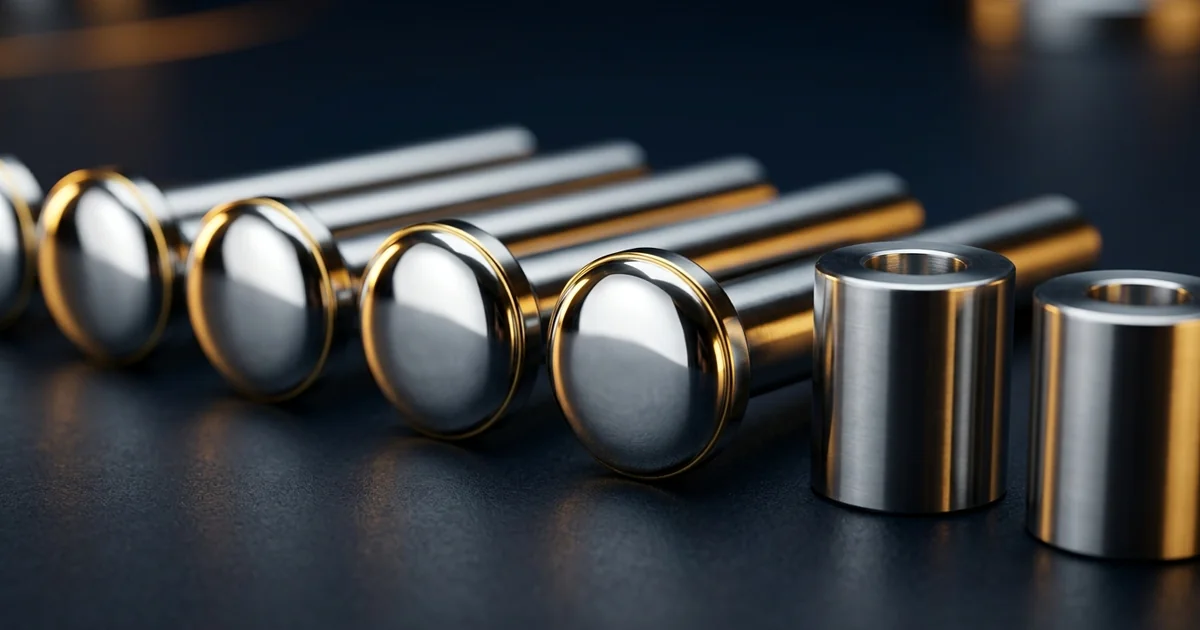
Tablet tooling is the set of punches and dies that compress powder into a tablet on a press. The upper and lower punches carry the tablet's face, including its cup shape and any embossing, while the die bore forms its side wall. ISO 18084:2011 specifies the main dimensions, tolerances and characteristics of punches and dies for all kinds of tablets. Its stated purpose is interchangeability of punches between the tableting machines of different manufacturers.
The ISO catalogue lists the standard as last reviewed and confirmed in 2022. Each part of the tool set has its own job and its own design options, which the table summarises from a tooling maker's 2022 technical article.
| Part | What It Does | Options Named in the Source |
|---|---|---|
| Punch head | Tracks through the press cams and passes under the pressure rolls | Angled or domed TSM head, EU head, extended head flat, rotating or indexable head, mirror-polished head |
| Punch barrel | Carries the head and tip and runs in the punch guides | Groove for dust cups or bellows, special key position and angle, mirror-finished barrel |
| Punch tip | Forms the tablet face: cup, land and any embossing | Cup depth, compound cup, reduced lower-tip width, increased relief depth |
| Die | Forms the tablet band and receives the punch tips | Bore taper, undercut, steel grade, carbide or ceramic liner |
The standard comes first, because it decides which of these options a press can accept.
TSM, EU and ISO 18084: Tooling Standards Compared
Most tablet tooling follows the B or D configuration, but two versions of those names exist. The American version is defined by the Tableting Specification Manual, known as the TSM. A 2008 article by Dale Natoli in Pharmaceutical Technology notes that the European Euronorm version is not published or governed by an organization or association. The two configurations are close, and the author suggested considering a single world standard.
| Feature | TSM | Euronorm |
|---|---|---|
| Standard governance | Published as the TSM | Not published or governed by an organization |
| Head profile | Angled top profile | Domed head profile |
| B-type inside head angle | 37° | 30° |
| D-type inside head angle | 30° | 30° |
| Overall head thickness | Greater | Less |
| Overall punch length | 0.010 inch shorter | 0.010 inch longer |
The table follows the 2008 article, so check current editions before ordering. A later article adds that the EU head predates the TSM domed head and should only be used on presses fitted with cams cut specifically for it. The full ISO 18084 tables sit behind the ISO paywall, so confirm dimensions against the current edition of whichever standard the press follows.
With the standard fixed, the geometry of the tablet face is the next decision.
Tablet Tooling Design: Cup Depth, Band and Die Taper
Cup depth and band thickness shape how stress is distributed through the powder bed, and that distribution affects whether a tablet holds together on release. For a given tablet thickness, a deeper cup leaves a thinner band. A 2023 study in Pharmaceutical Research tested eight punch geometries on acetaminophen tablets, from flat-faced to extra deep concave. It found that capping tendency rose with cup depth.
- Geometries tested — eight cup types ran from flat face, beveled edge and radius edge through standard, shallow and compound concave to deep and extra deep concave. Tablets were compressed from 50 to 300 MPa at 20 rpm on a Natoli NP-RD30 press.
- Capping index — the ratio of the compact's anisotropy, the axial to radial breaking force, to the material's anisotropy, the axial to radial Young's modulus.
- Result — a positive correlation between cup depth and capping index, and finite element analysis traced it to non-uniform stress distribution across the powder bed.
- Band thickness — Mazel and colleagues found that central lamination of biconvex tablets is promoted by tensile stresses from residual die wall pressure and tablet shape. A small band thickness and high compaction pressure favour it.
- Hidden cracks — X-ray tomography showed central cracks inside tablets that had not broken, so external visual examination can miss the failure.

Die taper attacks a different cause. A tooling maker explains that bore taper gives entrapped air room to escape and lowers ejection force, and it adds that the extra space lets the tablet begin expanding sooner. Air entrapment is a documented contributor to lamination. A 2015 compaction-simulator study gave direct proof of the role of air and found that lamination pressure fell as compact thickness rose. Our guide to pharmaceutical powder flow and granulation covers the powder side of deaeration.
Our guide to tablet defects covers these failures from the formulation side, and the imprint is where geometry meets regulation.
Tablet Shape and Embossing Design: Preventing Picking
Under 21 CFR 206.10, a solid oral dosage form drug product must carry a code imprint unless exempted under section 206.7. With the product's size, shape and color, the imprint must permit unique identification of the product and its manufacturer. The rule encourages letters or numbers over a symbol or logo alone. Every imprint is therefore cut into a punch tip, where it competes with the powder for adhesion.
A 2019 article by two Natoli engineers sets out how to design that imprint for picking resistance.
- Font — an ornate serif font is more prone to picking than a simple sans-serif font, which uses increased engraving and corner radii.
- Islands and peninsulas — islands are fully enclosed areas, such as the centre of the 9. Peninsulas are partly enclosed areas, found in E, S, K and M and in 2, 3 and 5.
- Pre-picking — it lowers an island by cutting less engraving depth. In the worked example an island depth fell from 0.30 mm to 0.15 mm, a 50 percent pre-pick, and the range runs from 10 to 100 percent.
- Taper — peninsulas are usually tapered between 10 and 50 percent of engraving depth, with 30 percent the most common.
- Compound cup — it gives more control over the cup curvature around the logo.
- Placement — character size, spacing and a position away from the centre can all reduce picking.
An imprint that survives the press still depends on what the punch face is made of.
Tablet Punch and Die Selection: Steels and Coatings
Steel choice decides how a tool resists impact, abrasion and corrosion, and how well powder releases from its face. Tooling makers group punch and die steels into a few families. Selection follows the product, because a sticky blend and an abrasive blend ask for different alloys. Coatings add a second route to release, with limits of their own.
| Steel Family | Examples Named | Use Described in the Sources |
|---|---|---|
| Standard shock-resistant | S7, S1, 408 | Punches for many pharma products; excellent shock resistance and higher maximum force ratings |
| High-chrome premium | M340, 440C | Sticky products, for enhanced release and corrosion resistance; M340 as punch steel, 440C for dies |
| Premium wear-resistant | D2, D3, K340, M2, A2 | Abrasive products and very long runs, resisting wear that degrades cup finish and tip edge |
| Particle metallurgy | PM3V, PM9V, PM10V; PM15V for dies | The most abrasion-resistant punch and die steels, for exceptionally abrasive products |
| Carbide or ceramic liner | Die liners | Die bore abrasion and wear rings with abrasive products |
The 2022 article notes that M340 is typically used for punches because of its higher impact toughness. Dies typically use 440C, since a punch and die of the same steel can increase the tendency to gall. The 2019 article puts the chromium in the high-chrome alloys at usually 16 to 18 percent. It names hard chrome and chromium nitride as the most common coatings and warns that coating layers can wear off over time. Release also depends on lubrication, covered in our guide to excipient selection for oral solid dosage forms.
A 2024 laboratory study compared uncoated steel with chromium nitride, zirconium nitride, titanium nitride and Ultracoat punches, pressing microcrystalline cellulose on a single-station press. After five hours the powder adhered to the titanium nitride and the uncoated steel punches. Surface roughness was similar across all punches.
Surface condition changes in service, which makes finish and cleaning a specification matter.
Punch Surface Finish, Roughness and Cleaning
A mirror-bright punch face is not necessarily a consistent one. Two recent studies show that roughness and surface chemistry each change sticking. Hughes and colleagues used a non-contact laser interferometer on chrome-coated S7 punches from commercial production that had developed sticking. Tsosie and colleagues found that a cleaned S7 punch surface changes within minutes of exposure to air.
- Roughness — the commercial punches failed acceptability criteria taken from a tooling standard, and the roughest areas matched areas of pronounced sticking.
- Lifetime monitoring — the interferometer method is non-destructive, so punches can be monitored over their lifetime and checked after coating treatments.
- Cleaning state — freshly cleaned punches showed strong adhesion for mannitol and starch. Starch lost its sticking tendency within minutes of aging, while mannitol stayed adhesive for several hours.
- Surface layer — contact angle and X-ray photoelectron spectroscopy showed a carbonaceous and oxide overlayer forming quickly, which reduced the polar surface energy.
- Visual checks — the authors state that a mirror finish does not guarantee the absence of residue or a consistent surface chemistry. They add that visual inspection is unreliable for judging cleanliness.
Wear changes the surface as well. The 2022 article notes that wear-resistant steels better resist the abrasive wear that degrades cup finish and tip edges. It adds that dies develop wear rings in the bore with abrasive products. The punch head wears too, with most of the wear concentrated in one small area because heads track through the cams in one direction.
These are laboratory results on small sets of excipients, so the practical lesson is process control. Define roughness acceptance, standardise the cleaning protocol and record the time between cleaning and use.
Surface control carries over when a product moves to another press, where more variables change.
Dwell Time, Press Type and Scale-Up
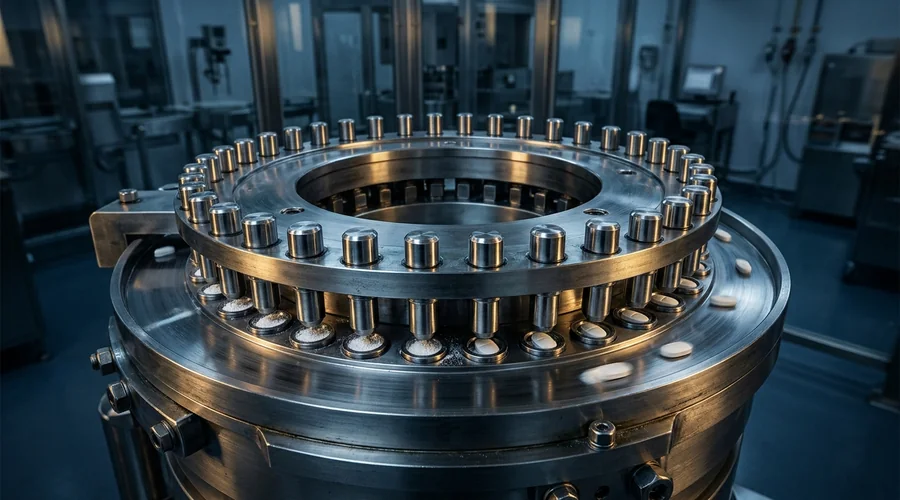
Tooling interacts with the press, so a tool set that works on one machine can behave differently on another. Dwell time depends on the turret pitch circle, press speed and head flat diameter, according to the 2022 article. Unloading conditions also differ between press types. Both matter when a product moves from a development press to production.
- Extended head flat — dwell can only be increased by slowing the press or enlarging the head flat. The extended head flat modification can extend dwell time by up to 40 percent, and it fits B and D tooling with TSM domed or EU head profiles.
- Unloading — in a 2019 compaction-simulator study, symmetrical decompression as on a rotary press gave capping and lamination for the model formulations. Asymmetrical unloading suppressed lamination, and loaded ejection eliminated both defects.
- Development presses — the same study's authors note that anticipating defects on eccentric presses can be complicated, especially for lamination.
- Small tablets — for very small tablets, typically 4 mm or less, the force rating depends on the lower punch tip bending or buckling. Undercut dies allow shortened, stronger tips, but they need shallow fill cams and effective lower punch retainers.
- Key position and angle — overall punch dimensions are largely standardised, yet key placement and angle vary with the press make and model.
A defect that appears only at scale is therefore often a tooling and press question before it is a formulation question. A clear specification sequence keeps those questions in order.
Decision Framework: Specifying Tablet Tooling
Specifying tooling works best as a sequence, because early decisions remove options from later ones. The order below runs from the press to the surface, and it ends with the questions that scale-up raises. Each step points back to a section above. The sequence suits a formulator, a technology-transfer team or a manufacturer briefing a development partner.
- Fix the standard and the press — TSM or Euronorm, B or D, the press make and model and the key angle.
- Set the tablet geometry — shape, thickness, cup depth and band thickness, with capping and lamination risk in mind. Ask the tooling supplier to review the design before it is frozen.
- Design the imprint — meet the identification rule in 21 CFR 206.10, choose a simple font, pre-pick islands, taper peninsulas and check logo clarity if the tablet will be coated.
- Match the steel to the blend — high-chrome grades for sticky products, wear-resistant or particle metallurgy grades for abrasive ones and liners for die wear.
- Decide on a coating — treat it as a surface-chemistry choice and plan for wear.
- Specify surface acceptance — roughness limits, a cleaning protocol and a defined time between cleaning and use.
- Plan the transfer — dwell time, unloading conditions, undercut dies and key details for each press the product will run on.
Followed in this order, the sequence turns a tooling catalogue into a specification that the formulation, the press and the regulation all support.
Working With a Pharmaceutical Formulation Consultant
Tooling decisions sit between powder behaviour, press mechanics and regulation, so a pharmaceutical formulation consultant works across all three. A brief usually starts with the tablet concept, the target press and the markets. Pharmaceutical product development services then carry the work from design review to trials on the intended press. Contract formulation and CDMO support can handle transfer and commercial supply.
- Tooling brief review — shape, cup depth, band and imprint checked against defect risk before tools are ordered.
- Formulation and tooling fit — lubricant and excipient choices matched to the steel and surface chosen.
- Defect investigation — separating formulation causes from tooling and press causes when capping, lamination, sticking or picking appears.
- Surface and cleaning procedures — roughness acceptance and cleaning steps written into the process.
- Scale-up and transfer — dwell time, unloading and tooling standard differences managed between sites.
The full range of services sits under pharmaceuticals and health care. Before approaching a consultant, collect the tablet drawings, the target press, the defects seen so far and the markets and standards involved.
Frequently Asked Questions
What is tablet tooling?
Tablet tooling is the set of punches and dies that compress powder into a tablet on a press. The punches carry the tablet's face, including its cup shape and any embossing, and the die bore forms its side wall. ISO 18084:2011 specifies the main dimensions, tolerances and characteristics of punches and dies for all kinds of tablets. It covers the measures needed to interchange punches between tableting machines of different manufacturers.
What is the difference between TSM and EU tablet tooling?
Both use the B and D configurations, but a 2008 article by Dale Natoli lists differences. The TSM head has an angled top profile while the Euronorm head is domed. The B-type inside head angle is 37 degrees against 30 degrees, and the TSM punch is 0.010 inch shorter. It also notes that the Euronorm configuration is not published or governed by an organization. A 2022 article adds that the EU head should only be used on presses fitted with cams cut for it, so check current editions and the press before ordering.
Does cup depth affect tablet capping?
In a 2023 study of eight punch geometries on acetaminophen tablets, capping tendency rose with cup depth. Finite element analysis traced the effect to non-uniform stress distribution across the powder bed. A separate study found that central lamination of biconvex tablets is favoured by a small band thickness and high compaction pressure. These results come from specific model formulations, so confirm the effect for your own blend on the intended press.
How do you prevent picking on embossed tablets?
US rules require a code imprint on most solid oral dosage forms, so the imprint has to survive compression. A tooling maker's 2019 guidance is to choose a simple sans-serif font and to pre-pick enclosed areas, such as the centre of a 9, by reducing engraving depth. It also advises tapering partly enclosed areas, such as the strokes of an E, and considering a compound cup. Excessive pre-pick reduces logo clarity on tablets that are coated after compression, so decide on coating before cutting the imprint.
Which punch steel suits sticky or abrasive products?
Tooling makers recommend high-chrome grades such as M340 and 440C for sticky products because they release powder better and resist corrosion. For abrasive products they recommend wear-resistant grades such as D2, particle metallurgy grades such as PM3V, PM9V and PM10V, and carbide or ceramic liners for worn die bores. Coatings such as hard chrome and chromium nitride add release but can wear off over time. A 2024 study found that surface chemistry rather than roughness separated the punches that stuck.
Does a mirror finish prevent sticking?
No. A 2026 study of S7 punch surfaces states that a mirror finish does not guarantee the absence of residue or a consistent surface chemistry. Cleaned punches changed their adhesion behaviour within minutes of exposure to air. A 2023 study found that chrome-coated punches with sticking had unacceptable roughness, and the roughest areas matched the areas of sticking, so both roughness and cleaning need written acceptance.
Why does a tablet defect appear only on a production press?
Presses differ in dwell time, unloading conditions and tooling details. In a 2019 compaction-simulator study, symmetrical decompression as on a rotary press produced capping and lamination for the model formulations, while asymmetrical unloading suppressed lamination. Dwell time depends on the turret pitch circle, press speed and head flat diameter, and key position and angle vary with press make and model. Compare tooling and press conditions before changing the formulation.
How can a pharmaceutical formulation consultant help with tablet tooling?
A consultant reviews the tablet shape, cup depth, band and imprint against defect risk before tools are ordered, and matches lubricant and excipient choices to the steel and surface. The same work separates formulation causes from tooling and press causes when defects appear. Pharmaceutical product development services extend this to cleaning and roughness procedures and press-to-press transfer, and contract formulation and CDMO support then handle commercial supply.
Specifying or Troubleshooting Tablet Tooling?
Global Formulation supports pharmaceutical teams with tooling design review, defect investigation, lubricant and excipient fit, surface and cleaning procedures, and technology transfer to a contract manufacturing partner.
Talk to Our Formulation Team