Textile Spin Finish Oil Chemistry: Lubricating Synthetic Fiber
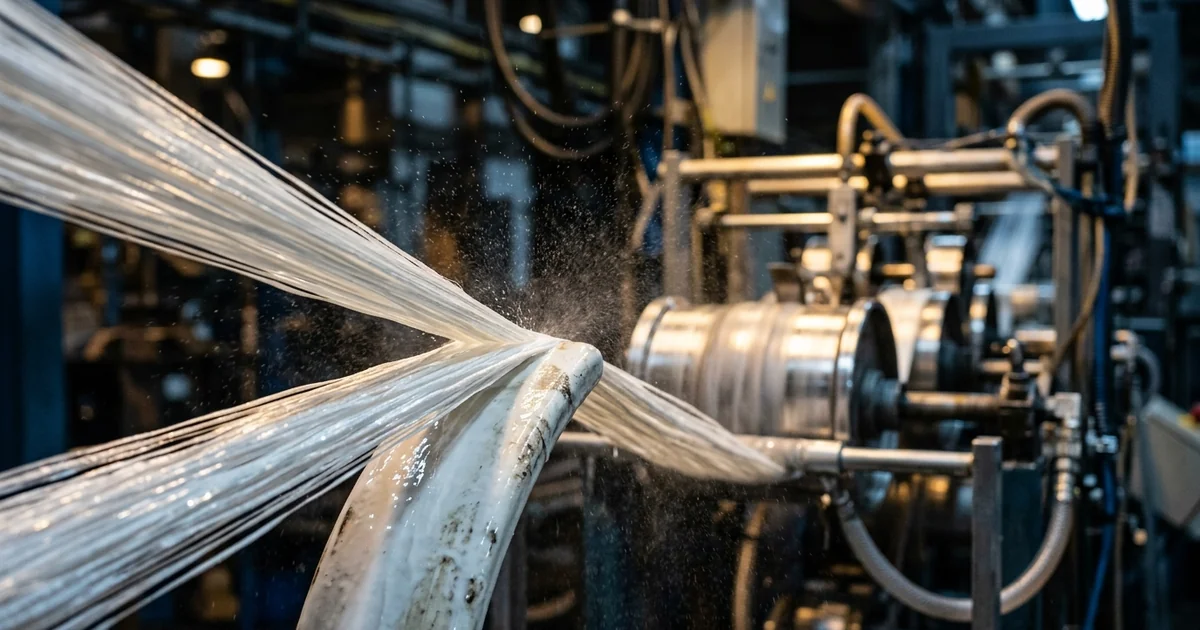
A polyester spinning line accelerates to production speed, and within minutes the winders are throwing static fly, filaments are wrapping the godets, and the packages are building soft and fuzzy. Nine times out of ten the polymer is fine and the fault is the surface coating: the textile spin finish oil chemistry is wrong for the process, or the pick-up has drifted. That thin layer of lubricant, emulsifier and antistatic agent is what lets brittle, highly charged synthetic filament survive contact with metal at thousands of metres a minute, and getting it wrong quietly wastes yield across every shift. This guide explains what a spin finish has to achieve, the lubricant and antistat chemistry inside it, how the application emulsion is kept stable, and how finish level is measured and controlled. It reflects the pattern we see across industrial lubricant problems, where the additive package is sound but the application and monitoring are where performance leaks away.
What a Spin Finish Does on Synthetic Fiber
To specify a finish you first have to be clear about the forces it is fighting. Synthetic fiber is spun and processed at high speed over hard ceramic and chromed-steel guides, and the polymer itself is a stiff electrical insulator with almost no natural lubricity. Every contact point generates friction and triboelectric charge, and a bare filament bundle has no way to shed either. A spin finish is the engineered surface layer that manages all of it, and it carries several distinct jobs at once.
- Friction control — it lowers the fiber-to-metal friction at guides, godets and heaters so threadline tension stays within a safe band and filaments do not snap or abrade
- Static dissipation — it makes the fiber surface slightly conductive so the charge built up at each contact leaks away instead of accumulating into fly, balloons and lapping
- Bundle cohesion — it holds the individual filaments together as a coherent yarn for winding, unwinding and downstream handling, without gluing them so tightly they cannot open in texturing
- Surface protection and downstream feed — it shields the fresh fiber surface and carries the frictional and antistatic properties the next process step needs, whether that is drawing, texturing, warping or knitting
The finish is applied as a fraction of a percent to a few percent on the weight of fiber, depending on whether the product is continuous filament or staple, and it is a processing aid rather than part of the finished textile. That framing matters, because almost every property of the finish is a compromise tuned to a specific machine and a specific downstream route, which is the theme the rest of this article develops.
Inside Spin Finish Oil Chemistry: Lubricant, Emulsifier, Antistat
A spin finish looks simple on a data sheet but is a balanced multi-component system, and each group of ingredients earns its place. The lubricant base is the largest part and sets the friction behaviour. The emulsifier system lets that oily base be diluted into water for application and keeps it stable. The antistatic agent handles charge, and a set of minor additives protects the finish, the fiber and the machinery. Understanding what each group does makes a supplier's specification far easier to read critically.
| Component group | Typical chemistry | Function |
|---|---|---|
| Lubricant base | Refined mineral (white) oil; synthetic polyol esters such as trimethylolpropane and pentaerythritol esters; polyethylene glycol esters; ethylene-oxide / propylene-oxide copolymers; silicone fluids for low fiber-to-fiber friction | Sets fiber-to-metal and fiber-to-fiber friction; carries the film that separates fiber from hard surfaces |
| Emulsifier | Nonionic surfactants — ethoxylated fatty alcohols, ethoxylated fatty acids, ethoxylated castor oil, sorbitan ester ethoxylates; anionic co-emulsifiers | Disperses the lubricant into a stable water emulsion; contributes hygroscopic antistatic effect and wetting |
| Antistatic agent | Potassium or ammonium salts of mono- and di-alkyl phosphate esters; alkane sulfonates; sulfosuccinate esters; occasionally quaternary ammonium salts | Lowers fiber surface resistivity so triboelectric charge dissipates rather than accumulating |
| Cohesive agent | Higher-molecular-weight polyethylene glycols; polyacrylate or polyurethane thickeners | Increases filament-to-filament cohesion for bundle integrity during winding and unwinding |
| Protective additives | Biocide / preservative, antioxidant, corrosion inhibitor, pH buffer, antifoam | Keep the circulating bath free of microbial growth, protect esters at heater temperatures, protect steel and aluminium machine parts and packages |
The lubricant choice is the biggest single decision. Mineral oil is cheap and lubricates well, but it can absorb into some polymers, it smokes at texturing temperatures, and it leaves a heavy residue on hot surfaces. Synthetic esters cost more but volatilise more cleanly and resist thermal breakdown, which is why they dominate finishes for high-temperature draw-texturing. Water-soluble esters and glycol copolymers add lubrication while also helping the emulsion and the antistatic performance, so many finishes blend several base types, exactly as a conventional lubricant blends base stocks to hit a property target — the same logic set out in our overview of lubricant formulation science. The next question is how that blend is turned into an even coating.
Spin Finish Emulsion Chemistry and Bath Stability
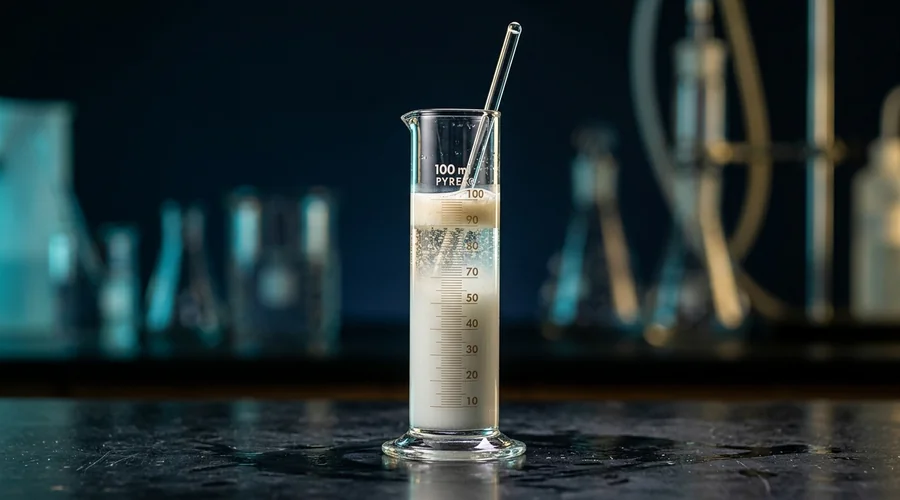
Almost every spin finish reaches the fiber as an oil-in-water emulsion, and the reason is practical. Metering a fraction of a percent of neat oil evenly onto fast-moving filament is difficult, but diluting that oil into water gives a larger, more manageable delivered volume that spreads uniformly and then flashes off to leave a thin film. The emulsion also lets an oily lubricant and water-soluble antistats travel together in one applied liquid. The cost of that convenience is that the emulsion has to stay stable under mill conditions, and several things attack it.
- Water hardness — calcium and magnesium ions can salt out anionic emulsifiers and antistats, coarsening the emulsion or breaking it, which is why many finishes specify deionised or softened water
- Temperature and shear — recirculating pumps and kiss rolls put the bath under continuous shear, and warm mill environments accelerate creaming and coalescence of the oil droplets
- Concentration drift — in a recirculated bath, evaporation concentrates the finish while fiber pick-up depletes it, so the applied concentration moves unless it is actively corrected
- Microbial growth — a warm, dilute, nutrient-rich water bath is an ideal home for bacteria and fungi, which produce slime, odour and acids that destabilise the emulsion and stain the fiber
Formulators answer this by designing self-emulsifying concentrates with a balanced surfactant blend, so the mill only adds water and gets a reproducible droplet size. Bath management does the rest: automatic water make-up controlled by a refractometer or conductivity meter holds the concentration steady, a preservative and disciplined housekeeping keep microbes down, and the concentrate is specified with a storage and freeze-thaw stability window. A finish that is chemically perfect but unstable in the mill's actual water will still fail, so emulsion robustness is part of the specification, not an afterthought.
Antistatic Behaviour on Synthetic Fiber
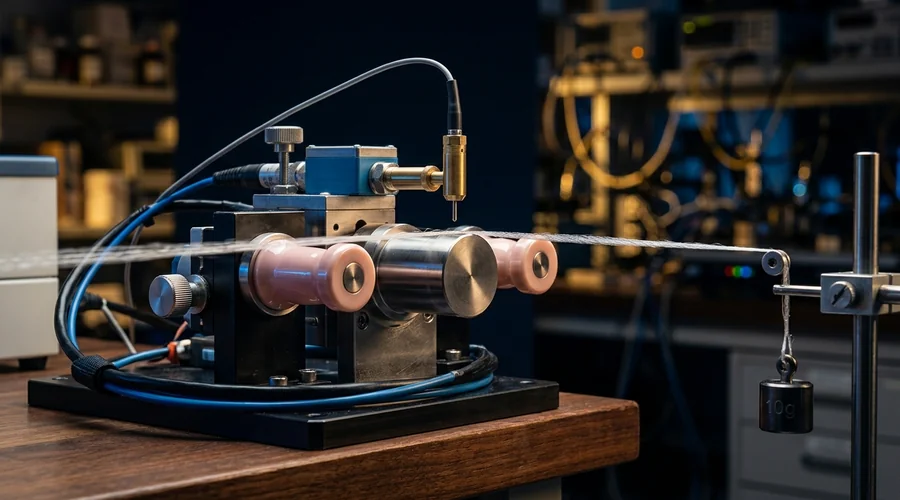
Static is not a nuisance on a synthetic fiber line; it is a primary process limit. Polyester, nylon and polypropylene are insulators with very high surface resistivity, so the charge generated at every guide has nowhere to go and builds until the filaments repel each other, spray outward as fly, lap the rolls or draw sparks near solvent or dust. An antistatic agent in the finish lowers the fiber surface resistivity so charge dissipates as fast as it forms, and it does this through two mechanisms that behave differently.
- Ionic surface conduction — salts such as alkyl phosphate esters form a thin ionic layer on the fiber that carries charge away by ion mobility, and this pathway keeps working reasonably well even in dry air
- Hygroscopic water film — polar and ethoxylated components attract a molecular film of atmospheric moisture, and that water film conducts the charge; this contribution falls sharply as relative humidity drops
The humidity dependence is why static complaints spike in winter and in air-conditioned plants, and why fiber-processing halls hold a controlled relative humidity rather than leaving it to chance. It is also why a finish that tested well in a humid lab can fail in a dry mill: the ionic antistat has to carry the load when the water film thins. The frictional and antistatic demands are linked, because both are governed by what happens at the fiber surface, and the same capstan relationship that amplifies threadline tension over each guide also determines how much rubbing, and therefore how much charging, occurs. For the deeper additive picture behind these choices, our guide to lubricant additive functions covers how friction modifiers and antistatic surfactants are engineered.
Application Methods and Finish-on-Yarn Control
How the finish is delivered matters as much as what is in it, because an uneven coating produces exactly the faults the finish is meant to prevent. Dry patches charge and break; heavy patches drip, smoke on heaters and cause dye defects. The three common application methods trade uniformity against cost and complexity, and the choice usually follows the fiber form and the line speed.
| Method | How it works | Where it fits |
|---|---|---|
| Metered applicator | A positive-displacement pump feeds finish to a ceramic tip, slot or pin at a rate locked to yarn speed | High-speed continuous filament spinning and draw-texturing, where uniform pick-up is critical |
| Kiss roll | A slowly turning roll dips into a finish trough and transfers a film to the yarn running across it | Lower-speed filament and some staple lines; simpler and cheaper but pick-up varies with speed and bath level |
| Spray application | Finish emulsion is sprayed onto a moving tow or web | Staple tow before crimping and cutting, and nonwoven webs such as spunbond and meltblown |
The quantity that ends up on the fiber is called finish on yarn or oil pick-up, and it is controlled and verified as a routine parameter. On the line, a speed-proportional metering pump keeps the delivered rate correct as the machine accelerates, while a recirculating kiss-roll bath needs automatic concentration control. Off the line, finish on yarn is measured by solvent extraction against a standard such as ASTM D2257 for extractable matter in textiles, and many modern lines add an online infrared or low-field nuclear magnetic resonance gauge for continuous feedback. Staple and filament often take two finish stages, a primary finish at spinning and a secondary finish at draw-texturing or at the tow line, and the two can be different chemistries chosen for their own process step. Whichever route is used, the discipline is the same: measure the pick-up, keep records, and treat a drift in finish on yarn as a process fault to investigate, the same way you would treat a metalworking fluid concentration drift.
Testing, Scourability and Regulatory Limits
A spin finish is only qualified when it has been tested for the properties that matter downstream, not just for friction on the bench. The finish has to spread and pick up evenly, dissipate charge at low humidity, survive the thermal load of texturing, wash out cleanly in dyeing, and meet the chemical restrictions that apply to textile inputs. Skipping any of these checks tends to surface as a defect much later, when the fiber is already fabric.
- Friction — fiber-to-metal and fiber-to-fiber friction are measured on a capstan or yarn-friction tester, and the result has to sit inside the band the target process needs
- Static — yarn specific resistance or charge decay on a running threadline is measured, ideally across a range of relative humidity down to the mill's worst case
- Thermal behaviour — volatility, smoke and heater-deposit tests screen how cleanly the finish behaves on hot texturing surfaces
- Emulsion stability — storage, hard-water and freeze-thaw cycling confirm the concentrate and the diluted bath hold up under real conditions
- Scourability and compatibility — the finish is checked for clean removal in the dye bath, and for any interference with dyeing, coating adhesion or rubber bonding where the fiber is left with residual finish
Scourability deserves particular attention because a residue that survives the dye bath shows up as oil spots, streaks and uneven shade, and for coated or laminated fabrics it weakens the bond at the interface. Regulatory limits are the other hard constraint. Alkylphenol ethoxylate emulsifiers, once common in spin finishes, are now designed out under the REACH restriction on nonylphenol ethoxylates, which caps them in textile articles that can be washed at 0.01 percent by weight. Restricted-substance lists for the textile supply chain, biodegradability expectations for the emulsifiers and lubricants, and low-fogging requirements for automotive textiles all narrow the formulator's options further. The practical decision framework is to fix the downstream route first, set the friction and antistatic targets and the humidity worst case from that route, then choose the most thermally stable and cleanly scourable chemistry that meets the applicable restricted-substance limits, and only then optimise cost. Do it in that order and the finish supports the process; do it cost-first and the yield loss shows up on every shift.
Frequently Asked Questions
What is a textile spin finish and why is it applied to synthetic fiber?
A spin finish is a thin coating of lubricant, emulsifier and antistatic agents applied to synthetic filament and staple fiber as it is spun, usually from a dilute water emulsion. It does three jobs at once: it lowers the friction between the fiber and the metal guides, rolls and heaters it runs over; it dissipates the static charge that hydrophobic polymers such as polyester and polypropylene build up during high-speed contact; and it gives the filament bundle enough cohesion to stay together through winding and downstream processing.
Without it, a modern spinning line running at thousands of metres a minute would produce broken filaments, static fly, wraps on the godets and unusable packages. The finish is a processing aid, not part of the final product, and most of it is meant to wash out in dyeing.
What are the main components of a spin finish oil?
A spin finish is built around a lubricant base, which is the largest single part and is usually a refined mineral oil, a synthetic polyol ester, a polyethylene glycol ester or an ethylene-oxide/propylene-oxide copolymer, sometimes with silicone for very low fiber-to-fiber friction. Around that sit nonionic emulsifiers, typically ethoxylated fatty alcohols, ethoxylated fatty acids or ethoxylated castor oil, which let the oil be diluted into a stable water emulsion.
The third functional group is the antistatic agent, most often a potassium or ammonium salt of an alkyl phosphate ester, or an alkane sulfonate or sulfosuccinate. Minor additives complete the package: cohesive film formers, wetting agents, an emulsion stabiliser, a preservative for the circulating bath, an antioxidant, a corrosion inhibitor and a pH buffer.
How does the antistatic part of a spin finish actually work?
Synthetic polymers are electrical insulators with very high surface resistivity, so the charge generated when fiber rubs against a guide has nowhere to go and simply accumulates. An antistatic agent lowers that surface resistivity in two ways. Ionic salts such as alkyl phosphates form a thin conductive layer on the fiber surface that lets charge leak away by ion movement, and this works fairly well even in dry air.
Hygroscopic components, including many of the ethoxylated emulsifiers, pull a molecular film of water from the atmosphere, and that water film carries the charge. This part of the effect fades as relative humidity drops, which is why static problems are worse in winter and why conditioning rooms hold a controlled humidity.
Why is spin finish applied as a water emulsion instead of neat oil?
Applying a fraction of a percent of active material evenly onto fast-moving fiber is far easier when the active is diluted into water, because the larger delivered volume is simpler to meter and spread uniformly, and the water flashes off leaving a thin, even film. A water emulsion also lets the formulator combine an oily lubricant with water-soluble antistats and cohesive agents in one applied liquid.
The trade-off is that the emulsion has to be stable: stable to the water hardness and temperature at the mill, stable to the shear of the recirculating system, and stable in storage as a concentrate. Formulators design self-emulsifying concentrates with a balanced surfactant system so the mill only has to add water, and many specify deionised water to stop hardness ions from salting out the anionic components.
What changes in a spin finish for draw-texturing versus plain spinning?
False-twist and air-jet texturing pull the yarn over heaters that can run well above 200 degrees Celsius, so the finish sees a thermal load that a simple spinning finish never does. Mineral oil smokes and leaves a sticky tar or varnish on heaters, guides and friction discs at those temperatures, which forces line stoppages for cleaning and causes yarn faults.
Texturing finishes therefore lean on thermally stable synthetic esters, especially neopentyl polyol esters, that volatilise more cleanly and leave far less residue. The friction target also shifts: the finish has to give the yarn the right grip on the friction discs to insert twist reliably, so it is tuned rather than simply minimised, and heater-deposit and volatility bench tests become part of qualifying the product.
How is the amount of spin finish on the fiber measured and controlled?
The quantity on the fiber is called finish on yarn or oil pick-up, and it is usually measured by solvent extraction: a weighed length of yarn is extracted with a solvent, the solvent is evaporated, and the residue is weighed against the fiber mass, following a method such as ASTM D2257. Many modern lines also carry an online gauge using infrared absorption or low-field nuclear magnetic resonance to read pick-up continuously and feed back to the metering pump.
Control on the line comes from a positive-displacement pump matched to the yarn speed, so the delivered rate stays proportional as the line accelerates. In a recirculating kiss-roll system, the bath concentration is held steady with automatic water make-up guided by a refractometer or conductivity meter, because evaporation concentrates the bath while fiber pick-up depletes it.
Does spin finish need to be removed before dyeing or coating?
Most spin finishes are designed to scour out cleanly in the dyeing or wet-processing bath, and if they do not, the residue shows up as oil spots, streaks or uneven shade, because oily patches repel dye liquor. For fabrics that will be coated, laminated or bonded, leftover finish is a bigger problem: it sits at the interface and weakens adhesion, so those substrates often get a dedicated scour before the coating step.
Tyre cord and other rubber-reinforcement yarns are an extreme case, where finish chemistry is chosen specifically so it does not interfere with the resorcinol-formaldehyde-latex dip that bonds the cord to rubber. Where a finish is deliberately left on, for example a coning oil on sewing thread, it is chosen to be compatible with the end use rather than to wash away.
Developing or Troubleshooting a Fiber Finish?
Global Formulation provides lubricant and specialty-fluid consultancy — spin finish and coning oil development, friction and antistatic tuning, emulsion stability work and restricted-substance compliance from concept to line trial.
Talk to Our Lubricants Team