Topical Semisolid Formulation: Creams, Gels, and Ointments for Drug Delivery
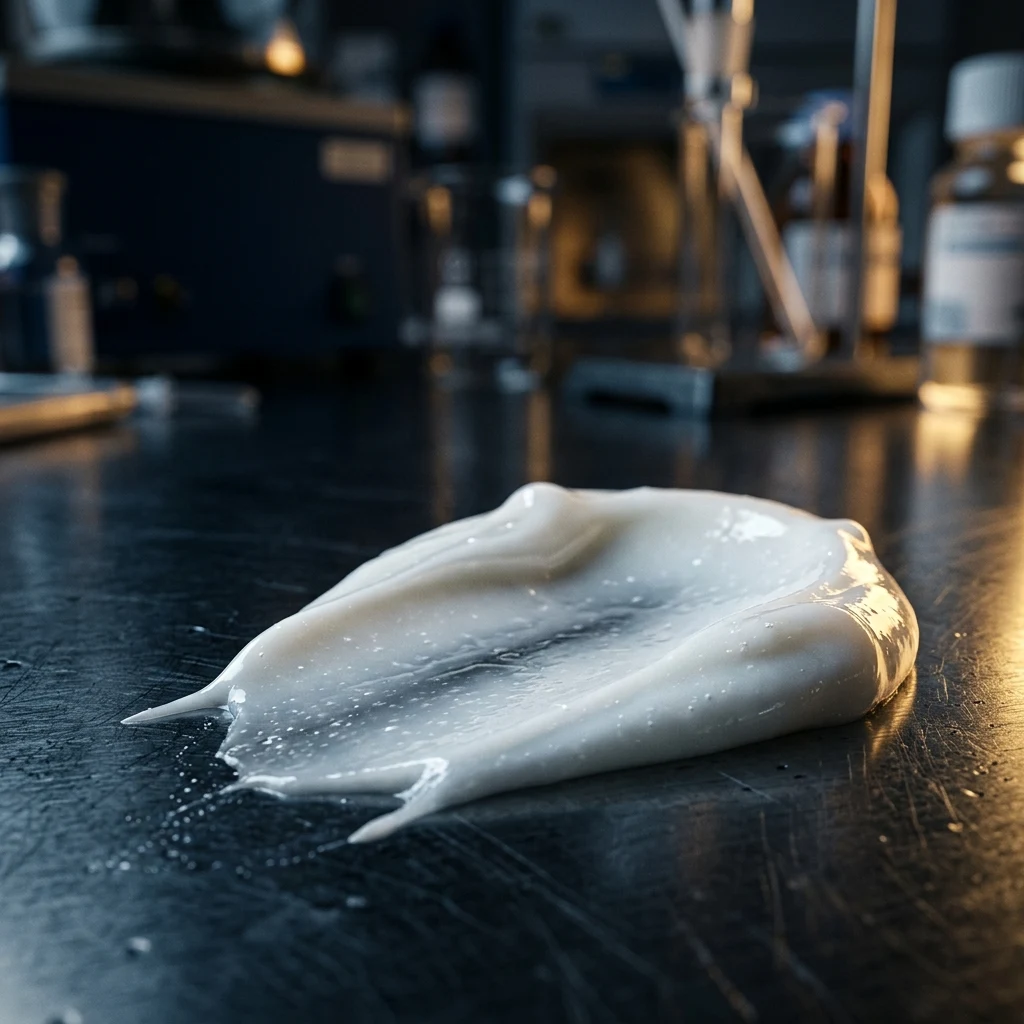
A topical drug product that tests perfectly in the lab but separates in its tube, spreads unevenly on skin, or releases its active ingredient inconsistently between batches never makes it past scale-up — and the root cause is almost always traced back to the semisolid base itself. Topical semisolid formulation is the discipline of building creams, gels, and ointments that deliver a drug reliably through skin while remaining physically stable, easy to apply, and manufacturable at commercial scale, and getting any one of those requirements wrong can stall a promising product for months. The stakes are high because semisolids sit at the intersection of three demanding disciplines at once: emulsion or gel-network chemistry, skin biology, and pharmaceutical manufacturing science, each with its own failure modes. This guide walks through how cream, gel, and ointment bases differ structurally, how rheology and penetration chemistry govern real-world performance, and what a rigorous manufacturing and stability program looks like before a semisolid product is ready for the market. Understanding these mechanics gives pharma formulators and brand teams the vocabulary to evaluate a contract manufacturer's semisolid process with genuine technical confidence.
Creams, Gels, and Ointments: Comparing Semisolid Dosage Forms
Every topical semisolid formulation starts with a base-type decision, and that single choice shapes nearly everything downstream — spreadability, occlusivity, drug release rate, and even how easily the active ingredient can be dissolved or suspended within the vehicle. Creams, gels, and ointments are structurally distinct systems, not interchangeable textures of the same underlying chemistry, and confusing them at the design stage leads to formulations that fight against the product's intended use. This distinction matters across all of pharmaceuticals and health care product development, from prescription dermatology treatments to OTC topical analgesics.
| Dosage Form | Structure | Typical Skin Feel / Use Case |
|---|---|---|
| Cream | Oil-in-water or water-in-oil emulsion, stabilized by an emulsifier system | Lighter, spreadable; O/W creams rinse off or absorb more readily than W/O creams |
| Ointment | Largely anhydrous, single-phase hydrocarbon, absorption, or water-soluble base | Thick, occlusive film; favored for dry or highly keratinized skin conditions |
| Gel | Liquid phase, typically aqueous, structured by a gelling polymer network | Translucent, non-greasy, rapid spreading; no emulsifier interface to destabilize |
Oral controlled-release dosage forms face a structurally different but conceptually related challenge — controlling where and how fast a drug is released — which is covered in detail in our guide to enteric-coated formulation design. For topical products specifically, the base-type decision made here cascades directly into the next design layer: how the finished formulation actually behaves under shear during application, which is a question of rheology.
Rheology and Base Selection for Topical Products
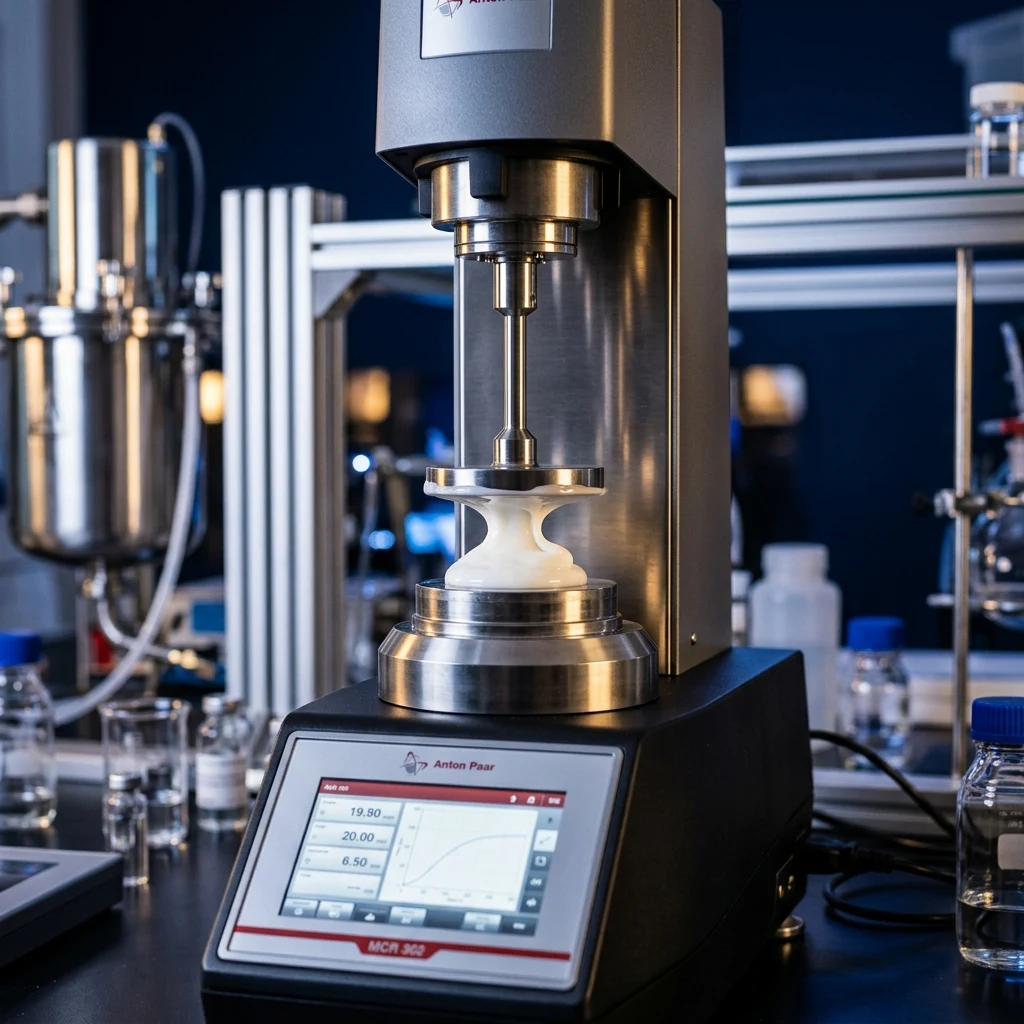
A topical formulation has to satisfy two rheological demands that pull in opposite directions: it must spread easily under the light shear of finger application, yet hold its position on skin afterward without running or dripping off vertical surfaces. Achieving both simultaneously requires shear-thinning behavior — a viscosity that drops sharply under applied shear and recovers once shear stops — combined with an adequate yield stress at rest. Formulators quantify this behavior with rotational and oscillatory rheometry, generating flow curves and viscoelastic profiles that become part of the formal product specification, not just a qualitative sensory impression.
- Hydrocarbon bases — petrolatum and mineral oil-based systems; highly occlusive, chemically inert, minimal water content
- Absorption bases — anhydrous bases such as lanolin-containing systems capable of absorbing some water while remaining largely non-aqueous
- Water-removable (emulsion) bases — oil-in-water creams that wash off with water, generally preferred where cosmetic elegance matters
- Water-soluble bases — typically polyethylene glycol systems that dissolve fully in water and contain no oil phase at all
Base type and rheology together define how the product feels and behaves on skin, but they say nothing yet about whether the active ingredient actually reaches its intended site of action — that depends on a separate set of penetration and release chemistry decisions.
Formulating for Skin Penetration and Drug Release
The stratum corneum exists specifically to keep external substances out of the body, which means every topical formulation is, at its core, an exercise in engineering a controlled and deliberate exception to that barrier. Drug release from the vehicle and subsequent penetration through skin are two separate steps, and a formulation can fail at either one independently — a well-designed vehicle can still underperform if the active ingredient's physicochemical properties are fundamentally mismatched to topical delivery, while a suitable drug candidate can underperform in a poorly designed vehicle that fails to release it efficiently.
- API physicochemical properties — molecular weight, lipophilicity (log P), and melting point all influence how readily a drug partitions out of the vehicle and into the stratum corneum's lipid-rich intercellular matrix
- Vehicle composition — the thermodynamic activity of the drug within its vehicle, not just total drug concentration, drives the diffusion gradient that pushes the active into skin
- Penetration enhancers — ingredients that reversibly loosen stratum corneum lipid packing or otherwise increase drug solubility within the barrier layer, improving flux at the cost of requiring careful tolerability evaluation
- Occlusivity — occlusive bases increase skin hydration and can meaningfully enhance penetration for some actives simply by changing the barrier's local hydration state
Formulators verify release performance using standardized in vitro methods, most commonly Franz diffusion cell testing, in which the formulation is placed against a membrane and drug flux into a receptor solution is measured over time — a method with a well-established scientific record described in detail in the Franz cell literature. This in vitro release testing (IVRT) approach differs from in vitro permeation testing conducted on excised skin, and regulatory submissions typically expect both types of data depending on the product's claims. Products delivering systemic rather than purely local effects sometimes use a transdermal patch format instead of a semisolid vehicle entirely, a delivery route with its own distinct adhesive and rate-controlling membrane chemistry covered in our guide to transdermal drug delivery patch technology.
Getting release and penetration chemistry right on paper is only half the challenge — the manufacturing process itself has to reproduce that same performance reliably, batch after batch, at commercial scale.
Manufacturing: Mixing, Homogenization, and Process Control
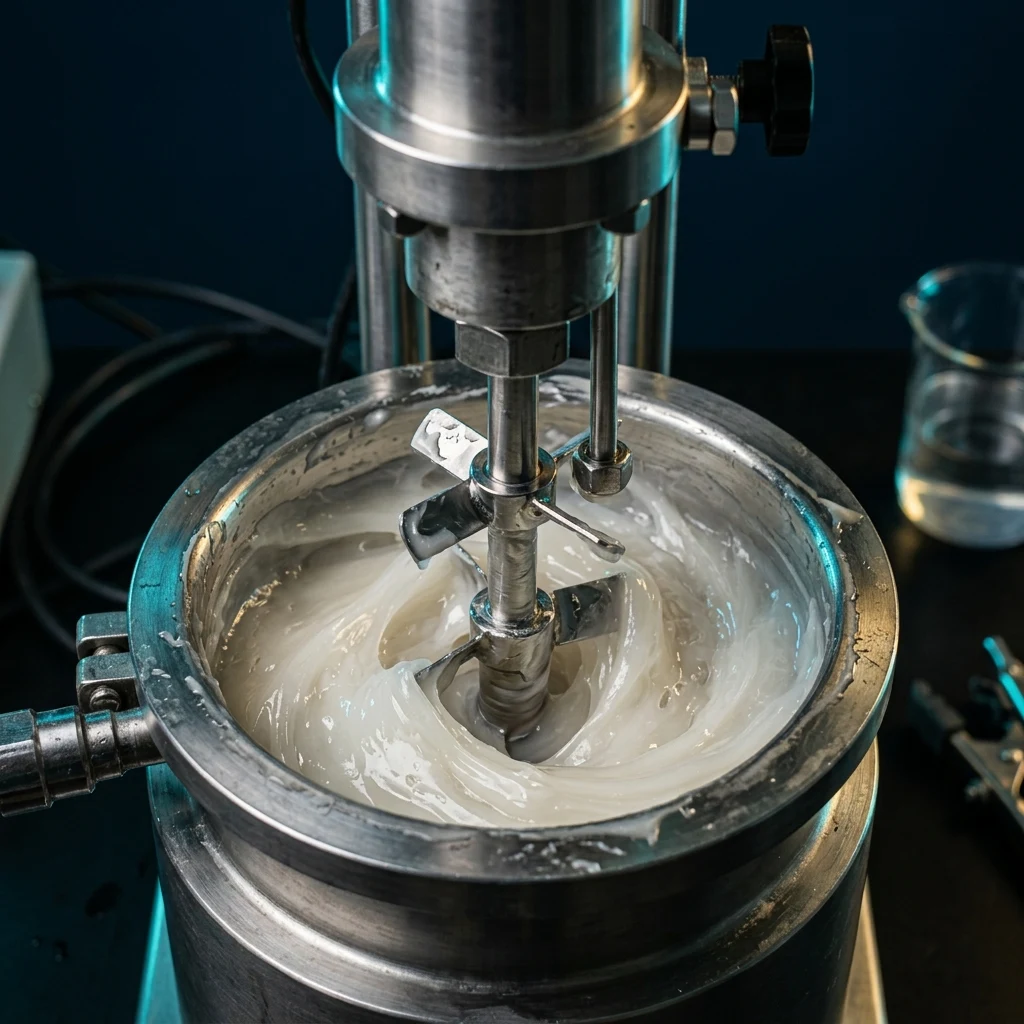
Semisolid manufacturing is not simply combining ingredients in the right ratio — the mechanical process used to combine them directly determines the finished product's droplet size, crystal structure, and ultimately its physical stability and drug release consistency. Two batches made from an identical formula can behave completely differently if homogenization intensity, phase addition temperature, or cooling rate differ between them, which is why process parameters are treated as critical to product quality, not just operational preference.
| Process Variable | Effect on Finished Product |
|---|---|
| Homogenization speed and duration | Controls emulsion droplet size distribution; under-homogenization risks poor stability, over-homogenization can affect viscosity and API distribution |
| Phase combination temperature | Emulsification typically occurs above the melting point of waxy components; premature cooling during mixing risks incomplete emulsification |
| Cooling rate | Governs crystal size and polymorphic form of waxes and fatty alcohols, affecting hardness, spreadability, and sometimes drug release rate |
| Mixing vessel scale and geometry | Heat transfer and shear distribution change between bench and production scale, requiring scale-up trials rather than direct parameter transfer |
A formulation that performs flawlessly in a small development batch is not automatically manufacturable at commercial scale, because heat transfer and mixing uniformity both change nonlinearly as vessel size increases — which is exactly why critical process parameters have to be identified and validated through structured scale-up trials rather than assumed to transfer directly from bench-scale success.
Stability, Preservation, and Packaging Considerations
A semisolid formulation that is physically and chemically sound at the moment of manufacture still has to survive its full labeled shelf life without separating, losing potency, or supporting microbial growth, which makes stability and preservation design an integral part of the formulation itself rather than an afterthought handled during quality control. Each base type carries its own characteristic failure mode, and anticipating that failure mode shapes both the formulation and its packaging.
- Emulsion stability — creams can separate under temperature cycling or when the emulsifier system is mismatched to the oil phase, so accelerated and real-time stability studies specifically probe for creaming, coalescence, or phase separation
- Gel network stability — many gelling polymers are sensitive to electrolytes, pH shifts, or incompatible actives, any of which can cause viscosity loss, syneresis, or cloudiness over time
- Microbial preservation — aqueous-based creams and gels require a validated preservative system, tested against defined challenge organisms to confirm antimicrobial effectiveness throughout shelf life and in-use conditions
- Packaging compatibility — tubes, jars, and airless pump systems each present different oxygen exposure, contamination risk, and extractable/leachable profiles that must be validated against the specific formulation
Formal stability programs generally follow internationally recognized frameworks such as ICH's stability guidelines, which define storage conditions, testing intervals, and acceptance criteria a formulation must meet before a shelf-life claim can be supported — a topic that connects directly to the broader regulatory expectations covered next.
Regulatory and Quality Considerations for Topical Pharmaceuticals
Topical semisolid products carry a distinct regulatory framework built specifically around the fact that formulation and process changes can alter in vivo performance even when the label formula stays identical. Regulators treat semisolids differently from oral solid dosage forms precisely because release and penetration performance are so sensitive to manufacturing and formulation variables that look minor on paper.
In the United States, the FDA's SUPAC-SS guidance for nonsterile semisolid dosage forms defines which formulation and manufacturing changes require additional testing or regulatory filings after initial approval, using IVRT as a key comparative tool for demonstrating that a post-approval change has not altered product performance. Stability programs supporting shelf-life claims are generally designed around ICH stability guidelines, while pharmacopeial standards published by organizations such as the United States Pharmacopeia define compendial testing methods for parameters including preservative effectiveness and drug release.
Building regulatory strategy alongside formulation development, rather than treating it as a final administrative step, is what allows a semisolid product to move from bench formulation through scale-up and into the market without a late-stage compliance surprise derailing an otherwise sound formulation.
Frequently Asked Questions
What's the practical difference between a cream, a gel, and an ointment?
A cream is an emulsion — either oil-in-water or water-in-oil — containing both an aqueous and an oily phase held together by an emulsifier, which gives it a lighter, spreadable feel that can be formulated to rinse off or absorb into skin. An ointment is typically a single-phase, largely anhydrous system built on a hydrocarbon, absorption, or water-soluble base, producing a thicker, more occlusive film that holds moisture against the skin.
A gel is a semisolid built by a gelling agent forming a three-dimensional network through a liquid phase, most often aqueous, giving a translucent, non-greasy texture with rapid spreading and no emulsifier-related stability concerns. Choosing between the three is a formulation decision driven by the target skin condition, desired occlusivity, and the active ingredient's compatibility with each base type.
Why does a semisolid formulation's rheology matter for how it performs in use?
Rheology determines whether a product spreads easily under the shear of finger application yet stays in place afterward without running off vertical or inclined skin surfaces, a balance achieved through shear-thinning behavior combined with an adequate yield stress. A product with too little yield stress migrates away from the application site before the active ingredient can be absorbed, undermining dosing accuracy and patient compliance.
A product with too much viscosity or an inadequate shear-thinning profile feels difficult to spread and creates an inconsistent, patchy application. Formulators characterize this behavior with rotational and oscillatory rheometry throughout development specifically because sensory feel and dosing consistency both trace back to the same underlying rheological profile.
How do penetration enhancers actually work in a topical formulation?
Penetration enhancers work by temporarily and reversibly disrupting the highly ordered lipid bilayer structure of the stratum corneum, the skin's primary barrier layer, which increases the drug's ability to diffuse through into deeper skin layers. Different enhancer classes act through different mechanisms — some fluidize the intercellular lipid packing, others increase drug solubility within the stratum corneum itself, and some transiently open polar transport pathways.
The choice and concentration of enhancer must be balanced carefully against local skin tolerability, since enhancers effective enough to meaningfully improve penetration can also increase the risk of irritation if not optimized specifically for the target formulation and application site.
What is In Vitro Release Testing (IVRT) and why is it required for topical products?
In Vitro Release Testing measures the rate at which a drug is released from a semisolid formulation across a synthetic membrane, most commonly using Franz diffusion cell apparatus, without involving actual skin tissue. IVRT is used as a quality-control and formulation-development tool to confirm that a product's release profile remains consistent between batches and is not altered by minor manufacturing or formulation changes, which is central to the FDA's SUPAC-SS framework for scale-up and post-approval changes to semisolid dosage forms.
It is distinct from in vitro permeation testing, which uses excised skin and estimates actual skin penetration rather than release from the vehicle, and regulatory submissions typically require both types of data depending on the product and claimed indication.
Why do topical formulations sometimes separate or change texture during stability testing?
Emulsion-based creams can separate when the emulsifier system is under-dosed or mismatched to the oil phase, when temperature cycling during storage stresses the emulsion's droplet interface, or when the formulation's electrolyte or pH balance shifts enough to destabilize the emulsifier's protective film around dispersed droplets. Gels can lose viscosity or become cloudy if the gelling polymer is incompatible with the active ingredient, a preservative, or the formulation's ionic strength, since many gelling agents are sensitive to electrolytes and pH outside their optimal range.
Ointments are generally the most physically stable base type because they lack an emulsion interface to break, but they can still show textural changes from polymorphic transitions in waxy components if the cooling process during manufacturing was not adequately controlled.
How does manufacturing process control affect a finished semisolid product's quality?
Homogenization speed, duration, and the temperature at which phases are combined directly determine emulsion droplet size and distribution in creams, which in turn governs texture, physical stability, and how consistently the active ingredient is distributed throughout the batch. Cooling rate matters just as much, particularly for ointments and creams containing waxes or fatty alcohols, because how quickly a formulation cools through its crystallization range affects crystal size and polymorphic form, which shows up later as changes in hardness, spreadability, or even drug release rate.
These process parameters are not incidental manufacturing details — they are critical process parameters that must be defined, controlled, and validated during scale-up, since a formulation that performs well at bench scale can behave quite differently once mixing geometry and heat transfer rates change in a production-scale vessel.
When should a pharmaceutical or dermatology brand bring in a formulation consultant for a semisolid product?
A formulation consultant adds the most value at three stages of semisolid product development. First, during base selection, where the tradeoffs between cream, gel, and ointment formats must be weighed against the active ingredient's stability, the target skin condition, and patient usability preferences. Second, during process design, where homogenization parameters, cooling profiles, and scale-up strategy need to be established with critical process parameters clearly defined before moving from bench to pilot scale.
Third, during release and stability testing design, where IVRT protocols, preservative efficacy testing, and ICH-aligned stability programs must be built correctly to support a regulatory submission. Engaging that expertise early avoids the costly scenario of a promising formulation failing scale-up or release-testing requirements after significant development investment has already been made.
Developing a Topical Pharmaceutical Product?
Global Formulation provides pharmaceutical formulation consultancy, semisolid base design, IVRT and stability protocol guidance, and contract development support for topical drug products worldwide.
Talk to Our Formulation Team