Two-Component Polyurethane Foam Sealant Chemistry Guide
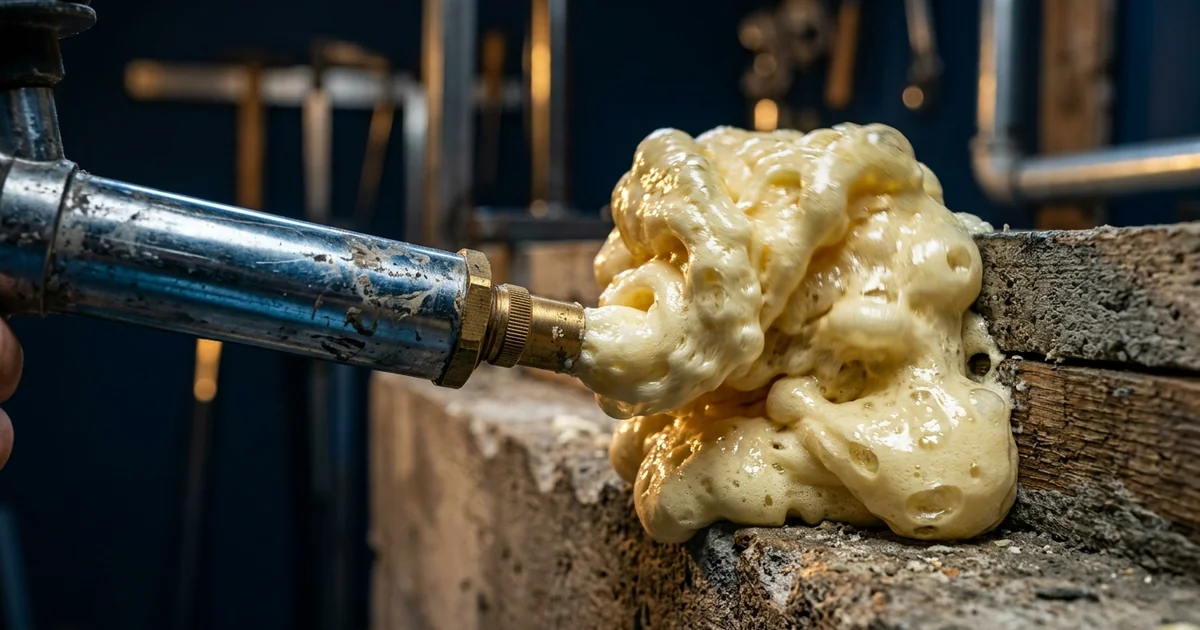
A window installer pulls the trigger on a foam gun, the bead swells into the perimeter gap, and a day later the frame has bowed just enough that the sash binds when it closes. That failure — foam that keeps expanding after it should have stopped, pushing on everything around it — is the most common complaint against polyurethane foam sealants, and it traces back to polyurethane foam sealant chemistry rather than to installer error. Get the cure profile, blowing-agent balance, and cell structure right and the same product seals air leaks, deadens sound, and adds insulation for decades; get them wrong and it shrinks off the substrate, crumbles under sunlight, or distorts the joint it was meant to protect. This guide walks through how one- and two-component PU foams cure and expand, why cell structure governs both insulation value and dimensional stability, how low-pressure dispensing keeps expansion force off delicate frames, and what a formulator has to characterise before scaling a foam to production. It reflects the polymer and sealant formulation work we do across our construction chemicals consultancy.
What a Polyurethane Foam Sealant Has to Do
A foam sealant is asked to do three jobs at once that pull in different directions: expand to fill an irregular gap without being forced in, cure into a solid that stays dimensionally put through decades of thermal cycling, and build enough closed cells to slow heat and air movement. A material tuned only for fast gap-filling tends to over-rise and then shrink back; one tuned only for rigidity cures too slowly to be practical on a job site. The craft of the formulation is holding all three properties in balance across the full range of temperatures, humidities, and gap sizes a product will actually meet. Knowing what "good" looks like for each job makes the chemistry choices that follow much easier to judge.
- Controlled expansion — the foam has to grow enough to bridge an uneven gap but stop before it generates force against the substrate, which is why applied density matters more than free-rise volume
- Dimensional stability — minimal post-cure shrinkage or swelling under heat and humidity, assessed against methods such as EN 1604
- Adhesion to mixed substrates — PVC, timber, concrete, masonry, and metal, ideally without a separate primer
- Thermal and acoustic performance — driven by closed-cell content and cell size for insulation, and by open structure and thickness for sound damping
- Reaction to fire — a defined Euroclass under EN 13501-1, with dedicated firestop grades tested as linear joint seals under EN 1366-4
- Low post-cure tack and clean trimmability — so excess can be cut flush without smearing
| Job | Property that controls it | Reference method |
|---|---|---|
| Fill the gap without distorting it | Rise profile, applied density, expansion pressure | FEICA one-component foam test methods |
| Stay put after cure | Crosslink density, cell-gas balance | EN 1604 (dimensional stability) |
| Insulate | Closed-cell fraction, cell size, blowing gas | Thermal conductivity (lambda) measurement |
| Carry structural load in a joint | Density, closed-cell content | ISO 844 (compressive properties) |
Which of these targets dominates depends almost entirely on whether the foam is a one-component or a two-component system — the split that shapes every other formulation decision.
One-Component vs Two-Component PU Foam: The Core Difference
The label on the can hides a fundamental chemistry difference. A one-component (1K, often called OCF) foam is a single isocyanate-terminated prepolymer that only finishes curing when the dispensed bead meets atmospheric moisture; a two-component (2K) foam keeps an isocyanate stream and a polyol-plus-catalyst stream apart until they combine in the cartridge nozzle, so the cure reaction is self-contained and does not wait on ambient humidity. That one distinction drives cure speed, the conditions each foam can work in, how consistent the cell structure is, and cost. For a manufacturer deciding which product to develop, it is the first fork in the road, and the rest of the formulation follows from it.
| Attribute | 1K (one-component) | 2K (two-component) |
|---|---|---|
| Cure trigger | Atmospheric moisture diffusing into the bead | Co-reactants mixed inside the cartridge |
| Full cure time | Many hours, humidity-dependent | Roughly an hour, humidity-independent |
| Deep or sealed fills | Risk of a soft, uncured core | Cures through the full section |
| Cold or dry conditions | Slow and unreliable | Reliable |
| Cell-structure consistency | More variable | More uniform |
| Cost and packaging | Lower cost, simple aerosol can | Higher cost, dual cartridge, short working time once triggered |
| Typical use | General gap-filling and insulation | Window and door fitting, firestop, tight tolerances, high volume |
The mechanism that makes a 2K foam independent of ambient moisture is the same one that lets a formulator dial in expansion and cell structure precisely — so it is worth looking at the reactions themselves. Our guide to polyurethane sealant bubbling and blistering covers the same water-driven carbon dioxide chemistry in the context of gunnable joint sealants.
How Polyurethane Foam Sealant Chemistry Drives Cure and Expansion
Two reactions run in parallel the moment the components meet, and the whole character of the foam depends on their relative speed. The gelation reaction — isocyanate groups reacting with polyol hydroxyls — builds the polymer network that gives the foam its strength. The blowing reaction — isocyanate reacting with water to release carbon dioxide, plus a dissolved physical blowing agent flashing to gas as the exotherm heats the mass — is what makes it rise. If blowing outruns gelation the cell walls rupture and the foam collapses or splits; if gelation outruns blowing the foam stays dense and under-expanded.
- Isocyanate source — construction foams use polymeric MDI rather than TDI because its far lower vapour pressure makes it markedly safer to handle, a point reinforced by OSHA guidance on isocyanates
- Polyol backbone — polyether polyols dominate for hydrolysis resistance and low-temperature flexibility; polyester polyols give higher strength and better fire char but weaker hydrolytic stability
- Catalyst balance — tertiary amine catalysts accelerate the blow reaction while tin or other metal catalysts push gelation, and the ratio between them sets the rise-to-set window
- Silicone surfactant — a polyether-modified silicone stabilises the thin cell walls during rise and largely determines whether cells stay closed or open
- Blowing agents — chemical (water and carbon dioxide) combined with physical agents that have moved from chlorofluorocarbons to hydrochlorofluorocarbons to hydrofluorocarbons and now to hydrocarbons and low-GWP alternatives
- Isocyanate index — formulations carry a slight stoichiometric excess of isocyanate so all the polyol reacts and some isocyanate remains to build additional crosslinks and, in 1K, to complete the moisture cure
The water reaction is worth spelling out because it does two jobs at once. An isocyanate group reacts with water to give an unstable carbamic acid that breaks down into carbon dioxide gas and an amine; that amine then reacts with more isocyanate to form a urea linkage, one of the hard-segment structures that gives polyurethane polymers their strength. The reaction is strongly exothermic, and that heat is what volatilises the physical blowing agent and accelerates gelation, so in a foam the blowing chemistry and the cure chemistry are physically coupled rather than independent.
The balance of these reactions does not just decide whether the foam rises — it fixes the cell structure that everything from insulation value to long-term shrinkage depends on.
Cell Structure, Density, and Insulation Performance
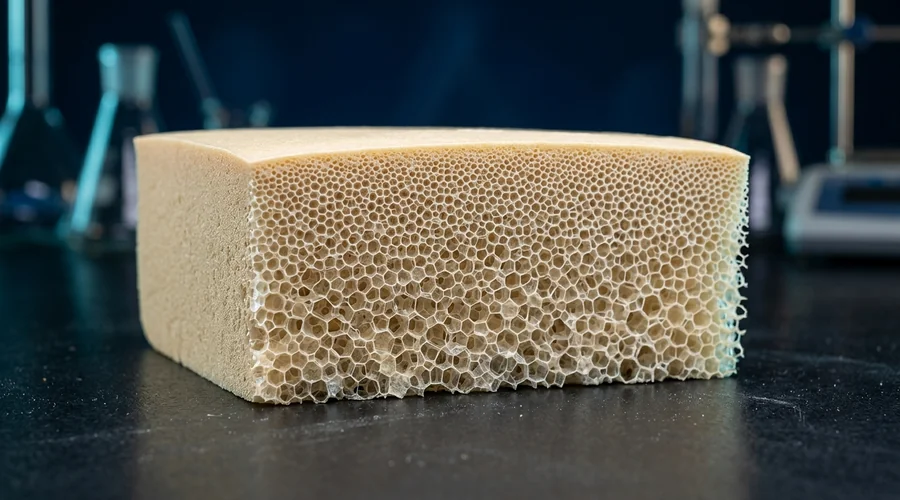
Once the foam has set, its performance is essentially locked into the geometry of millions of gas-filled cells. A predominantly closed-cell foam traps blowing gas in discrete pockets, which lowers thermal conductivity, keeps water absorption low, and raises compressive strength. An open-cell foam has ruptured windows between cells, so it is softer, vapour-permeable, and better at absorbing sound, but a weaker insulator. Closed-cell fraction, average cell size, and overall density are the three numbers that describe a cured foam.
- Closed-cell content — governs the lambda value, moisture resistance, and rigidity; the single most important structural parameter for an insulating sealant
- Cell size — finer, more uniform cells scatter radiant heat better and give a smoother, cleaner cut face
- Density — free-rise density and in-cavity ("applied") density differ, and over-filling a gap raises applied density along with expansion pressure
- Blowing-gas conductivity — foams blown with heavier hydrocarbons or hydrofluoroolefins insulate better than carbon-dioxide-blown foams because the trapped gas itself conducts less heat
- Thermal drift — over years, air slowly diffuses into closed cells and blowing gas diffuses out, raising lambda; a foam can meet its target the day it cures and drift outside spec later
| Property | Closed-cell foam | Open-cell foam |
|---|---|---|
| Thermal conductivity | Low (better insulator) | Higher |
| Water absorption | Low | High |
| Compressive strength | Higher | Lower |
| Acoustic absorption | Moderate | Higher |
| Vapour permeability | Low | High |
| Typical use | Insulating and structural gap seals | Acoustic and vapour-open seals |
A foam can hit its target lambda on day one and still fail a specification two years later through thermal drift or shrinkage — which is why cell structure is controlled at the dispensing stage as much as in the formulation. Where a joint has to accommodate real movement, a compressible pre-formed filler is often the better tool, as covered in our guide to expansion joint filler materials.
Low-Pressure Dispensing and Application Control
The expansion pressure that bows a window frame is not a formulation defect on its own — it is the product of the formulation and how the foam is delivered. Low-pressure foam systems are engineered so the free rise is gentle and the foam reaches tack before it can generate enough force to move a frame. Gun-grade cans with an adjustable metering valve let an installer lay a controlled bead and stop the effective expansion by trimming, where straw-dispensed cans give far less control. For a 2K cartridge, the static mixer geometry and trigger design decide how completely the two streams combine, which in turn sets cure uniformity.
- Low-pressure vs standard foam — reduced post-application expansion force, developed specifically for window and door perimeters and other confined joints
- Gun vs straw dispensing — metering accuracy, bead consistency, and the ability to pause and reuse a part-used can
- Fill technique — partially fill the gap and let the rise complete rather than packing it solid; fill deep joints in successive lifts
- Substrate preparation — a lightly dampened substrate speeds a 1K cure and improves adhesion, while dust, frost, and release agents defeat it
- Ambient conditions — can and substrate temperature change viscosity, rise rate, and yield, and most winter failures trace to a cold can rather than the formula
Controlling expansion in the field only works if the formulation behind it has been characterised properly — which is where development and scale-up discipline earns its keep. The same delivery-versus-chemistry trade-off shows up across the sealant category, as our comparison of polyurethane vs silicone sealants for construction joints lays out.
Formulating, Testing, and Scaling a PU Foam Sealant
Moving a foam from a promising lab pour to a consistent product on a filling line is where most projects stall. The bench work has to define not a single formulation but a response surface — how yield, density, cell structure, and cure time shift with temperature, humidity, catalyst level, and propellant charge — because the plant will never hold bench conditions exactly. Aerosol-can and cartridge filling then add their own variables: propellant solubility, can pressure over shelf life, valve compatibility, and prepolymer viscosity drift. A structured development program treats all of it as one system rather than a recipe.
- Define the performance envelope — target applied density, yield per can, tack-free and cut times, adhesion build, and the required Euroclass fire rating
- Screen the chemistry — isocyanate, polyol, catalyst, and surfactant combinations evaluated against that envelope
- Characterise across the climate window — hot and humid, cold and dry, and the extremes of gap size the product will see in use
- Lock the blowing-agent system — against current F-gas and ozone regulation and regional VOC limits
- Validate the packaging — propellant compatibility, can and cartridge pressure and shelf-life aging, valve and gun performance
- Transfer to plant — filling-line trials, in-process pressure and weight checks, and retained-sample stability testing
| Test | What it verifies | Reference |
|---|---|---|
| Compressive properties | Load-bearing behaviour of the cured foam | ISO 844 |
| Dimensional stability | Post-cure shrinkage or swelling under heat and humidity | EN 1604 |
| Reaction to fire | Euroclass classification | EN 13501-1 |
| Linear joint firestop | Fire resistance of a foam-sealed gap | EN 1366-4 |
| Yield, cell structure, adhesion, movement | Application performance of one-component foams | FEICA test methods |
For a manufacturer without a dedicated polyurethane lab, this is exactly the kind of program a construction chemicals formulation partner runs end to end — from isocyanate and polyol selection through climate-window characterisation and filling-line trials — so the first commercial batch behaves like the last lab batch. The decision that shapes everything else is 1K versus 2K: choose 1K for cost-sensitive general gap-filling where humidity and cure time are forgiving, and 2K where speed, cold or sealed conditions, firestop performance, or tight dimensional tolerances rule. Every choice after that — polyol type, catalyst balance, blowing agent, dispensing format — follows from that first fork and from the climate the product has to survive.
Frequently Asked Questions
What is the real difference between one-component and two-component polyurethane foam?
A one-component foam is a single isocyanate-terminated prepolymer that only finishes curing when the dispensed bead absorbs moisture from the surrounding air, so its cure speed and completeness depend on ambient humidity and on the foam not being sealed away from the atmosphere. A two-component foam keeps an isocyanate stream and a polyol-plus-catalyst stream apart until they meet in the cartridge nozzle, so the cure reaction carries everything it needs within the mix and proceeds regardless of ambient humidity.
In practice that means a two-component foam reaches full cure within roughly an hour and works in cold, dry, or sealed conditions, while a one-component foam is cheaper and simpler but cures over many hours and can leave a soft core in thick or enclosed fills.
Why does expanding foam sometimes keep growing and bend a window frame?
The bead is still rising after it has been placed, and if the polymer network sets slowly relative to the blowing reaction, the foam generates expansion pressure against whatever confines it before it is rigid enough to stop. In a window or door perimeter that pressure can bow a lightweight frame enough to bind the sash.
Low-pressure foam systems are formulated so the free rise is gentle and the foam reaches tack before it can build significant force, and correct technique — partially filling the gap and letting the rise complete rather than packing it solid — keeps the applied density and the pressure down.
Is closed-cell or open-cell foam better for insulation?
Closed-cell foam is the better insulator because each cell traps blowing gas in a discrete pocket, which lowers thermal conductivity, keeps water absorption low, and raises compressive strength. Open-cell foam has ruptured windows between cells, so it is softer, vapour-permeable, and good at absorbing sound, but it insulates less well and takes up moisture.
For sealing air leaks and adding thermal value around penetrations and perimeters, a predominantly closed-cell foam is the usual choice, while open-cell grades are used where acoustic damping or vapour permeability matters more than R-value.
Why does one-component foam sometimes stay soft or sticky in the middle?
One-component foam cures by reacting with water vapour that diffuses in from the surrounding air, and in a thick section or a joint that is sealed on both sides, moisture never reaches the core in the quantity the reaction needs. The outside skins over while the centre stays partially reacted, remaining soft, releasing carbon dioxide, and continuing to off-gas unreacted isocyanate for days or weeks.
The fix is to fill deep joints in successive thin lifts so each layer can cure, to lightly dampen the substrate, or to specify a two-component foam whose cure does not depend on atmospheric moisture at all.
What blowing agents are used in modern polyurethane foam sealants, and why did they change?
Modern construction foams rise on a combination of chemically generated carbon dioxide, from the reaction of isocyanate with water, and a physical blowing agent that is dissolved under pressure and flashes to gas as the exotherm heats the mix. The physical agents have moved through several generations: chlorofluorocarbons and then hydrochlorofluorocarbons were phased out under the Montreal Protocol for ozone depletion, the hydrofluorocarbons that replaced them are now being reduced for their high global warming potential, and current products lean on hydrocarbons such as isobutane and dimethyl ether alongside low-GWP hydrofluoroolefins.
Each transition forces reformulation because the agents differ in solubility, flammability, volatility, and how well the trapped gas itself insulates.
Which standards apply to polyurethane foam sealants?
Reaction to fire is classified under EN 13501-1, which assigns a Euroclass rating, and foams used to seal linear gaps in fire-rated construction are tested as joint seals under EN 1366-4. Mechanical and dimensional behaviour draws on ISO 844 for compressive properties of rigid cellular plastics and EN 1604 for dimensional stability under defined temperature and humidity.
The European adhesive and sealant industry association, FEICA, also publishes standardised test methods specifically for one-component foams covering yield, cellular structure, adhesion, and post-cure movement, and blowing-agent choice is further constrained by regional F-gas and VOC regulations.
Why would a manufacturer bring in a formulation consultant instead of developing a foam sealant in-house?
A polyurethane foam sealant is not a single recipe but a response surface — yield, density, cell structure, and cure time all shift with temperature, humidity, catalyst level, and propellant charge — and characterising that surface takes a dedicated polyurethane lab plus aerosol filling and cartridge expertise that many building-products companies do not have. A consultant who has run the pathway before can start from isocyanate, polyol, catalyst, and surfactant combinations already known to hit a given envelope, then focus effort on the climate-window testing and filling-line trials that actually determine whether the product is consistent.
The manufacturer still owns the finished claims and regulatory position, so the value is in compressing months of trial-and-error and reducing the risk that the first plant batch behaves differently from the last lab batch.
Developing a Polyurethane Foam Sealant?
Global Formulation provides construction chemicals consultancy — PU foam formulation, blowing-agent and cell-structure optimisation, and filling-line scale-up support for sealant manufacturers.
Talk to Our Formulation Team