Ultimate Guide to CIP Cleaning in Food and Beverage Manufacturing
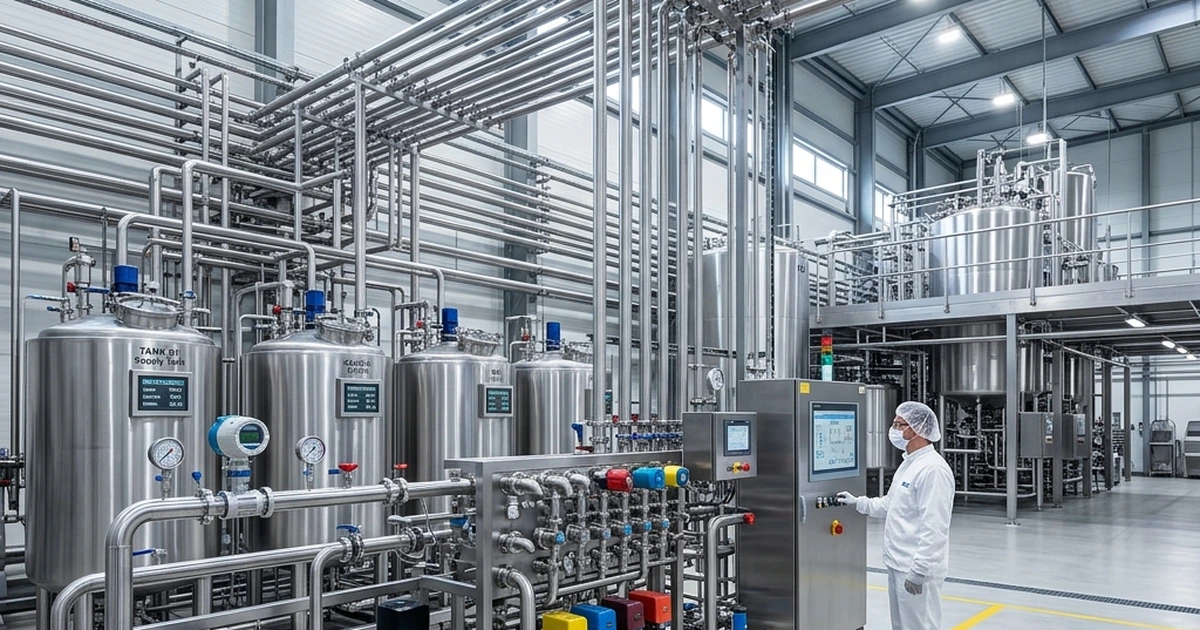
A production line that cannot be cleaned to a validated standard between batches is a production line that cannot legally ship food or beverage product, which is exactly why CIP cleaning sits at the operational core of every dairy, brewing, and food processing facility rather than functioning as an afterthought bolted onto the process. Clean-in-place systems circulate rinse, alkaline, acid, and sanitising solutions through tanks and pipework without dismantling the equipment, replacing the inconsistency of manual scrubbing with a programmed, repeatable, and documentable cycle. Getting CIP chemistry and system design wrong does not just risk a failed cleaning validation — it risks microbiological contamination, allergen carryover between product runs, and regulatory action that can shut a line down entirely. This guide covers the complete landscape: the caustic-acid sequence chemistry and mechanisms behind effective cleaning, classification of CIP system architectures, the properties that define chemical performance, a practical chemical and cycle selection framework, system design and operating practice, validation methods and standards, regulatory considerations, common failure modes, and where the discipline is heading. It draws on the perspective of engineers and formulators who specify, validate, and troubleshoot CIP systems across food and beverage manufacturing.
In This Guide
- What Is CIP Cleaning and Why It Matters in Industry
- The Science Behind CIP: Key Chemistry and Mechanisms
- Types and Classification: A Complete Overview
- Key Performance Properties and Specifications
- Selection Guide: Choosing the Right CIP Chemistry for Your Application
- System Design and Cleaning Cycle Process
- Testing Methods and Industry Standards
- Regulatory and Environmental Considerations
- Common Problems and How to Address Them
- Industry Trends and Future Outlook
What Is CIP Cleaning and Why It Matters in Industry
CIP cleaning is the automated process of circulating cleaning and sanitising solutions through tanks, pipework, valves, and process equipment without opening or dismantling the system, replacing manual disassembly-and-scrub cleaning with a programmed, repeatable sequence. It sits within the broader discipline of industrial cleaning chemistry but diverges sharply in scale and stakes, since a single validated CIP cycle governs the microbiological and allergen safety of every batch that follows it through the same equipment. Regulatory bodies and customers alike treat CIP performance as a direct proxy for food safety management, and a disproportionate share of product recalls and contamination incidents in dairy, brewing, and food manufacturing trace back to an inadequately designed or poorly executed cleaning cycle rather than a raw material defect. For engineers and quality managers responsible for keeping production lines compliant, understanding how chemistry, system design, and validation intersect is what separates a facility that passes every audit from one exposed to a costly recall.
The Science Behind CIP: Key Chemistry and Mechanisms
Every CIP cycle depends on the same four interacting variables — time, temperature, chemical concentration, and mechanical action — a relationship known industry-wide as Sinner's Circle, where increasing any one variable allows a corresponding reduction in another without sacrificing cleaning outcome. Alkaline cleaning, almost always the primary wash step, works by saponifying fats into water-soluble soaps, hydrolysing proteins into smaller soluble fragments, and dispersing suspended soil through surfactant action, all of which proceed faster and more completely at elevated temperature and hydroxide concentration. Acid cleaning, typically the second active step, dissolves mineral scale such as milkstone and beerstone through direct chemical reaction with calcium, magnesium, and oxalate deposits, while simultaneously helping restore the passive chromium oxide layer on stainless steel surfaces that alkaline exposure can disrupt.
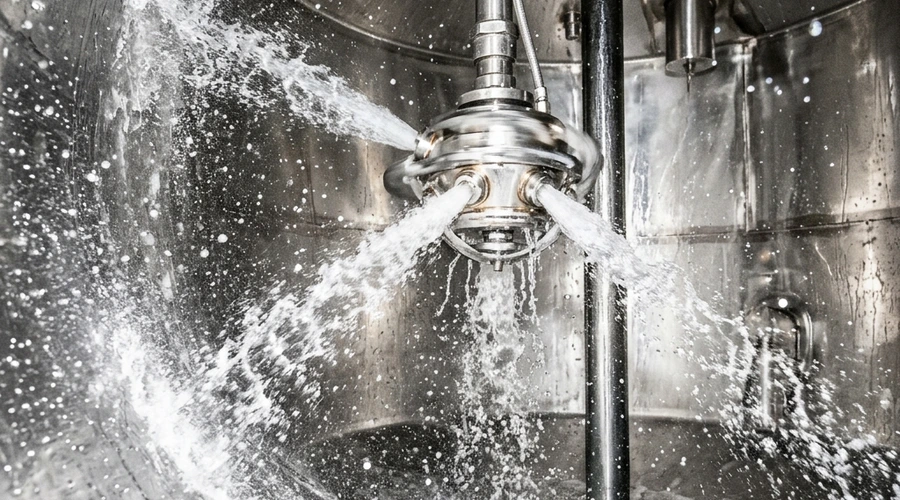
Mechanical action inside a CIP system comes from turbulent flow velocity through pipework and spray ball coverage inside tanks, and no chemical formulation can compensate for a system that fails to deliver adequate flow or coverage to every internal surface. These principles combine into a consistent set of governing rules that shape every CIP program regardless of the specific product being manufactured:
- Saponification and hydrolysis — hot alkaline solution converts fats to soluble soaps and breaks down protein structures into smaller, rinseable fragments.
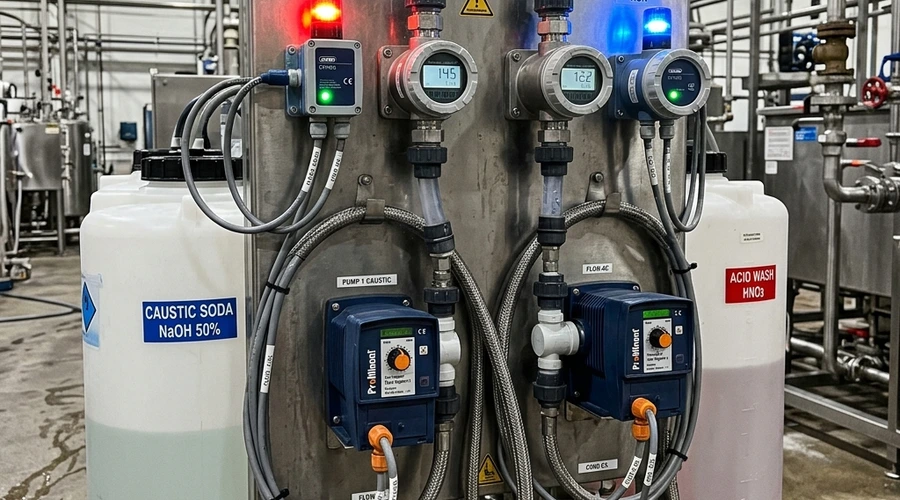
- Chelation — sequestering agents in the caustic wash bind calcium and magnesium ions from water hardness and product residue, preventing them from re-depositing as scale.
- Acid dissolution — organic and inorganic acids dissolve mineral scale and restore stainless steel passivation following alkaline exposure.
- Turbulent flow scouring — Reynolds numbers above the turbulent threshold in pipework provide the mechanical action that chemistry alone cannot deliver.
Recognising that chemistry and mechanical delivery are inseparable halves of the same cleaning outcome is the foundation for the classification framework that follows.
Types and Classification: A Complete Overview
CIP systems and chemistries are classified along two axes simultaneously — the system architecture that delivers the cleaning solutions and the chemical class used at each stage of the cycle — and treating these as interchangeable choices is a common source of underperforming installations. System architecture ranges from single-use designs that discharge every solution to drain after one pass, to recovery designs that store and reuse caustic and acid batches across multiple cycles until titration confirms depletion. Chemical classification follows the cleaning function required at each stage, since a general-purpose alkaline cleaner formulated for light beverage soil will underperform badly against heavy dairy fouling. The table below summarises the major categories a specifier is likely to encounter.
Each category exists because a specific soil profile and product-contact requirement demands it, not as an arbitrary quality tier, which is exactly why the properties section that follows treats performance as application-specific rather than universally rankable.
Key Performance Properties and Specifications
CIP chemicals are specified against a set of measurable properties that predict cleaning outcome and equipment compatibility long before a validation failure would otherwise reveal itself on the production floor. Because CIP cycles run largely unattended once programmed, waiting for a visible cleaning failure to appear is a far costlier way to discover a chemical mismatch than validating properties up front. The table below outlines the properties most consistently used to specify and monitor CIP chemistry.
None of these properties tells the full story in isolation — a caustic solution with excellent saponification power but poor rinsability will still leave residue capable of tainting the next product batch. Carrying this interconnected view of performance directly into the selection process is what prevents a specification from looking correct on paper while underperforming on the floor.
Selection Guide: Choosing the Right CIP Chemistry for Your Application
Selecting CIP chemistry starts with correctly characterising the soil the process actually generates, because dairy fouling, beerstone, sugar caramelisation, and oil-based sauce residues each demand a fundamentally different chemical strategy rather than a variation on the same generic cleaner. Treating CIP chemical selection as a one-size-fits-all commodity purchase, the way many facilities approach it during initial commissioning, is one of the most common and costly mistakes in food plant sanitation. The practical decision sequence below reflects how experienced sanitation engineers typically approach a new or revised CIP chemical specification.
- Characterise the soil profile — protein, fat, mineral scale, sugar, or starch, since this determines whether caustic strength, chelation, or a dedicated acid descale step is the priority.
- Assess water hardness and supply quality — hard water demands chelated formulations to prevent scale redeposition during the alkaline wash.
- Confirm materials of construction — stainless steel grade, gasket elastomers, and any aluminium or plastic components all constrain acceptable chemical concentration and temperature.
- Match system architecture — single-use versus recovery design changes both the required chemical stability and the concentration monitoring strategy.
- Set the validation and monitoring plan — define acceptance criteria for concentration, temperature, and microbiological outcome before the cycle is locked into production.
This selection logic only pays off if the chemistry is actually delivered at validated concentration and temperature by the system itself, which is where CIP system design and cycle operation becomes the deciding factor in real-world cleaning outcomes.
System Design and Cleaning Cycle Process
Getting CIP system design right matters as much as selecting the right chemistry, since even a perfectly formulated cleaner will underperform if the piping network cannot deliver turbulent flow or if spray balls fail to reach every internal tank surface. A standard cycle runs a water pre-rinse to flush gross product residue, followed by the hot caustic wash, an intermediate rinse to clear alkaline carryover, the acid wash to dissolve scale and restore passivation, and a final rinse before any sanitising step is applied. System designers size pump capacity and pipe diameter to guarantee minimum turbulent flow velocity throughout the return path, since any section running below that threshold becomes a chronic cleaning weak point regardless of how well the chemistry performs elsewhere in the circuit.
Testing Methods and Industry Standards
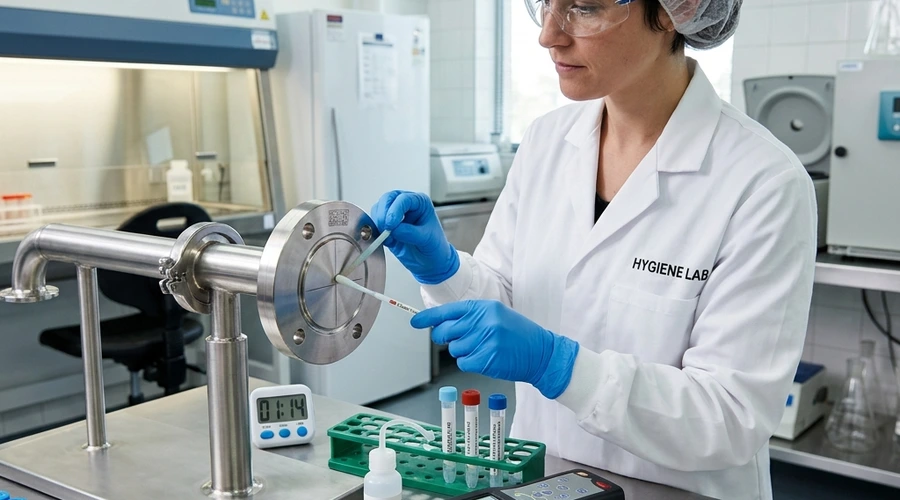
CIP validation has to confirm performance across physical, chemical, and microbiological dimensions simultaneously, since a system can look visually spotless while still harbouring residual protein soil or a viable biofilm colony in a low-flow section. Facilities therefore combine standardised bench and field tests with routine in-line monitoring to build a defensible, auditable record of cleaning performance over time.
- Riboflavin fluorescence coverage testing — confirms spray ball coverage reaches every internal tank surface during commissioning and periodic re-validation.
- Total organic carbon or protein swab testing — quantifies residual soil load on the final rinse water or product-contact surface after a completed cycle.
- Microbiological environmental monitoring — confirms the sanitising step has reduced viable organisms on critical contact surfaces to an acceptable level.
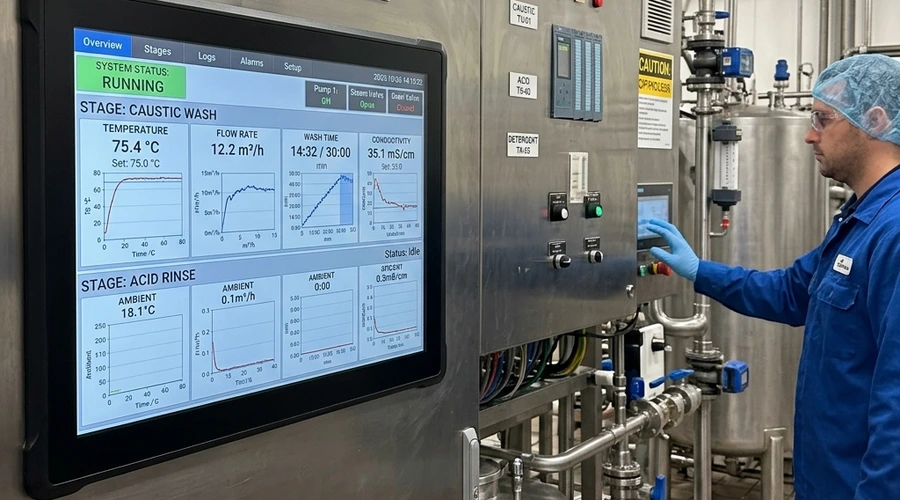
- In-line conductivity and temperature logging — provides continuous, automated documentation that each cycle ran within its validated concentration and temperature envelope.
Consistent, layered testing across commissioning, routine monitoring, and periodic re-validation is what allows quality teams to demonstrate control to auditors on defensible data rather than assumption alone, a discipline that becomes especially important once food safety regulation enters the picture.
Regulatory and Environmental Considerations
CIP cleaning sits at the centre of food safety regulatory compliance rather than functioning as a peripheral sanitation task, since programs such as HACCP formally designate cleaning validation as a critical control point in most food and beverage manufacturing operations. Regulatory frameworks including FDA food safety guidance and EU hygiene regulations expect documented evidence that CIP cycles are validated, monitored, and periodically re-verified rather than simply assumed to work because they were designed correctly at installation. Environmental pressure is reshaping chemistry choices as well, with facilities increasingly favouring biodegradable organic acid descalers and lower-temperature, surfactant-boosted alkaline formulations — guided in part by programs such as the EPA Safer Choice standard — that reduce both effluent load and the energy cost of heating large volumes of caustic solution. Water reuse and recovery system adoption is accelerating for the same reason, since reducing single-use discharge volume addresses both cost and regulatory discharge-limit pressure simultaneously.
Common Problems and How to Address Them
Most CIP cleaning failures trace back to a small set of recurring root causes rather than a genuinely novel chemistry problem, which is why experienced sanitation engineers develop a mental checklist of likely culprits before recommending a full system audit or re-validation. Recognising the pattern early can prevent a facility from a failed audit or, worse, a product contamination incident.
- Dead legs and low-flow branches — usually introduced by a later equipment modification that was never re-validated against the original flow and coverage design.
- Under-strength chemical concentration — commonly caused by depleted recovery tanks, dosing pump drift, or incomplete drainage diluting the next cycle's charge.
- Temperature shortfall — points to heat exchanger fouling or undersized heating capacity rather than a chemistry problem, since caustic performance is strongly temperature-dependent.
- Spray ball misalignment or fouling — a mechanical issue that leaves shadowed tank surfaces uncleaned regardless of chemical concentration or contact time.
Reading these failure patterns correctly during a troubleshooting audit is itself a specialised skill, and it is precisely this diagnostic capability that determines whether a CIP issue gets resolved with a targeted fix or escalates into a compliance event. With these failure mechanisms understood, the natural next question is how the discipline itself is evolving to prevent them.
Industry Trends and Future Outlook
The CIP cleaning discipline is being reshaped by three converging pressures: sustainability targets that make water and energy reduction a measurable cost-saving lever rather than a secondary benefit, digitalisation that is turning conductivity, temperature, and flow data into continuous automated validation rather than periodic manual spot-checks, and growing adoption of milder, biodegradable chemistries that reduce environmental impact without sacrificing validated cleaning performance. Real-time sensor-driven CIP optimisation, where cycle time and chemical dosing adjust automatically based on measured soil load rather than a fixed worst-case recipe, is moving from pilot projects toward mainstream adoption in large-scale dairy and beverage operations. Sanitation engineers and formulators who build technical fluency in low-temperature alkaline chemistry, biodegradable descaling agents, and sensor-integrated cycle control now will be positioned to lead process development as sustainability and digitalisation pressure continues tightening across the food and beverage sector.
Frequently Asked Questions
1. What is CIP cleaning and how does it differ from manual cleaning?
CIP, or clean-in-place, is a method of cleaning the interior surfaces of tanks, pipework, and processing equipment by circulating cleaning and sanitising solutions through the system without dismantling it. Manual cleaning requires operators to disassemble equipment and scrub surfaces by hand, which is labour-intensive, inconsistent between operators, and impractical for enclosed piping networks and large storage vessels. CIP replaces that variability with a programmed, repeatable sequence of rinse, alkaline wash, intermediate rinse, acid wash, and final rinse steps controlled by time, temperature, concentration, and flow velocity — the four parameters collectively known as the Sinner's Circle alongside mechanical action. Because the cycle is automated and monitored, CIP delivers validated, documented cleaning outcomes at a scale and consistency manual methods cannot match in continuous food and beverage production.
2. How do I choose the right CIP chemicals for my process?
Chemical selection starts with identifying the dominant soil type left by the specific product being processed, since protein and fat residues respond best to alkaline chemistry while mineral scale and beerstone respond to acid chemistry. Dairy, meat, and egg processing typically demand a strong caustic wash to saponify fats and hydrolyse proteins, followed by an acid rinse to remove mineral deposits and restore surface passivation on stainless steel. Beverage and brewing operations often need a milder alkaline step paired with a dedicated acid cycle to control beerstone and carbonate scale, while lines handling high-fat or baked-on soils may require chelated or surfactant-boosted caustic formulations for adequate soil suspension. The final decision also depends on water hardness, materials of construction, and whether the line requires a peracetic acid or quaternary ammonium sanitising step after the acid-alkali sequence.
3. What is the typical caustic-acid CIP sequence and why does the order matter?
A standard CIP cycle runs a water pre-rinse to remove gross product residue, a hot caustic wash to saponify fats and dissolve proteins, an intermediate rinse to flush out residual alkali, an acid wash to dissolve mineral scale and restore metal passivation, and a final rinse to bring the system back to a neutral, sanitary condition before optional sanitiser application. Running acid before caustic is generally avoided because acid can fix protein soils onto the surface, making them significantly harder for the subsequent alkaline step to remove. The intermediate rinse step is equally important because carryover of caustic into the acid wash neutralises the acid before it can act on scale, wasting chemical and extending cycle time without improving cleanliness.
4. How is CIP cleaning validated in a food or beverage plant?
Validation combines physical, chemical, and microbiological verification rather than relying on any single test, because a system can appear visually clean while still carrying protein residue or a viable biofilm. Riboflavin fluorescence testing under UV light is commonly used during commissioning to confirm spray ball coverage reaches every internal surface, since shadowed areas simply never receive mechanical cleaning action regardless of chemical strength. Total organic carbon or protein swab testing on the final rinse water quantifies residual soil load, while microbiological swabbing of critical contact surfaces confirms that the sanitising step has reduced viable organisms to an acceptable level. Ongoing validation typically layers routine conductivity and temperature logging from the CIP skid's control system with periodic microbiological environmental monitoring to confirm the programmed cycle continues to deliver its originally validated result.
5. What causes CIP cleaning to fail or leave residue in a production line?
The most common root cause is inadequate flow velocity or dead legs in the piping network, since CIP relies on turbulent flow to deliver mechanical scouring action and any stagnant section simply never receives effective cleaning regardless of chemical concentration or contact time. Under-strength chemical concentration from depleted CIP recovery tanks, incorrect dosing pump calibration, or dilution from incomplete drainage between cycles is another frequent failure mode that often goes undetected until a microbiological or allergen cross-contamination incident occurs. Temperature shortfalls matter as much as concentration, because caustic soil removal is strongly temperature-dependent and a system running below its validated set point will underclean even at nominal chemical strength. Spray ball misalignment, mineral scale buildup that narrows pipe diameter, and worn seals that create hidden crevices are mechanical issues that chemistry alone cannot compensate for, which is why CIP troubleshooting always considers equipment condition alongside chemical formulation.
6. What is the difference between single-use and recovery CIP systems?
A single-use CIP system discharges each cleaning solution to drain after one pass, which simplifies chemistry management and eliminates cross-contamination risk between products but consumes significantly more water and chemical over time. A recovery CIP system stores caustic and acid solutions in dedicated tanks after use, reusing them for multiple cycles until titration testing shows the active concentration has dropped below the validated threshold, at which point the batch is discarded or re-fortified. Recovery systems substantially reduce chemical and water consumption and are the standard choice for large-scale continuous dairy, beverage, and brewing operations, but they require more sophisticated concentration monitoring, filtration to remove suspended soil, and stricter change-of-product protocols to prevent allergen or flavour carryover. The choice between the two architectures depends on production scale, product changeover frequency, and the facility's water and effluent treatment capacity.
7. How do CIP requirements differ between dairy, brewing, and general food processing?
Dairy processing generates heavy protein and butterfat soils that demand strong hot caustic with chelating agents to prevent calcium and magnesium precipitation from milk minerals, along with an acid step to control milkstone deposition on heat exchanger surfaces. Brewing and beverage lines contend with beerstone, a tenacious calcium oxalate scale, which typically requires a dedicated acid-based descaling cycle in addition to the standard caustic wash, and carbonated lines add pressure and foam-control considerations to the cycle design. General food processing spans an enormously wide range of soil types, from starch and sugar residues to oil-based sauces, so chemical selection and cycle parameters are usually customised per product line rather than following a single universal recipe. Despite these differences, all three sectors converge on the same underlying Sinner's Circle principles of time, temperature, chemical concentration, and mechanical action, which is what makes CIP a coherent discipline rather than a collection of unrelated recipes.
Absar Khan
Absar Khan is a senior industrial consultant with cross-disciplinary expertise spanning pharmaceutical manufacturing, cosmetics and personal care, home and institutional care chemicals, aerosols, lubricants, and advanced process engineering. His work integrates formulation chemistry, GMP facility design, validation science, quality systems, regulatory compliance, and large-scale manufacturing optimization.
LinkedIn Portfolio: Connect with Absar Khan on LinkedIn
Need Expert Guidance on CIP Cleaning?
Our team provides end-to-end technical consultancy — from formulation development and chemistry selection through to scale-up, process engineering, and regulatory strategy.