Ultimate Guide to Compressor Oils: Air, Refrigeration, and Gas Types

A compressor is only as reliable as the lubricant film protecting its bearings, rotors, and valves from the extreme temperature, pressure, and contamination stresses generated inside it — and few components fail as expensively, or as preventably, as a compressor running on the wrong oil. Compressor oil is not a single product category but three fundamentally distinct engineering disciplines: air compressor lubrication in an open-loop system exposed to atmosphere, refrigeration compressor lubrication sealed inside a closed refrigerant loop, and gas compressor lubrication that must survive direct contact with the process gas itself. Getting the selection wrong does not just shorten oil life — it can cause valve deposits, bearing seizure, refrigerant system fouling, or unplanned shutdown of a critical process compressor. This guide covers the complete landscape: the chemistry and mechanisms behind each compressor type, classification systems, key performance properties, a practical selection framework, application and change-out practice, testing standards, regulatory and environmental considerations, common failure modes, and where the category is heading. It draws on the perspective of engineers who specify and troubleshoot compressor lubrication across industrial air, refrigeration, and process gas systems.
In This Guide
- What Is Compressor Oil and Why It Matters in Industry
- The Science Behind Compressor Lubrication
- Types and Classification: A Complete Overview
- Key Performance Properties and Specifications
- Selection Guide: Choosing the Right Oil for Your Compressor
- Application and Change-Out Process
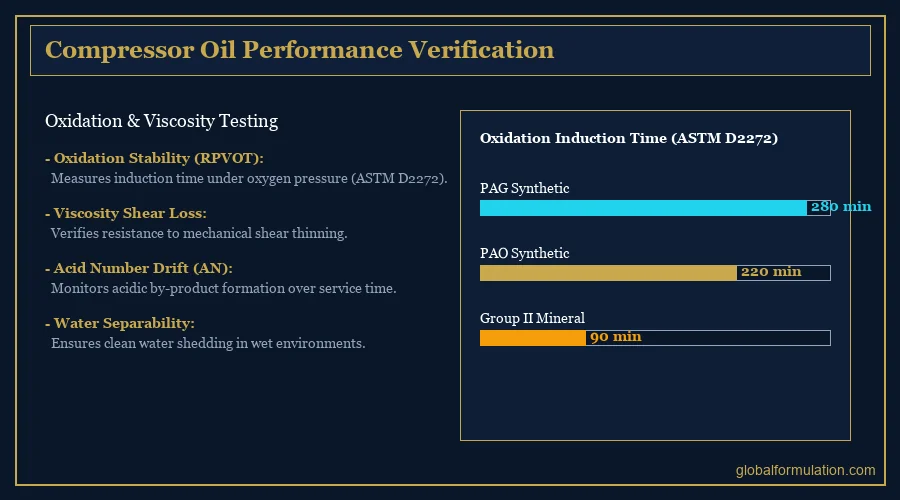
- Testing Methods and Industry Standards
- Regulatory and Environmental Considerations
- Common Problems and How to Address Them
- Industry Trends and Future Outlook
What Is Compressor Oil and Why It Matters in Industry
Compressor oil is the engineered lubricant that protects the moving parts of air, refrigeration, and gas compressors from friction, heat, and contamination while often performing secondary roles such as sealing, cooling, and noise damping that few other industrial lubricants are asked to do simultaneously. It sits within the broader discipline of industrial lubricants but diverges sharply by application, since a compressor lubricant's environment is defined as much by what gas or refrigerant it contacts as by the mechanical loads it withstands. Compressor downtime is a direct commercial cost across manufacturing, HVAC, refrigeration, and process gas industries, and a disproportionate share of unplanned compressor failures trace back to lubricant breakdown, contamination, or simple misapplication of the wrong oil type. For engineers and maintenance specialists responsible for keeping these machines running, understanding how each compressor category's lubrication demands differ is what separates a system that reaches its full design life from one that fails avoidably early.
The Science Behind Compressor Lubrication
Every compressor lubricant has to perform the same basic job — maintaining a boundary or hydrodynamic film between moving metal surfaces under load — but the chemistry required to do that job reliably diverges completely once temperature, contamination exposure, and chemical compatibility with the working fluid are factored in. Air compressor oil operates in an open-loop environment where atmospheric moisture, dust, and oxygen are continuously drawn in with intake air, so oxidation resistance and the ability to shed water rather than emulsify with it become the dominant design priorities. Refrigeration compressor oil instead operates inside a sealed, closed-loop system alongside a specific refrigerant, and the two must remain compatible — either fully miscible so oil returns to the compressor from the evaporator, or engineered for controlled immiscibility — across an enormous temperature swing from hot discharge gas down to sub-zero evaporator conditions.
Gas compressor lubrication adds a third and often more severe chemical challenge, since the process gas itself can dilute, react with, or strip the oil film depending on its composition. These distinctions in operating environment translate into a set of governing chemistry principles that shape everything downstream in this guide:
- Oxidation resistance — base oil and antioxidant package must resist thermal breakdown at sustained discharge temperatures without forming varnish or sludge that restricts oil flow.
- Refrigerant miscibility — the lubricant's polarity must match the target refrigerant's polarity closely enough to avoid phase separation or wax formation at low evaporator temperatures.
- Gas dilution resistance — in gas compressors, the base oil viscosity and volatility must be selected so the process gas does not strip the film or excessively thin the working viscosity.
- Water separability — air compressor oils must shed condensed moisture rather than emulsify it, since a stable water-oil emulsion accelerates corrosion and additive depletion.
Recognising that the working fluid — air, refrigerant, or process gas — dictates the chemistry rather than mechanical design alone is the foundation for the classification framework that follows.

Types and Classification: A Complete Overview
Compressor oils are classified along two axes at once — the compressor category they serve and the base oil chemistry used to formulate them — and conflating the two is a common source of specification error. ISO 6743-3A governs the air compressor classification system most engineers encounter first, using letter codes to distinguish mineral from synthetic formulations and to flag additional performance features, while refrigeration and gas compressor oils are typically specified by refrigerant compatibility or gas service rather than a single unified letter code. The table below summarises the major classes a specifier is likely to encounter.
Each class exists because a specific compressor duty and working fluid combination demands it, not as an arbitrary tier of quality, which is exactly why the properties section that follows treats performance as application-specific rather than universally rankable.
Key Performance Properties and Specifications
Compressor oils are specified against a set of measurable properties that predict service life and equipment protection long before a failure would otherwise reveal itself in the field. Because compressors often run continuously in critical processes, waiting for a visible performance problem to appear is a far costlier way to learn a lubricant was mismatched than validating properties up front. The table below outlines the properties most consistently used to specify and validate a compressor oil.
None of these properties tells the full story in isolation — an oil with excellent oxidation stability but poor refrigerant miscibility will still cause oil-return failures in a refrigeration system. Carrying this interconnected view of performance directly into the selection process is what prevents a specification from looking correct on paper while underperforming in service.
Selection Guide: Choosing the Right Oil for Your Compressor
Selecting a compressor oil starts with correctly identifying the compressor category and its working fluid, because air, refrigeration, and gas compressors each demand a fundamentally different chemistry rather than a variation on the same base oil. Treating compressor oil selection as a simple viscosity-grade decision, the way many buyers approach general industrial lubricants, is one of the most common and costly mistakes in this category. The practical decision sequence below reflects how experienced lubrication engineers typically approach a new or replacement compressor oil specification.
- Identify the compressor type and duty — reciprocating, rotary screw, or centrifugal, and whether the application is intermittent or continuous-duty.
- Confirm the working fluid — atmospheric air, a specific refrigerant designation, or a named process gas, since this alone eliminates most incompatible products.
- Match the base oil chemistry to duty severity — mineral for light or intermittent duty, PAO or POE synthetic for continuous-duty or extended service interval targets.
- Verify OEM approval — cross-check the compressor manufacturer's approved lubricant list, since warranty coverage often depends on using a listed product.
- Set the monitoring plan — establish a used-oil analysis interval appropriate to the duty cycle rather than defaulting to a generic calendar-based change schedule.
This selection logic only pays off if the oil is actually applied and maintained to the standard the specification assumes, which is where the practical change-out and monitoring process becomes the deciding factor in real-world reliability.
Application and Change-Out Process
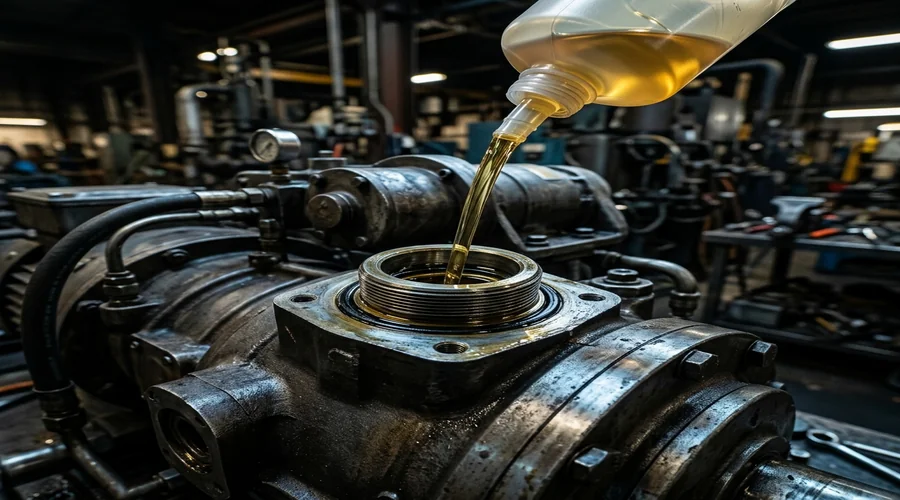
Getting a compressor oil into service correctly matters almost as much as selecting the right product, since even a well-matched lubricant can underperform if the system is not properly flushed, filled, and monitored from day one. A change-out begins with fully draining the old charge and, when switching base oil chemistries, flushing the system to remove residual oil that could contaminate the new fill and compromise its additive package. Refrigeration and gas compressor systems add an extra layer of discipline, since air and moisture ingress during a service event can hydrolyse ester-based lubricants or introduce non-condensable gases that degrade system efficiency.

Testing Methods and Industry Standards
Compressor oil testing has to validate performance across conditions that are difficult to fully replicate in a single laboratory protocol, since oxidative stress, water contamination, and refrigerant or gas compatibility each require a distinct test methodology. Lubricant manufacturers and independent labs therefore rely on a combination of standardized bench tests and, for refrigeration and gas applications, refrigerant- or gas-specific compatibility trials before a product earns OEM approval.
- ASTM D2272 RPVOT testing — pressurized oxygen exposure at elevated temperature quantifies remaining oxidation life, the primary predictor of air compressor oil service interval.
- ISO 6743-3A classification testing — establishes the DAA through DAG letter designation used to match air compressor oils to OEM specifications.
- ASHRAE refrigerant miscibility protocols — determine floc point and phase behavior of refrigeration lubricants across the compressor's full operating temperature range.
- OEM approval testing — major compressor manufacturers maintain their own qualification programs requiring documented laboratory and field performance data before listing a lubricant as approved.
Consistent, standardized testing across bench and application-specific methods is what allows engineers to compare compressor oils on defensible data rather than manufacturer claims alone, a discipline that becomes especially important once environmental and refrigerant regulation enters the picture.
Regulatory and Environmental Considerations
Compressor oil selection is increasingly shaped by refrigerant regulation rather than lubricant chemistry alone, since the phase-down of high-global-warming-potential HFC refrigerants under the Kigali Amendment and regional F-gas regulations is driving refrigeration compressor manufacturers toward new low-GWP refrigerants that demand their own compatible lubricants. The transition from legacy mineral and alkylbenzene oils to POE and, increasingly, PVE (polyvinyl ether) chemistries tracks directly with the industry's move away from CFC and HCFC refrigerants toward HFC and now HFO blends. Air compressor oil faces separate but related pressure from workplace exposure and disposal regulations governing used industrial oil, while gas compressor lubricants used in oil and gas processing must additionally satisfy sour-service and process-safety documentation requirements specific to that sector.
Common Problems and How to Address Them
Most compressor oil-related failures trace back to a small set of recurring root causes rather than a genuinely novel chemistry problem, which is why experienced reliability engineers develop a mental checklist of likely culprits before recommending a full oil analysis or system inspection. Recognising the pattern early can save a facility from an unplanned shutdown or a costly compressor rebuild.
- Varnish and sludge formation — usually traces to sustained operation above the oil's design discharge temperature accelerating oxidation, not a defect in the lubricant chemistry itself.
- Refrigerant dilution — commonly caused by excess refrigerant migrating into the crankcase during off-cycles, thinning the oil film right when startup lubrication is most critical.
- Emulsified water contamination — frequently a sign of degraded water-separability additive performance, often after extended service life or oil chemistry mismatch.
- Seal swelling or degradation — points to a chemical incompatibility, most often from introducing a PAG-based oil into a system designed for mineral or PAO chemistry.
Reading these failure patterns correctly during inspection is itself a specialized skill, and it is precisely this diagnostic capability that determines whether a compressor issue gets resolved with a targeted oil change or an expensive full rebuild. With these failure mechanisms understood, the natural next question is how the category itself is evolving to prevent them.
Industry Trends and Future Outlook
The compressor oil category is being reshaped by three converging pressures: refrigerant regulation that continues to narrow the approved chemistry palette for refrigeration lubricants, energy-efficiency targets that make oil-related friction reduction a measurable cost-saving lever rather than a secondary benefit, and growing adoption of extended service-interval synthetic formulations across continuous-duty air compressors. PVE and next-generation ester chemistries are gaining ground precisely because they deliver compatibility with low-GWP HFO refrigerant blends without sacrificing the miscibility performance the industry relies on. Formulators and lubrication engineers who build technical fluency in low-GWP refrigerant compatibility and extended-drain synthetic chemistry now will be positioned to lead product development as regulation and energy-efficiency targets continue tightening across all three compressor categories.
Frequently Asked Questions
1. What is the difference between air, refrigeration, and gas compressor oils?
Air compressor oils operate in an open-loop system where the lubricant is continuously exposed to atmospheric moisture and oxygen, so oxidation resistance and water separability dominate the formulation priorities. Refrigeration compressor oils operate inside a sealed, closed-loop system where the lubricant must remain fully miscible or deliberately immiscible with a specific refrigerant across a wide temperature range, since phase separation or wax formation at low evaporator temperatures can starve bearings of lubrication. Gas compressor oils face the most chemically demanding environment of the three because the process gas itself — whether hydrocarbon, hydrogen, or a sour gas containing H2S — can dilute, react with, or strip the lubricant film, so the correct product depends entirely on which gas is being compressed rather than on viscosity alone.
2. How do I choose the right compressor oil for my equipment?
Selection starts with identifying the compressor type and duty — rotary screw, reciprocating, or centrifugal — because each generates a different combination of discharge temperature, shear, and oil carryover that the lubricant chemistry must withstand. For air compressors, matching the ISO 6743-3A class (DAA, DAB, DAC, or DAG) to the compressor manufacturer's specification and discharge temperature is the starting point, followed by choosing mineral, PAO, or PAG base oil depending on required service interval and operating severity. For refrigeration and gas compressors, the refrigerant or process gas identity determines lubricant compatibility non-negotiably, so a specifier should never substitute a lubricant across refrigerant families or gas streams without confirming compatibility data from the compressor OEM.
3. What are the key differences between mineral, PAO, and PAG compressor oils?
Mineral compressor oils remain the lowest-cost option and perform adequately in moderate-duty air compressors with shorter service intervals, but they oxidise faster at sustained high discharge temperatures and require more frequent changes. PAO (polyalphaolefin) synthetic oils offer significantly better oxidation stability, lower volatility, and wider operating temperature range, making them the standard choice for continuous-duty rotary screw compressors targeting 8,000-hour or longer service intervals. PAG (polyalkylene glycol) oils are used selectively, particularly in oil-free or oil-flooded rotary screw air compressors and specific refrigeration applications, because their polarity gives excellent lubricity and detergency but requires careful seal and paint compatibility verification since PAG is not universally compatible with standard elastomers.
4. Why does compressor oil sometimes fail prematurely or cause equipment damage?
Premature compressor oil failure most commonly traces back to sustained operation above the oil's design discharge temperature, which accelerates oxidation and can lead to varnish deposits on valves and bearings that restrict oil flow and clearances. Refrigerant dilution is a frequent hidden cause in refrigeration systems, where excess refrigerant migrating into the crankcase during off-cycles thins the oil film and reduces effective viscosity right when startup lubrication is most critical. Cross-contamination from mixing incompatible oil chemistries during a top-up, or from moisture ingress that hydrolyses ester-based lubricants in refrigeration systems, are both entirely preventable failures that stem from inadequate maintenance discipline rather than a flaw in the lubricant itself.
5. How often should compressor oil be changed?
Change interval depends heavily on base oil chemistry, discharge temperature, and duty cycle rather than a single universal number, with mineral air compressor oils typically requiring replacement every 2,000 to 4,000 hours and premium PAO synthetics extending to 8,000 hours or beyond under the same conditions. Refrigeration compressor oil is rarely changed on a fixed schedule in a properly sealed system, since the lubricant should remain stable for the compressor's service life unless contamination, moisture ingress, or a compressor burnout event occurs. The only reliable way to set an accurate interval for any compressor type is periodic used-oil analysis tracking oxidation byproducts, acid number, and viscosity drift, since running to a generic calendar interval either wastes serviceable oil or risks operating on a degraded charge.
6. What testing standards apply to compressor oils?
Air compressor oils are evaluated primarily against ASTM D2272 (rotating pressure vessel oxidation test) for oxidation life, ASTM D892 for foam resistance, and ASTM D1401 for water separability, all of which predict service life under sustained heat and moisture exposure. Refrigeration lubricants are tested for miscibility and floc point against the specific refrigerant per ASHRAE and refrigerant-manufacturer protocols, since a lubricant that performs well with one refrigerant can fail completely with another due to differing polarity. Gas compressor oils add specialized dilution and demulsibility testing specific to the process gas stream, and classification societies or API guidance documents govern lubricant approval for critical process compressors in oil and gas facilities.
7. Can synthetic and mineral compressor oils be mixed?
PAO synthetic and mineral compressor oils are generally miscible and can be mixed without an immediate adverse reaction, but doing so dilutes the synthetic oil's superior oxidation stability down toward mineral-oil performance and shortens the effective service interval below what either product would deliver alone. PAG synthetic oils are a different case entirely, since PAG is not compatible with mineral oil, PAO, or many standard elastomers and seals, so mixing PAG into a system designed for mineral or PAO oil can cause seal swelling, sludge formation, or outright lubrication failure. The safest practice is always to fully drain and flush a compressor system before switching base oil chemistries, and to consult the compressor manufacturer's compatibility documentation rather than assuming any two compressor oils can be blended.
Absar Khan
Absar Khan is a senior industrial consultant with cross-disciplinary expertise spanning pharmaceutical manufacturing, cosmetics and personal care, home and institutional care chemicals, aerosols, lubricants, and advanced process engineering. His work integrates formulation chemistry, GMP facility design, validation science, quality systems, regulatory compliance, and large-scale manufacturing optimization.
LinkedIn Portfolio: Connect with Absar Khan on LinkedIn
Need Expert Guidance on Compressor Oils?
Our team provides end-to-end technical consultancy — from lubricant selection and formulation chemistry through to specification, scale-up, and regulatory strategy.