Vaccine Formulation Cold Chain Stability: Adjuvants and Stabilizers
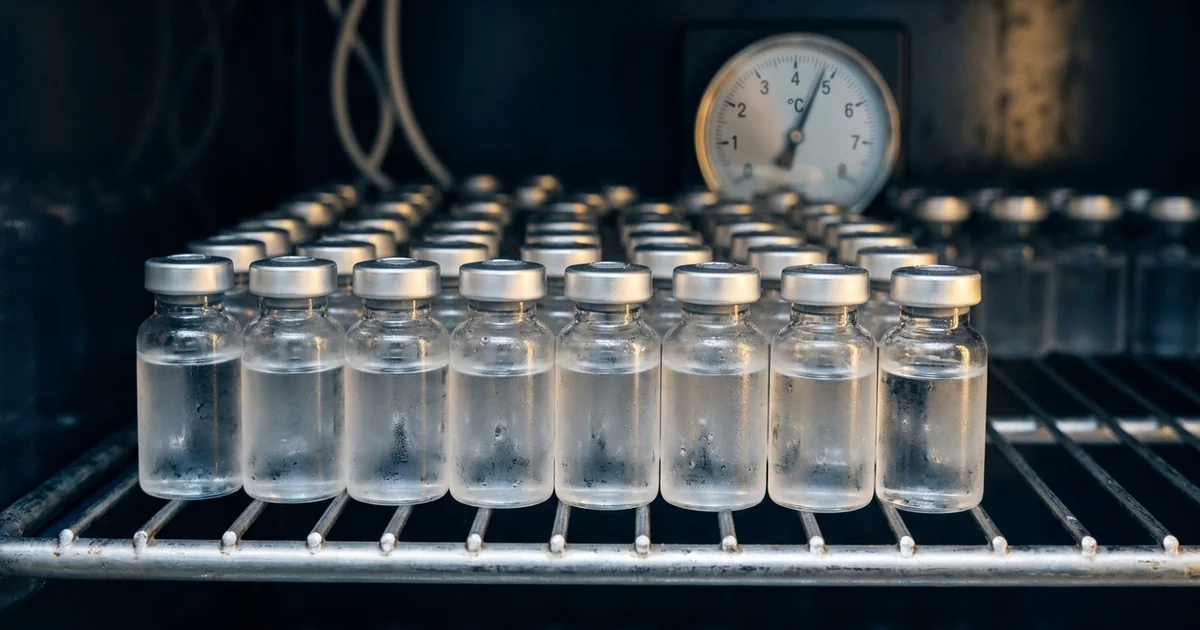
A vaccine batch that passed every release test leaves the plant, travels three days to a regional store, and arrives with a freeze indicator tripped. The whole consignment is now unusable, not because it got too warm, but because it spent a night against the ice packs in a transport box. This is the routine reality of vaccine distribution, and it traces back to decisions made years earlier at the formulation bench. Vaccine formulation cold chain stability is the discipline of choosing the antigen's buffer, its stabiliser system, its adjuvant and its physical form. The aim is a finished product that survives the temperatures it will actually meet, including the freezing it must never meet. Get it right and a product ships with a wide safety margin and, sometimes, a label that tolerates excursions. Get it wrong and a technically effective vaccine is lost in the field at scale, with the wastage rate for some programmes reaching a large fraction of doses produced. This article explains what degrades in a vaccine, why aluminium adjuvants make freezing the dominant risk, and how sugar and amino acid stabilisers work. It also covers where freeze-drying and thermostable formats help, and how to build all of this into a development programme rather than discovering it in distribution. It is written for pharmaceutical engineers and manufacturers who own the formulation and the process.
Why Vaccine Formulation Cold Chain Stability Is a Design Problem
The cold chain is often described as a logistics challenge, but its cost and its failure modes are set by the formulation. A liquid, aluminium-adjuvanted vaccine in a phosphate buffer has a narrow temperature window and a hard freeze limit that no amount of better refrigeration can widen. A robustly formulated freeze-dried product may tolerate days at ambient temperature. The difference between those two outcomes is decided during development, and it then governs the refrigeration, transport and monitoring spend for the entire commercial life of the product. Treating stability as a formulation deliverable, quantified early, is what keeps a programme from carrying an avoidable distribution burden.
- Storage temperature is a formulation output — the buffer, stabiliser and adjuvant determine whether the label reads 2–8 °C, –20 °C, or lower, and each step down multiplies distribution cost.
- Freeze sensitivity is usually adjuvant-driven — aluminium salt suspensions are permanently damaged by a single freeze, so the adjuvant choice often sets the lower temperature limit.
- Wastage is large and measurable — heat and freeze excursions, expiry and breakage combine to waste a significant share of doses in many immunisation programmes.
- Excursion tolerance can be engineered — a controlled temperature chain or thermostable label is achievable for some products, but only if the formulation is designed and the stability data generated to support it.
Because the formulation sets these constraints, the rest of this article works through the levers a developer actually controls, starting with the degradation the formulation is fighting. The broader context of pharmaceutical stability programmes is covered across the pharmaceuticals and health care knowledge base.
What Actually Degrades in a Vaccine
A vaccine is not one molecule but a system: an antigen, an adjuvant, a buffer, stabilising excipients, sometimes a preservative, all in a container. Each element can lose function, and the dominant pathway depends on the antigen type. Understanding which reaction is rate-limiting for a given product tells the developer which excipient and which storage condition will actually protect it. The degradation mechanisms are well characterised in the literature and map onto specific formulation countermeasures.
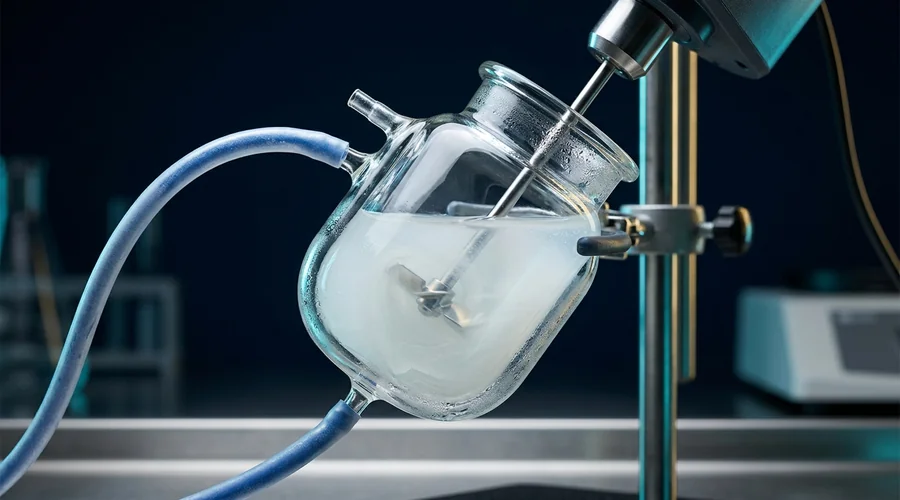
- Protein antigens — lose potency through unfolding, aggregation, deamidation, oxidation of methionine and cysteine residues, and adsorption onto container surfaces.
- Polysaccharide and conjugate antigens — degrade by hydrolysis of the polysaccharide chain and by cleavage of the linker in conjugate vaccines, both accelerated by heat and by unfavourable pH.
- Live attenuated organisms — lose viability, which is an all-or-nothing loss of the dose; sensitive to heat, desiccation and freeze-thaw.
- Inactivated whole-virus antigens — lose conformational epitopes as the particle disassembles or the surface proteins denature.
- The adjuvant — aluminium salts aggregate on freezing; emulsions cream or coalesce; the antigen can also desorb from the adjuvant over time.
- The container closure — the antigen can adsorb to glass or elastomer, and leachables from the stopper can catalyse oxidation.
Once the dominant pathway is known, the single largest physical risk for most adjuvanted products becomes clear: freezing. That risk comes from the adjuvant itself.
Adjuvants and the Freeze-Sensitivity They Impose
An adjuvant strengthens and directs the immune response so that less antigen, or fewer doses, achieves protection. The trade-off is that the adjuvant brings its own stability profile, and for the aluminium salts that dominate licensed vaccines that profile is defined by a hard intolerance of freezing. A developer choosing an adjuvant is also choosing the product's lower temperature limit and a large part of its distribution risk, so the decision belongs in early formulation, not at the end. The main adjuvant classes behave differently under thermal stress.
| Adjuvant class | Examples | Main stability constraint |
|---|---|---|
| Aluminium hydroxide | Adsorbs many recombinant and toxoid antigens | Irreversible aggregation on a single freeze; phosphate buffers can displace adsorbed antigen |
| Aluminium phosphate | Used where the antigen adsorbs better at its surface charge | Same freeze intolerance; particle size and adsorption shift with pH and storage time |
| Oil-in-water emulsions | Squalene-based emulsion adjuvants | Creaming, coalescence and droplet-size growth on temperature cycling; usually still refrigerated |
| Saponin / liposome combinations | Combination adjuvant systems | Liposome integrity and saponin partitioning sensitive to temperature; often lyophilised or kept cold |
| TLR-agonist adjuvants | Monophosphoryl lipid A and related | Often co-formulated on aluminium or in liposomes, inheriting those constraints |
- Freezing collapses aluminium suspensions — ice formation forces the fine primary particles together into large aggregates that do not redisperse on thawing, reducing the surface area available to hold antigen.
- Aggregation changes potency and the immune response — the aggregated adjuvant delivers antigen differently, so a frozen dose is not just weaker but altered.
- Buffer choice interacts with the adjuvant — phosphate is generally avoided with aluminium hydroxide because phosphate ions compete with antigen for the adsorption sites; histidine is a common alternative.
- Emulsions fail differently — they are less freeze-defined but need droplet-size specifications monitored over shelf life and after any temperature excursion.
Because the adjuvant so often sets the freeze limit, the stabiliser system has to do the rest of the work: protecting the antigen against heat, interfacial stress and, where possible, against freezing too.
Stabilizer Systems: Sugars, Amino Acids, and Buffers
A vaccine stabiliser system is a small set of excipients chosen to hold the antigen in its native, potent state through manufacturing, storage and, for dried products, the freeze-drying cycle. Each class of stabiliser addresses a specific stress, and a working formulation usually combines several. The selection is empirical, guided by excipient-screening studies, but the mechanisms are well established and constrain the starting shortlist. The goal is a formulation robust enough that normal cold-chain variation does not move the product out of specification.
- Disaccharides (sucrose, trehalose) — act as cryoprotectants during freezing and as lyoprotectants during drying, replacing the hydrogen bonds water normally makes with the protein and forming the amorphous glass that immobilises it in a dried cake.
- Amino acids (glycine, arginine, histidine, glutamate) — buffer the formulation, reduce protein–protein association that leads to aggregation, and act as bulking agents in lyophilised products.
- Proteins and hydrolysates — recombinant human albumin, or plant and yeast hydrolysates as animal-free alternatives to gelatin, stabilise live organisms and coat surfaces to limit adsorption.
- Buffers (histidine, phosphate, Tris, citrate) — hold pH in the antigen's stable range; the choice is constrained by adjuvant compatibility and by pH shifts that occur when some buffers freeze.
- Surfactants (polysorbate 20 and 80) — protect against aggregation at air–liquid and container interfaces, particularly during agitation in transport.
- Chelators and antioxidants — sequester trace transition metals and quench oxidation where the antigen has vulnerable residues.
Stabilisers can widen the temperature window substantially, but a liquid formulation still has a ceiling. To go further — toward tolerating ambient temperatures — most programmes turn to removing the water.
Freeze-Drying and the Move Toward Thermostability
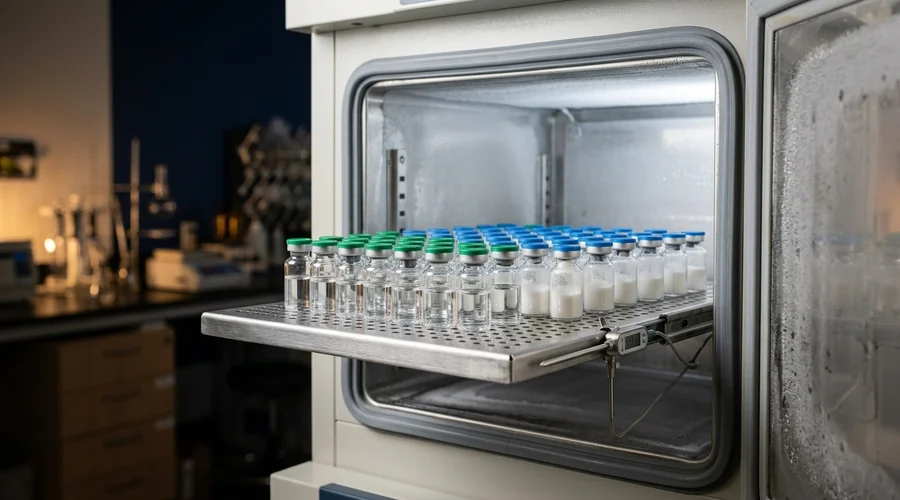
Removing water from a formulation slows almost every degradation reaction, because the molecular mobility that drives unfolding, hydrolysis and aggregation depends on water. Freeze-drying is the established route, converting the liquid into a dry, glassy cake that is reconstituted with a diluent before use. Many live viral vaccines are supplied this way precisely because the liquid form is too fragile. Freeze-drying is not free of cost, and newer drying methods aim to push stability further, but the physical principle is the same across all of them. The fundamentals of the freeze-drying process are covered in depth in the guide to pharmaceutical lyophilization.
What freeze-drying achieves and costs
A well-formulated lyophilised vaccine trades a short, fragile liquid life for a long, robust dry one, but the conversion introduces its own stresses and a more complex process. The freezing and drying steps can themselves denature the antigen, the cake must meet a residual-moisture specification, and the finished process is slower and more capital-intensive than filling a liquid.
- Stability gain — dried products often tolerate higher temperatures for longer, and some carry excursion allowances a liquid could not support.
- Process stress — ice crystal formation and the air–ice interface stress proteins during the cycle, which is why lyoprotectant selection is central.
- Residual moisture — too much water left in the cake plasticises the glass and shortens shelf life; the specification is tight and monitored.
- Reconstitution burden — the diluent, the mixing step and the short in-use shelf life move a handling and cold-chain requirement to the point of care.
Thermostable formats and the CTC label
Beyond conventional lyophilisation, developers are pursuing formats that tolerate ambient storage: optimised glass-forming stabiliser systems, spray drying, and drying antigen into films or onto membranes. The regulatory counterpart is the World Health Organization's controlled temperature chain designation, which lets a qualifying product spend a limited period at up to 40 °C immediately before administration.
- Controlled temperature chain — a small number of vaccines carry this label, permitting a single excursion of a defined duration at up to 40 °C before use.
- Alternative drying — spray drying and film drying can produce ambient-stable powders but need the antigen, excipients and process co-optimised.
- Regulatory evidence — any relaxed storage claim requires a full stability package demonstrating potency and safety across the claimed conditions.
- Product-by-product — thermostability is achieved one vaccine at a time; there is no universal formulation fix.
Even a thermostable product still travels through a distribution system built around refrigeration, so understanding that system — and its blind spots — is part of formulating for it.
The Cold Chain, CTC, and Freeze Monitoring
The cold chain is the unbroken series of refrigerated storage and transport steps that carries a vaccine from the filling line to the point of administration, conventionally at 2–8 °C for most products, with some held frozen. Its weak points are the transfers: loading docks, transport boxes, last-mile delivery and clinic refrigerators. Historically the monitoring emphasis has been on heat, but survey data has repeatedly shown that accidental freezing is at least as common and often goes undetected. For a freeze-sensitive formulation, that blind spot is the main threat.
- Standard storage — 2–8 °C covers most licensed vaccines; some require –20 °C or lower, which sharply increases equipment and transport cost and complexity.
- Transfer points fail most — temperature excursions cluster at manual handovers rather than during steady-state storage.
- Freezing is under-monitored — field studies across multiple countries have found a substantial proportion of monitored shipments exposed to sub-zero temperatures, frequently from ice packs conditioned incorrectly.
- Monitoring tools — electronic temperature loggers, vaccine vial monitors that integrate cumulative heat exposure, and freeze indicators or shake tests that reveal a past freeze event.
- The shake test — for aluminium-adjuvanted liquid vaccines, a suspected frozen vial sediments visibly faster than a never-frozen control, giving a field check for freeze damage.
The practical conclusion for a developer is that formulation robustness is the most reliable defence, because it does not depend on every handler in a long chain doing everything correctly. That robustness is built during development.
Building Stability Into Development
Stability is cheapest to engineer at the start, when the antigen and adjuvant are set but the formulation is still open. Decisions taken then fix the storage temperature, the freeze sensitivity, the physical form and the cold-chain cost for the product's whole commercial life. A structured formulation and stability programme converts a fragile candidate into a robust one before it enters clinical trials, where a stability surprise is expensive and slow to fix. This is also where a biologics formulation and protein stability partner adds the most value, by running the studies that a small developer often lacks the equipment or time to do.
- Characterise the antigen — run forced-degradation studies to identify the dominant loss pathway and the pH and temperature range where the antigen is stable.
- Screen buffers and stabilisers — use high-throughput excipient screening against the identified stress to shortlist a buffer, sugar, amino acid and surfactant combination.
- Fix adjuvant compatibility — confirm antigen adsorption, check for desorption over time, and verify the buffer does not compete with the antigen for the adjuvant surface.
- Decide liquid versus lyophilised — base the choice on the accelerated-stability data, the target storage claim and the manufacturing and cost implications.
- Design the ICH stability programme — set long-term, intermediate and accelerated conditions, add deliberate freeze-thaw and agitation stress, and define potency-indicating assays.
- Qualify the container closure — test antigen adsorption to the glass and stopper, extractables and leachables, and headspace oxygen.
- Plan the technology transfer — document formulation, process parameters, the lyophilisation cycle and acceptance criteria so a contract manufacturer reproduces the stability profile at scale.
Worked through in this order, the storage label and the excursion tolerance are known outcomes of the development programme rather than late surprises. The decision framework for a developer is direct. Identify what degrades. Let the adjuvant set the freeze limit and formulate around it. Use stabilisers to widen the heat margin, choose the physical form deliberately, and generate the stability data to support whatever storage claim the market needs. A vaccine that is designed for its cold chain reaches more people than one that merely survives ideal conditions.
Frequently Asked Questions
Why do most vaccines need to be kept at 2 to 8 degrees Celsius?
The 2 to 8 degrees Celsius window is a compromise that slows the chemical and physical degradation of the active antigen without freezing the product. Antigens are proteins, polysaccharides, inactivated viruses or live attenuated organisms, and all of them lose potency over time through hydrolysis, aggregation, oxidation or loss of viability, with the rate roughly doubling for every ten-degree rise.
Refrigeration buys shelf life measured in months to a few years. The lower bound matters as much as the upper one, because freezing can rupture live organisms and, critically, causes irreversible aggregation of aluminium-adjuvanted vaccines. So the cold chain is really a temperature band, not just an upper limit.
What is an adjuvant and how does it affect vaccine stability?
An adjuvant is a component added to a vaccine to strengthen and shape the immune response to the antigen, allowing a lower antigen dose or fewer doses. The most widely used adjuvants are aluminium salts, typically aluminium hydroxide or aluminium phosphate, which adsorb the antigen onto their surface. Oil-in-water emulsion adjuvants and other newer systems are used in specific products.
Adjuvants add their own stability constraints: aluminium salt suspensions are physically damaged by freezing, which collapses the fine particle structure into large aggregates that cannot be redispersed and that change the immune response. Emulsion adjuvants can cream, coalesce or change droplet size on temperature cycling. The adjuvant therefore often sets the freeze sensitivity and the storage temperature of the whole product.
How does freeze-drying improve vaccine stability, and what are its limits?
Freeze-drying, or lyophilisation, removes most of the water from the formulation and locks the antigen into an amorphous solid glass, which slows the molecular motion that drives degradation. A well-designed lyophilised vaccine can be far more stable than its liquid equivalent, sometimes tolerating higher temperatures for longer, which is why many live viral vaccines are supplied dry with a separate diluent.
The limits are practical. The freezing and drying steps themselves stress the antigen, so lyoprotectants such as sucrose or trehalose are needed to protect it. The dried cake still degrades if residual moisture is too high or if it is stored warm. And once reconstituted, the vaccine is a liquid again with a short in-use shelf life, so the reconstitution step reintroduces a cold chain and handling requirement at the point of use.
Which excipients are used to stabilise vaccines?
Vaccine stabiliser systems are built from a few functional classes. Sugars such as sucrose and trehalose act as lyoprotectants and cryoprotectants, forming the protective glass in freeze-dried products and shielding proteins during freezing. Amino acids like glycine, arginine and histidine buffer the formulation and reduce aggregation.
Proteins and hydrolysates, historically gelatin or human serum albumin and now often recombinant albumin or plant-derived hydrolysates, stabilise live organisms. Buffers such as phosphate, histidine or Tris hold the pH in the antigen's stable range, though phosphate is avoided with aluminium hydroxide because it can displace adsorbed antigen. Surfactants like polysorbate 20 or 80 protect against interfacial stress and aggregation. Chelators and antioxidants are added where trace metals or oxidation are a problem.
What is a thermostable vaccine and how close is the technology?
A thermostable vaccine is one formulated to tolerate storage outside the standard 2 to 8 degrees Celsius range, ideally at ambient temperature, for a useful period. Several approaches are in use or in development: optimised freeze-dried formulations with robust glass-forming stabilisers, spray-dried powders, and drying antigen into thin films or onto membranes.
Some existing products already carry a controlled temperature chain label from the World Health Organization, which permits a single excursion to up to 40 degrees Celsius for a limited number of days before use. Fully ambient-stable versions of most vaccines are not yet routine, because the antigen, the adjuvant and the drying process all have to be re-optimised together, and the regulatory stability package to support a new label claim is substantial. Progress is real but incremental and product-specific.
Why is freezing often more damaging to a vaccine than a brief warm excursion?
A brief warm excursion accelerates degradation reactions that were already happening slowly, and if the excursion is short the cumulative potency loss can be small and is often recoverable within the product's stability budget. Freezing causes a different, physical kind of damage that is usually sudden and irreversible.
Ice crystal formation concentrates solutes in the remaining liquid, shifts pH sharply, and creates large ice-water interfaces, all of which can denature proteins and disrupt suspensions. For aluminium-adjuvanted vaccines, a single freeze event aggregates the adjuvant permanently and can reduce both potency and safety. Because field monitoring has historically focused on heat, accidental freezing during transport and storage has been shown in surveys to be a widespread and under-recognised problem. This is why freeze indicators are now used alongside heat monitors.
When should a vaccine developer engage a formulation and stability partner?
The most useful point is during preclinical development, once the antigen and the intended adjuvant are chosen but before the clinical formulation is locked. Formulation decisions made then determine the storage temperature, the freeze sensitivity, whether the product will be liquid or lyophilised, and the eventual cold chain cost for the life of the product.
A stability partner can run forced-degradation and excipient-screening studies to find a robust buffer, stabiliser and container system, design the ICH-compliant stability programme, and model the shelf life. Engagement is also valuable when transferring a process to a contract manufacturer, when scaling lyophilisation from lab to production, or when pursuing a controlled temperature chain or thermostable label for an existing product. Building formulation robustness in early is far cheaper than discovering a freeze-sensitivity or potency-loss problem during clinical trials or after launch.
Developing or Transferring a Vaccine Formulation?
Global Formulation provides vaccine adjuvant formulation consulting, cold chain stabilizer product development services, lyophilized vaccine stability technology support, and vaccine contract manufacturing partner selection for developers and manufacturers.
Talk to Our Formulation Team