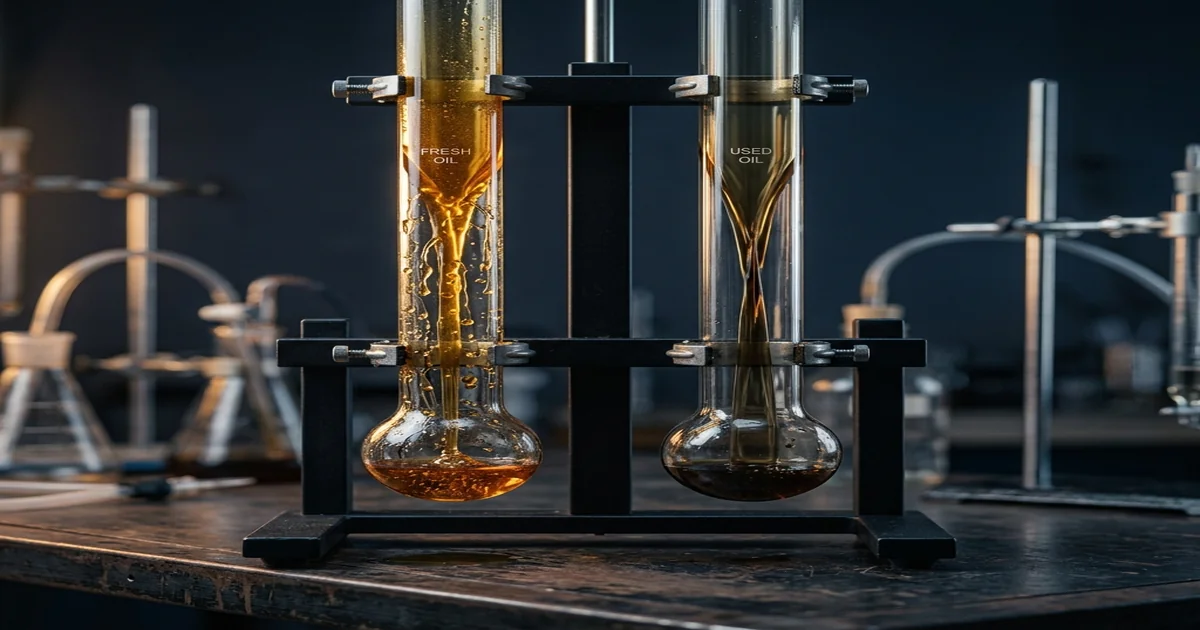
Engine oil viscosity breakdown turns a routine oil analysis report into an urgent conversation about warranty exposure. A lubricant that left the plant meeting its labelled SAE grade arrives at the next drain interval measuring thinner than spec, and the maintenance team is left wondering whether the oil failed, the engine is unusually severe on lubricants, or the sample was simply mishandled. The cost is real: a thinned oil film loses hydrodynamic separation at exactly the load and temperature extremes where the engine needs it most, accelerating wear on bearings, cam lobes, and piston rings. This guide walks through the shear degradation mechanisms that cause engine oil viscosity breakdown, shows you how to separate permanent polymer shear from fuel dilution and thermal effects, and lays out the diagnostic and formulation path to a lubricant that holds its grade for the full service interval.
Understanding the Problem: What You Are Seeing and Why It Matters
Viscosity breakdown shows up as a used oil analysis reporting kinematic viscosity below the lower bound of the oil's labelled SAE grade, sometimes accompanied by a driver or technician noticing lower oil pressure or a slightly noisier valve train. Unlike oxidative thickening, which raises viscosity over time as the oil ages, shear-related breakdown moves in the opposite direction — the oil gets thinner, not thicker, and the shift can happen well before the scheduled drain interval in severe-duty applications.
The commercial impact compounds because the failure is often invisible until wear damage is already underway. A fleet operator who trusts the labelled viscosity grade without periodic verification may not discover the problem until a bearing failure or increased oil consumption forces a teardown, at which point the root cause investigation has to work backward through months of operating history. In warranty and OEM contexts, a documented pattern of premature viscosity loss across multiple units can trigger a formal field investigation into whether the lubricant specification matches the engine's actual duty cycle.
Industries most exposed to this failure include heavy-duty trucking and off-highway equipment operating under sustained high load, performance and turbocharged passenger vehicles with tight valve train tolerances, and any fleet running extended drain intervals where the oil's shear stability margin is fully consumed before the next scheduled change. Wherever high shear rates, high temperatures, and long service intervals combine, the risk of viscosity breakdown rises sharply.
Root Causes: The Mechanisms Behind This Failure
Modern multigrade engine oils achieve their wide temperature range performance by blending a lower-viscosity base oil with a viscosity index improver — a long-chain polymer that coils tightly at low temperature and unwinds to thicken the oil at high temperature. That same polymer chain is the weak point in the system, because the mechanical forces inside a running engine are strong enough to physically break it apart. Understanding which mechanism is thinning the oil is the first step toward choosing the right corrective formulation, since polymer shear, fuel dilution, and thermal breakdown each demand a different fix.
Mechanical Shear of Viscosity Index Improvers
The narrow clearances between piston rings and cylinder walls, and the high contact stresses at cam-follower and valve train interfaces, subject the oil film to intense shear rates over millions of cycles. These forces can physically fracture the long polymer backbone of the viscosity index improver into shorter fragments. A shorter polymer chain occupies less hydrodynamic volume in solution and provides substantially less thickening effect, so the oil's measured viscosity drops permanently even though the base oil itself is largely chemically unchanged. This is the dominant mechanism behind viscosity breakdown in modern multigrade oils.
Polymer Molecular Weight and Shear Stability Trade-off
Higher molecular weight polymers provide more viscosity-boosting effect per unit of treat rate, which is commercially attractive, but higher molecular weight chains are also more susceptible to mechanical scission under shear because longer chains experience greater hydrodynamic drag forces along their length. Formulators balance this trade-off by selecting polymer chemistry and molecular weight distribution based on the expected shear severity of the target application, and an oil formulated for light-duty passenger use may lack the shear stability margin needed in a high-load diesel or performance engine.
Fuel Dilution as a Compounding Factor
Unburned fuel that leaks past piston rings into the crankcase, common during cold starts, short-trip driving, or certain emissions regeneration cycles in diesel engines, acts as a low-viscosity diluent that thins the oil independent of any polymer damage. Fuel dilution can occur alongside shear breakdown and make the total viscosity loss look more severe than polymer shear alone would explain, which is why distinguishing the two mechanisms matters for an accurate root cause finding.
Thermal and Oxidative Base Oil Effects
At elevated sustained temperatures, base oil molecules can undergo thermal cracking that reduces their own viscosity contribution, while oxidative byproducts can simultaneously increase viscosity by forming larger, more viscous molecules. These two effects can partially offset each other, which sometimes masks the magnitude of polymer shear loss unless the analysis separates viscosity trend from oxidation markers like acid number.
| Root Cause Category | Primary Mechanism | Typical Observable Trigger | Reversibility |
|---|---|---|---|
| Mechanical polymer shear | VII chain fracture under high shear rate | High-load, high-RPM duty; tight valve train clearances | Permanent |
| Molecular weight mismatch | Polymer selected for lighter duty than actual service | Extended drain interval in severe-duty application | Permanent, recurring |
| Fuel dilution | Unburned fuel entering crankcase past rings | Short-trip driving, cold starts, DPF regeneration cycles | Reversible on drain |
| Thermal/oxidative base oil shift | Base oil cracking offset by oxidative thickening | Sustained high sump temperature over extended service | Permanent |
Diagnosis: How to Confirm the Root Cause
Confirming viscosity breakdown correctly means ruling out fuel dilution and sampling error before concluding that polymer shear is responsible, because each of these three causes points to a different corrective action. A rushed diagnosis that jumps straight to reformulation without checking dilution data risks solving the wrong problem while the actual cause keeps recurring.
Kinematic Viscosity Trending Against Baseline
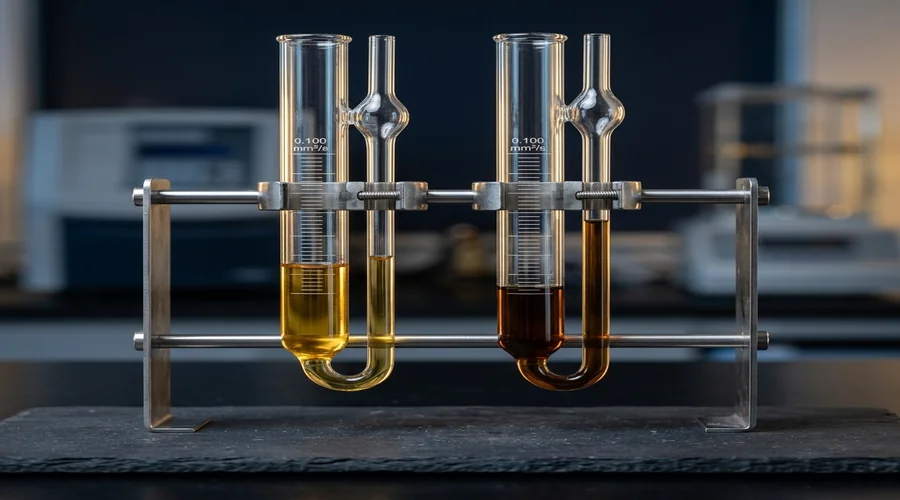
The foundation of diagnosis is comparing kinematic viscosity at 100°C, measured according to methods such as ASTM International D445, against the fresh oil's certified baseline value and the oil's labelled SAE grade boundaries. A single data point is useful, but trending viscosity across consecutive oil analysis reports from the same unit reveals whether the loss is a one-time event or a progressive pattern consistent with cumulative shear damage.
Fuel Dilution Cross-Check
Every viscosity complaint should be checked against the fuel dilution percentage reported in the same used oil analysis. A viscosity drop that closely tracks a high fuel dilution reading points toward dilution as the primary driver, while a viscosity drop that occurs with normal or low fuel dilution readings shifts suspicion firmly toward polymer shear. Skipping this cross-check is the most common reason a shear-stability complaint gets misattributed to the wrong cause.
Permanent Shear Stability Bench Testing
Where a formulation is under investigation before it reaches the field, standardized shear stability tests that subject fresh oil to a defined mechanical or ultrasonic shear cycle, then remeasure viscosity, quantify how much permanent viscosity loss the polymer package is likely to experience under representative severity. This bench data allows a formulator to compare candidate viscosity index improver chemistries objectively before committing to a full-scale field trial.
Elemental and Oxidation Marker Correlation
Reviewing acid number, oxidation index, and wear metal concentrations alongside the viscosity trend helps separate thermal-oxidative effects from pure mechanical shear. A viscosity loss with minimal change in oxidation markers is more consistent with mechanical polymer scission, while a viscosity result that moves opposite to what oxidation markers suggest indicates competing thermal and oxidative effects that need to be considered together rather than viewed as a single mechanism.
Solution Strategies: Corrective Approaches
The right corrective path depends entirely on which mechanism the diagnosis confirmed, and applying a shear-stability fix to a dilution problem — or vice versa — wastes a full drain interval while the real cause keeps damaging the engine. Matching the strategy to the confirmed mechanism is what turns a recurring complaint into a permanently resolved one.
Selecting Shear-Stable Polymer Chemistry
Where mechanical shear is confirmed as the dominant mechanism, the underlying fix is choosing a viscosity index improver chemistry and molecular weight distribution engineered for greater shear stability under the application's actual severity, rather than simply meeting the target grade at a lower cost. Star-branched and other specialty polymer architectures are designed to resist chain scission more effectively than standard linear polymers at a comparable initial thickening efficiency, and matching polymer selection to duty cycle severity — not just to the labelled SAE grade — is the core corrective principle.
Addressing Duty Cycle and Drain Interval Mismatch
When shear loss traces back to a mismatch between the oil's shear stability margin and the actual operating severity, the correction may involve shortening the drain interval to stay within the oil's proven shear-stable service life, or moving to a formulation validated for the specific duty cycle rather than a general-purpose grade. This is particularly relevant for extended-drain programmes, where the interval was often set based on oxidative life rather than shear stability margin.
Resolving Fuel Dilution Separately
Where fuel dilution is confirmed as a contributing or primary factor, the corrective path lies in the fuel and combustion system rather than the lubricant formulation — addressing injector condition, cold-start calibration, or regeneration cycle frequency depending on the engine type. Reformulating the oil's viscosity grade to compensate for a dilution problem treats the symptom rather than the root cause and typically fails to resolve the complaint permanently.

Prevention: Process Controls and Formulation Strategies to Avoid Recurrence
Preventing recurring viscosity breakdown means matching lubricant selection to actual operating severity from the outset, rather than defaulting to the lowest-cost oil that meets the labelled grade on a fresh-oil basis. Fleets and OEMs that see the fewest shear-related complaints treat shear stability as a qualification criterion equal in importance to fresh-oil viscosity, and they validate it under representative conditions before committing to a drain interval.
Duty-Cycle-Matched Formulation Qualification
Qualifying a lubricant against bench shear stability testing that reflects the specific application's severity — not a generic industry minimum — ensures the polymer package selected has adequate margin for the actual mechanical stress it will experience. This is especially important when extending drain intervals, since a longer interval demands a correspondingly larger shear stability margin.
Routine Used Oil Analysis Programmes
Scheduling periodic used oil sampling at intervals shorter than the full drain period allows a fleet to catch a shear stability shortfall while there is still time to intervene, rather than discovering the problem only at the scheduled drain when wear damage may already be underway. Trending viscosity alongside fuel dilution and wear metals over multiple sampling points is far more diagnostic than any single snapshot.
Drain Interval Validation
Extended or optimized drain intervals should be validated with field trial data that specifically tracks viscosity retention through the full proposed interval under representative duty cycle conditions, not solely oxidative life indicators such as total base number depletion. A drain interval set purely on oxidative criteria can still allow shear-driven viscosity loss to fall out of grade well before the oil is due for change.
Fuel System Maintenance
Because fuel dilution compounds and can be mistaken for shear breakdown, maintaining injector calibration, addressing cold-start enrichment issues, and monitoring regeneration cycle frequency in diesel applications reduces the dilution component of viscosity loss and makes any remaining shear-related trend easier to isolate and address.
When to Escalate to a Specialist
Most viscosity breakdown complaints resolve through structured used oil trending and the corrective strategies described above, but certain patterns exceed what routine fleet maintenance or in-house quality checks can reliably fix. Recognising these signals early prevents repeated oil changes that fail to address the underlying mismatch.
Escalation is appropriate when viscosity loss recurs across multiple drain intervals despite switching to a product marketed as shear-stable, when a fleet-wide pattern suggests the lubricant specification itself does not match the actual duty cycle severity, or when documented wear damage has already occurred and needs to be correlated against the oil analysis history for a warranty or liability determination. These situations typically require viscometric shear bench testing and polymer chemistry expertise beyond what a standard used oil report alone can resolve.
Complex multi-factor cases — where viscosity loss coincides with unexplained wear metal trends, a recent switch in fuel type or engine calibration, or a need to requalify a lubricant specification against a new extended-drain programme — benefit from a formulation review that considers shear stability alongside the oil's full performance profile. Our team supports root cause analysis and corrective lubricant strategy from failure diagnosis through validated reformulation and field trial support.
For related formulation background, see our guide to lubricant formulation fundamentals and our overview of rust preventive oil film chemistry, both of which share base oil and additive interaction principles relevant to viscosity performance.