Vitamin C Serum Formulation: Ascorbic Acid Stability Solutions
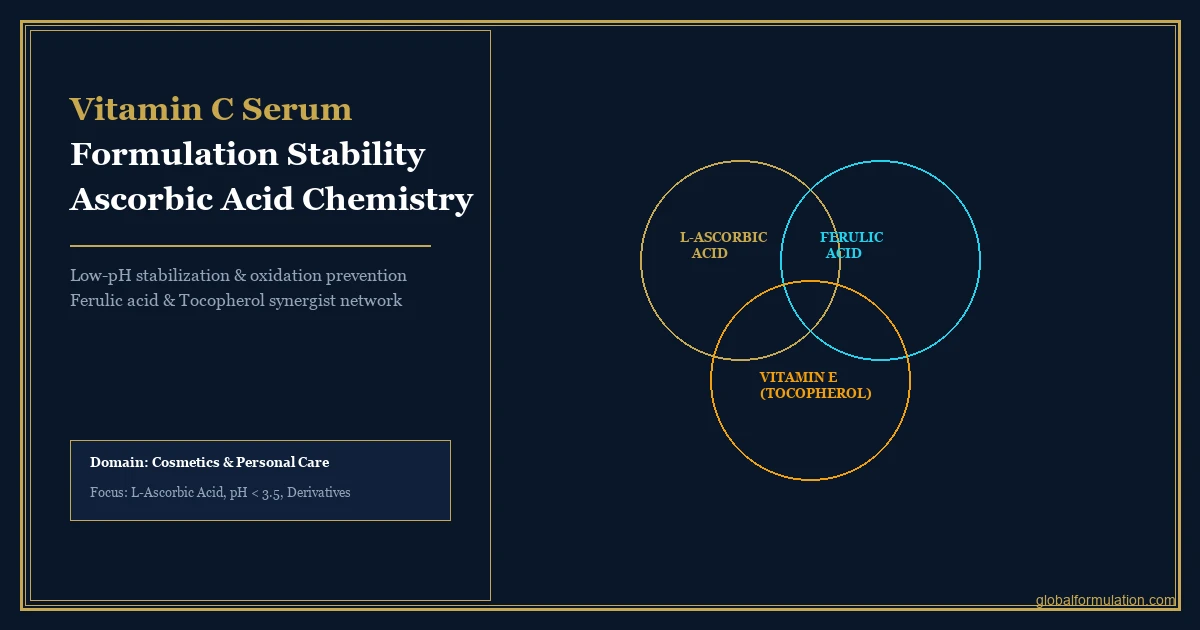
A vitamin C serum that ships colorless and turns amber-brown on a customer's shelf within weeks is one of the fastest ways an indie skincare brand generates refund requests and one-star reviews. The active ingredient behind that discoloration, L-ascorbic acid, is also the most clinically validated form of vitamin C in skincare, which puts formulators in a bind between using the ingredient with the strongest evidence base and using one that survives shelf life. Vitamin C serum formulation stability comes down to controlling a handful of interlocking variables — pH, water content, trace metal contamination, and oxygen exposure — each of which accelerates the same oxidative degradation pathway if left unmanaged. This guide explains why L-ascorbic acid oxidizes so readily, how low-pH and antioxidant strategies slow that process down, and when a more stable vitamin C derivative is the better formulation choice. It's written for cosmetic formulators and skincare entrepreneurs building serums within the broader cosmetics and personal care category.
Why Vitamin C Serum Formulation Stability Starts With L-Ascorbic Acid's Chemistry
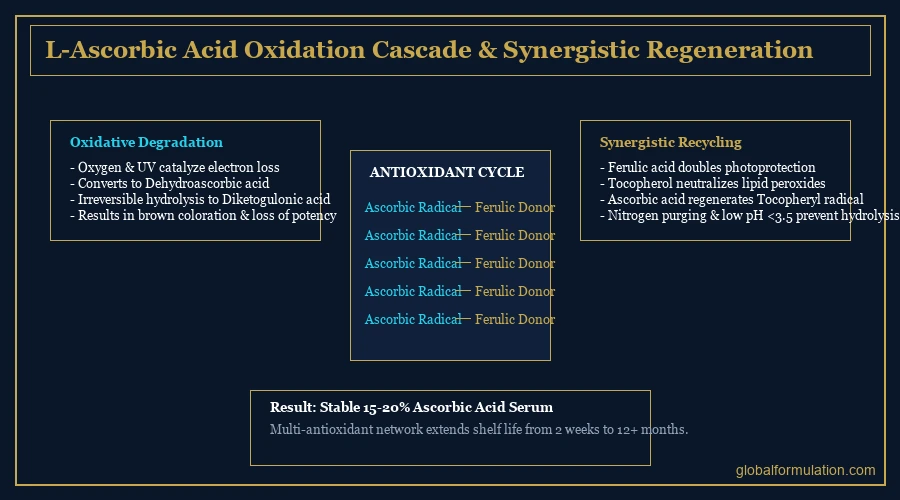
L-ascorbic acid is the form of vitamin C with the deepest clinical evidence behind it, backed by decades of published research on collagen synthesis support, antioxidant protection, and pigmentation control. That same molecule is also an exceptionally efficient electron donor, which is precisely what makes it useful as an antioxidant and precisely what makes it so hard to keep stable in a bottle. Once dissolved in water, ascorbic acid readily donates electrons to dissolved oxygen and trace metal ions, oxidizing first to dehydroascorbic acid and then progressively breaking down into erythrulose and other degradation products that carry a visible yellow-to-brown color. Formulators aren't fighting a manufacturing defect when a vitamin C serum discolors; they're watching the same chemistry that makes the ingredient work in the first place run to completion inside the bottle.
- Electron donation — Ascorbic acid's antioxidant activity and its instability are the same chemical property, not two separate problems
- Dehydroascorbic acid (DHAA) — The first oxidation product; still bioactive but represents lost potency and the first visible step toward discoloration
- Trace metal catalysis — Iron and copper ions catalyze ascorbic acid oxidation even at very low concentrations, often introduced through raw materials or water supply
- Visible discoloration — Progressive yellowing to amber-brown is a reliable, visually apparent indicator of oxidative degradation already in progress
Because that oxidation pathway is driven by water, oxygen, metal ions, and pH all at once, a stable vitamin C serum formulation strategy has to control several of these variables simultaneously rather than relying on any single fix.
The Low-pH Formulation Strategy: pKa, Skin Penetration, and Stability Trade-offs
Ascorbic acid's stability and its ability to penetrate skin are both governed by the same acid-base chemistry, which is why low-pH formulation has become the standard approach for pure L-ascorbic acid serums. The molecule's first acid dissociation constant sits close to pH 4.2, meaning that below roughly pH 3.5 the majority of ascorbic acid exists in its neutral, non-ionized form rather than its ionized conjugate base. That neutral form is both more chemically stable and more readily able to cross the stratum corneum, which is why most published efficacy data on L-ascorbic acid comes from formulations held at low pH rather than near-neutral ones.
- pH below ~3.5 — Maximizes the non-ionized fraction of ascorbic acid, favoring both stability and skin penetration
- Consistent buffering — Low pH has to be held through the full shelf life; drift toward neutral pH as the formula ages accelerates ionization and instability
- Irritation trade-off — Sustained low pH increases the likelihood of stinging or irritation, particularly on compromised or sensitized skin barriers
pH control alone slows oxidation, but it doesn't stop it, which is why nearly every stable L-ascorbic acid serum on the market pairs low pH with a second line of chemical defense.
Antioxidant Synergists and Chelation: Vitamin E, Ferulic Acid, and EDTA
Because ascorbic acid degrades through electron transfer to oxygen and metal ions, the most effective stabilization strategies intercept those same pathways rather than trying to eliminate oxygen and metals from the formula entirely, which usually isn't achievable in a real production environment. Alpha-tocopherol, or vitamin E, is one of the most established co-antioxidants used alongside L-ascorbic acid, and the two work through a genuinely synergistic mechanism: vitamin C regenerates oxidized vitamin E back to its active form, extending the useful life of both antioxidants rather than simply adding their individual effects together.
Ferulic acid, a plant-derived phenolic antioxidant, has become closely associated with vitamin C serums following published research showing it further stabilizes the combined vitamin C and vitamin E system and enhances photoprotection. EDTA plays a different but equally important role — as a chelating agent, it sequesters trace iron and copper ions that would otherwise catalyze oxidation, neutralizing one of the fastest degradation pathways at a very low use level.
Antioxidant synergists slow the chemistry down at the molecular level, but they can't compensate for a manufacturing or packaging process that keeps reintroducing oxygen and light to the formula.
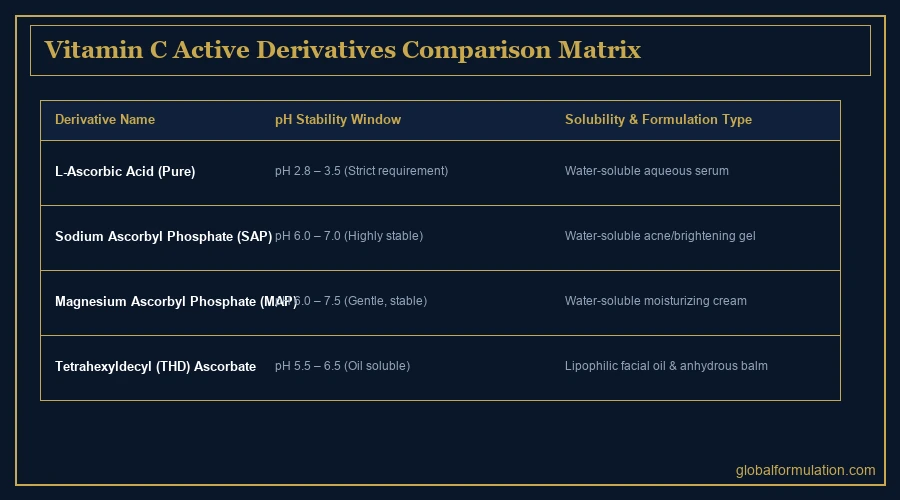
Stable Vitamin C Derivatives: When to Choose SAP, MAP, or Ascorbyl Glucoside
When a brand can't manage low-pH, anhydrous, or airless-packaging requirements, or wants a gentler product for sensitive skin, vitamin C derivatives offer a chemically different path to the same ingredient story. These derivatives modify the ascorbic acid molecule, most often by attaching a phosphate, glucose, or fatty ester group, in a way that dramatically improves stability at near-neutral pH. The trade-off is that skin has to convert the derivative back into active ascorbic acid using its own enzymes, and that conversion is generally slower and less complete than applying L-ascorbic acid directly.
| Derivative | Solubility | Stability Advantage | Typical Use Case |
|---|---|---|---|
| Sodium ascorbyl phosphate (SAP) | Water-soluble | Stable at near-neutral pH; converted by skin phosphatase enzymes | Sensitive-skin and multi-active formulas |
| Magnesium ascorbyl phosphate (MAP) | Water-soluble | Similar phosphate-ester stability profile to SAP | Water-based serums needing gentler actives |
| Ascorbyl glucoside | Water-soluble | Glucose-conjugated; converted by skin glucosidase enzymes | Brightening formulas paired with other water-soluble actives |
| Tetrahexyldecyl ascorbate | Oil/lipid-soluble | Ester form resists hydrolysis; compatible with anhydrous systems | Oil-based serums and anhydrous formulations |
Choosing a derivative over pure L-ascorbic acid is a legitimate formulation decision, not a compromise. It trades some of the strongest published clinical data for a formula that survives real-world shelf life and broader compatibility with other actives.
Packaging and Manufacturing Controls That Protect Shelf Life
Even a well-designed low-pH or derivative-based formula can fail early if manufacturing and packaging don't protect it from the same oxygen and light exposure the chemistry was designed to resist. Dissolved oxygen introduced during mixing is one of the most overlooked stability risks in vitamin C serum manufacturing, which is why some producers purge the batch and headspace with nitrogen before filling to displace oxygen the formula would otherwise carry into the finished container.
- Opaque or amber packaging — Blocks UV and visible light that accelerates ascorbic acid photodegradation
- Airless pump dispensers — Limit repeated air exposure with every use, unlike jars or open-mouth bottles
- Nitrogen headspace purging — Displaces dissolved and headspace oxygen during and after filling
- Single-use ampoules — Minimize how often a batch is exposed to air, commonly used for pure L-ascorbic acid formulas with the shortest practical shelf life
Packaging decisions made at the manufacturing stage determine whether a chemically sound formula actually reaches the consumer in the condition it left the lab, which brings the discussion to how vitamin C behaves once it has to share a routine with other active ingredients.
Formulating Around Vitamin C: Compatibility With Niacinamide and Other Actives
Vitamin C rarely lives alone in a skincare routine, and its low-pH stability requirement creates real compatibility friction with some of the most popular actives it gets paired with. Niacinamide is the most commonly cited example: at low pH and elevated temperature, niacinamide can hydrolyze toward nicotinic acid, a related compound associated with a higher likelihood of flushing, though the practical significance of this reaction in finished products depends heavily on formulation conditions. Niacinamide's own pH stability profile sits closer to neutral, which is the opposite end of the range that pure L-ascorbic acid needs.
- Separate products or steps — Many brands sidestep the pH conflict entirely by formulating vitamin C and niacinamide as separate products used at different times of day
- Derivative substitution — Using a near-neutral-pH vitamin C derivative instead of L-ascorbic acid removes the pH conflict and allows single-formula combination
- Retinoid layering — Retinoids carry their own stability constraints around light and oxidation, and are conventionally recommended at a different time of day rather than combined with vitamin C in one formula
None of these compatibility challenges are reasons to avoid vitamin C. They're formulation constraints that determine whether it belongs in a serum, a moisturizer, or a standalone product, a decision covered in more depth in how moisturizers and serums differ as delivery formats.
Frequently Asked Questions
Why does my vitamin C serum turn yellow or brown over time?
That color change is the visible sign of L-ascorbic acid oxidizing, first to dehydroascorbic acid and then to further breakdown products like erythrulose that carry a yellow-to-brown color. It happens because ascorbic acid is a powerful electron donor — the same chemical property that makes it a useful antioxidant on skin also makes it react readily with dissolved oxygen and trace metal ions in the bottle.
A colorless or pale straw serum that stays that way through its shelf life indicates the formulation's stabilization strategy, including low pH, antioxidant synergists, and protective packaging, is actually working.
Why do vitamin C serums need such a low pH?
Ascorbic acid's first acid dissociation constant sits close to pH 4.2, so keeping the formula below roughly pH 3.5 maximizes the fraction of the molecule in its non-ionized form. That non-ionized form is both more chemically stable against oxidation and more able to cross the skin's outer barrier, which is why most of the published clinical research on L-ascorbic acid comes from low-pH formulations.
The trade-off is a higher chance of stinging or irritation, especially on sensitive or compromised skin.
What's the difference between L-ascorbic acid and vitamin C derivatives like SAP or MAP?
L-ascorbic acid is the active form of vitamin C itself, with the deepest clinical evidence behind it, but it's chemically unstable and requires low pH and careful packaging to hold up over shelf life. Derivatives like sodium ascorbyl phosphate (SAP) and magnesium ascorbyl phosphate (MAP) attach a phosphate group to the ascorbic acid molecule, which dramatically improves stability at near-neutral pH but requires the skin's own enzymes to convert the derivative back into active ascorbic acid after application.
That conversion step generally makes derivatives gentler and easier to formulate with, but somewhat less potent than direct L-ascorbic acid application.
Can I combine vitamin C and niacinamide in the same product?
It's possible, but it requires deliberate formulation choices because L-ascorbic acid's low-pH requirement conflicts with niacinamide's more neutral pH stability range. At low pH and elevated temperature, niacinamide can slowly convert toward nicotinic acid, a related compound linked to a higher chance of flushing, though how significant this is in a real finished product depends heavily on the specific formulation and storage conditions.
Many brands avoid the issue entirely by using a stable vitamin C derivative instead of L-ascorbic acid, or by keeping the two actives in separate products used at different times.
Why do vitamin E and ferulic acid get added to vitamin C serums?
Vitamin E (alpha-tocopherol) and vitamin C work through a genuinely synergistic antioxidant mechanism — ascorbic acid can regenerate oxidized vitamin E back to its active form, which extends the effective working life of both antioxidants in the formula. Ferulic acid, a plant-derived phenolic antioxidant, further stabilizes that combined vitamin C and vitamin E system and has been shown in published research to enhance photoprotection when the three are combined.
This is why the vitamin C, vitamin E, and ferulic acid combination shows up so consistently across serum formulations rather than vitamin C being used alone.
Does packaging really make a measurable difference to vitamin C serum shelf life?
Yes — packaging addresses two of the main drivers of ascorbic acid oxidation directly: light exposure and repeated air contact. Clear glass or jars that get opened and exposed to air repeatedly accelerate oxidation regardless of how well the formula itself was stabilized, which is why stable products consistently use opaque or amber containers paired with airless pump dispensers.
Some manufacturers go a step further and purge the batch with nitrogen before filling, or package pure L-ascorbic acid in single-use ampoules specifically to limit how often the formula is exposed to air.
Is a vitamin C derivative always the safer choice for a new skincare brand?
Not necessarily — it depends on what the brand is optimizing for. Derivatives like SAP, MAP, ascorbyl glucoside, and tetrahexyldecyl ascorbate offer far better shelf stability, broader pH compatibility with other actives, and generally lower irritation potential, which reduces manufacturing and customer-complaint risk substantially.
But L-ascorbic acid still carries the deepest published clinical evidence for outcomes like collagen synthesis support and pigmentation improvement, so brands prioritizing clinical substantiation over formulation simplicity often still choose to solve the stability challenge directly rather than switching to a derivative.
Developing a Vitamin C or Active-Ingredient Serum?
Global Formulation provides cosmetic formulation consultancy — active-ingredient stability strategy, pH platform design, and packaging selection for serums and treatment products.
Talk to Our Formulation Team