Crystalline Waterproofing Admixture vs Hydrophobic Pore-Blocking Technology
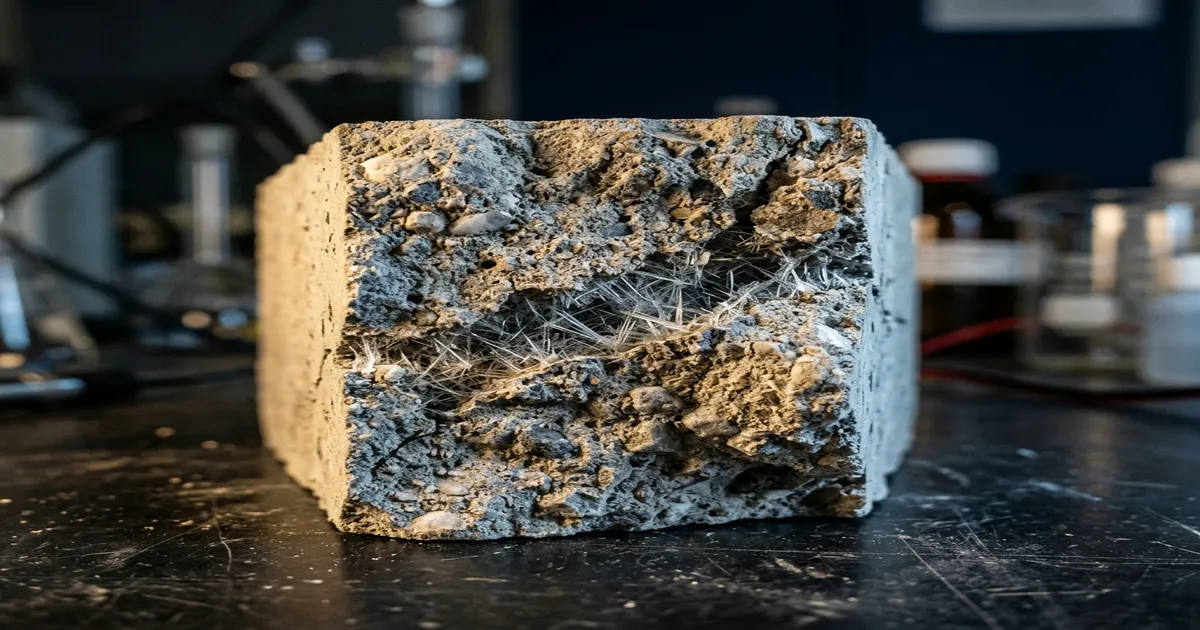
A basement wall that starts weeping six months after handover is one of the most expensive defects in construction. Fixing it means excavating the outside face or injecting resin from the negative side. That remedial work costs many times more than the crystalline waterproofing admixture which could have been batched into the mix. Yet the choice between integral waterproofing technologies is still made on price per bag rather than on exposure condition. The two dominant chemistries behave very differently once water arrives under pressure. This article explains how crystalline and hydrophobic pore-blocking admixtures actually work, how the ACI classification separates them, which test standards prove real performance, and what formulating either product line involves. Global Formulation supports construction chemical manufacturers developing integral waterproofing systems, and the sequence below reflects the order in which these decisions get made and verified in practice.
Why Waterproofing Moved Inside the Concrete
A surface membrane only protects a structure for as long as it stays continuous, bonded, and undamaged. That condition is difficult to guarantee on a real site, where reinforcement cages, formwork ties, and follow-on trades all get in the way. Once water breaches a membrane at a single point, it travels laterally between the membrane and the substrate. It then enters the concrete somewhere else entirely, which makes the leak almost impossible to trace back to its entry point. An integral waterproofing concrete admixture takes a different route by modifying the concrete itself. The barrier becomes the full thickness of the element rather than a film on its face.
Concrete is not inherently waterproof because hydrated cement paste retains an interconnected network of capillary pores left behind by mixing water that was never consumed in hydration. Water moves through that network by two distinct mechanisms, and the distinction drives every specification decision that follows.
- Capillary absorption — an unsaturated element draws water in by surface tension acting in fine pores, with no external pressure required. This dominates in façades, screeds, and paving that wet and dry repeatedly.
- Pressure-driven flow — a standing head of water forces flow through the connected pore network, which is the governing condition for basements, tanks, lift pits, and tunnel linings.
- Transport of aggressive species — chlorides, sulfates, and dissolved carbon dioxide travel with the water, so permeability control is a durability measure as much as a dryness measure.
- Crack pathways — a shrinkage or thermal crack short-circuits the pore network entirely and can carry more water than the intact matrix around it.
The two admixture families discussed below each attack a different part of this picture, and neither addresses all four. Understanding which mechanism a product actually interrupts separates a specification that holds up from one that fails its first wet season. Start with the technology that changes the pore itself.
How a Crystalline Waterproofing Admixture Seals Concrete from Within
A crystalline waterproofing admixture is supplied as a dry powder built on three components: Portland cement, finely graded silica sand, and a reactive chemical fraction. The reactive fraction is the active ingredient, and it needs two things that concrete supplies in abundance — water, and the calcium hydroxide released as a by-product of cement hydration. When those meet, the reaction precipitates insoluble crystalline deposits directly inside the capillary pores and micro-cracks, physically obstructing the flow path rather than merely coating it. The deposits are mineral in nature and chemically integral to the cement matrix. Unlike an organic coating, they are not consumed, washed out, or degraded by ultraviolet exposure.
- Dispersion — the powder is batched with the mix and distributes the reactive fraction throughout the concrete body rather than concentrating it at a surface.
- Reaction — the reactive chemicals react in the presence of moisture with free lime and other hydration products, nucleating insoluble crystal growth inside the pore structure.
- Pore obstruction — the growing crystals narrow and eventually block the capillary tracts that would otherwise carry water through the element.
- Dormancy — reactive material that finds no further water or free lime remains unreacted and inert within the hardened concrete.
- Reactivation — when a later crack admits water, the dormant fraction is reactivated and precipitates fresh growth into the crack, progressively narrowing it.
That reactivation behaviour is what gives crystalline products their self-sealing reputation, and the mechanism is real rather than marketing language. The limits are equally real: the capability applies to fine, essentially static hairline cracks, and it depends on residual reactive material still being present when the crack forms. A crack that keeps opening and closing under thermal or structural cycling will out-run the crystal growth, so crystalline chemistry supplements crack control reinforcement rather than replacing it. These mineral deposits are closely related to the hydration products described in general references on calcium silicate hydrate chemistry. That relationship is why they integrate with the matrix instead of sitting on top of it.
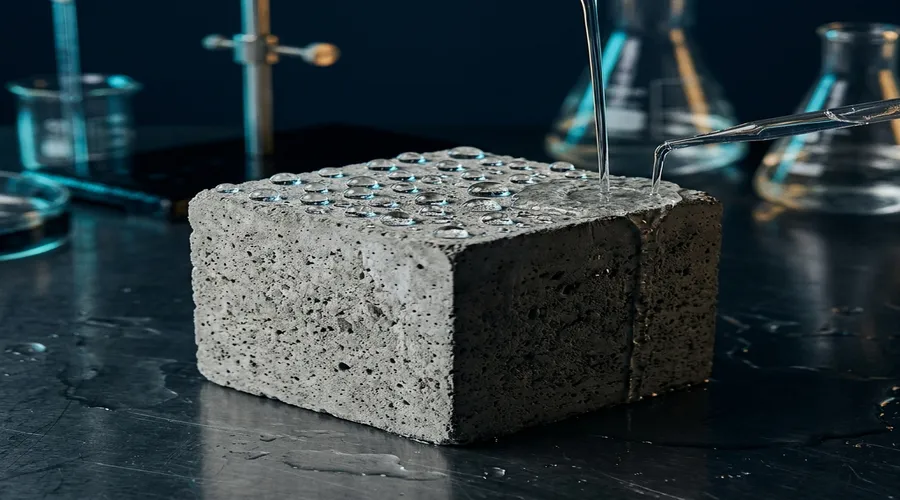
Crystalline chemistry solves the problem by removing the void. The competing technology leaves the void intact and changes something else entirely.
Hydrophobic Pore-Blocking Technology: Changing the Wall, Not the Void
Hydrophobic pore blocking technology takes the opposite approach to crystalline chemistry. Instead of filling the capillary, it lines the capillary wall with a water-repellent film, so the pore stays open but stops attracting water. Cement paste is naturally hydrophilic, which is precisely why an untreated concrete surface pulls water into itself by suction. Deposit a repellent lining and the contact angle rises above ninety degrees, at which point capillary action reverses direction and works against water entry rather than for it.
Three chemistry families dominate this category, and they differ in durability, cost, and how they interact with the rest of the mix design.
- Fatty acid soaps — calcium and ammonium stearates, oleates, and related salts, supplied as powders or emulsions; the most economical route and the most widely used in general construction.
- Silanes and siloxanes — organosilicon emulsions that chemically bond to the siliceous pore wall, giving a more durable and alkali-stable repellent layer at higher cost.
- Oil and wax dispersions — butyl stearate, vegetable oil derivatives, and refined wax emulsions that deposit a physical repellent film within the pore network.
- Fine pore-blocking solids — inert or pozzolanic fines that reduce pore connectivity by particle packing, frequently combined with a repellent for a dual effect.
The consequence of leaving the void open is decisive and often overlooked. Under wetting-and-drying exposure, where water arrives only by suction, a hydrophobic admixture performs extremely well and cuts absorption sharply. Apply a genuine hydrostatic head to the same element and pressure drives water straight through the still-open pore. The surface effect was never designed to resist bulk flow. That single distinction is formalised in the classification system specifiers should be using.
Crystalline vs Hydrophobic: Matching the Technology to the Exposure
The American Concrete Institute resolves the confusion in this product category with a two-way split that belongs in every specification. In its report on chemical admixtures for concrete, the American Concrete Institute classifies permeability reducing admixture chemistry as either PRAN, for non-hydrostatic conditions, or PRAH, for hydrostatic conditions. Hydrophobic water repellents fall into the first group and crystalline products into the second. Writing the classification into the specification, rather than a brand name or a generic phrase like "waterproofing admixture", eliminates most substitution disputes before they start.
| Classification | Designed Exposure | Typical Chemistry | Typical Application |
|---|---|---|---|
| PRAN — non-hydrostatic | Wetting and drying, no standing head | Stearates, oleates, silanes, siloxanes, wax emulsions | Façades, precast panels, screeds, external paving |
| PRAH — hydrostatic | Sustained water pressure against the element | Reactive crystalline chemistry | Basements, water tanks, lift pits, tunnel linings |
Beyond the classification, the two families differ across several properties that matter during design, construction, and the service life of the structure. The comparison below reflects how each technology behaves rather than how it is marketed.
| Property | Crystalline Admixture | Hydrophobic Pore-Blocking Admixture |
|---|---|---|
| Sealing mechanism | Fills the pore with insoluble crystal growth | Lines the pore wall with a repellent film |
| Performance under hydrostatic head | Designed for it | Limited; pressure drives flow through the open pore |
| Reduction of capillary absorption | Effective | Effective, often the stronger performer on sorptivity |
| Self-sealing of later hairline cracks | Yes, via dormant reactive fraction | No active crack-sealing mechanism |
| Supply form | Dry cementitious powder | Powder or liquid emulsion |
| Effect on air content | Generally minimal | Soaps are surface-active and tend to entrain air |
| Durability of the active mechanism | Mineral, integral to the matrix | Organic films can degrade; silanes are more stable |
| Relative material cost | Higher | Lower |
Some manufacturers now combine both chemistries in a single product precisely because mixed-exposure elements are common, and a retaining wall with a fluctuating water table genuinely experiences both regimes. Whichever route is specified, the claim only means something if it is backed by the right test — which brings the standards into play.
Testing and Standards: Proving Permeability Reduction
Permeability is not a single measurable property, so no one test can validate a waterproofing admixture across both exposure conditions. Each standard method measures a specific transport mechanism, and a product can score well on one while offering little protection against another. A credible verification programme therefore pairs at least one absorption test with one pressure test, and adds an ingress test where durability rather than dryness is the governing concern. Reading a single favourable result as general proof of waterproofing is the most common evaluation error in this category.
| Standard | What It Measures | Relevance |
|---|---|---|
| ASTM C1585 | Rate of water absorption (sorptivity) of unsaturated concrete | Direct measure of capillary suction — the PRAN condition |
| EN 12390-8 | Depth of water penetration under sustained pressure | The pressure test that distinguishes true hydrostatic performance |
| ASTM C1202 | Electrical indication of resistance to chloride ion penetration | Durability proxy for ingress of dissolved aggressive species |
| EN 934-2 | Definitions and requirements for concrete admixtures | Conformity framework including water-resisting admixtures |
| ASTM C494 | Chemical admixtures for concrete — uniformity and effect on concrete | Confirms batch-to-batch consistency and mix compatibility |
| ACI 212.3R | Report on chemical admixtures for concrete | Source of the PRAN and PRAH classification |
The sorptivity method defined in ASTM C1585 is the right tool for evaluating a repellent, since it isolates capillary uptake in an unsaturated specimen. Where chloride-driven corrosion of reinforcement is the real risk, the rapid method in ASTM C1202 gives a comparative durability indication that pure water tests miss. Specifying both the standard and the acceptance limit turns a test report into an enforceable requirement. That same discipline matters just as much on the manufacturing side.
Formulating and Manufacturing Waterproofing Admixtures
Developing either product family involves more process engineering than the chemistry alone suggests, which is where most new entrants underestimate the timeline. The active fraction is a small part of the finished product by mass. The manufacturing challenge is delivering it uniformly and keeping it stable until it reaches the batching plant. A formulation that performs perfectly in a laboratory mixer can fail in the field because of blend segregation, packaging moisture ingress, or an unexpected interaction with the customer's superplasticizer. Anticipating those failure modes during development is far cheaper than diagnosing them after a leaking basement.
Crystalline Products — Dry Blend Challenges
A crystalline product is essentially a specialised dry mortar, and dry blending is unforgiving of shortcuts. The reactive fraction is a minority component by mass, so any segregation during blending or handling shows up later as inconsistent field performance. Everything downstream of the reaction chemistry — grinding, blending time, packaging — exists to protect that fraction until it reaches the mixer.
- Blend homogeneity — a reactive fraction present at low addition must be evenly distributed across a full production batch, which demands controlled mixer geometry and validated blending time.
- Particle size control — fineness governs reaction kinetics and dispersion in the concrete, so grinding and grading are process-critical rather than cosmetic.
- Moisture-barrier packaging — the reactive chemistry is water-activated by design, so any humidity reaching the bag during storage consumes activity before the product is ever used.
- Set behaviour verification — the cementitious carrier and reactive salts both influence setting, which has to be characterised against the cements the target market uses.
Hydrophobic Products — Emulsion and Dispersion Challenges
Liquid repellents move the problem from powder handling to colloid stability. An emulsion has to survive months in a hot or freezing warehouse, then disperse instantly into a highly alkaline mix without breaking. Formulators who treat the emulsifier package as an afterthought usually discover the gap as a customer complaint about separation in the drum.
- Emulsifier system design — stearate and silane emulsions need a surfactant package that survives the alkaline concrete environment without destabilising in the drum.
- Shelf and freeze-thaw stability — warehouses are rarely temperature-controlled, so phase separation and freeze-thaw recovery must be tested to realistic worst-case storage.
- Air content control — soaps are surface-active and entrain air, which improves cohesion but can reduce compressive strength if left unmanaged.
- Superplasticizer compatibility — repellents and polycarboxylate ethers compete for the same particle surfaces, so slump retention has to be verified in combination.
That last point deserves emphasis, because it is where laboratory results and site results most often diverge. The adsorption behaviour explored in our guide to plasticizers and superplasticizers applies directly here. A water repellent and a high-range water reducer can each perform correctly alone, then produce unacceptable slump loss together. Manufacturers building a construction chemicals portfolio need a documented compatibility matrix covering the cements and superplasticizers their customers actually use, not a single reference mix.
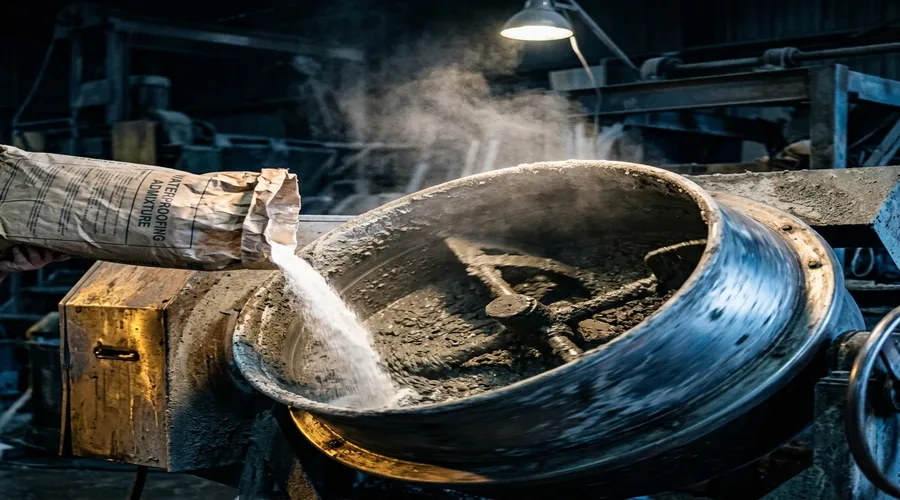
A development programme that ends with a compatibility matrix, third-party test data to the relevant standards, and validated packaging is a product specifiers can accept. One that ends with a promising laboratory result is still a prototype — and the gap between the two is usually measured in field failures.
Specification and Site Mistakes That Undermine Integral Waterproofing
Most integral waterproofing failures are not chemistry failures. They are decisions made around the admixture that quietly cancel out what it was supposed to deliver, and they repeat across projects with striking consistency. Reviewing this short list before the concrete is ordered catches the majority of them at the only stage where correction is cheap.
- Specifying a repellent for a hydrostatic element — the most expensive error in the category, and the one the PRAN and PRAH classification exists to prevent.
- Assuming the admixture covers the joints — construction joints, tie-holes, and pipe penetrations need waterstops and sealants, because no admixture protects a discontinuity it was never in.
- Ignoring crack control — a moving crack outpaces crystalline self-sealing, so reinforcement detailing and joint spacing still govern the outcome.
- Neglecting curing — poor early curing leaves a coarser, more connected pore network for water to exploit, undoing much of the permeability reduction that was paid for.
- Skipping the trial mix — cement chemistry, aggregate, and admixture combination vary by region, so performance must be verified with the project's actual constituents.
- Accepting the wrong test report — a sorptivity result submitted as evidence of hydrostatic performance is a mismatch that should be rejected at the submittal stage.
Curing deserves particular attention because it interacts directly with both technologies. The moisture-retention mechanisms covered in our article on concrete curing compounds determine how complete hydration becomes. Incomplete hydration leaves exactly the interconnected capillary network that integral waterproofing is meant to close. Where exposure is severe or joint detailing is complex, integral chemistry is frequently paired with the coating systems described in our guide to polymer-modified cementitious waterproofing. That pairing gives redundancy at the interfaces where water actually enters.
The decision framework reduces to three questions asked in order. Does water arrive under pressure or by suction? Does the element's joint and crack detail create paths the admixture cannot reach? Has the specified performance been demonstrated by the test method that matches the exposure? Manufacturers and specifiers who answer those three before the pour is scheduled rarely end up excavating a basement wall two years later. Teams developing or evaluating these products often bring in a formulation consultant at the specification stage. That is the point where the cost of being wrong is still close to zero.
Frequently Asked Questions
What is the difference between a crystalline waterproofing admixture and a hydrophobic water-repellent admixture?
A crystalline admixture reacts chemically inside the concrete, using water and the calcium hydroxide released by cement hydration to precipitate insoluble crystalline deposits that physically fill capillary pores and micro-cracks. A hydrophobic admixture does not fill the pore at all. It deposits a water-repellent lining of fatty acid soap, silane, or siloxane on the pore wall. That lining raises the contact angle, so capillary suction no longer draws water in. The practical consequence is straightforward. The crystalline route obstructs the flow path itself, so it keeps working under a standing head of water. The hydrophobic route only suppresses capillary absorption, and pressure eventually drives water through the still-open pore. This is why ACI 212.3R classifies them into two separate performance categories rather than treating them as interchangeable products.
Can a crystalline waterproofing admixture really self-seal cracks in concrete?
Yes, within limits, and the mechanism is well understood rather than marketing language. A portion of the reactive chemical stays unreacted and dormant in the hardened concrete. Initial curing simply does not supply enough free water or free lime to consume it. When a crack later forms and water enters, that dormant fraction is reactivated and precipitates fresh crystalline growth into the crack, progressively narrowing the flow path. The capability is genuine but bounded: it applies to fine, essentially static hairline cracks, and it depends on both moisture being present and residual reactive material remaining. A crack that keeps moving under thermal or structural cycling re-opens faster than it seals. Crystalline admixtures are therefore not a substitute for proper joint design and crack control reinforcement.
Does an integral waterproofing admixture remove the need for a membrane?
It depends entirely on what the membrane is being asked to do, and this is where most specification disputes originate. An integral admixture lowers the permeability of the concrete body itself, so it addresses seepage through sound concrete and through fine pore structure very effectively. It does nothing for construction joints, pipe penetrations, tie-holes, honeycombed pours, or a crack wider than the crystalline growth can bridge. In real structures, those interfaces are where water almost always enters. Many below-grade designs therefore keep both: the admixture makes the concrete durable and self-sealing, while waterstops, joint sealants, and a membrane handle the discontinuities. Removing the membrane is a decision that should follow from a joint-by-joint risk review, not from a product datasheet.
Do waterproofing admixtures affect workability, setting time, or compressive strength?
They can, and this is exactly why trial mixes with the project's own cement and aggregates are non-negotiable. Crystalline products are largely cementitious powders, so they contribute fines, increase water demand slightly, and can shift setting behaviour depending on the reactive chemistry used. Hydrophobic products based on stearate and oleate soaps are surface-active by nature, so they tend to entrain air. Entrained air improves cohesion, but it can reduce compressive strength if the content is not controlled. Both families also interact with high-range water reducers, since polycarboxylate ether superplasticizers compete for the same particle surfaces. The reliable approach is to fix the admixture combination early. Verify slump retention, air content, set time, and strength together in one trial programme rather than testing each variable in isolation.
How is waterproofing admixture performance actually tested and verified?
No single test covers both exposure conditions, so a credible verification programme uses at least two methods that measure different transport mechanisms. Capillary absorption is measured by sorptivity testing to ASTM C1585, which quantifies how fast an unsaturated specimen draws water in by suction. That is the condition a hydrophobic admixture is designed for. Resistance to a standing head is measured by water penetration depth under pressure to EN 12390-8, which is the condition that separates a genuine hydrostatic-grade product from a water repellent. Chloride ion penetration to ASTM C1202 is often added because durability specifications usually care about ingress of dissolved aggressive species, not just water. Reading a sorptivity result as proof of hydrostatic performance is the single most common testing error in this product category.
Which technology should be specified for a below-grade basement versus an exposed façade or paving element?
Match the technology to whether water arrives under pressure or by suction, because that one question resolves most cases. A below-grade basement, water tank, lift pit, or tunnel lining sits below the water table or against saturated soil. Water therefore arrives under a genuine hydrostatic head, which makes a crystalline product in the hydrostatic category the appropriate specification. An exposed façade, parapet, precast panel, screed, or external paving is wetted by rain and then dries. The dominant transport mechanism there is capillary absorption, so a hydrophobic pore-blocking admixture is both effective and usually more economical. Elements that alternate between the two conditions — a retaining wall with a fluctuating water table, for instance — should be specified for the more severe case. Some manufacturers combine both chemistries in a single product precisely to cover mixed exposure.
What does developing a waterproofing admixture product line actually involve for a manufacturer?
It involves considerably more process engineering than the chemistry alone suggests, which is why many entrants underestimate the timeline. A crystalline product is a dry blend, so the real challenges are homogeneity of a low-addition reactive fraction and particle size control. Moisture-barrier packaging matters just as much, since it keeps a hygroscopic reactive powder dormant through storage and shipping. A hydrophobic liquid product is an emulsion, so the challenges shift to emulsifier selection, shelf stability, freeze-thaw resistance, and preventing phase separation in a warehouse without temperature control. Both then need a compatibility matrix against the superplasticizers and cements the target market actually uses, plus third-party test data to the relevant standards before specifiers will accept the product. Building that evidence package correctly at the development stage is far cheaper than reformulating after a field failure.
Developing a Waterproofing Admixture Product Line?
Reactive chemistry selection, emulsion stability work, superplasticizer compatibility matrices, standards-ready test programmes. Global Formulation provides construction chemical R&D services and concrete durability formulation support from concept to commercial batch.
Discuss Your Project