Wrinkle Finish Paint: The Chemistry Behind the Textured Look
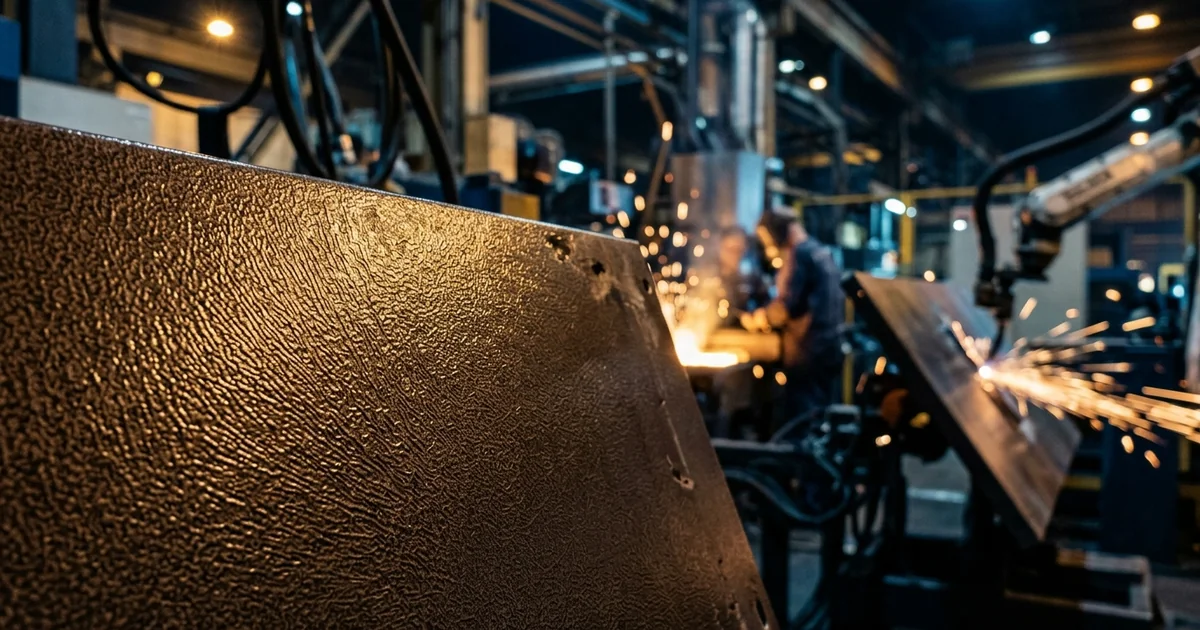
A camera housing or a motor enclosure with a fine, bark-like ridged texture is not hiding a manufacturing flaw with a clever paint job — the texture is the paint job. Getting that pattern to form consistently, panel after panel, batch after batch, is one of the more counterintuitive corners of industrial coating chemistry, because wrinkle finish paint chemistry deliberately triggers a curing behavior that every other enamel is formulated to avoid. Coating engineers who don't understand the mechanism either can't reproduce a client's target texture or, worse, "fix" an ordinary enamel's accidental wrinkling and can't figure out why a genuine wrinkle-finish product refuses to lay down flat. This guide explains what actually happens inside the film as it cures, why the resin and drier choices are inverted relative to a standard gloss enamel, and how stoving parameters and film thickness are used to dial the pattern in. It draws on the same alkyd and stoving-enamel chemistry we apply across our paints and coatings consulting work.
Why Wrinkle Finish Paint Chemistry Turns a Defect Into a Feature
Every alkyd enamel formulator learns early that an unbalanced drier system can cause a film to wrinkle instead of drying smooth, and in a standard gloss coating that outcome is a rejected batch, not a selling point. The mechanism is straightforward once isolated: if the surface of a film cures into a rigid skin considerably faster than the material underneath it, the still-soft sublayer keeps shrinking as it continues to oxidize and lose solvent, and the already-rigid skin has no way to shrink along with it. Something has to give, and because the skin is tough rather than brittle, it buckles into a repeating ridge pattern rather than cracking or delaminating. Our guide to alkyd resin manufacturing covers this same drier-balance mechanism from the side of avoiding it in ordinary coatings.
Wrinkle finish paint chemistry takes that exact failure mode and formulates toward it on purpose, using resin and drier choices selected specifically to widen the gap between surface cure speed and bulk cure speed. Instead of trying to eliminate the imbalance, the formulator amplifies and controls it:
- Fast-skinning resin base — an oxidizable oil or alkyd chosen for unusually reactive fatty-acid unsaturation, so the surface locks into a rigid film quickly
- Deliberately imbalanced driers — heavy on the driers that accelerate surface cure, light on the driers that would otherwise pull the sublayer's cure rate up to match
- Controlled stoving conditions — heat and airflow tuned to keep that surface-to-bulk cure gap consistent across an entire production run
Every one of those three levers has a direct chemical basis, starting with the resin system that makes fast surface skinning possible in the first place.
The Resin System: Oxidized Oils and Wrinkle Varnishes
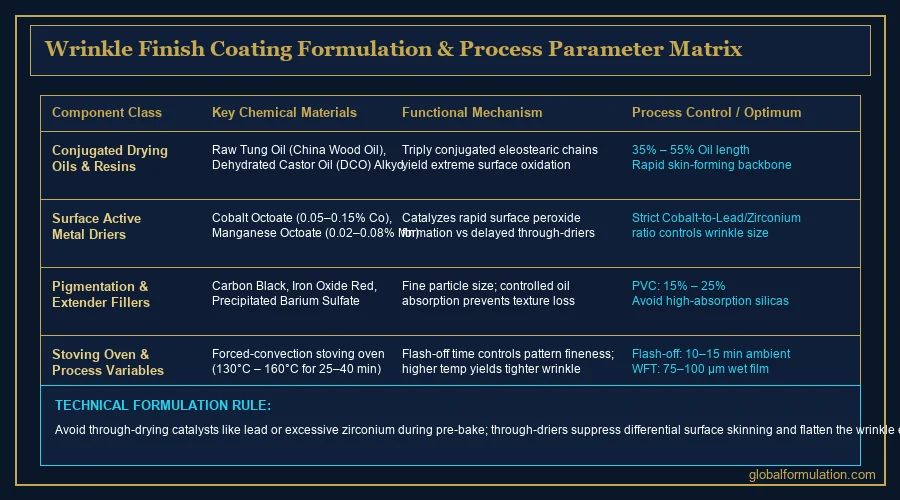
The resin base in a wrinkle finish enamel has to do something a standard gloss alkyd resin is specifically formulated not to do: cure unevenly, skin-first, rather than curing uniformly through the film depth. Dehydrated castor oil alkyds and specially oxidized ("blown") tung oil varnishes have been the traditional choices for this job because their fatty acid chains carry unusually reactive double-bond patterns, in some cases conjugated triene systems, that oxidize and cross-link far faster on air exposure than the fatty acids in an ordinary soybean or linseed-oil alkyd. That reactivity is precisely what a wrinkle finish needs at the surface — a resin that skins over almost immediately once oxygen and heat reach it.
| Resin Base | Fatty-Acid Character | Formulation Role |
|---|---|---|
| Dehydrated castor oil alkyd | Conjugated, highly reactive unsaturation | Classic fast-skinning wrinkle base |
| Blown (oxidized) tung oil varnish | Conjugated triene fatty acids | Very rapid, tough surface-skin formation |
| Specially oxidized linseed oil alkyd | Partially conjugated unsaturation | Slower skinning; tends toward a coarser pattern |
Pigmentation and solvent choice are built around that same reactive resin rather than around gloss or flow, which is a genuine formulation trade-off — a wrinkle varnish is rarely optimized for the smooth leveling a customer would want in a standard topcoat. That trade-off is acceptable because leveling is not the goal; skin formation speed is. Getting the resin to skin fast is only half the mechanism, though — the drier package is what actually sets how wide the gap is between that fast skin and the slower-curing film underneath it.
Drier Chemistry: Engineering the Skin-First Cure
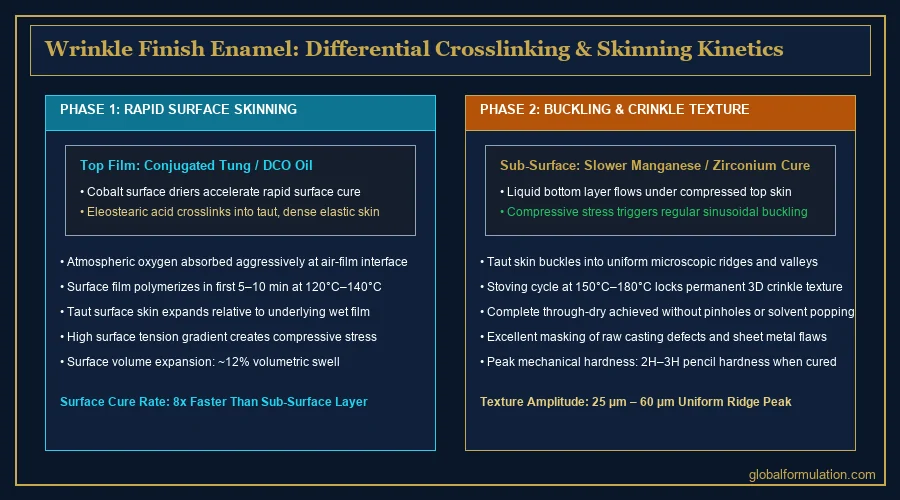
Driers are metal-soap catalysts that speed up the oxidative cross-linking of an unsaturated oil or alkyd film, and in a standard enamel they are balanced deliberately to avoid exactly the buckling described above. Cobalt driers act primarily at the film surface, where atmospheric oxygen is most available, accelerating the skin-forming reaction. Through-driers such as zirconium, calcium, or manganese compounds are included alongside cobalt in a balanced enamel specifically to pull the cure rate deeper in the film up to match the surface, so the whole coating sets together rather than skinning over a soft interior.
Wrinkle finish paint chemistry deliberately breaks that balance. The drier package is weighted toward the fast surface-active driers and away from the through-driers that would otherwise even out the cure profile, which is the direct chemical cause of the skin-first, shrink-later sequence that produces the wrinkle pattern:
- Surface-active driers — dosed to form a tough skin quickly once the coated part is exposed to oxygen and heat
- Through-driers deliberately minimized — kept low enough that the sublayer continues curing and shrinking well after the surface has already gone rigid
Getting that imbalance right on the bench is only the starting point — turning it into a consistent, reproducible texture on a production line depends on how the part is heated once it is coated.
The Stoving Process: Temperature, Airflow and Film Thickness
Heat is the process variable that makes the drier imbalance behave predictably instead of randomly, which is why wrinkle finish is almost always a stoved (baked) coating rather than an air-dry one. A forced-air oven accelerates the surface-skinning reaction uniformly across an entire part, so every section of a panel reaches its skin-forming point at close to the same time — something ambient air-drying cannot guarantee, since airflow, humidity, and local temperature all vary uncontrolled across a shop floor. Oven temperature and dwell time are the two levers an applicator adjusts to hit a target texture, alongside the wet film thickness applied before the part goes into the oven.
Film thickness matters because it sets how much sublayer material is available to shrink beneath the already-rigid skin. A thicker wet film generally produces a coarser, larger-scale wrinkle because there is more material driving the buckling; a thinner film tends toward a finer, tighter texture. Applicators tune film build, oven temperature, and dwell time together against the specific resin and drier system rather than relying on a single universal setting, since each of those variables shifts the others.
A correctly stoved wrinkle finish holds its texture indefinitely once fully cured, which is what makes the process worth the tighter oven control it demands compared with a standard air-dry enamel.
Formulating for Function: Hiding Defects, Grip and Glare Control
Wrinkle finish earned its long industrial history because the texture solves real functional problems, not only a decorative one, and that functional case is usually what justifies the extra process control a customer's specification is asking a coater to deliver. A cast or stamped metal part that carries minor porosity, weld marks, or surface roughness would need extra grinding and filling to look acceptable under a smooth gloss topcoat — a wrinkle texture disguises those same imperfections without any additional surface-finishing step, because the eye reads the entire surface as intentionally textured rather than flawed.
Beyond hiding cosmetic flaws, the texture changes how a part performs in day-to-day handling:
- Grip — the ridged surface gives tools, camera bodies, and enclosure housings more friction under the hand than a smooth gloss finish provides
- Glare reduction — the broken, multi-angled surface scatters reflected light instead of returning a sharp specular highlight, which matters under bright shop, studio, or field lighting
- Perceived durability — a textured finish visually reads as tougher and more resistant to scuffing, reinforcing the functional housing or tool-case category it is usually applied to
Those combined benefits explain why wrinkle finish has stayed in continuous use on instrument enclosures, motor and pump housings, and tool cases well after smoother, lower-cost coating options became widely available — the texture is doing genuine functional work, not just decorating the part. That said, wrinkle finish is not the only route to a textured industrial coating, and knowing where it fits against the alternatives matters when a specification calls simply for "a textured finish."
Wrinkle Finish vs Other Textured Coatings
"Textured coating" covers several genuinely different chemistries, and confusing them at the specification stage is a common source of coating mismatches between a customer's expectation and what actually ships. A standard gloss enamel that wrinkles unintentionally is a process failure to be corrected through better drier balance, not a texture to be sold. A true wrinkle finish enamel is a deliberately engineered liquid coating built on the oxidative skin-cure mechanism covered above. Wrinkle-textured powder coatings achieve a visually similar ridged surface through an entirely different route — controlled melt flow and gel-time formulation during the powder's oven cure, rather than an oxidative skin forming over a shrinking liquid film — which means the resin chemistry, cure profile, and even the equipment needed are not interchangeable with a liquid wrinkle enamel.
| Coating Type | Texture-Forming Mechanism | Cure Method | Typical Use |
|---|---|---|---|
| Standard gloss alkyd enamel | Balanced driers avoid skin-first cure | Air-dry or low-bake | General decorative and protective coating |
| Liquid wrinkle finish enamel | Imbalanced skin-forming drier system on a fast-oxidizing resin | Forced-air stoving | Instrument housings, tool cases, motor and pump covers |
| Wrinkle-texture powder coating | Controlled melt flow and gel-time formulation | Electrostatic spray, oven cure | Modern textured enclosures and appliance housings |
Choosing between these routes comes down to production line capability as much as chemistry — a shop already running powder lines will generally reach for the powder route, while a liquid-coating operation with stoving ovens already in place is better positioned for a traditional wrinkle enamel. Either way, the decision should start from understanding that a wrinkle texture is never accidental chemistry, but the deliberate product of resin, drier, and cure control working together.
Frequently Asked Questions
What actually causes the ridged wrinkle pattern to form during curing?
The ridges form because the coating's surface cures into a tough, rigid skin much faster than the film underneath it. That skin locks in place while the sublayer is still soft and continuing to shrink as it oxidizes and loses solvent, and because a rigid skin cannot stretch to keep pace with a shrinking base, it has nowhere to go but to buckle.
That buckling settles into the repeating ridge-and-valley pattern that defines a wrinkle finish, rather than tearing or flaking, because the skin is tough enough to deform without rupturing. The same skin-first cure imbalance is treated as a defect to eliminate in ordinary gloss enamels — wrinkle finish paint chemistry is built specifically to trigger it on purpose.
Why must wrinkle finish paint be baked or stoved rather than air-dried?
Heat is the main lever a formulator and applicator have over how fast and how evenly the surface skin forms relative to the film underneath. At room temperature, oxidative cure is slow and uneven across a part, which produces an inconsistent, patchy texture instead of a uniform pattern.
Stoving in a forced-air oven accelerates and standardizes that skin-forming reaction across the whole surface at once, which is what makes the finished wrinkle pattern reproducible from part to part. This is also why wrinkle finish is almost never specified for air-dry-only production lines — the process depends on controlled heat to work correctly.
What resins are traditionally used in wrinkle finish or crinkle finish paints?
Dehydrated castor oil alkyds and specially oxidized ("blown") tung oil varnishes are the classic resin bases, chosen because their fatty acid chains carry unusually reactive, often conjugated, double bonds that oxidize and cross-link far faster than the fatty acids in a standard soybean or linseed alkyd. That fast reactivity is exactly what produces the quick, tough surface skin the wrinkling mechanism depends on.
Modern formulations sometimes build on other engineered alkyd systems, but they are all selected for the same fast-skinning oxidative behavior rather than for gloss or flexibility, which is what a standard enamel resin is optimized for instead.
Does film thickness change the size of the wrinkle pattern?
Yes — film thickness is one of the process variables that shapes wrinkle size, alongside stoving temperature and oven airflow. A thicker wet film generally produces a coarser, larger wrinkle pattern because there is more sublayer material shrinking beneath the skin, while a thinner film tends toward a finer, tighter texture.
The exact relationship still depends on the specific resin and drier system in use, which is why coating suppliers and applicators test and set film-build targets on the actual product rather than assuming a universal thickness-to-pattern rule.
What's the difference between "wrinkle finish" and "crinkle finish" paint?
In practice, the coatings trade uses "wrinkle finish" and "crinkle finish" interchangeably to describe the same oxidative skin-buckling texture — the naming is a matter of regional and supplier convention rather than a distinct chemistry or process. Some suppliers informally use "crinkle" for a finer, tighter texture and "wrinkle" for a coarser one, but there is no industry-wide standardized technical line between the two terms.
A formulator specifying either term should confirm with the coating supplier exactly which texture grade and resin system they mean, rather than assuming the label alone settles it.
Can a wrinkle-textured finish be achieved with powder coatings instead of liquid enamel?
Yes, wrinkle-textured powder coatings exist and are common in modern appliance and enclosure manufacturing, but they reach the same visual result through a different mechanism. Rather than an oxidative skin forming over a shrinking liquid film, powder wrinkle textures are built through controlled melt flow and gel-time formulation during the powder's oven cure.
The resin system and cure chemistry involved are genuinely different from a liquid alkyd wrinkle enamel even though the finished surface looks similar, so a formulator choosing between the two is really choosing between two different coating technologies, not two versions of the same chemistry.
What industries and products commonly use wrinkle finish coatings, and why?
Wrinkle finish has a long history on cameras and optical instrument bodies, and it remains common today on electronic and instrument enclosures, motor and pump housings, tool cases, and other equipment with cast or stamped metal surfaces. The appeal is practical as much as aesthetic: the texture hides minor casting porosity, weld marks, and surface imperfections without extra surface-finishing steps.
It also improves grip and cuts glare under bright shop or studio lighting compared with a smooth gloss surface. That combination of defect-hiding, functional grip, and a distinctive decorative look is why the finish has stayed in continuous industrial use even as smoother, lower-cost coating options became available.
Developing a Textured Industrial Coating?
Global Formulation provides paints and coatings consultancy — wrinkle and crinkle enamel resin systems, drier balance troubleshooting, and stoving process optimization for functional, decorative metal finishes.
Talk to Our Formulation Team