How to Formulate Laundry Detergents: Technical Guide
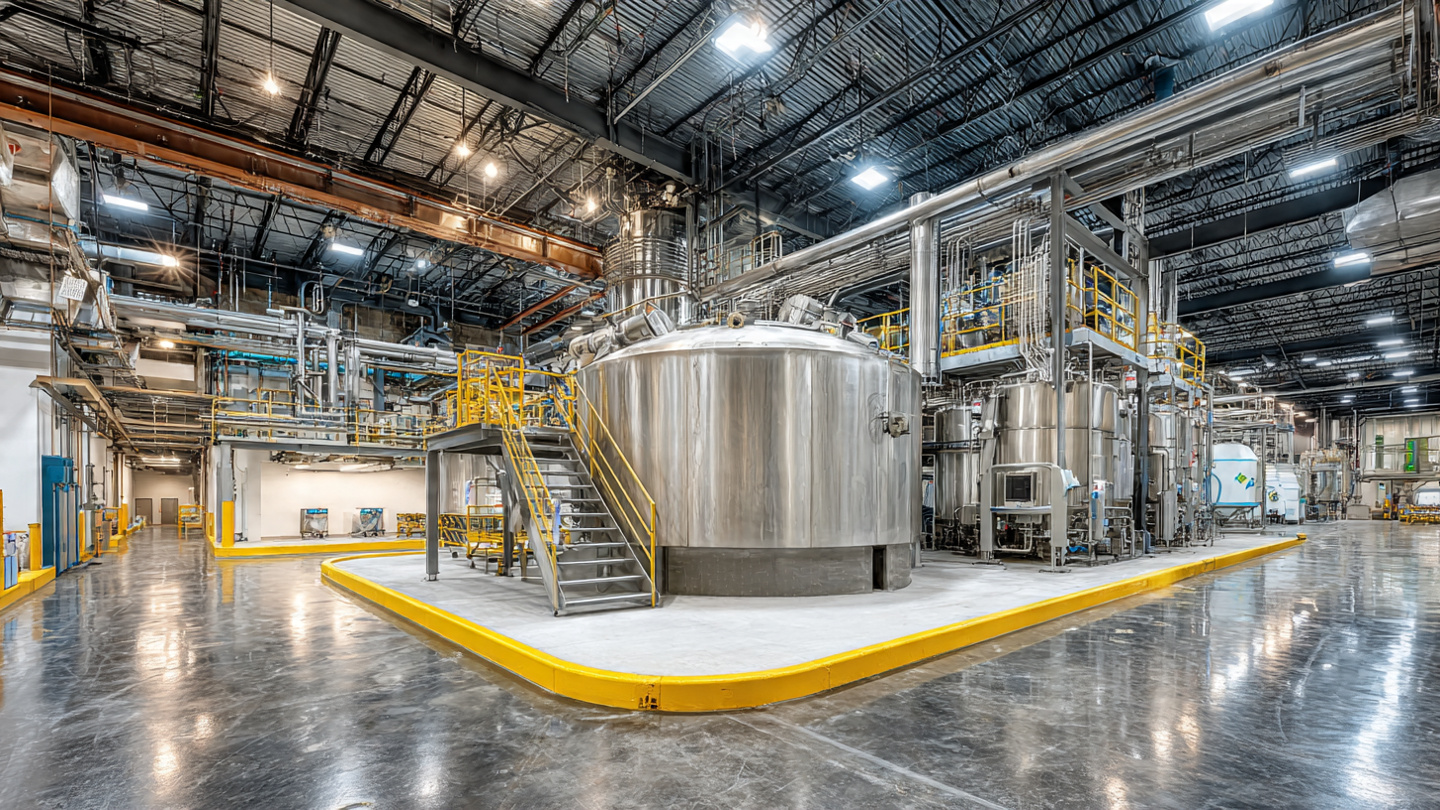
Formulating laundry detergents is a highly structured branch of formulation science that combines surfactant physical chemistry, water softening, enzyme kinetics, and regulatory standards. For startups, entrepreneurs, and chemical manufacturers, relying on simplistic online formulas or copy-pasted "recipes" inevitably leads to product failure, caking, batch separation, or fabric damage. Developing a highly stable, competitive laundry detergent requires a deep understanding of micellar thermodynamics, builder selection, and scale-up process engineering.
Understanding the Market & Why Formulations Matter
The laundry care market is exceptionally competitive, featuring a wide spectrum of products ranging from low-cost powders in emerging rural regions to premium liquid formulations, dosing pods, and specialized institutional detergents. Modern buyers judge laundry detergents based on four key performance metrics: stain removal speed, fragrance longevity, soft fabric hand-feel, and complete lack of chemical residues on fabrics.
Formulators must engineer detergent bases that can handle varying water hardness levels and washer characteristics without underperforming. When detergent formulations are technically weak or poorly balanced, several severe commercial failures manifest:
- Fragrance Fading: Rapid loss of premium scent profile due to direct chemical oxidation during storage.
- Hard Water Failure: Rapid loss of cleaning power as surfactant micellization is blocked by untreated calcium ions — see our dedicated guide to hard water challenges in detergent formulation for builder selection strategy.
- Fabric Graying & Degradation: Redeposition of suspended soils back onto fibers due to weak polymer suspension.
- Batch Inconsistency: Uncontrolled variations in active surfactant levels, bulk densities, or viscosities.
Types of Laundry Detergents and Their Formulation Approach
Heavy-Duty vs. Light-Duty: The HDL/HDP Classification
Before choosing a format, formulators classify a detergent as either heavy-duty or light-duty — a distinction that drives every downstream ingredient decision. Heavy-duty liquid (HDL) and heavy-duty powder (HDP) detergents are formulated for machine or hand laundering of everyday soiled fabric: they carry a full builder system, bleach or bleach-activator components, and enzyme blends targeted at fabric-borne stains like sweat, food, and grease. In many markets — India, the Middle East, and Southeast Asia in particular — heavy-duty powder is sold and marketed simply as "washing powder." Light-duty liquid (LDL) detergents, by contrast, are the milder surfactant-only systems used for dishwashing and hand care, without the alkaline builders or bleach systems a heavy-duty laundry formula needs. Every format covered below — powder, liquid, concentrated, bar, or pod — is a heavy-duty system engineered for laundry, not the light-duty category.
Powder Laundry Detergents
Powder detergents continue to command significant market share globally due to their low cost-per-wash and compatibility with traditional bucket washing. A robust powder formulation focuses on incorporating strong alkaline builders to handle hard water, stabilizing enzymes within a dry matrix, and controlling bulk density using granular fillers.
Liquid Laundry Detergents
Liquid detergents represent the fastest-growing sector, particularly in urban areas with modern front-load and top-load automatic washing machines. Designing liquid bases requires highly optimized surfactant solubility, temperature-independent viscosity control, and complex preservative shielding to prevent bacterial growth.
Concentrated and High-Efficiency Detergents
High-efficiency (HE) and concentrated formulas are engineered for low water volume washers, requiring highly specialized surfactant systems and suds-suppressing polymers. These systems must deliver maximum cleaning performance in compact dosages without causing over-foaming, which can damage washing machine electronics.
Detergent Bars & Cakes
Detergent bars are widely used in hand-wash segments where manual scrubbing is preferred. The formulation must be physically hardened using mineral fillers to resist water softening and cracking while maintaining smooth foam release without drying out the skin.
Pods & Capsules
Pods are highly advanced unit-dose systems where low-moisture surfactant concentrates are sealed in water-soluble polyvinyl alcohol (PVA) film. The chemical base inside the pod must have very low free-water content to avoid pre-dissolving the protective film before use.
Basic Chemistry Behind Laundry Detergent Formulations
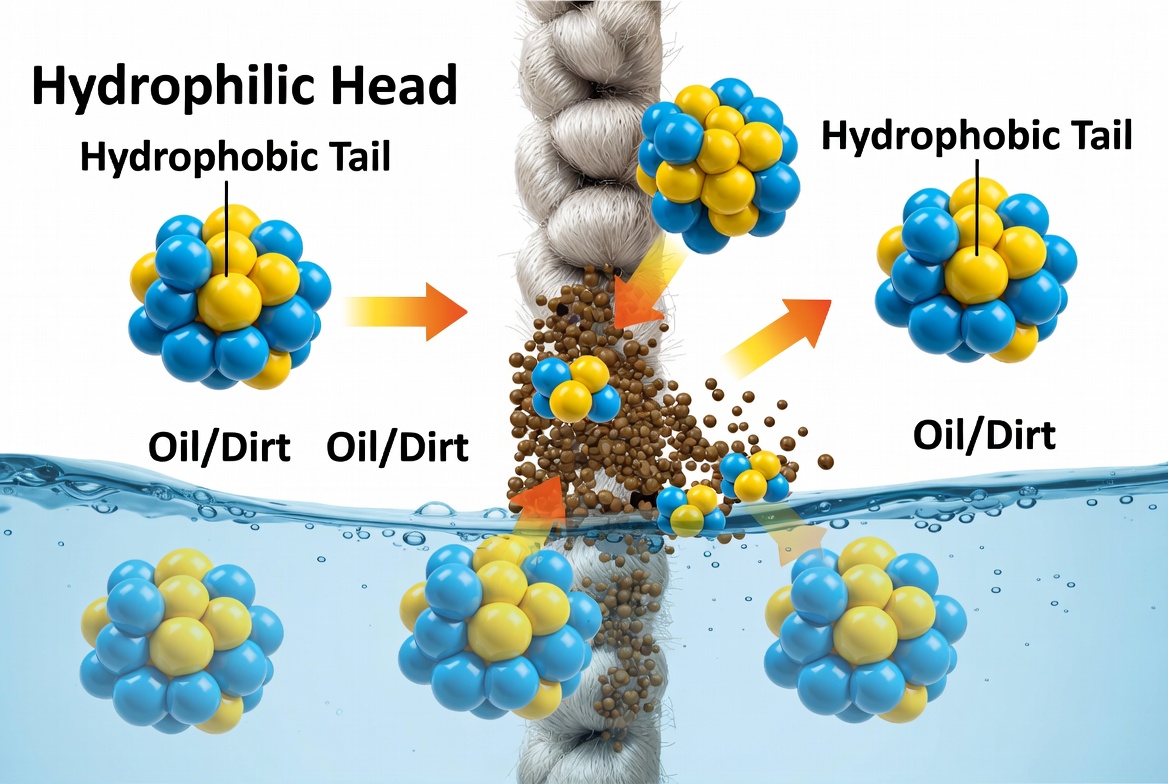
Detergent science centers on spontaneous soil removal through physical chemistry, starting with lowering water's surface tension to wet fibers. The thermodynamics of soil solubilization is governed by the self-assembly of surfactant molecules, calculated via the **Critical Micelle Concentration (CMC) Gibbs Free Energy Equation**:
Additionally, builders must soften water by binding divalent metal ions, preventing them from precipitating the active surfactants. Soil suspension polymers then coat the dispersed soil particles, providing electrostatic and steric repulsion to keep dirt suspended in water and prevent redeposition onto fabrics.
Key Ingredients Used in Laundry Detergent Formulations
Surfactants – The Cleaning Backbone
Surfactants are the primary active ingredients in all detergent formulations. Formulators balance anionic surfactants (e.g., Linear Alkylbenzene Sulfonate, LABSA) with non-ionic surfactants (e.g., Ethoxylated Alcohols) based on the **Hydrophilic-Lipophilic Balance (HLB) Equation**:
Builders – Water Conditioning and Performance Enhancement
Builders bind Ca2+ and Mg2+ ions to protect surfactants from precipitating. Zeolites act via ion exchange, calculated through the **Cation Exchange Capacity (CEC) Kinetics Equation**:
Fillers – Bulk and Flow Control
Granular fillers, principally sodium sulfate, are incorporated in dry powder formulations to ensure consistent bulk densities and prevent clumping. Formulators must balance filler ratios to maintain product performance while keeping manufacturing costs competitive.
Enzymes
Enzymes are highly specific biochemical catalysts added to break down tough stains at lower wash temperatures. Protease digests protein-based stains, amylase targets starches, lipase breaks down oily grease, and cellulase polishes cotton fibers to restore brightness. Our guide to bio-enzymatic cleaner formulation covers enzyme stabilization and dosing in more technical depth.
Optical Brighteners
Optical brighteners are specialized fluorescent compounds that absorb invisible UV light and re-emit it in the blue spectrum. This blue emission counteracts the natural yellowing of fabrics over time, making white garments look remarkably clean and bright.
Fragrance, Dyes & Feel
Fragrance oils are essential for establishing a strong sensory connection with users, while stable dyes provide a distinct visual brand identity. These delicate compounds must be thoroughly stabilized in the chemical base to prevent product discoloration or scent degradation over time.
Additives & Stabilizers
Modern detergents rely on specific additives to maintain stability and performance across their shelf life:
- Anti-Redeposition Polymers: Preventing suspended soils from settling back onto fabric fibers.
- Suds Suppressors: Regulating foaming heights to protect automatic washing machine systems.
- Corrosion Inhibitors: Protecting washing machine drums and internal metallic parts from corrosion.
- Preservatives: Essential in liquid formulations to block microbial and fungal contamination.
Laundry Detergent Formulations for Powders: Structural Design
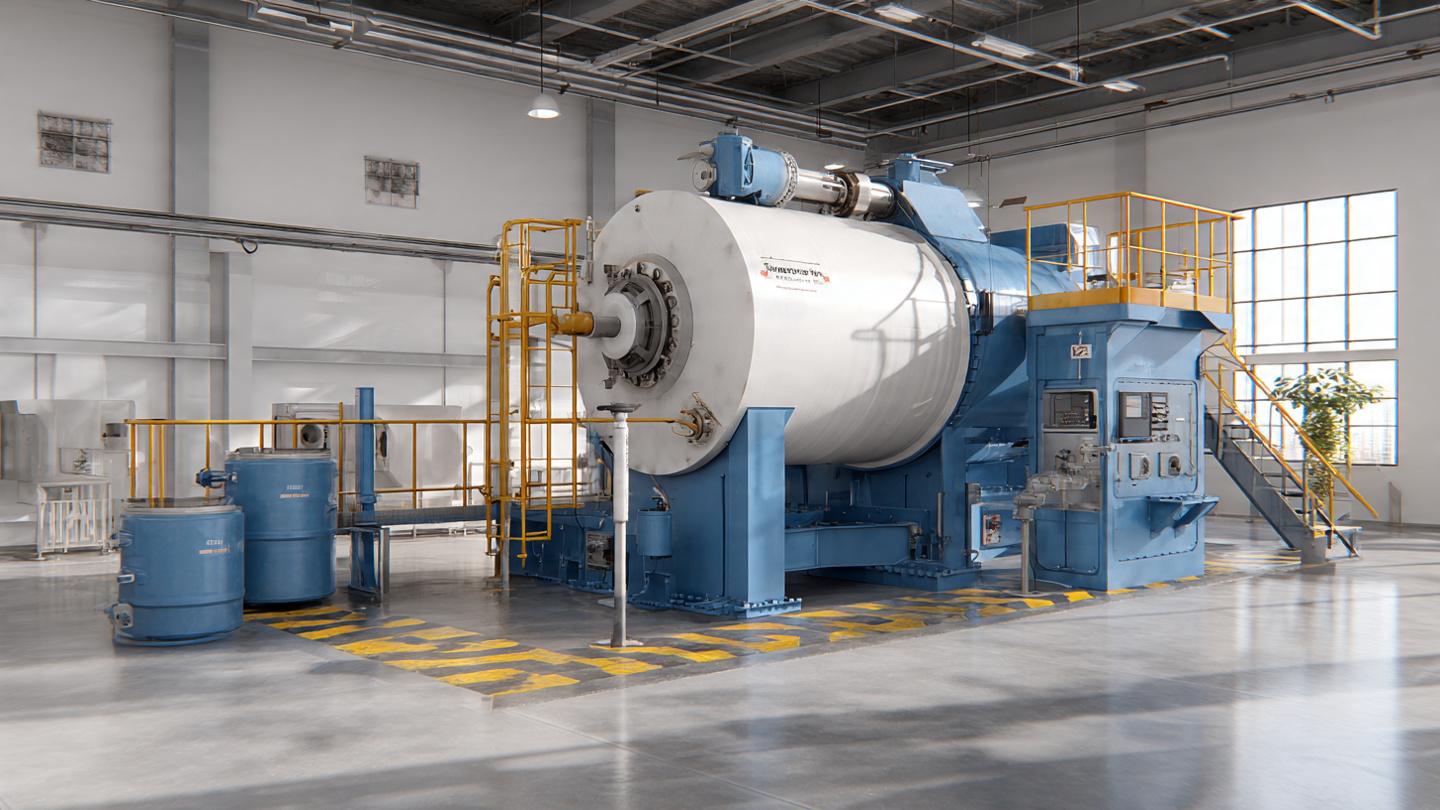
Developing commercial powder detergents requires precise physical engineering to ensure excellent flow, quick dissolution, and long shelf life. The mixing sequence must be carefully controlled to ensure uniform surfactant distribution without causing the dry builder powders to clump.
Laundry Detergent Formulations for Liquids: System Design and Stability
Liquid detergents are complex surfactant solutions that require precise physical stabilization. Formulators must balance active ingredients, electrolytes, and water to prevent the mixture from separating, turning cloudy, or losing viscosity. For a process walkthrough specific to this format, see our companion guide on liquid detergent formulation.
To ensure long-term stability and prevent separation, liquid detergent formulations must focus on four key physical parameters:
- Hydrotrope Balancing: Adding solubilizers like sodium xylene sulfonate to prevent surfactant separation.
- Viscosity Modification: Utilizing associative polymers or salts to achieve a premium, thick flow profile.
- pH Stabilization: Buffering the liquid base to pH 8.0-8.5 to maintain enzyme stability and skin safety.
- Preservative Protection: Incorporating broad-spectrum biocides to prevent bacterial growth in water-based systems.
Manufacturing Process: From Formulation Bench to Factory Floor
Scaling a detergent formula from the laboratory bench to industrial manufacturing requires careful process design. While laboratory trials focus on ingredient compatibility, full-scale production must optimize heat transfer, mixing energy, and material handling.
Industrial manufacturing employs specialized workflows tailored to the physical form of the detergent:
- Dry Blending (Powders): Mixing builders, neutralizing surfactants, post-adding enzymes, and packaging the dry blend.
- Wet Compounding (Liquids): Dispersing surfactants in water, adjusting viscosity, adding preservatives, and automated filling.

Quality, Compliance & BIS Requirements
In India, laundry detergent manufacturers must comply with standards set by the Bureau of Indian Standards (BIS) (IS 4955 for powders, IS 13101 for liquids). These standards regulate active detergent content, pH limits, and phosphate safety parameters.
Additionally, brands must comply with local metrology labeling laws and provide safety documentation. For international markets, formulations must meet ECHA REACH requirements and EPA safety standards.
Authoritative regulatory references:
👉 Bureau of Indian Standards Official Portal
👉 European Chemicals Agency Compliance Portal
What Happens When Detergents Are Poorly Formulated?
Releasing an unvalidated detergent formula to the market presents serious commercial risks. Poorly balanced chemistry can cause direct fabric damage, skin irritation, or physical package failures that can quickly damage a new brand's reputation.

Typical Problems in Laundry Detergent Formulations and Their Technical Roots
Detergent stability and performance issues are rarely random; they are almost always caused by specific chemical or physical imbalances in the formulation.
Common formulation problems and their underlying chemical causes include:
- Powder Lumping & Caking: Excessive free moisture in dry raw materials or lack of anti-caking silicates.
- Phase Separation (Liquids): High electrolyte concentrations or insufficient hydrotrope solubilizer levels.
- Suds Lock in Washers: Lack of silicone suds suppressors or over-reliance on high-foaming anionic surfactants.
- Fragrance Separation: Mismatch between the fragrance oil's HLB and the surfactant base's micellar structure.
Business Strategy for Startups Entering the Detergent Space
To succeed in the highly competitive detergent market, startups must align their chemical formulations with a clear business strategy. This involves selecting a target price tier, securing consistent raw material suppliers, and conducting thorough performance testing before launch. Founders evaluating the broader liquid cleaning category should also review our liquid detergent manufacturing startup guide for capital and licensing specifics.
A successful business strategy for new detergent brands rests on four key pillars:
- Target Pricing Tier: Choosing to compete in the economy, mid-range, or premium market segment.
- Supply Chain Stability: Securing reliable sources for active surfactants, builders, and enzymes.
- Pilot Batch Testing: Running small-scale production trials to verify formula stability before full-scale manufacturing.
- Regulatory Verification: Completing BIS certification and safety testing prior to commercial distribution.
Why Expert Support in Detergent Formulations Is Critical
Laundry detergent chemistry is dynamic, requiring continuous optimization as raw material prices fluctuate and environmental regulations tighten. Partnering with experienced formulation consultants helps new brands shorten development timelines, optimize active ingredient costs, and ensure consistent batch quality. Our guide on choosing the right product development consultant outlines the technical checklist to apply before signing an engagement. For the plant-economics view of a bar-format line, the Detergent Cake & Laundry Bar Manufacturing Standard Project Report sets out an India-basis feasibility and financial model — three costed investment configurations, a five-year projected P&L with IRR and payback, and an itemised plant and machinery schedule.
Learn More About Household Cleaner Formulations & Technology
Laundry detergent chemistry is part of the broader home care sector. To explore other formulation sciences like liquid soaps, dishwashing solutions, and floor cleaners, visit:
👉 Household Cleaners Formulations and Technology
👉 Surfactant Selection Guide for Cleaning Formulations
👉 How to Start a Dishwash Liquid Manufacturing Business
Frequently Asked Questions (FAQ)
1. Can a startup begin with just one laundry detergent product?
Yes. Many successful brands start with a single core detergent and then expand. The key is to ensure that the initial product has a well-validated formulation, stable performance, and clear positioning before adding variants. This focused approach also lets a startup validate raw material sourcing and manufacturing consistency before the added complexity of running multiple SKUs at once.
2. Is foam level the best indicator of detergent performance?
No. High foam does not always mean better cleaning and can even be a problem in modern washing machines. Performance is better measured through stain removal, whiteness retention, fabric feel, and lack of residues. In fact, high-efficiency (HE) machines are specifically designed for low-foam formulas, so an overly sudsy detergent can trigger suds-lock errors or trap soil back onto fabric during the rinse cycle.
3. Do I need separate formulations for hard and soft water regions?
In many cases, yes. At minimum, your laundry detergent formulations should be tested in representative water hardness conditions. Builders and surfactant systems are often tuned differently for regions with very hard water. A formula validated only in soft-water conditions can show sharply reduced cleaning performance and surfactant precipitation once sold into a hard-water market, so regional water-hardness data should inform the builder ratio from the earliest formulation stage.
4. How long should stability testing be done before launch?
A typical approach is to use a combination of accelerated stability studies (elevated temperatures) and real-time storage. While exact protocols vary by company, the objective is to ensure that the detergent remains stable and effective through its intended shelf life. Accelerated studies commonly run for four to twelve weeks at elevated temperature to approximate a year or more of ambient storage, but real-time confirmation at room temperature is still needed before a formula is signed off for commercial launch.
5. Why do zeolite-based powders sometimes leave a residue on dark fabrics?
Zeolite 4A is insoluble in water and works by ion-exchange rather than dissolving, so if the wash cycle uses cold water or a short rinse, undissolved zeolite particles can remain trapped in fabric weave and appear as a faint white residue, especially on dark colors. This is corrected by balancing zeolite particle size, pairing it with a soluble co-builder, and validating rinse performance at the target wash temperature during formulation.
6. Can enzymes and bleach-based brighteners be combined in one detergent?
Only with careful formulation. Oxidative bleach components can denature protease, amylase, lipase, and cellulase enzymes on contact, destroying their catalytic activity before the wash cycle even begins. Commercial formulations that combine both typically use encapsulated or coated enzyme granules, or physically separate the bleach and enzyme phases until the wash cycle activates them.
7. What is the difference between washing powder and heavy-duty detergent?
"Washing powder" is the common consumer name, in South Asian, Middle Eastern, and Southeast Asian markets, for heavy-duty powder (HDP) detergent — the industry term for a fully built laundry powder containing alkaline builders, a bleach or bleach-activator system, and enzymes targeted at fabric-borne stains. It sits in the same "heavy-duty" category as heavy-duty liquid (HDL) laundry detergent, as opposed to the milder light-duty liquid (LDL) formulas used for dishwashing.
Need Professional Laundry Detergent Formulations & Scale-Up Engineering?
Discuss your surfactant micellar chemistry, zeolite cation exchange parameters, and liquid stability goals with Global Formulation. Develop GHS-compliant, optimized, and market-ready laundry detergent templates.
Email: consulting@globalformulation.com
Phone: +91 9819548320 +91 8169102990
About the Specialist
Absar Khan is the principal consultant and chemical formulation architect at Global Formulation. He possesses cross-disciplinary engineering expertise spanning agrochemical milling lines, aerosol packaging systems, pharmaceutical cleanroom layouts, cosmetics, and green chemical plant setups. Absar leads scientific and engineering advisory teams supporting manufacturers globally in technology selection, GMP layouts, validation frameworks, and regulatory strategies.
LinkedIn Portfolio: Connect with Absar Khan on LinkedIn