Liquid Fertilizer Stability: Salting-Out and Sludge Control
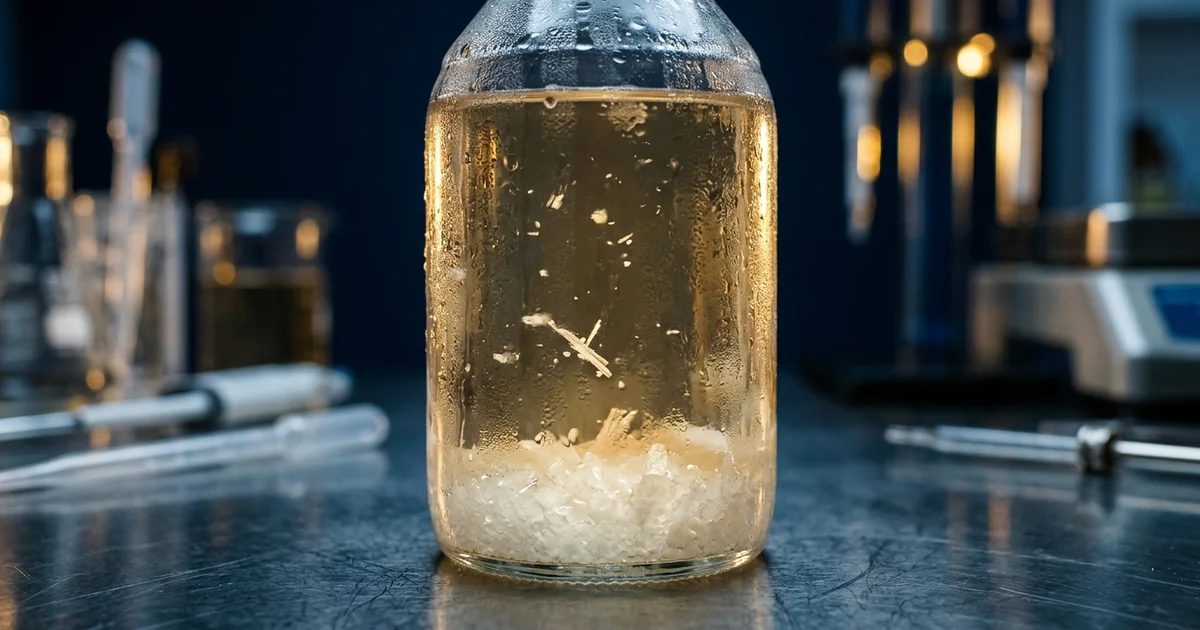
A tank of clear liquid fertilizer passes every check on the day of manufacture, then sits through a cold week and crystallises at the bottom. Liquid fertilizer stability decides whether a product can be pumped, metered and sold, because crystals, sludge and settled solids block lines and pull nutrients out of the delivered grade. The failures differ by product: urea ammonium nitrate salts out on cooling, ammonium polyphosphate sludges in storage, and suspensions settle when the clay network fails. This guide explains each mechanism, the salt-out temperatures of common grades, the ISO test method, the effect of adding sulphur or potash, and mixing compatibility. It draws on manufacturer data sheets, an engineering publication on UAN, extension guidance and patent literature, with formulation support from Global Formulation.
Liquid Fertilizer Stability: Solutions, Suspensions and Failure Modes
Fluid fertilizers fall into two families, and each fails in its own way. Solution fertilizers are dissolved completely in water, so their limit is solubility. Suspension fertilizers keep part of the nutrients, particularly potash, as dispersed solids, so their limit is how well the suspension holds. Knowing which limit applies is the first step in any stability study.
| Failure Mode | Typical Product | What Happens | Main Variables |
|---|---|---|---|
| Salting out | UAN, ammonium polyphosphate and other clear solutions | Solids separate from the liquid on cooling | Grade, composition, storage temperature |
| Sludging | Ammonium polyphosphate made from wet-process acid | Gelatinous iron and aluminium precipitates form and can continue during storage | Acid impurities, polyphosphate content, pH, temperature |
| Settling | Suspension fertilizers | Suspended solids settle if the product is not used soon after blending | Suspending agent, solids content, time |
| Incompatibility | Tank mixes with pesticides or other fertilizers | Precipitates or layering, or a loss of biological activity | Carrier, mixing order, chemistry |
The solution and suspension split follows Mississippi State University Extension's publication on fluid fertilizers, and the later sections add the evidence for each failure mode. The nitrogen solution is the simplest and best documented case, so it comes first.
UAN Solutions: Three Grades and Their Salt-Out Temperatures
Urea ammonium nitrate solutions are urea and ammonium nitrate dissolved in water, and they dominate the nitrogen solutions market in the United States. Three standard grades carry 28, 30 and 32 percent nitrogen, and each grade has its own salt-out temperature. An engineering publication from Uhde describes the composition by two characteristics: the temperature at which the solution starts to crystallise, and the balance of nitrogen sources. About half of the nitrogen is amide nitrogen from urea, and the rest is split equally between nitrate and ammonium.
| Grade | Urea (wt %) | Ammonium Nitrate (wt %) | Lowest Salt-Out, Uhde (°C) | Typical Salt-Out, CF Industries (°C) |
|---|---|---|---|---|
| UAN-28 | 30.0 | 40.1 | -18 | -18 (0°F) |
| UAN-30 | 32.7 | 44.2 | -10 | -9 (16°F) |
| UAN-32 | 35.4 | 44.3 | -2 | 0 (32°F) |
The two columns differ by up to two degrees for the same grade. Uhde's table lists salting-out temperatures at the compositions shown, which it labels as the lowest. The CF Industries specification lists typical properties of a commercial product, with composition ranges, and states that they are not guaranteed.
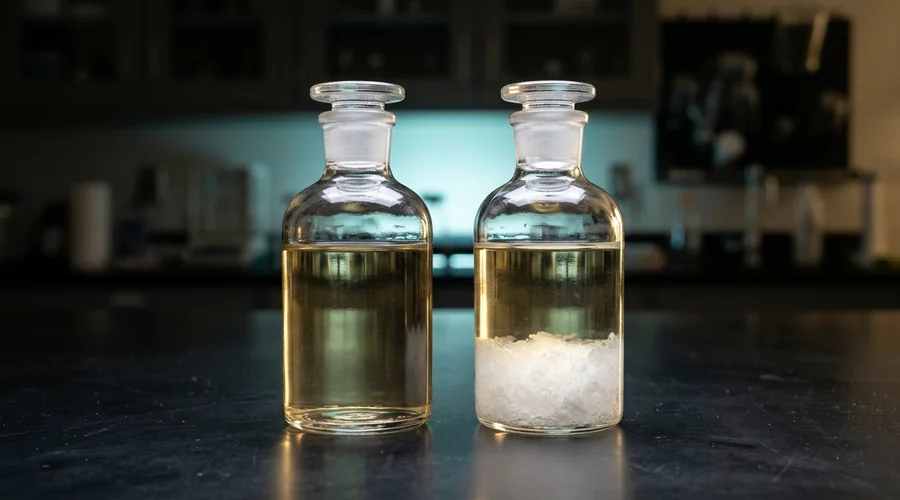
Grade choice follows climate. A patent that describes the US market places 32 percent nitrogen in the warmer South and Gulf Coast. It places 30 percent in the east and 28 percent in the colder corn belt and northern plains. All three keep a nominal ammonium nitrate to urea weight ratio of 1.29, because that combination gives the highest solubility and nitrogen analysis at a given salt-out temperature. The Uhde publication adds two practical points. Large tanks show only partial salting out even in cold climates without heating, and adding water lowers the salt-out temperature for long spells of extreme cold.
UAN also needs corrosion care. CF Industries adds a corrosion inhibitor that reduces the corrosion rate of carbon steel under ambient conditions, and notes that UAN remains corrosive. Phosphate solutions face a different limit, which is sludge.
Ammonium Polyphosphate: Sludging, Impurities and Shelf Life
Ammonium polyphosphate solutions such as 10-34-0 and 11-37-0 serve as starter fertilizers, and their stability problem differs from that of UAN. Wet-process phosphoric acid carries metal impurities from the phosphate rock, including iron, aluminium, magnesium, calcium, sodium and potassium. Iron and aluminium salts are quite soluble in merchant acid, but their solubility falls rapidly when the acid is ammoniated. The resulting precipitate is called sludge.
- pH window — at the usual ammoniation range of pH 5 to 7, gelatinous iron and aluminium precipitates can form, and the sludging can continue during storage.
- Handling and agronomy — the precipitates create a handling problem and tie up phosphorus in forms crops cannot easily use.
- Shelf-life target — the fertilizer industry wants a shelf life above six months, which was hard to reach from merchant grade acid.
- Polyphosphate sequestration — concentrating the acid beyond about 60 to 62 percent P2O5 turns orthophosphates into polyphosphates, which can sequester metal ions and help stability. The industry answer was superphosphoric acid, although sludging still appeared on extended holding.
- Impurity removal — cation exchange removes magnesium and calcium but leaves most of the iron and aluminium, because iron in phosphate rock is mostly trivalent.
These points come from the background of a patent on stable ammonium polyphosphate liquid fertilizer from merchant grade acid. Its own standard is a product that stays substantially sludge-free for six months at 25°C with no sequestering or suspending agent added. A commercial data sheet shows what a supplier reports for the same grade.
| Property | 10-34-0 Typical Value in a 2022 Supplier Data Sheet |
|---|---|
| Polyphosphate | 70.2 percent of total P2O5 |
| Iron, aluminium, magnesium | 0.5 percent Fe2O3, 0.6 percent Al2O3, 0.15 percent MgO |
| Solids | 0 percent |
| pH | 6.1 |
| Salt-out temperature | 0°F (-17.7°C) |
| Viscosity | 72 cP at 4°C, 45 cP at 18°C, 23 cP at 38°C |
Viscosity is a handling limit as well: the same product is more than three times as viscous at 4°C as at 38°C, which matters for pumping in cold weather. The next question is how to measure the cold limit reliably.
Measuring Salt-Out Temperature: ISO 23381 and Supercooling
A salt-out figure is only as good as the method behind it. ISO 23381 specifies a simple test for the salt-out temperature, also called the crystallisation temperature, of liquid fertilizers. In the method, the fertilizer is cooled in a dry ice and methanol bath until the liquid crystallises, and then warmed at ambient temperature. The salt-out temperature is the temperature at which the last crystal dissolves.
The BSI summary of the standard describes this procedure. Older practice differs. A patent on ammonium sulphate, urea and ammonium nitrate solutions describes a conventional test that notes the temperature at which crystals first form, ignoring any possible supercooling. Its preferred test forms crystals first and then records the temperature at which they redissolve, which it calls the dissolution temperature.
- First-crystal figure — the temperature at which crystals first appear, so supercooling can shift it.
- Last-crystal figure — the redissolution temperature that ISO 23381 and the patent's preferred test both use.
- What to report — the method, the exact composition tested and whether the figure is a first-crystal or a last-crystal value.
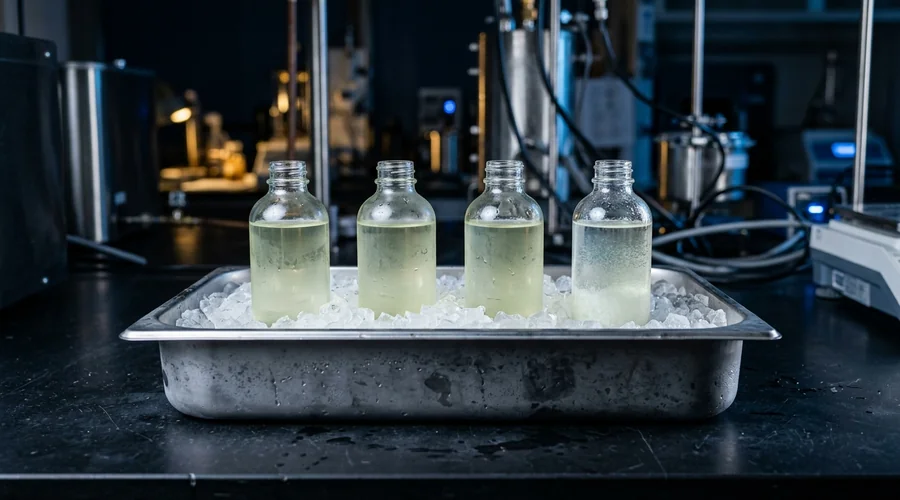
A measured salt-out temperature gives the cold limit of the base product. The next section shows how additions move that limit.
Sulphur, Potash and Micronutrients: What Changes the Limit
Every addition to a clear liquid has to fit inside the same solubility envelope. Sulphur and potash are the two most common additions to nitrogen and phosphate solutions. Each has a known ceiling in a clear liquid, beyond which the product becomes a suspension or loses cold stability. The sources give specific examples.
| Addition | Observation in the Sources |
|---|---|
| Ammonium thiosulphate in UAN | Mixes readily with UAN at the ratios normally desired; Mississippi State lists a 28-0-0-5 grade made this way with a salting-out temperature of about 0°F |
| Ammonium sulphate in UAN | UAN-32 plus ammonium sulphate gives 28-0-0-2 and 26-0-0-2.5 solutions with a 0°C salt-out temperature, which the patent calls inadequate for colder regions |
| Potash | No more than 11 percent potash goes into solution and 9 percent is more practical; higher grades are usually suspensions |
| Boron, secondary and micronutrients | Can be custom mixed with fluid fertilizers, with a compatibility test on small amounts first |
The patent explains why thiosulphate has competition. Only about half of its sulphur is in sulphate form, the form regarded as desirable plant food, and its cost per unit of sulphur is a concern. Ammonium sulphate overcomes both points. The patent still had to search for combinations of urea, ammonium nitrate and ammonium sulphate that give the lowest salt-out temperature for a given analysis. Our guide to chelated micronutrient fertilizers covers how metals are held in solution. When a grade needs more potash than a clear liquid holds, the formulation moves to suspensions.
Suspension Fertilizers: Clay Networks and Settling
When a grade needs more potash than a clear solution can hold, a suspension keeps the extra solids dispersed. Mississippi State Extension notes that suspensions are partially dissolved in water, and that some nutrients, particularly potash, are suspended much as mud is in water. Suspending agents, typically a clay such as attapulgite, keep the material from settling out. No standard analysis exists, because almost any grade of suspension can be blended.
- Higher potash — potash does not have to dissolve to stay dispersed, so a suspension can carry more of it than a solution.
- Settling — suspensions settle if they are not used soon after blending, and the extension guidance says to apply them the day they are blended.
- Pesticide interaction — paraquat is deactivated by binding to negatively charged clays. A suspension that will carry paraquat needs a suspending agent without negative charge, such as a xanthan gum product.
- Cost — those alternatives are usually more expensive than the clays normally used in fertilizers.
The pesticide interaction shows that stability depends on the intended tank mix. The next section covers how to test that.
Mixing and Compatibility: Jar Tests and Chemical Limits
Liquid fertilizers are often used as carriers for pesticides and micronutrients, so stability includes behaviour in the tank. UF/IFAS Extension describes two forms of incompatibility, physical and chemical. Physical problems such as precipitates and layering show up in a jar test. Chemical incompatibility can reduce biological activity or cause phytotoxicity even when the mix looks sound.
- Read the labels first, since many give the mixing sequence and a jar test procedure.
- Use one-quart jars and amounts proportional to the real mix.
- Establish the carrier, water or liquid fertilizer. Use two jars, one with and one without a compatibility agent, which matters most when a liquid fertilizer is the carrier.
- Fill each jar to half capacity with carrier and add the components in the label order.
- Cap the jar, shake or invert gently, then let it stand for 15 to 30 minutes, reshaking if signs of incompatibility appear.
For the full tank, the UF/IFAS publication on tank-mixing pesticides advises filling half the tank with the liquid fertilizer carrier. It also advises starting agitation before the first product and pre-slurrying dry products in a small volume of water. Mississippi State Extension adds that most fluid fertilizers can carry pesticides if the label allows it, and that a compatibility test on small amounts should always come first. Our guide to water soluble fertilizers for fertigation covers the equivalent questions for dissolved solids. All these findings come together in a design sequence.
Designing a Stable Liquid Fertilizer: A Decision Path
The sources point to a repeatable design sequence. It starts with the coldest storage and transport temperature, because that sets the salt-out limit the product must meet. It then fixes the nutrient sources and ends with tests under the conditions of use. Each step links to a finding above.
- Fix the cold limit from the coldest expected storage and transport temperature, then choose the grade. Adding water lowers the salt-out temperature for long spells of extreme cold.
- Choose the nitrogen sources and keep the ammonium nitrate to urea ratio near the optimum for the target salt-out temperature.
- Choose the sulphur source knowing the trade between ammonium thiosulphate and ammonium sulphate.
- Qualify the phosphate source by its iron, aluminium and magnesium content, its polyphosphate fraction and the ammoniation pH.
- Decide between solution and suspension for potash, using the 9 to 11 percent ceiling as the guide.
- Measure the salt-out temperature by a stated method such as ISO 23381.
- Run storage trials that cover realistic temperatures, including warm storage, and look for solids and sludge.
- Test mixing compatibility with the intended carrier, then check chemical compatibility separately.
- Set batch release tests for nutrient grade, solids, pH, density, viscosity and salt-out temperature, the parameters a supplier data sheet reports.
Each step needs data from the plant, which is where outside support helps.
Working With an Agrochemical Formulation Consultant
Liquid fertilizer stability sits between phase chemistry, raw material quality and field practice, so an agrochemical formulation consultant works across all three. The brief usually starts with the grade, the climate and the sales region. Agrochemical product development services then carry the work from bench trials to plant batches. A contract formulation agrochemical manufacturer can handle scale-up and supply.
- Cold-limit definition — linking the target region and storage chain to a salt-out specification.
- Composition work — nitrogen, phosphate, sulphur and potash sources balanced against the solubility envelope.
- Raw material qualification — acid impurity profile and polyphosphate fraction for phosphate products.
- Test programme — ISO 23381 salt-out tests, storage trials and release specifications.
- Suspension design — suspending agent choice and pesticide compatibility.
- Tank-mix compatibility — jar tests and follow-up checks for chemical compatibility.
- Scale-up — pilot batches and technology transfer, as in our guide to starting a liquid fertilizer manufacturing unit.
The full range of services sits under agro chemicals, and our overview of agrochemical technology and formulations shows how the product families connect. Our guide to NPK fertilizer formulation covers the solid side of the grade system. Before approaching a consultant, collect the target grade, the coldest storage temperature, the nutrient sources and their suppliers, and any pesticides the product must carry.
Frequently Asked Questions
What is liquid fertilizer stability?
Liquid fertilizer stability is the ability of a product to stay uniform and usable through storage, transport and mixing. Clear solutions must not crystallise or form sludge, and suspensions must not settle, over the temperatures and times the product will see.
Each product type fails differently. Urea ammonium nitrate salts out on cooling, ammonium polyphosphate can sludge in storage, and suspensions settle if they are not used soon after blending.
What is the salt-out temperature of UAN 28, 30 and 32?
An Uhde publication gives the lowest salt-out temperatures as -18°C for UAN-28, -10°C for UAN-30 and -2°C for UAN-32. A CF Industries specification lists typical values of -18°C, -9°C and 0°C for the same grades.
The small differences come from composition and definition, and the supplier states that its typical values are not guaranteed. Always confirm the figure for the product you buy or make.
What is the difference between salting out and sludging?
Salting out is the crystallisation of dissolved salts when a solution is cooled below its salt-out temperature, and it is reversible when the product is warmed. UAN and clear phosphate solutions show it.
Sludging is the formation of gelatinous iron and aluminium precipitates in ammonium polyphosphate made from wet-process phosphoric acid. It can continue during storage and ties up phosphorus in forms crops cannot easily use.
How is the salt-out temperature of a liquid fertilizer measured?
ISO 23381 specifies a simple test. The fertilizer is cooled in a dry ice and methanol bath until the liquid crystallises, then warmed at ambient temperature. The salt-out temperature is the temperature at which the last crystal dissolves.
A first-crystal reading can differ because supercooling delays the first crystals. A good report states the method and whether the figure is a first-crystal or a last-crystal value.
Why does ammonium polyphosphate form sludge?
Wet-process phosphoric acid carries iron, aluminium and other metal impurities from the phosphate rock. Iron and aluminium salts are quite soluble in the acid, but their solubility drops rapidly when the acid is ammoniated, and gelatinous precipitates can form at pH 5 to 7.
Polyphosphates sequester metal ions and help stability, which is why superphosphoric acid became the industry answer. Even then, sludging can appear on extended holding.
How much potash can a clear liquid fertilizer hold?
Mississippi State Extension states that no more than 11 percent potash goes into solution and that 9 percent is more practical to manufacture. Grades with more potash are usually suspensions.
A suspension holds the extra potash as dispersed solids, so it does not have to dissolve. The trade-off is that suspensions settle if they are not used soon after blending.
Why do suspension fertilizers use clay, and what is the drawback?
Suspending agents, typically a clay such as attapulgite, keep the solid fertilizer material from settling out. They allow a suspension to carry potash and other solids that would not stay in solution.
The drawback is that the negatively charged clay binds and deactivates paraquat. If a suspension must carry paraquat, a suspending agent without negative charge, such as a xanthan gum product, is needed, usually at higher cost.
How can an agrochemical formulation consultant help with liquid fertilizers?
A consultant links the climate and storage chain to a salt-out specification, balances the nitrogen, phosphate, sulphur and potash sources against solubility, and qualifies raw materials such as phosphoric acid. They also design the ISO 23381 and storage test programme.
Agrochemical product development services then cover pilot batches and scale-up, including support from a contract formulation agrochemical manufacturer.
Fighting Salting-Out, Sludge or Settling in a Liquid Fertilizer?
Global Formulation supports fertilizer makers with salt-out and storage test programmes, raw material qualification, suspension design, tank-mix compatibility work and scale-up to a contract manufacturing partner.
Talk to Our Formulation Team