Pharmaceutical Stability Testing: ICH Guidelines Explained
Pharmaceutical stability testing exists because a drug product that passes every release test can still fail a patient a year later. Degraded potency, an impurity that crosses a safety threshold, or a dissolution profile that drifts out of specification are stability failures, not manufacturing failures — and they surface long after the batch has already shipped. Regulators worldwide anchor their expectations for preventing exactly this gap to the ICH Q1 series of guidelines, and getting the storage conditions, testing frequency, or shelf-life extrapolation wrong carries real consequences: rejected marketing applications, expensive re-testing campaigns, or a recall built on data that should never have passed internal review. This guide walks through how ICH Q1A(R2) structures long-term, intermediate, and accelerated storage studies, how forced degradation and photostability testing build the analytical foundation stability data depends on, and how ICH Q1D and Q1E convert raw assay results into a defensible shelf life. Whether you are drafting a first stability protocol or auditing an existing CDMO program, this framework separates a stability dossier that survives regulatory review from one that generates deficiency letters.
1. Why ICH Q1A(R2) Exists: The Regulatory Framework
Before the International Council for Harmonisation (ICH) unified stability requirements, a company seeking approval in the United States, Europe, and Japan faced three different national expectations for storage conditions, testing frequency, and shelf-life justification — tripling the testing burden for no scientific gain. ICH Q1A(R2), "Stability Testing of New Drug Substances and Products," resolved this by defining a single harmonized framework now adopted, directly or with minor regional adaptation, by the FDA, EMA, PMDA, and most national regulators including India's CDSCO and the WHO prequalification program. The guideline does not test a single formulation-specific claim; it defines the entire study architecture a sponsor must follow to generate stability data regulators will actually accept.
The Q1A(R2) framework specifies which storage conditions apply to which climatic zone, how frequently samples must be pulled and tested, what constitutes a disqualifying "significant change," and how long a study must run before a shelf life can be proposed at filing. It works alongside a family of companion guidelines: ICH Q1B for photostability, ICH Q1D for reduced bracketing and matrixing designs, and ICH Q1E for the statistical treatment that converts raw stability data into a justified expiry date. Together, these documents — published by the ICH Quality guideline series — form the backbone of every stability protocol used in pharmaceutical product development, from a generic tablet to a novel biologic.
Understanding this architecture up front prevents the single most common and costly protocol design mistake: choosing storage conditions or testing intervals that satisfy one regulator but require an entirely separate parallel study to satisfy another.
2. Storage Conditions: Long-Term, Intermediate & Accelerated Testing
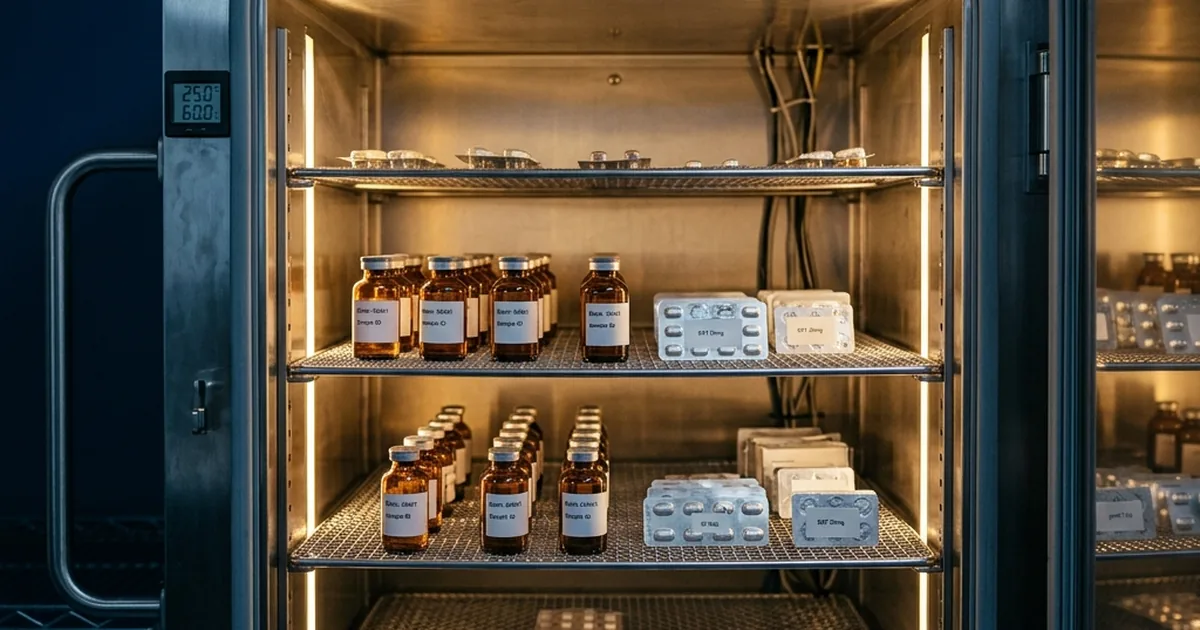
Every ICH-compliant stability program runs at least two, and often three, storage conditions in parallel, and each condition answers a different question. Long-term testing at the actual recommended storage condition is the only data type that can ultimately support a final shelf life. Accelerated testing at an elevated stress condition predicts likely long-term behavior quickly enough to support a provisional shelf life at the time of filing, while intermediate testing exists purely as a fallback when the accelerated data raises a flag the sponsor needs to investigate more carefully.
| Storage Condition | Temperature / Humidity | Minimum Data at Filing | Purpose |
|---|---|---|---|
| Long-term (Zone II) | 25°C ± 2°C / 60% RH ± 5% | 12 months | Primary basis for the approved shelf life |
| Long-term (Zone III/IV) | 30°C ± 2°C / 65% RH ± 5% | 12 months | Primary shelf-life basis for hot/humid markets |
| Intermediate | 30°C ± 2°C / 65% RH ± 5% | 6 months | Required only if accelerated data show significant change |
| Accelerated | 40°C ± 2°C / 75% RH ± 5% | 6 months | Rapid stress prediction; supports provisional shelf life |
| Refrigerated storage | 5°C ± 3°C | 12 months long-term | Cold-chain products (many biologics, some liquids) |
| Frozen storage | -20°C ± 5°C | Long-term only, no accelerated | Frozen biologics and cell-based products |
Testing frequency for long-term studies typically follows 0, 3, 6, 9, 12, 18, 24, and 36 month intervals, tapering to yearly beyond two years, while accelerated and intermediate studies are usually tested at 0, 3, and 6 months. Every study design must run on a minimum of three primary batches manufactured at pilot scale or larger, using the same synthetic route, formulation, and — critically — the same container closure system intended for the market. A dissolution profile that behaves acceptably in an open dish but degrades unexpectedly in the final blister pack is exactly the kind of finding this requirement exists to catch, which is why storage-condition selection is inseparable from the packaging decisions made during modified-release and other dosage-form design work.
3. Forced Degradation and Stress Testing
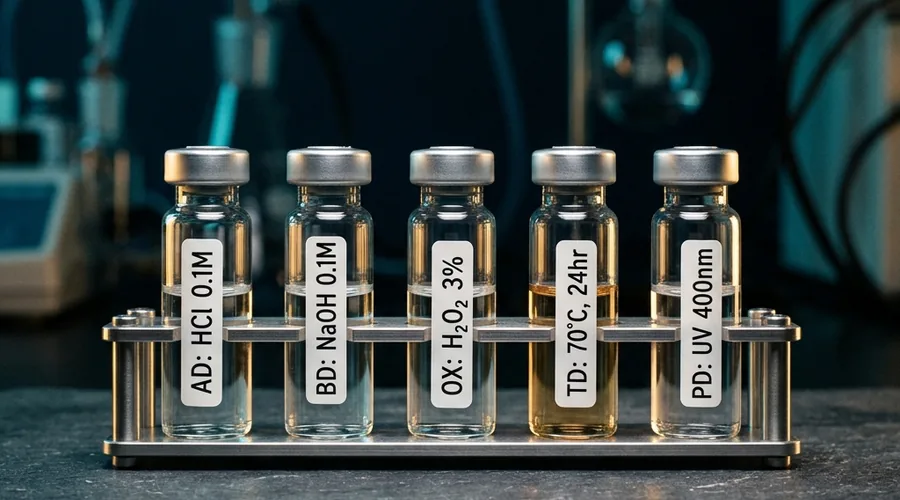
Forced degradation testing is frequently confused with accelerated stability testing, but the two serve entirely different purposes. Where accelerated testing predicts how a real batch will behave under moderate stress over months, forced degradation deliberately pushes a sample far past any realistic storage condition — with the explicit goal of generating degradation products, not preventing them. The output is not a shelf life; it is proof that the analytical method can actually see what it needs to see.
A properly designed stress-testing program applies each of the following conditions independently, so that any resulting degradation product can be attributed to a single, identifiable pathway:
- Acid hydrolysis — exposure to dilute hydrochloric acid, revealing acid-labile functional groups such as esters and amides.
- Base hydrolysis — exposure to dilute sodium hydroxide, often the most aggressive condition for ester- and lactam-containing molecules.
- Oxidation — exposure to dilute hydrogen peroxide, identifying oxidation-prone sites such as thioethers, tertiary amines, and phenolic groups.
- Thermal stress — elevated dry heat, typically 60–80°C, distinguishing purely thermal degradation from hydrolytic pathways.
- Humidity stress — high relative humidity at moderate temperature, relevant to hygroscopic actives and moisture-sensitive solid dosage forms.
- Photolytic stress — defined light exposure per ICH Q1B, addressed in detail below.
The degradation products characterized during stress testing directly inform the impurity specification limits set under ICH Q3B, and any excipient interaction observed during this phase should feed back into excipient selection for the dosage form before formal stability batches are ever manufactured — catching an incompatible excipient here is far cheaper than discovering it eighteen months into a long-term study.
4. Photostability Testing Under ICH Q1B
Light exposure degrades a meaningful proportion of drug substances, yet photostability is the one stress condition most formulators underestimate until a clear glass bottle or a poorly opaque blister foil fails in the field. ICH Q1B defines a confirmatory testing protocol distinct from the general photolytic condition used in forced degradation screening, and it applies to both the unprotected drug substance and the fully packaged, market-configuration drug product.
The guideline specifies two acceptable light source options — Option 1 uses a combination cool white fluorescent and near-UV lamp, Option 2 uses a xenon or metal halide lamp approximating natural daylight — and requires a minimum total exposure of not less than 1.2 million lux hours of visible light together with not less than 200 watt-hours per square meter of near-UV energy. Each study runs three sample sets in parallel: the sample directly exposed, an identical sample protected from light as a dark control, and — for the drug product — a sample in its actual market packaging to confirm the container closure system provides adequate protection.
A product that fails confirmatory photostability testing is rarely reformulated from scratch; the more common and more cost-effective fix is a packaging change — amber glass instead of clear, an opaque overwrap, or a light-protective coating on the tablet core, decisions that connect directly to the coating technology choices covered in film versus sugar tablet coating. Regional guidance from the EMA's quality guideline series mirrors the ICH Q1B protocol closely, so a study designed to satisfy one major regulator generally satisfies the others with no redesign required.

5. Bracketing, Matrixing & Statistical Shelf-Life Determination
Running the full stability protocol on every strength, pack size, and container configuration a product will be marketed in quickly becomes prohibitively expensive, and ICH Q1D exists specifically to permit statistically justified shortcuts without sacrificing the confidence regulators require. These reduced designs only apply when the sponsor can first demonstrate that the different presentations are similar enough to behave predictably.
- Bracketing — tests only the extremes of a design factor, such as the smallest and largest pack size, and extrapolates the result to every configuration in between, provided the intermediate conditions genuinely fall within the tested range.
- Matrixing — tests a statistically selected subset of the full sample-by-time-point matrix at each pull-point, rotating which subset is tested so that every combination is eventually covered across the full study duration.
Once the raw assay and degradation data exist, ICH Q1E governs how that data becomes a shelf life claim. The standard approach applies linear regression to each quantitative attribute that changes over time — assay, individual degradation products, dissolution — and a pooling test first determines whether batch-to-batch differences in slope and intercept are small enough to combine the batches into a single regression. The shelf life is the point at which the 95% confidence bound for the regression line intersects the acceptance criterion, not simply the last time point tested.
6. Post-Approval Commitments: Ongoing Stability Programs
Regulatory approval does not close the stability file — it opens a new, ongoing obligation. Sponsors commit to continuing long-term testing on the original registration batches through the full proposed shelf life, and most regulators also require an annual batch stability program: at minimum one production batch per strength and container configuration per year, tested on a reduced schedule, to confirm that commercial-scale manufacturing continues to produce material with the same stability profile as the batches originally studied.
Certain product categories carry additional post-approval stability burden. Sterile injectables and other parenteral formulations often require in-use stability data covering the period after a vial is punctured or a reconstituted product is prepared at the bedside — a distinct study from the sealed-container shelf life. Cold-chain products, including many biologics and protein therapeutics, add excursion studies that characterize how much time the product can tolerate outside its labeled refrigerated or frozen range during shipping or a temporary equipment failure without compromising safety or efficacy.
Designing a stability protocol that satisfies every applicable regulator on the first submission — rather than discovering a gap during review and losing months to a deficiency response — is one of the most consistently underestimated aspects of pharmaceutical product development. An experienced formulation and regulatory strategy consultant can align storage conditions, batch selection, and testing frequency with the target markets from day one, turning what is often treated as a late-stage compliance checkbox into a planning decision made alongside the formulation itself.
Frequently Asked Questions
What is the difference between real-time and accelerated stability testing?
What triggers "significant change" under ICH Q1A(R2)?
What is the difference between a drug product's shelf life and a drug substance's retest date?
What is forced degradation testing and how does it differ from a formal ICH stability study?
What are bracketing and matrixing stability designs, and when can they be used?
How far can accelerated stability data be extrapolated to support a shelf life?
Expert Pharmaceutical Stability & Regulatory Strategy Support
Partner with our team to design ICH-compliant stability protocols — from forced degradation and photostability studies through statistical shelf-life justification and regulatory submission.
Request Consultation