Solubility Enhancement Techniques for Poorly Soluble Drugs
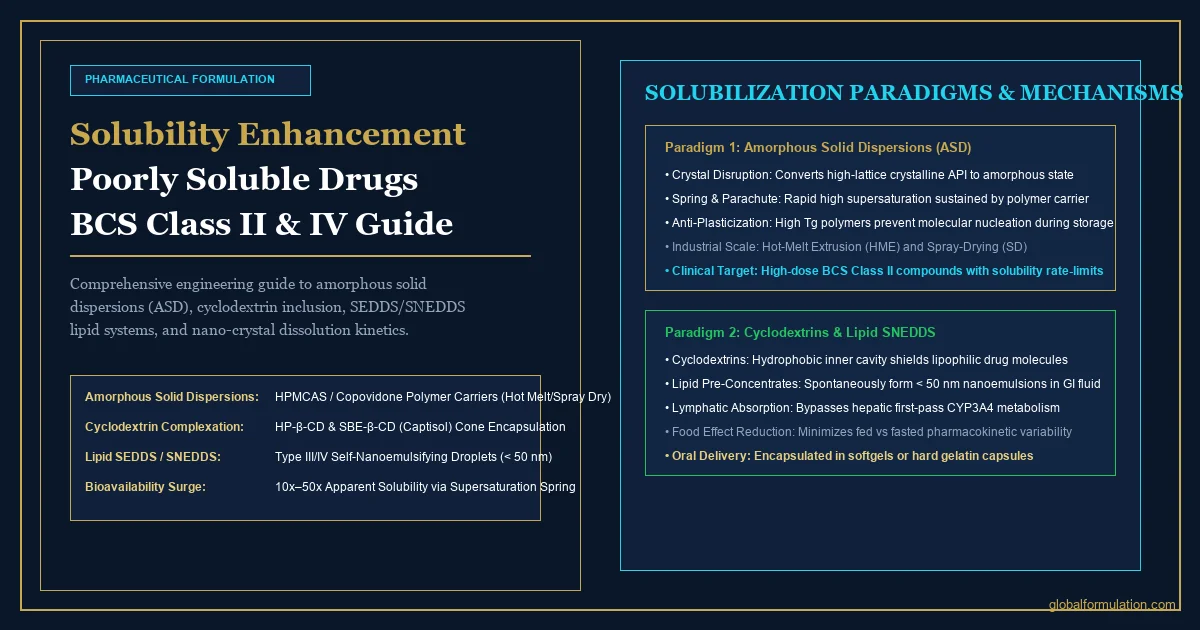
A promising drug candidate can fail in development for a reason that has nothing to do with its biological activity. It simply won't dissolve fast enough, or in high enough concentration, to reach the bloodstream in a therapeutic dose. Solubility enhancement for poorly soluble drugs has become one of pharmaceutical formulation's central disciplines. Roughly 40% of currently marketed drugs, and a much larger share of compounds now moving through development pipelines, fall into this poorly water-soluble category. When a molecule can't dissolve, its potency on paper counts for nothing — the drug simply passes through the gastrointestinal tract without ever being absorbed. This guide walks through the core techniques formulators actually reach for: particle size reduction and nanocrystal technology, amorphous solid dispersions, and cyclodextrin complexation. It also covers the selection criteria that determine which one fits a given molecule. Global Formulation has guided pharmaceutical manufacturers and startups through exactly this BCS Class II and Class IV formulation challenge. The frameworks below reflect what actually survives scale-up and regulatory review — not just what looks promising in an early feasibility study.
Why Solubility Enhancement Decides Whether a Candidate Survives Development
Solubility problems don't announce themselves as dramatically as toxicity findings do, which is exactly why they derail so many development programs before anyone identifies the real cause. A molecule can pass every safety and efficacy benchmark in vitro and still fail in vivo simply because too little of it ever crosses into systemic circulation. Because absorption failure looks identical to a genuine lack of efficacy from the outside, teams sometimes abandon a chemically sound candidate rather than recognize a solvable formulation problem. Catching a solubility bottleneck early, ideally before a single clinical dose is administered, determines whether a program needs a formulation fix or an outright restart.
- Failed bioavailability studies — a candidate can show strong pharmacological activity in isolated assays yet fail first-in-human dosing purely because too little drug reaches the bloodstream
- Food effect variability — poorly soluble drugs are especially prone to large differences in absorption between fed and fasted states, complicating dosing guidance
- Inflated dose requirements — compensating for poor solubility with a larger dose increases cost of goods and can worsen the side-effect profile
- Batch-to-batch variability — uncontrolled particle size or polymorphic form differences between batches translate directly into inconsistent clinical exposure
None of these outcomes are inevitable — they're the predictable result of treating solubility as a downstream packaging problem instead of a formulation variable engineered from the start. The Biopharmaceutics Classification System is the framework that tells a formulator exactly which of these risks applies to a given molecule.
The BCS System: Where Solubility Becomes the Limiting Factor
The Biopharmaceutics Classification System sorts drug substances into four categories based on two independent properties: aqueous solubility and intestinal permeability. Formulators rely on it constantly because it immediately shows which lever actually needs pulling — a permeability problem calls for a completely different fix than a solubility problem does. Class II and Class IV compounds are both defined by low solubility. That's where solubility enhancement techniques earn their keep, while Class I and Class III molecules rarely need this kind of intervention at all. Recognizing which class a candidate falls into early in development prevents a formulation team from applying the wrong toolkit to the wrong problem. That's a gap our pharmaceutical and healthcare formulation practice is built specifically to close.
| BCS Class | Solubility | Permeability | Typical Formulation Approach |
|---|---|---|---|
| Class I | High | High | Minimal formulation intervention needed |
| Class II | Low | High | Primary target for solubility enhancement — dissolution rate limits absorption |
| Class III | High | Low | Permeation enhancement, not solubility, is the limiting factor |
| Class IV | Low | Low | Hardest case; often needs solubility enhancement combined with a permeation or delivery-route strategy |
Class II compounds are the ones this guide focuses on. Dissolution rate, not the amount of drug in the dose, is what actually limits how much reaches circulation — and that's a problem formulation science can solve. Particle size reduction is usually the first technique a formulator reaches for on exactly this kind of molecule.
Particle Size Reduction: Micronization and Nanocrystal Technology
Reducing particle size is often the first technique formulators try on a Class II molecule. Dissolution rate scales directly with the surface area exposed to gastrointestinal fluid — the physical relationship that underlies most solubility enhancement work. Standard micronization, which mills particles down into the low single-digit micron range, is enough to rescue many moderately insoluble compounds without requiring exotic processing. For molecules that remain poorly soluble even after micronization, nanocrystal technology pushes particle size down further, into the nanometer range. Techniques like wet media milling or high-pressure homogenization make this possible, an approach explored further in our nanoparticle drug delivery guide. The tradeoff is processing complexity and cost, which is why nanocrystal technology is usually reserved for compounds where micronization alone doesn't clear the bioavailability bar.
- Micronization — jet milling or fluid energy milling reduces particle size into the low single-digit micron range, increasing surface area and dissolution rate for moderately insoluble compounds
- Wet media milling — a common nanocrystal production method using milling media in an aqueous stabilizer suspension to grind particles down to the nanometer range
- High-pressure homogenization — forces a drug suspension through a narrow gap at high pressure, using cavitation and shear forces to fracture particles
- Stabilizer selection — nanocrystal suspensions require a surfactant or polymer stabilizer to prevent particle aggregation and re-crystallization during storage
Particle size reduction works well for compounds whose crystalline form simply has too little surface area exposed. But for molecules where the crystal lattice itself is the obstacle, no amount of milling solves the underlying problem. That's exactly the case amorphous solid dispersions are built to address.
Amorphous Solid Dispersions: Mechanism and Polymer Selection
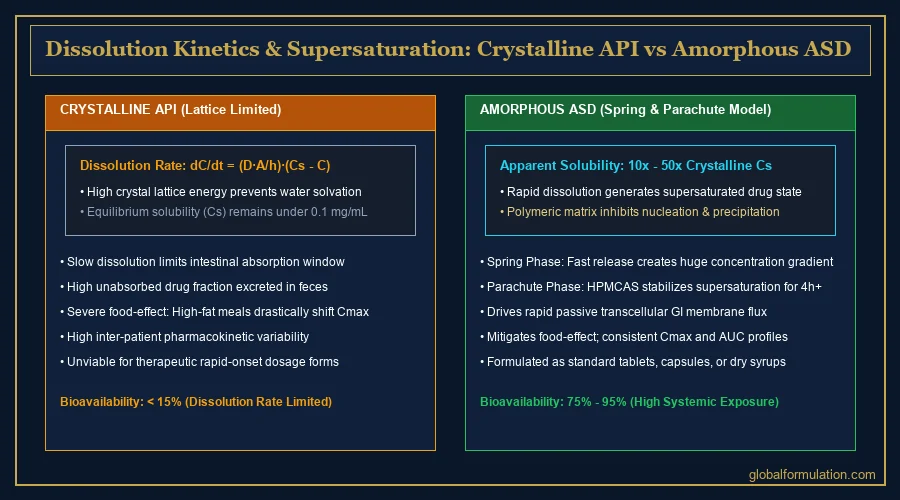
An amorphous solid dispersion suspends a drug in a disordered, non-crystalline state within a polymer matrix. That eliminates the crystal lattice energy a molecule's own crystalline form has to overcome before it can dissolve. Because the amorphous form has no ordered lattice to break apart, it typically dissolves far faster than the crystalline form. It can reach apparent solubility well above what the stable crystalline form allows, sometimes generating a transient supersaturated state in the gut. The polymer matrix does more than just carry the drug. As described in a 2021 manufacturing-strategy review published in Acta Pharmaceutica Sinica B, it's chosen specifically to slow the amorphous drug's tendency to recrystallize once dissolution begins. That delay extends the window during which extra drug stays in solution long enough to be absorbed. Manufacturing an amorphous solid dispersion at commercial scale typically relies on either hot-melt extrusion or spray drying. The choice between them depends heavily on the drug's thermal stability and the polymer's processing characteristics. The resulting granulate is usually compressed into the same modified-release tablet platforms covered in our modified-release tablet technology guide.
- Hot-melt extrusion — melts drug and polymer together and forces the molten mixture through a die, solidifying into an amorphous matrix without solvent
- Spray drying — dissolves drug and polymer in a common solvent, then atomizes and rapidly dries the solution so the drug has no time to recrystallize
- Polymer selection — polymers such as povidone, copovidone, and hypromellose acetate succinate are chosen for their ability to form a stable amorphous matrix and inhibit recrystallization
- Supersaturation maintenance — the polymer's role in delaying recrystallization during dissolution is often just as important as the amorphous drug loading itself
Amorphous solid dispersions solve the crystal lattice problem directly. But they aren't the only route to a supersaturated solution — cyclodextrin complexation reaches the same destination through an entirely different molecular mechanism.
Cyclodextrin Complexation and Other Solubilization Strategies
Cyclodextrins are cyclic sugar molecules shaped like a hollow cone, with a hydrophobic interior cavity and a hydrophilic exterior. That structure lets them physically encapsulate a poorly soluble drug molecule inside the cavity, while presenting a water-friendly surface to the surrounding fluid. That inclusion complex dramatically increases the apparent solubility of the encapsulated drug without any chemical change to the molecule itself. This makes cyclodextrin complexation attractive for compounds that are sensitive to the heat or solvents used in other techniques. The approach works best for relatively small, moderately lipophilic molecules that fit well inside the cyclodextrin cavity; very large or highly polar molecules often don't complex efficiently enough to matter. Beyond oral formulations, cyclodextrin complexation is especially valuable for parenteral solubilization. It can replace the harsher co-solvents or surfactants that would otherwise be needed to get an insoluble drug into an injectable solution.
- Beta-cyclodextrin derivatives — chemically modified cyclodextrins such as hydroxypropyl-beta-cyclodextrin offer improved aqueous solubility and safety profile over the native compound
- Complexation efficiency — depends on cavity-to-guest molecule fit; molecular modeling and phase-solubility studies determine whether a given drug is a good complexation candidate
- Parenteral solubilization — cyclodextrins can replace co-solvents or surfactants in injectable formulations, often with a better local tolerability profile
- Regulatory familiarity — several cyclodextrin derivatives have an established regulatory track record, which can simplify excipient justification during filing
Cyclodextrin complexation, particle size reduction, and amorphous solid dispersion technology each solve the same underlying problem through a different mechanism. The right choice for a given molecule depends less on which technique is "best" and more on which one matches that molecule's specific chemistry.
Choosing the Right Technique: A Comparison Framework
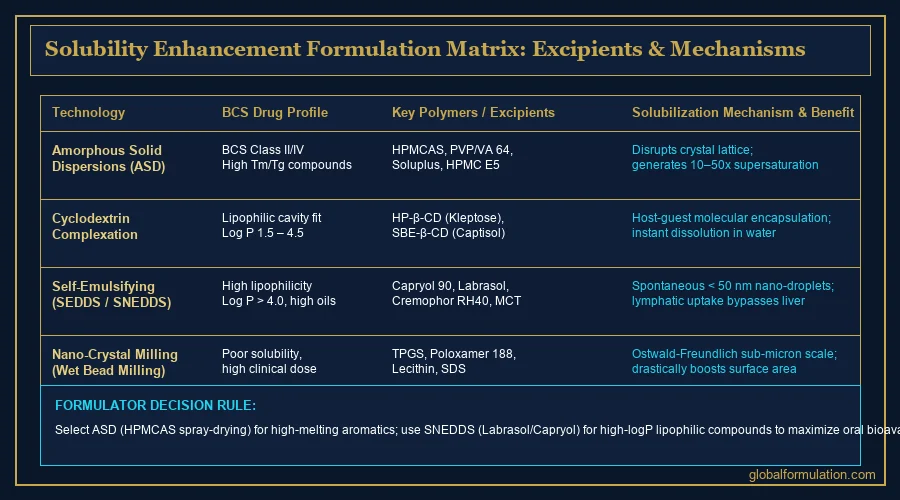
No single solubility enhancement technique wins across every molecule, because each one depends on a different physicochemical property of the drug substance to work. Matching technique to molecule requires characterizing the compound's melting point, thermal stability, crystallization tendency, and molecular size well before committing to a manufacturing platform. Getting this match wrong doesn't just waste a formulation cycle. It can send a program down a path where scale-up eventually fails for reasons that were predictable from day one. The comparison below is a starting screening framework, not a substitute for actual feasibility data on the specific molecule.
| Technique | Best Fit For | Key Limitation | Typical Manufacturing Route |
|---|---|---|---|
| Micronization | Moderately insoluble, mechanically millable compounds | Limited gain for very high-dose or highly crystalline compounds | Jet milling / fluid energy milling |
| Nanocrystal technology | Highly insoluble compounds needing a high dissolution rate | Complex stabilizer selection; higher processing cost | Wet media milling / high-pressure homogenization |
| Amorphous solid dispersion | High crystal lattice energy compounds, thermally stable enough for processing | Physical instability risk on storage; polymer selection is critical | Hot-melt extrusion / spray drying |
| Cyclodextrin complexation | Small-to-moderate, moderately lipophilic, or heat/solvent-sensitive molecules | Poor fit for very large or highly polar molecules | Aqueous complexation / lyophilization |
Screening a candidate against this framework early, ideally during preformulation rather than after a failed pilot batch, is what keeps a formulation program on schedule. The alternative is discovering the solubility strategy was wrong only after tooling has already been ordered.
De-Risking BCS Class II and IV Development With the Right Formulation Partner
Selecting and scaling a solubility enhancement technique is rarely a decision a formulation team should make in isolation. The right answer depends on data, melting point, thermal degradation profile, and crystallization kinetics, that most early-stage programs haven't fully generated yet. A formulation partner experienced across particle engineering, amorphous dispersion, and complexation chemistry can screen a candidate against multiple approaches in parallel. That parallel screening beats betting an entire development timeline on the first technique that seems plausible. Getting the excipient system right alongside the solubility strategy matters just as much. Our guide to excipient selection for oral solid dosage forms is worth reading alongside this one for any program moving toward a tablet or capsule endpoint. That parallel screening often decides whether a program reaches first-in-human dosing on schedule. The alternative is discovering a fundamental solubility mismatch only after a pilot batch has already failed.
Every technique in this guide is really answering the same question from a different angle. How much of this drug will actually be available to do its job once it's inside the body? Getting that answer right during formulation, rather than discovering it wrong during a failed bioequivalence study, is what determines whether a chemically promising molecule ever becomes a marketed therapy.
Frequently Asked Questions
What percentage of drugs in development have poor water solubility?
Industry estimates place roughly 40% of currently marketed oral drugs into the poorly water-soluble category defined by BCS Class II and Class IV. An estimated 70-90% of compounds in early-stage discovery pipelines fall into that same category. That proportion has grown over recent decades as drug discovery techniques like high-throughput screening and combinatorial chemistry have favored larger, more lipophilic molecules. These molecules bind their targets tightly but dissolve poorly in aqueous fluid.
This is exactly why solubility enhancement has shifted from a niche specialty into a mainstream formulation discipline that most pharmaceutical development programs now budget for from an early stage.
How do I know if my drug candidate needs solubility enhancement or a different formulation approach entirely?
The starting point is BCS classification: characterizing the compound's equilibrium solubility across the physiological pH range and its intestinal permeability using standard assays. A molecule with low solubility but high permeability, BCS Class II, is a strong candidate for the techniques covered in this guide. Dissolution rate, not absorption capacity, is the limiting step for that class.
If permeability is also low, BCS Class IV, solubility enhancement alone often isn't enough, and the formulation strategy needs to also address permeation, sometimes through an entirely different delivery route.
Is nanocrystal technology always better than standard micronization?
No — nanocrystal technology costs more to develop and manufacture, and it isn't necessary for every poorly soluble compound. Standard micronization, which is simpler and cheaper to scale, is often sufficient for moderately insoluble drugs. A modest particle size reduction is often enough to clear the bioavailability bar.
Nanocrystal processing is reserved for compounds where micronization alone doesn't achieve adequate exposure. The additional development cost and stabilizer complexity only pays off when it's solving an otherwise unsolvable problem.
Why do amorphous solid dispersions sometimes fail during storage even after passing initial testing?
An amorphous drug is thermodynamically unstable by definition — it's higher in energy than its crystalline form. Given enough time, humidity, or temperature stress, it will always tend to revert toward that more stable crystalline state. A dispersion can pass release testing and still recrystallize months into a shelf-life study. That happens if the polymer matrix wasn't specifically validated against that drug's own crystallization tendency, or if the manufacturing process left residual crystalline seeds behind.
That's why a proper amorphous solid dispersion program runs physical stability monitoring, not just dissolution testing, throughout the entire shelf-life study rather than only at release.
Can cyclodextrin complexation be used for injectable drug products?
Yes, and it's one of cyclodextrin complexation's most valuable applications. It can solubilize a poorly soluble drug for intravenous or other parenteral administration without relying on the harsher co-solvents or high-surfactant vehicles that often cause injection-site irritation or hemolysis. Several cyclodextrin derivatives, including hydroxypropyl-beta-cyclodextrin, have an established regulatory and clinical safety track record specifically in parenteral formulations.
That existing track record can meaningfully simplify the excipient safety justification during a regulatory filing compared with introducing a novel solubilizing excipient.
Do these solubility enhancement techniques change the drug molecule itself?
No, and that's an important distinction from a regulatory standpoint. Particle size reduction, amorphous solid dispersion, and cyclodextrin complexation are all physical formulation strategies. They change the physical state or immediate molecular environment of the drug substance, not its chemical structure.
Because the active pharmaceutical ingredient itself is unchanged, these approaches generally don't trigger the same level of regulatory scrutiny as a genuine chemical modification would. A prodrug or a new salt form are examples of that kind of modification. The formulation itself still requires its own characterization and stability data.
Why work with a formulation consultant instead of testing all three techniques independently?
Screening a candidate against particle size reduction, amorphous dispersion, and cyclodextrin complexation all independently is expensive and slow when done without a framework for narrowing the field early. An experienced formulation partner can evaluate a molecule's melting point, thermal stability, and crystallization behavior against all three mechanisms in parallel. That screening often rules out one or two approaches from preformulation data alone, before committing manufacturing resources to a pilot batch.
That upfront screening is frequently the difference between a program that reaches proof-of-concept on schedule and one that doesn't. The slower program often spends a year discovering its first-choice technique was never going to work for that specific molecule.
Developing a Poorly Soluble Drug Candidate?
BCS classification, particle engineering, amorphous solid dispersion development, and cyclodextrin complexation screening. Global Formulation supports pharmaceutical manufacturers and startups from preformulation through scale-up-ready solubility strategy.
Talk to Our Formulation Team