Intumescent Fire Resistant Paints: Formulation & Ratings

A comprehensive technical and commercial guide to intumescent fire resistant paints. Learn how passive fire protection coatings protect critical structures from catastrophic failure, modeled through Fourier's law of heat conduction and chemical decomposition kinetics.
Guide Contents
- 1. Market Importance of Fire Safety
- 2. Defining Intumescent Chemistry
- 3. Fourier's Law of Heat Transfer
- 4. Arrhenius Reaction Kinetics
- 5. Key Ingredient Categories
- 6. Technical Formulation Gaps
- 7. Manufacturing & Scale-Up Controls
- 8. Fire Ratings & Global Certifications
- 9. Frequently Asked Questions (FAQ)
1. Why Intumescent Fire Resistant Paints Matter in Today’s Market
Fire safety has transitioned rapidly from a basic regulatory checklist into a core engineering, architectural, and financial priority in modern infrastructure design. High-density urban environments, sophisticated skyscrapers, metro rails, airports, and industrial complexes contain huge amounts of load-bearing structural steel. However, structural steel is highly vulnerable to thermal degradation, losing up to 50% of its mechanical yield strength when heated to temperatures of only 550–600°C.
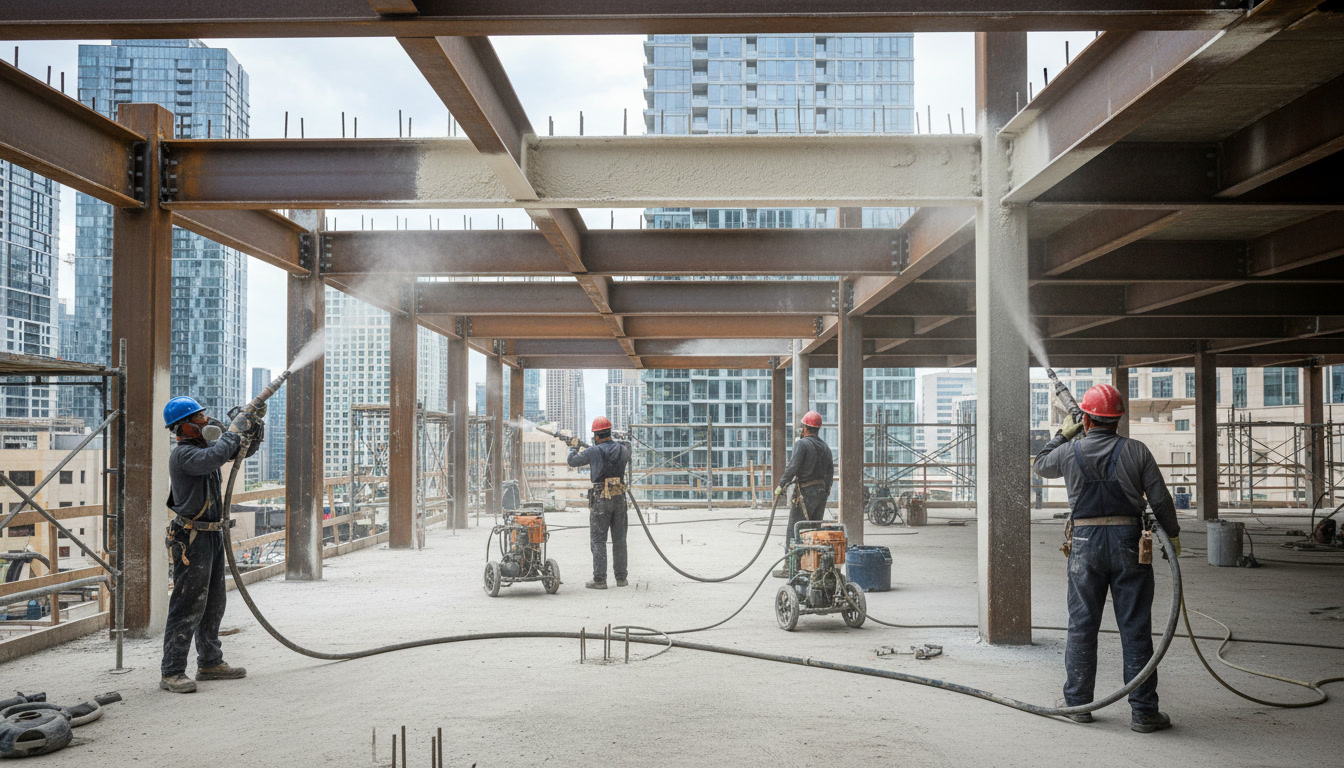
Without active or passive fire protection systems in place, unprotected structural steel exposed to a standard building fire will reach its critical collapse temperature within minutes. This rapid structural failure drastically reduces evacuation window limits and exposes emergency first responders to severe safety risks. Intumescent coatings offer an elegant, lightweight solution, maintaining mechanical integrity and delaying core structural failure for hours without adding dead load or altering aesthetic profiles. Within the broader paints and coatings industry, this passive fire protection category commands premium pricing precisely because of its safety-critical function.
In emerging industrial markets like India, demand is expanding rapidly. The National Building Code (NBC) imposes strict compliance parameters on high-occupancy structures, commercial workspaces, high-tech data centers, and heavy processing complexes. By applying high-performance fire-resistant paints, project managers can easily secure statutory approvals, satisfy insurer compliance mandates, and protect long-term physical assets from catastrophic thermal damage.
2. What Exactly Is an Intumescent Fire Resistant Paint?
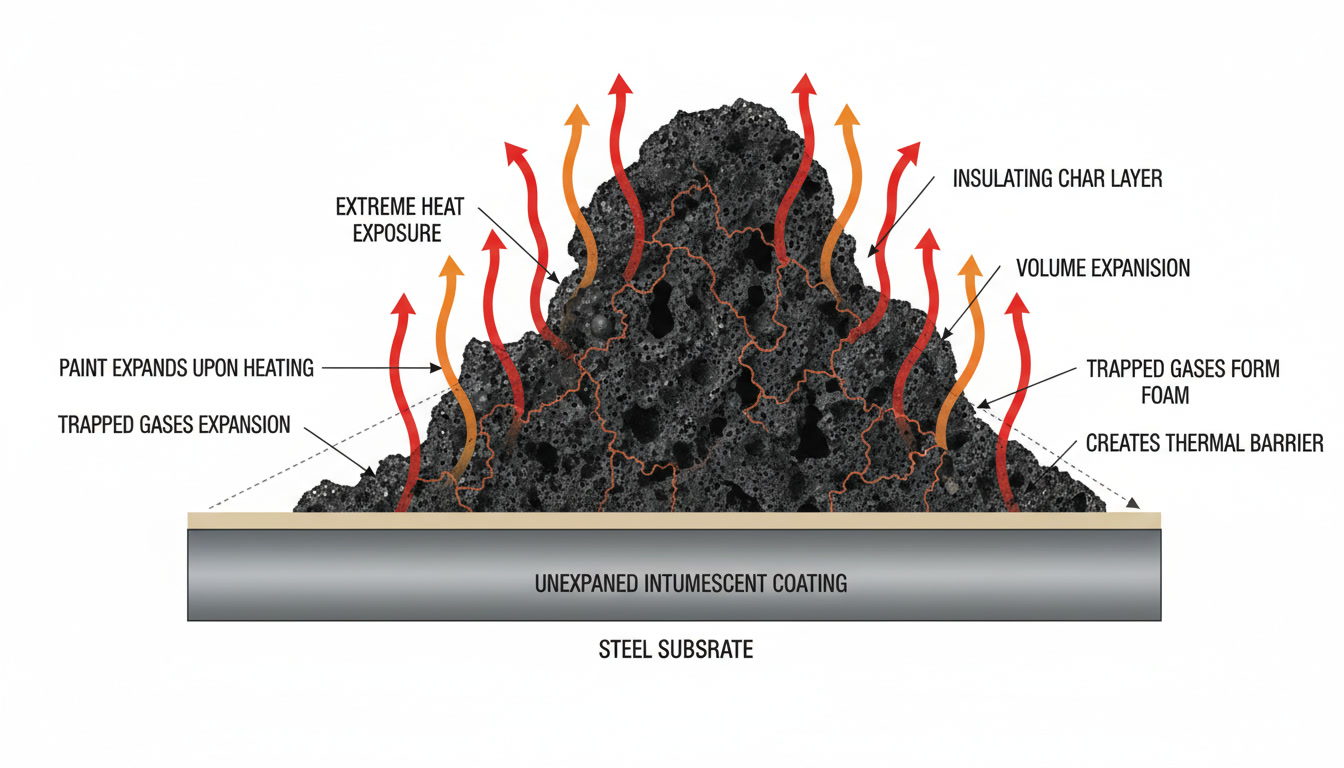
An intumescent fire-resistant paint is an engineered, thermally reactive coating designed to remain completely dormant under ordinary operating conditions. It presents as a smooth, decorative topcoat indistinguishable from conventional protective paint systems. However, upon exposure to temperatures exceeding 200–250°C (typical of early fire ignition), the coating undergoes a highly controlled series of chemical and physical transformations. Because the same steel substrate must also resist rust before it ever sees a fire, intumescent systems are always applied over an anti-corrosion coating base, not as a standalone protective layer.
Unlike simple flame-retardant paint additives that merely suppress early flame spread across surfaces, a true thin-film intumescent coating undergoes rapid physical expansion:
- Thermal Foam Expansion — expands up to 40–100 times its original dry film thickness (DFT)
- Insulating Carbonaceous Char — forms a highly stable, low-density, highly porous carbon foam char layer
- Structural Heat Blocker — the expanded char acts as a physical heat-blocking shield, dramatically slowing the rate of thermal transfer to the structural steel substrate
By delaying the steel core temperature rise, these reactive systems effectively buy critical evacuating windows (typically 30, 60, 90, or 120 minutes) for building occupants and emergency response teams, preventing immediate building collapse.
3. The Physics of Insulation: Fourier's Law of Heat Transfer
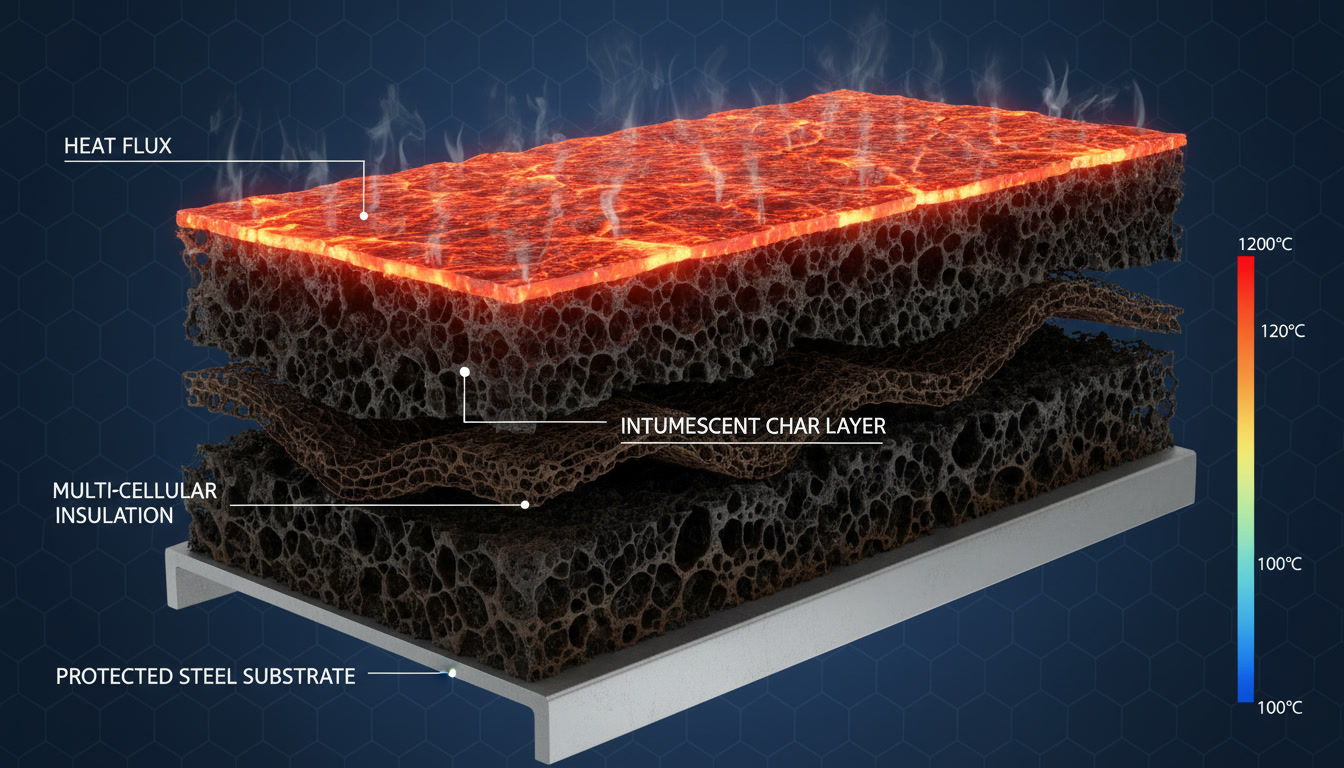
The ability of an expanded carbonaceous char layer to protect a steel structural column from intense heat is governed by fundamental thermodynamic principles. When fire envelopes the steel member, heat energy flows from the high-temperature flame boundary to the cooler steel core. The rate of this thermal transfer is modeled by **Fourier's Law of Heat Conduction**:
Where:
- dQ / dt — rate of heat flow (Watts) conducted into the structural steel core
- k — thermal conductivity (W/m·K) of the expanded carbonaceous char barrier
- A — surface area of the steel member exposed to the heat boundary
- dT / dx — temperature gradient across the insulation barrier, where dx is the char layer thickness
An effective intumescent coating optimizes two variables in this equation. First, it maximizes the char thickness (dx) via highly efficient gas-blowing agents, drastically reducing the overall temperature gradient (dT / dx). Second, the chemical composition generates a highly porous carbon foam structure with an extremely low thermal conductivity value (k ≤ 0.05 W/m·K), effectively blocking heat transmission and keeping the underlying steel core below its critical structural failure temperature (550°C) for up to 120 minutes of intense fire exposure. This reactive, expansion-based insulation mechanism is fundamentally different from the passive, non-reactive insulation approach used in heat-resistant silicone paints, which resist continuous elevated temperature rather than a single fire event.
4. The Chemistry of Intumescence: Arrhenius Reaction Kinetics
The formation of a stable, low-density, insulating carbon char layer is not a simple physical event. It is a highly sensitive, multi-stage chemical cascade that must execute in a precise, synchronized sequence across rising temperatures. If the individual reactions do not trigger in the correct thermal order, the blowing gases will escape before the binder resin melts, or the char will carbonize prematurely, preventing proper expansion and resulting in coating failure.
The rates of these individual decomposition and polymerization reactions are modeled mathematically using **Arrhenius chemical reaction kinetics**:
Where:
- ri — rate of chemical reaction i (e.g., acid release, esterification, gas release, char cross-linking)
- Ai — pre-exponential frequency factor characterising molecular collisions
- Ea,i — activation energy (J/mol) of the specific reaction
- R — universal gas constant (8.314 J/mol·K)
- T — absolute temperature (Kelvin) at the coating boundary
To achieve optimal intumescence, the formulation must synchronize three distinct reaction kinetics:
- Acid Catalyst Release (T ≥ 150°C) — the phosphate-based acid source must decompose to generate polyphosphoric acid before the carbonific compounds react
- Esterification & Carbonification (180°C ≤ T ≤ 250°C) — polyphosphoric acid reacts with the carbon donor (e.g., pentaerythritol) to form carbonaceous esters while the thermoplastic binder resin melts into a highly viscous liquid state
- Gas Outgassing & Foaming (200°C ≤ T ≤ 280°C) — the blowing agent (e.g., melamine) decomposes, releasing large quantities of nitrogen gas to expand the molten polymer matrix before the ester cross-links into a solid, rigid carbon char foam
5. Key Functional Ingredient Categories
Formulating an industrial-grade, certified intumescent paint requires a precise balance of highly specialized functional raw materials. These ingredients are divided into several core chemical groups, each performing a specific role in the thermal expansion cascade. A minor shift in raw material purity, moisture levels, particle size, or dispersion quality can completely disrupt this delicate chemical balance, resulting in failed fire ratings.
The primary ingredient groups essential to high-performance intumescent paint systems include:
- Acid Catalyst Donors — typically inorganic salts like Ammonium Polyphosphate (APP); decompose under heat to generate polyphosphoric acids, which dehydrate the carbon source to initiate char formation
- Carbonific Donors — polyhydric carbon compounds, most commonly Pentaerythritol or Dipentaerythritol; react with the generated acids to build the carbon skeleton of the insulating char foam
- Blowing Agents — thermally reactive nitrogen compounds, primarily Melamine; decompose to release nitrogen and ammonia gases, which expand the molten carbonaceous matrix into a low-density foam
- Thermoplastic Resin Binders — polymeric systems such as acrylic copolymers or solvent-borne vinyl acetate-ethylene systems; hold the active ingredients, provide weather resistance, and form the critical molten matrix required to trap blowing gases during a fire. Solvent-borne binder selection is directly constrained by regional VOC regulations for coatings, pushing many formulators toward waterborne acrylic alternatives
- Synergistic Additives and Pigments — inorganic mineral fillers like Titanium Dioxide, zinc borate, and silica; reinforce the physical char structure, preventing the expanded foam from collapsing under the mechanical force of turbulent flames
Since every intumescent system is applied over an anti-corrosive primer (see FAQ below), the choice between zinc phosphate primer chemistry and other passivating primer technologies has a direct bearing on long-term adhesion and fire certification validity.
6. Technical Formulation Challenges and Common Gaps
Intumescent fire resistant paints are technically complex products, and developing them is significantly more challenging than formulating conventional decorative or anti-corrosive coatings. Many paint manufacturers attempt to enter this high-value category by using generic recipe sheets or basic trial-and-error blending. This approach often leads to expensive product recalls, failed third-party certifications, and poor performance in real-world fires.
The primary technical formulation challenges in intumescent coatings include:
- Moisture Ingress and Water Sensitivity — many standard inorganic salts (such as low-molecular-weight APP) are highly water-soluble; under high humidity these compounds can migrate to the surface, causing the coating to blister, lose fire performance, or wash away
- Rheological Stability and Sagging — achieving the high DFT required for steel columns often requires applying up to 1–2 mm of wet paint in a single coat; this demands complex shear-thinning rheology to prevent the wet film from sagging off vertical steel surfaces
- Char Structural Integrity — the expanded carbon foam must withstand intense mechanical turbulence of hot rising gases; without inorganic mineral reinforcing agents the char can disintegrate, leaving bare steel exposed to the fire
- In-Can Chemical Shelf Life — high loading levels of active chemical compounds can lead to pre-reaction or hard settling inside the storage can, converting the premium coating into an unusable solid mass within months
7. Industrial Scale-Up and Manufacturing Process Control
Successfully scaling up an intumescent formulation from the laboratory bench to industrial commercial production requires strict process control. The chemical reaction dynamics of the final coating are highly sensitive to particle size distribution and polymer dispersion. Using conventional paint blending techniques without proper temperature controls can damage active ingredients, cause premature reactions, and lead to poor fire performance. This same sensitivity to elevated process temperatures is common across products designed for high-temperature industrial environments, where thermal stability during both manufacturing and end use is a shared formulation challenge.
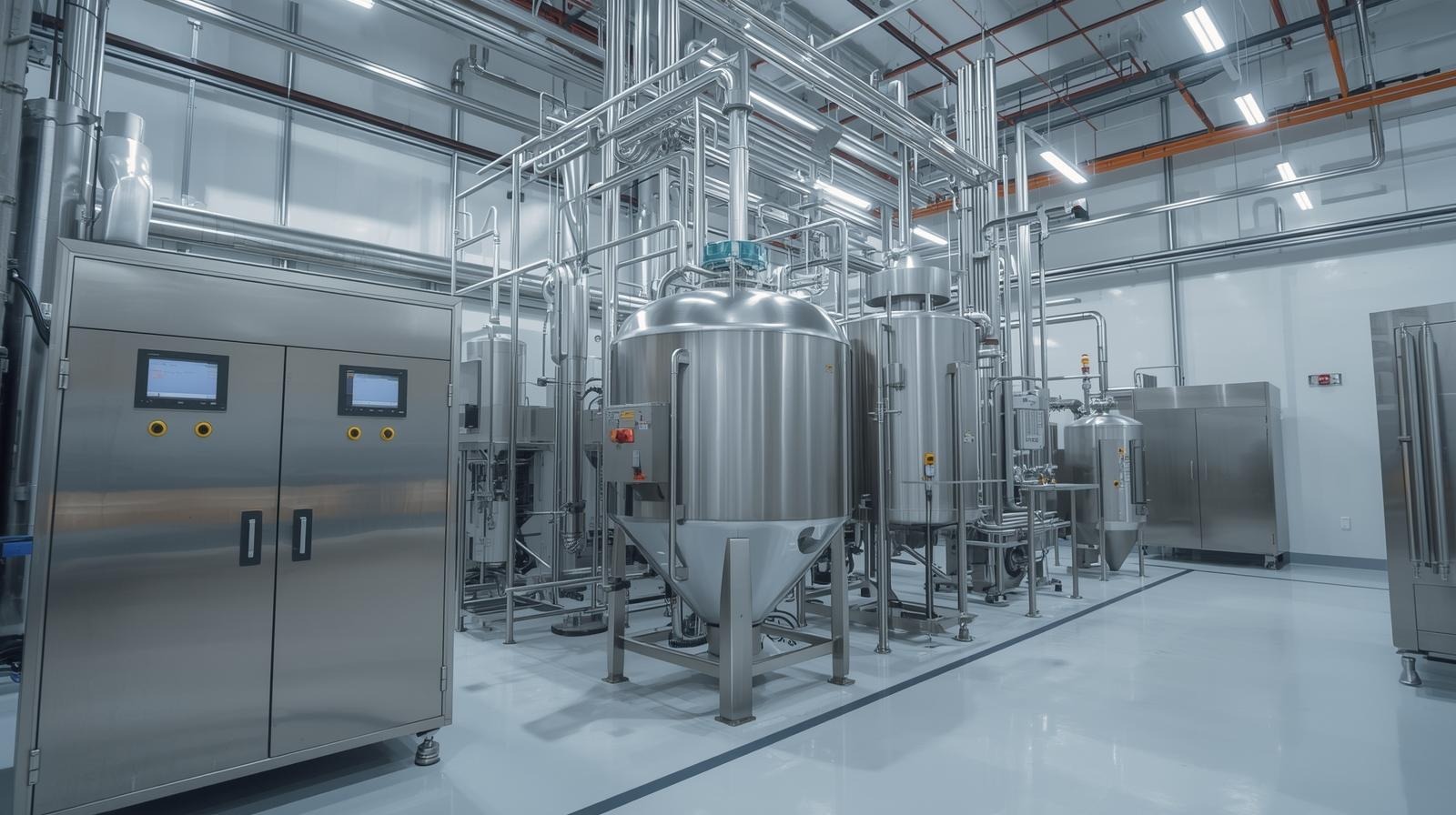
A standardized, high-yield manufacturing sequence includes:
- High-Shear Slurry Dispersion — pigments and reinforcing mineral agents are dispersed at high speeds (tip velocities of 18–22 m/s) to achieve a fine, homogeneous grind
- Low-Shear Functional Incorporation — active ingredients (APP, Pentaerythritol, Melamine) are introduced under low-shear conditions; excessive mixing speeds at this stage can fracture the delicate crystal structures of these functional raw materials, leading to premature decomposition and loss of fire rating performance
- Continuous Temperature Monitoring — slurry temperature must be kept strictly below 50°C during mixing; frictional heat exceeding this limit can trigger premature esterification and pre-reaction, ruining the batch
- De-Aeration and Filtration — the final paint must be filtered through a 150–200 micron mesh and de-aerated to prevent micro-bubbles from forming inside the packaging, which can introduce moisture and destabilise shelf life
8. Fire Ratings and International Testing Standards
In the fire protection industry, a coating's performance cannot be claimed based on laboratory tests alone. It must be formally validated through full-scale fire testing under standardized furnace conditions, following strict global regulatory frameworks. These standards simulate the rapid temperature rise of real-world structural fires, ensuring the coating provides reliable protection under extreme conditions.
The critical global testing standards governing intumescent coatings include:
- ISO 834 (Fire Resistance Testing Standard) — international benchmark specifying the standard time-temperature curve for evaluating structural building elements; see the official ISO 834 Standard Page
- BS 476 Parts 20/21 — widely recognised British Standard governing the fire resistance of load-bearing structural elements, commonly specified in India and the Middle East
- EN 13381 Series — comprehensive European testing standard evaluating the contribution of protective coatings to the fire resistance of structural steel columns and beams
- ASTM E119 / UL 263 — primary American testing standards for structural steel passive fire protection systems, widely used in global oil & gas and industrial infrastructure projects
Each of these regional standards shares the same underlying goal, and a comparative overview of how fire-resistance ratings are defined and compared across BS 476, ASTM E119, and related time-temperature curves is useful when specifying a system for an export project spanning multiple regulatory regions.
| Standard | Primary Region | Scope |
|---|---|---|
| ISO 834 | International | Standard time-temperature curve for furnace testing |
| BS 476 Parts 20/21 | UK, India, Middle East | Fire resistance of load-bearing structural elements |
| EN 13381 Series | European Union | Contribution of protective coatings to steel column/beam fire resistance |
| ASTM E119 / UL 263 | United States | Structural steel passive fire protection, oil & gas and industrial infrastructure |
Frequently Asked Questions (FAQ)
1. How long does intumescent fire resistant paint last?
Service life depends on the binder system, exposure conditions, and maintenance. In controlled interior environments, certified systems perform reliably for many years when applied over approved primers and topcoats.
2. Is intumescent paint waterproof?
Most thin-film systems are not inherently waterproof. Under high humidity, standard active ingredients can dissolve or wash away. To prevent this, a compatible protective topcoat is mandatory for weather and moisture resistance in exterior or industrial environments.
3. Can intumescent paint be applied directly on bare steel?
No. Intumescent systems must be applied over an approved anti-corrosive primer. The primer must be fully compatible with the intumescent coating to ensure proper adhesion and maintain fire certification validity.
4. What determines a 30, 60, 90, or 120-minute fire rating?
The fire rating depends on the steel section factor (Hp/A), the dry film thickness (DFT) of the intumescent coating, the compatibility of the primer/topcoat system, and performance under standardized furnace testing.
5. Can one intumescent formulation work for all steel sizes?
No. Different steel sizes heat up at different rates depending on their mass and exposed surface area. Consequently, they require different certified coating thicknesses to maintain protection.
6. Is in-house development possible without expert support?
While possible in theory, in-house development carries high technical and financial risk. The complex reaction chemistry, dispersion mechanics, and expensive certification testing make expert guidance highly valuable for success.
Conclusion
Intumescent fire resistant paints are sophisticated, highly engineered chemical systems rather than simple coatings. Developing these products requires a deep understanding of polymer science, heat transfer thermodynamics, reaction kinetics, and strict global fire certification standards.
To succeed in this high-margin market, manufacturers must prioritize scientific formulation development and strict process control. Partnering with specialized R&D and engineering consultants helps minimize technical risks and accelerates the path to certified commercial production.
Need Expert Guidance on Intumescent Paint Development?
Discuss your protective coatings roadmap with Global Formulation. Secure certified formulations, stabilize your process dispersion, and navigate global fire resistance approvals.
Email: consulting@globalformulation.com
Phone: +91 9819548320 +91 8169102990
About the Specialist
Absar Khan is the principal consultant and chemical formulation architect at Global Formulation. He possesses cross-disciplinary engineering expertise spanning agrochemical milling lines, aerosol packaging systems, pharmaceutical cleanroom layouts, cosmetics, and green chemical plant setups. Absar leads scientific and engineering advisory teams supporting manufacturers globally in technology selection, GMP layouts, validation frameworks, and regulatory strategies.
LinkedIn Portfolio: Connect with Absar Khan on LinkedIn