Liquid Applied Waterproofing Membrane: PU, PMMA, Acrylic
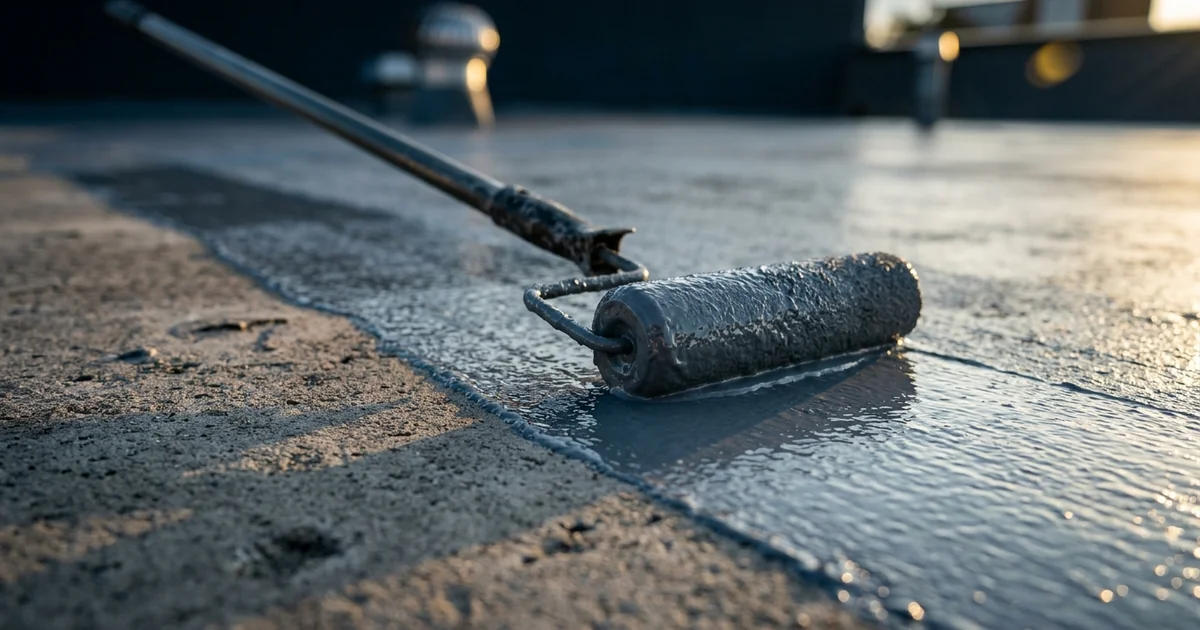
A deck membrane has to stay watertight while the concrete beneath it cracks, expands and shrinks. It is also buried under a wearing course, insulation or asphalt, so a failed membrane is expensive to reach and repair. A liquid applied waterproofing membrane removes the laps by curing into one bonded, seamless film, but its chemistry decides how that film meets moisture, cold, ponding water and traffic. This guide compares polyurethane, PMMA and acrylic systems on cure mechanism, substrate tolerance, reinforcement, standards, and bridge-deck and tunnel use. It rests on four European Technical Assessments, current ASTM scopes and open research, with formulation support from Global Formulation.
Liquid Applied Waterproofing Membrane: What the Film Must Do
A liquid applied waterproofing membrane is a cold-applied liquid that cures on the substrate into a bonded, seamless, elastomeric film. ASTM C836 describes the class as one- or two-component membranes that cure after spreading or spraying into an elastomeric film able to maintain a seal against liquid water. Because the film has no laps, continuity depends on coverage and thickness rather than on welded seams. That moves part of the quality risk from the factory to the applicator, so the liquid, primer and reinforcement are tested and sold together as a kit.
The film has four jobs, and each one connects to a formulation lever and a test method.
- Bond — the film must adhere to concrete, steel, wood or old bitumen sheet, through a primer where the kit lists one.
- Movement — it must stretch across cracks and joints, and ASTM C1305 is the laboratory method for crack bridging.
- Watertightness — it must resist water under pressure, which ASTM C1306 measures as hydrostatic pressure resistance.
- Exposure — it must survive sunlight, heat, cold and traffic, and the European assessments grade this for each kit as use categories.
Tiled wet areas follow a different route, which our guide to wet-area waterproofing covers under EN 14891, so this article stays with roofs, decks, bridges and tunnels. The cement-based and bitumen families have their own pages on polymer-modified cementitious waterproofing and bituminous waterproofing membranes. The wider field sits under our construction chemicals hub. Next, the three resin families are compared before each gets its own chemistry.
PU, PMMA and Acrylic: Three Chemistries Compared
Polyurethane, PMMA and acrylic membranes all end as an elastomeric film, but they reach it by three different routes. Polyurethanes build polymer from isocyanate groups, PMMA resins harden by free-radical polymerization of methacrylate monomer, and acrylic membranes dry from a water dispersion. Each route has its own weak point: water for polyurethane, vapour and flammability for PMMA, and drying and ponding for acrylic. The table compares them on the points that decide a specification.
| Feature | Polyurethane | PMMA | Acrylic Dispersion |
|---|---|---|---|
| Cure route | Isocyanate reacts with polyol, or with moisture in one-component grades | Peroxide and amine start radical polymerization of methacrylate | Water evaporates, then particles deform and fuse |
| Packaging | One- or two-component | Two-component, built with a reinforcing fleece | Ready-to-use, water-based |
| Main weak point | Moisture in the substrate or between coats | Flammable, volatile monomer | Needs film-forming temperature and drying time; ponding water |
| Light stability | Aromatic types darken; aliphatic finish layer used | Assessed kit described as UV resistant | Exposure category set for each kit |
| Minimum thickness in assessed kits | 2.1 mm and 1.2 mm | 2 mm | 1.7 mm |
| European assessment route | ETAG 005 Part 6 | ETAG 005, edition 2004 | ETAG 005 Part 8 |
The thickness and assessment rows come from public assessments of four kits, which later sections cite one by one. ASTM C836 itself does not sort membranes by resin type, so the resin family predicts the weak point while the kit data decide the performance. Polyurethane comes first because its moisture reaction shapes so much of the site practice.
Polyurethane Waterproofing Membrane: Cure and Blisters
Polyurethane membranes form urethane links when isocyanate groups meet hydroxyl groups, but isocyanate also reacts with water. That second reaction gives carbon dioxide gas and urea links, as the general polyurethane chemistry shows for foams. Gas is useful in a foam and a defect in a film, which is why a damp deck or damp between coats produces blisters. Moisture is therefore a reactant that site practice has to control.
- Two-component grades — polyol-side and isocyanate-side parts are mixed on site. The Triflex ProThan assessment covers a two-component polyurethane with a polyester fleece and a thixotropic variant for vertical areas and details.
- One-component grades — the HYPERDESMO assessment covers a one-component elastomeric polyurethane with a minimum layer thickness of 1.2 mm and an optional geotextile.
- Aromatic and aliphatic isocyanates — aromatic types are more reactive and cheaper, but polyurethanes made from them tend to darken in light. Coatings that need colour stability use aliphatic types.
- Protective finish — the HYPERDESMO system adds an aliphatic polyurethane UV protection layer, with a minimum of 150 g/m2 in the kit.
That assessment reports unreinforced film data before and after ageing. After 200 days at 80 °C, tensile strength fell from 9 to 4 MPa and elongation fell from 450 to 213 percent. After 5,000 hours of UV exposure with moisture, tensile strength moved from 9 to 8 MPa and elongation from 450 to 500 percent. Heat ageing was the harsher test for this film, since it roughly halved the elongation.
A deck-coating maker's troubleshooting note lists four blister types in polyurethane systems. They are the practical symptoms of the moisture chemistry and of trapped air, so they are worth recognising on site.
- Moisture blisters — large blisters with a trace of moisture beneath, caused by coating a damp deck or by damp between coats.
- Pinhole blisters — small blisters over surface pores, where air in the concrete expands as the film sets. The maker advises thinner coats, extra primer and starting the base coat late in the day as the deck cools.
- Gassing — bubbles from applying the coating thicker than the instructions allow.
- Solvent blisters — trapped solvent when a coat goes on before the previous one has cured, most often in cold or dry weather.
The same isocyanate and water chemistry causes bubbling in sealants, which our post on polyurethane sealant bubbling and blistering explains. The next resin family avoids moisture chemistry altogether and trades it for a different hazard.
PMMA Waterproofing Resin: Radical Cure and Cold Weather
PMMA membranes harden by free-radical polymerization of methacrylate monomer, not by reaction with moisture. A peroxide and an amine react as a redox pair to produce the radicals. In a methacrylate bone-cement study, Przesławski and co-workers showed that a higher initiating system concentration raises the radical count and speeds polymerization, which shortens the setting time. That lever sets how soon the next layer of a PMMA kit can follow, which matters for the wet-on-wet build described below.
- Induction period — the same study saw a stretch with no reaction. It attributes this to oxygen and to the stabiliser left in the monomer, so initiator levels are set against both.
- Incomplete conversion — polymerization turns diffusion-controlled as the polymer forms, so conversion stays below unity, and the study lists residual monomer among the known drawbacks of methacrylate cements.
- Exothermic cure — methacrylate polymerization releases heat, which the study describes as highly exothermic.
- Cold-weather and detail grades — the ALSAN 770 assessment names a low-temperature version of the resin and thixotropic versions of both grades.
- Wet-on-wet build — ALSAN 770 goes on as 1.5 kg/m2 of resin, a fleece layer and 1.0 kg/m2 of resin. No drying time separates the steps, and the minimum thickness is 2 mm.
The monomer sets the site-safety profile. ICSC 0300 for methyl methacrylate gives a flash point of 10 °C (open cup), a boiling point of 100.5 °C and a vapour pressure of 3.9 kPa at 20 °C. Its vapour is 3.5 times heavier than air and forms explosive mixtures between 1.7 and 12.5 percent by volume. The card also warns that the substance can polymerize on heating, in light or on contact with catalysts and oxidants, so it is stored only if stabilised.
Ventilation and ignition control therefore belong in the method statement for any PMMA job. The monomer's volatility also links to the wider issue covered in our post on pollution caused by VOCs. Acrylic dispersions trade that hazard for water-based handling and for a different set of constraints.
Acrylic Waterproofing: Film Formation and Ponding Water
Acrylic membranes dry rather than react, so their film forms by physics. Keddie and Routh describe latex film formation as three stages that overlap in time, namely drying, particle deformation and interdiffusion, as an open-access 2012 paper summarises. The film forms only above the minimum film formation temperature, which is often related to the polymer's glass transition. Below that temperature the film is cracked or powdery.
- Coalescing agent — a co-solvent lowers the glass transition temperature so particles deform, then evaporates from the film. The same paper notes active research to cut such volatile organic compounds.
- Fleece-reinforced kit — the ENKRYL assessment covers a pure acrylate dispersion with a polyester fleece of at least 110 g/m2. Its minimum thickness is 1.7 mm, and the primer is based on acrylate dispersion or vinyl chloride copolymer.
- Substrate range — that kit reaches category P4 on concrete or steel and on foam board covered with bitumen sheeting, but only P1 on bare foam board.
- ASTM D6083 — the specification for acrylic roof coatings covers liquid-applied, water-dispersed acrylic latex elastomeric protective coatings and gives no application guidance.
Ponding water is the acrylic weak point. A 2026 open-access paper in the Journal of Coatings Technology and Research calls extended ponding one of the most deleterious service conditions for elastomeric acrylic roof coatings. Pooled water suppresses drying and favours algal and cyanobacterial biofilm. The biofilm then swells and shrinks with humidity, and the stress starts mud-cracking and erosion of the coating.
Falls and drainage therefore belong in an acrylic specification. Our post on cool roof coating chemistry covers the acrylic and silicone binders used in reflective roof coatings. Whatever the resin, the substrate decides whether it bonds, which is the subject of the next section.
Substrate Moisture, Primers and Adhesion
Adhesion and blistering are both decided before the first coat of membrane goes on. The substrate sets the moisture load, the pore structure and the surface the primer has to wet. ASTM D4263 indicates capillary moisture in concrete with a plastic sheet, and ASTM F2170 determines percent relative humidity in a slab with in situ probes. Both describe a measurement, and the pass level for a membrane comes from the maker's instructions.
The installation clauses of the assessments list control points that every chemistry shares, ordered here as a site sequence.
- Use appropriately trained installers.
- Inspect the surface for cleanliness and correct preparation.
- Apply the kit's own primer where the technical file requires one.
- Check that weather and curing conditions suit the product.
- Process the minimum quantity per square metre that gives the minimum thickness.
- Inspect the finished work and document the results.
The ALSAN 770 assessment lists concrete, mortar, cement screed, ceramic tiles, steel, stainless steel, copper, wood-based panels and bitumen sheets as admitted substrates, with different primers for different groups. ENKRYL calls for an acrylate dispersion or vinyl chloride copolymer primer. The HYPERDESMO assessment recommends product temperatures between 0 and 40 °C and does not admit support temperatures above 45 °C. A dry, clean, primed substrate lets the film do its job, and the next step is to build the film to the right thickness and reinforce the details.
Reinforcement, Thickness and Detailing
Roof penetrations, upstands, drains and day joints are where a seamless film has to prove itself. Two assessed kits specify a polyester fleece of at least 110 g/m2. A third uses a named reinforcing fleece, and a fourth lists an optional geotextile of 50 to 150 g/m2. The fleece carries the film across movement, and the quantity consumed per square metre controls the thickness.
| Kit | Chemistry | Minimum Thickness | Minimum Quantity | Reinforcement | Vapour Resistance Factor μ |
|---|---|---|---|---|---|
| Triflex ProThan (ETA-10/0254) | Two-component polyurethane | 2.1 mm | 3.0 kg/m2 | Polyester fleece, at least 110 g/m2 | About 35,000 |
| HYPERDESMO (ETA 04/0082) | One-component polyurethane | 1.2 mm | 1.5 kg/m2 of membrane | Optional geotextile, 50 to 150 g/m2 | About 1,100 |
| ENKRYL (ETA-04/0021) | Acrylate dispersion | 1.7 mm | 3.4 kg/m2 | Polyester fleece, at least 110 g/m2 | About 2,370 |
| ALSAN 770 (ETA-12/510) | Flexible reactive PMMA | 2 mm | 2.5 kg/m2 | Named reinforcing fleece | About 5,100 |
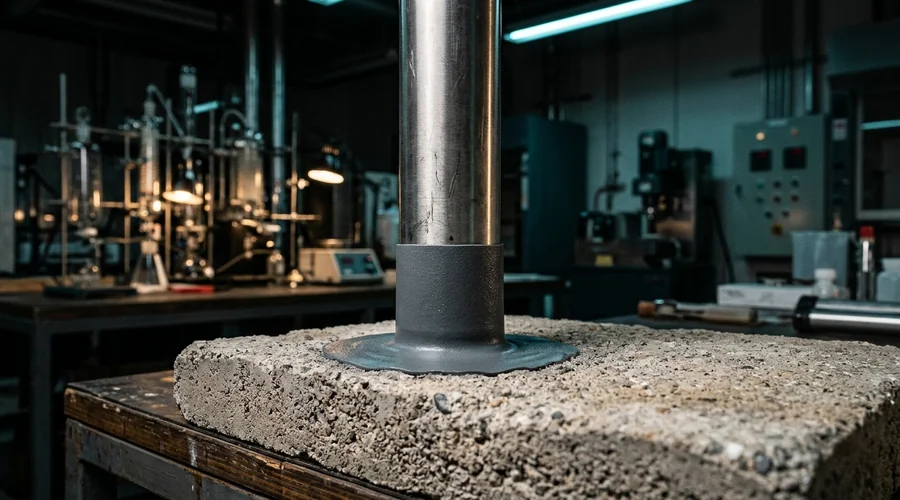
The vapour resistance factor multiplies thickness to give an equivalent air-layer thickness. At the minimum thickness, our arithmetic puts the values near 73 m for Triflex ProThan, 10 m for ALSAN 770, 4 m for ENKRYL and 1.3 m for HYPERDESMO. That spread is wide, so read the vapour data for the specific kit and not for the resin family. Details then need their own practice, and the assessments record several.
- Thixotropic grades — Triflex ProThan Detail and ALSAN 770 TX are thixotropic variants for vertical and strongly pitched areas and details.
- Thickness control — the HYPERDESMO assessment points to supervising the kilograms used per square metre and checking visually that each coat fully covers the one below.
- Day joints — the same assessment tested delamination of a layer applied over another and found it above the required 50 kPa.
- Repairs — remove the deteriorated layers, then overlap the new coats at least 3 cm onto the sound coat.
Reinforcement and thickness make the film robust, and the assessments grade the result with defined test programmes, which the next section sets out.
ETAG 005 and ASTM Standards: What the Tests Measure
Two families of documents dominate liquid membranes: the European ETAG 005 route for roof kits and the ASTM specifications for decks, walls and roof coatings. ETAG 005 is a guideline used as a European Assessment Document, with separate parts for each chemistry, such as Part 6 for polyurethane and Part 8 for water-dispersible polymers. Its results appear as use categories, so a specifier can match a kit to a roof. ASTM instead issues material specifications and separate test methods.
| Category | Values in the Four Assessments | Meaning |
|---|---|---|
| Working life | W3; W2 for HYPERDESMO | Assumed working life of 25 years (W3) or 10 years (W2), a basis for choosing products and not a guarantee |
| Climatic zone | M and S; S only for ALSAN 770 | Moderate and severe |
| Mechanical damage | P1 to P4 | Resistance to perforation, from low to high |
| Roof slope | S1 to S4 | All slopes |
| Lowest surface temperature | TL4 | Minus 30 °C |
| Highest surface temperature | TH4 | 90 °C |
The assessments also test tensile properties after heat ageing, UV exposure with moisture and hot water. The HYPERDESMO document cites EOTA technical reports TR 111, TR 110 and TR 112 for these tests. On the ASTM side, documents are organised by where the membrane sits and what covers it.
| Standard | Edition Read | What It Covers |
|---|---|---|
| C836/C836M | 18 (2022) | Cold liquid-applied elastomeric membrane, one- or two-component, for decks and walls under hydrostatic pressure, covered by a separate wearing course, traffic course or backfill |
| C957/C957M | 25 | Cold liquid-applied elastomeric membrane with an integral wearing surface, for decks not under hydrostatic pressure and for pedestrian and vehicular traffic |
| C1471/C1471M | 22 | Guide to using a C836 membrane on vertical cast-in-place concrete under intermittent hydrostatic pressure |
| C1305/C1305M | 25 | Laboratory method for the crack-bridging ability of a membrane |
| C1306/C1306M | 24 | Laboratory method for resistance to hydrostatic pressure |
| D6083 | 24 | Water-dispersed acrylic latex elastomeric protective roof coatings |
| D6947 | 16 (2023) | Single-component, moisture-cured urethane coating for spray polyurethane foam roofing |
The C836 requirement list covers hardness, weight loss, nonvolatile matter, low-temperature crack bridging, film thickness, adhesion in peel after water immersion, extensibility after heat ageing and storage stability. The numerical limits sit in the paid standards, so confirm the current edition before writing a specification. With the categories and standards in hand, the question becomes how membranes behave when asphalt or shotcrete goes on top.
Bridge Decks and Tunnels: Seamless Liquid Membrane Limits
A bridge deck adds a layer that roofs do not have, which is hot asphalt laid over the membrane. The Hong Kong Highways Department guidance note RD/GN/033 (2008) considers polyurethane or acrylic liquid membranes the most effective systems for providing the required waterproofing properties. It also lists their limits: low adhesion to asphalt surfacing, high cost and damage from milling plant. The note treats primer, membrane, tack coat and surfacing as one integral system.
- Bond to concrete — mean tensile adhesion of at least 1.0 N/mm2 and a minimum of 0.7 N/mm2. Tests follow BD 47 at 5 ± 2 °C, with a pull-off tester for checks on site.
- Bond to asphalt — shear adhesion and tensile bond minimums that depend on the surfacing thickness.
- Wheel tracking — rut depth of no more than 13 mm at 55 to 60 °C with no surface cracking. The tensile bond after the test must be at least 70 percent of the bond before it.
- Construction damage — the tack coat can be contaminated or damaged by site plant, so the note advises keeping traffic off the membrane and tack coat except during paving.
- Thin structural layers — below 120 mm, the note recommends a 40 mm layer of effectively impermeable asphalt, with air voids no higher than 4 percent, over the membrane.
In the note's laboratory trials of eleven systems, most failed to meet the bond strengths it sets. The lesson for a formulator is that the membrane, primer and tack coat form one development problem. The interface above the film needs as much testing as the film.
Tunnel linings use a related family called spray-applied membranes. A 2015 World Tunnel Congress paper lists the materials in use as ethylene-vinyl acetate, methyl methacrylate-acrylate, polyurea and rubber-modified bitumen. It adds that the International Tunnelling Association published design guidance in 2013 and that China issued the standard CECS 342:2013 for spray-applied acrylate. Holter and Foord's three-year test of an EVA-based membrane on sprayed concrete in a Norwegian rail tunnel measured tensile bond of 1.2 to 1.3 MPa. The same test found a membrane moisture content of 12 to 17 percent by weight. A seamless liquid membrane in a tunnel therefore has to hold its bond for years against damp concrete. That is why the testing tracks moisture and bond over time.
Choosing a Chemistry: A Decision Sequence
A chemistry choice is a chain of constraints, and the order in which you test them matters. Start with the exposure and the traffic, because the use category narrows the field before cost does. Then test the substrate moisture, the application window and the detail density against each cure mechanism. The sequence below turns the earlier sections into a repeatable screen.
- Define the exposure — roof slope, ponding risk, sunlight, traffic and surface temperature range, matched to the S, P, TL and TH categories.
- Measure the substrate — moisture by a method such as ASTM D4263 or F2170, because isocyanate cure and drying acrylics respond to water differently.
- Check the application window — match the product's temperature range, such as the HYPERDESMO limits of 0 to 40 °C for the product and 45 °C for the support. An acrylic needs its film-forming temperature, and PMMA offers a low-temperature grade.
- Count the details — penetrations, upstands and drains call for thixotropic grades and fleece.
- Check ventilation and ignition control — a PMMA job needs both because of the monomer.
- Check the layer above — wearing course, asphalt tack coat, ballast or tile decides whether C836, C957 or a bond test governs.
- Confirm the certification route — an ETAG 005 assessment for European roofs, or the ASTM specification named in the project.
The sequence produces a shortlist, not a winner. Laboratory screening of the shortlisted kits against the project's own substrates then settles the choice.
Working With a Construction Chemicals Formulation Consultant
Liquid membranes combine polymer chemistry, reinforcement, primers and certification, so a development project spans several disciplines at once. A construction chemicals formulation consultant joins those strands into one plan. The aim is a kit whose data hold up against ETAG 005 or ASTM requirements. Construction chemical product development services then carry the plan into pilot batches and production.
- Chemistry selection — polyurethane, PMMA or acrylic matched to the market, climate and application skills.
- Kit design — resin, primer, fleece, detail grades and finish layer developed as one system.
- Test programme — ageing, crack bridging and adhesion work planned against the target assessment or specification.
- Moisture and cure troubleshooting — blister and pinhole diagnosis on trial areas before launch.
- Regulatory and safety mapping — monomer handling, labelling and the certification route for each market.
- Scale-up and transfer — handover to a contract formulation scale-up partner with defined specifications.
The full range of services sits under construction chemicals, and our guide to starting a waterproofing chemical manufacturing business covers equipment and economics. Before approaching a consultant, collect your target substrates, climate range and certification goal. Those three inputs decide which chemistry is realistic.
Frequently Asked Questions
What is a liquid applied waterproofing membrane?
A liquid applied waterproofing membrane is a cold-applied liquid that cures on the substrate into a bonded, seamless, elastomeric film. ASTM C836 describes the class as one- or two-component membranes that cure after spreading or spraying into a film able to maintain a seal against liquid water.
Because the film has no laps, its continuity depends on coverage, thickness and reinforcement at details. Polyurethane, PMMA and acrylic dispersions are the three resin families compared in this guide.
What is the difference between PU, PMMA and acrylic liquid membranes?
The difference starts with the cure route. Polyurethane cures through isocyanate reactions, and one-component grades also react with moisture. PMMA hardens by free-radical polymerization of methacrylate monomer started by a peroxide and an amine.
Acrylic membranes dry from a water dispersion as particles deform and fuse above the minimum film formation temperature. Each route sets a different weak point: moisture for polyurethane, monomer flammability for PMMA, and drying and ponding for acrylic.
Why do polyurethane membranes blister on damp concrete?
Isocyanate groups react with water to form carbon dioxide gas and urea links. When that happens under or inside a curing film, the gas forms blisters. A deck-coating maker lists moisture blisters from a damp deck or damp between coats among the main blister types.
Air in concrete pores also expands as the film sets and causes pinhole blisters. That maker advises thinner coats, extra primer and starting the base coat late in the day. Measure substrate moisture with a method such as ASTM D4263 or F2170 and follow the maker's pass level.
When is a PMMA waterproofing resin the right choice?
PMMA resins cure by radical polymerization, so setting time is tuned through the initiator system, and a kit can be built wet-on-wet. The ALSAN 770 assessment, for example, applies resin, fleece and a second resin layer without drying time between steps.
The same assessment names a low-temperature version and thixotropic versions for vertical details. The trade-off is the monomer, which is highly flammable with a flash point of 10 °C, so the job needs ventilation and ignition control.
Can an acrylic liquid membrane be used where water ponds?
Ponding is the main weak point of elastomeric acrylic roof coatings. A 2026 open-access paper calls extended ponding one of the most deleterious service conditions for them. Pooled water suppresses drying and favours algal and cyanobacterial biofilm.
The biofilm swells and shrinks with humidity, and the resulting stress starts mud-cracking and erosion. Design falls so the roof drains, and confirm the ponding performance of a specific coating with its maker before specifying it.
How thick should a liquid roof membrane be?
Thickness is set by the kit assessment, not by a general rule. The four public assessments read for this guide give these minimum thicknesses. A one-component polyurethane needs 1.2 mm, an acrylic dispersion 1.7 mm, a PMMA kit 2 mm and a two-component polyurethane 2.1 mm.
On site, thickness is controlled through the quantity consumed per square metre, with minimums such as 3.0 kg/m² for the Triflex ProThan kit and 3.4 kg/m² for the ENKRYL kit. Check that each coat covers the one below, and follow the data sheet of the kit you install.
What do the ETAG 005 categories W3, P4 and TL4 mean?
W3 is an assumed intended working life of 25 years, and W2 is 10 years. The assessments state that these figures are a basis for choosing products and not a guarantee from the producer.
P1 to P4 grade resistance to mechanical damage from low to high, and S1 to S4 cover roof slopes. TL4 is a lowest surface temperature of minus 30 °C, TH4 is a highest surface temperature of 90 °C, and climatic zones M and S mean moderate and severe.
How can a construction chemicals formulation consultant help with a liquid membrane?
A consultant helps you choose the chemistry for the target market, screen resins, fillers and primers, and set the test programme against ETAG 005 or ASTM requirements. They also design the kit, including reinforcement and detail grades.
Construction chemical product development services then cover pilot batches, stability work and transfer to a contract formulation scale-up partner.
Developing a Liquid Waterproofing Membrane or Fixing a Blistering Problem?
Global Formulation supports construction chemicals makers with chemistry selection, kit design, ETAG 005 and ASTM test planning, and scale-up to a contract manufacturing partner.
Talk to Our Formulation Team