Liquid Hand Wash Formulation: A Manufacturing Guide

Formulating a professional-grade liquid hand wash requires balancing surfactant thermodynamics with rheological stability to ensure skin compatibility and high product shelf-life. For startups and chemical manufacturers looking to establish authority in the premium hygiene and personal care sector, success lies in understanding the complex molecular interactions of raw material classes and executing an energy-efficient industrial process. This guide provides a detailed technical blueprint to elevate your formulation chemistry and maximize manufacturing profits without risking intellectual property.
Industrial Roadmap for Hygiene Startups
- 1. The Science of Cleansing: Surfactant Chemistry
- 2. Critical Components of a High-Performance Formulation
- 3. The Manufacturing Process: Process Flow & Engineering
- 4. Industrial Scale-Up: Transitioning from Lab to Factory
- 5. Market Trends and Industry Profitability Strategies
- 6. Regulatory Compliance and Quality Control (QC)
- 7. Frequently Asked Questions (FAQ)
1. The Science of Cleansing: Surfactant Chemistry
Liquid hand wash formulation is a delicate balance of surface-active agents (surfactants) designed to emulsify organic soils while preserving the integrity of the skin's lipid barrier. In the manufacturing business, selecting the right surfactant system is the primary determinant of product performance and consumer perception. Most industrial formulations rely on a synergistic blend of anionic and amphoteric surfactants to achieve high foaming capacity without compromising on mildness.
Technical accuracy is paramount when discussing surfactant interactions. Anionic surfactants, such as Sodium Laureth Sulfate (SLES), provide the primary cleaning power and voluminous foam, while amphoteric co-surfactants, like Cocamidopropyl Betaine (CAPB), serve to stabilize the foam and significantly reduce the skin irritation potential of the primary cleaning agent. Understanding micelle self-assembly and Critical Micelle Concentration (CMC) thresholds, along with Hydrophilic-Lipophilic Balance (HLB) principles, ensures that the cleaning action is both efficient and dermatologically safe.
Surfactant Systems and Active Chemistry
Selecting specific surfactant combinations dictates the physical chemistry at the interface of dirt particles, skin, and water. Anionic systems exhibit highly negative surface charges that easily wrap around oily residues, whereas amphoteric structures display variable charges depending on the system's pH. By establishing a robust mixed-micelle network, formulators can decrease the overall skin-irritation index while simultaneously improving the foam height, density, and stability under different water hardness levels.
2. Critical Components of a High-Performance Formulation
Beyond the cleansing agents, a premium hand wash formulation incorporates a suite of functional additives that differentiate a commodity product from a high-margin industrial asset. Stabilizers and viscosity modifiers are used to achieve the "luxury feel" or thickness that consumers associate with quality. In the manufacturing business, precision in viscosity control is often achieved through electrolyte adjustment (such as sodium chloride buffers) or the integration of natural gums and cellulose thickeners.
Moisturizers and emollients are equally critical, especially in a market increasingly focused on skin health. Ingredients like Glycerin, Panthenol (Pro-Vitamin B5), and Aloe Vera extracts serve to replenish moisture stripped during the cleansing process, binding water molecules to the epidermis for long-lasting softness. Furthermore, the fragrance and colorant systems must be carefully selected to remain stable at the product's natural pH, typically adjusted with citric acid to match the skin's acidic mantle (pH 5.5).
- Viscosity Modifiers — achieving the perfect flow using salt buffers or cellulose thickeners.
- Moisturizing Agents — humectants that bind water to the skin for long-lasting softness.
- Pearlizing & Opacifying Agents — creating the aesthetic "pearly" or opaque look for premium positioning.
- Preservative Systems — ensuring a 24-month shelf life by preventing microbial growth.
Choosing between these additive classes is closely related to the surfactant-selection logic used across the wider cleaners and detergents formulation space, since HLB balancing and preservative compatibility follow the same underlying principles whether the finished product is a hand wash or a shower gel. For a side-by-side look at how a closely related personal-care wash format handles the same additive trade-offs, see our shower gel manufacturing and formulation guide.
3. The Manufacturing Process: Process Flow & Engineering
Industrial hand wash manufacturing typically employs a cold-blending process, which is energy-efficient but requires a strict order of addition to prevent "clumps" or separation. The process engineering begins with the preparation of deionized (DI) water, followed by the sequential addition of surfactants under constant, low-shear agitation. Over-agitation must be strictly avoided to prevent excessive aeration, which can lead to settling issues, micro-foaming, and cloudiness in the final product.
For startups in the manufacturing business, the layout of the production line is as important as the formulation itself. Automated filling and capping systems ensure that the product remains uncontaminated and the industry profits are maximized through reduced labor costs and high output. For those exploring simpler structures, see our guide on manufacturing without a factory.
1. Deionized Water Preparation
Ensuring the base water is free from mineral salts that could interfere with surfactant performance, micellar packing, and preservative efficacy.
2. Sequence of Addition
Typically, the primary anionic surfactant is blended first to ensure complete dispersion, followed by the viscosity modifiers, then the mild co-surfactants, and finally the sensitive additives like fragrance, color, and preservatives.
3. Viscosity and pH Stabilization
The final adjustment phase where the "body" of the soap is set. pH must be verified for every batch to ensure it falls precisely within the skin-compatible 5.0 - 6.0 range.
4. Industrial Scale-Up: Transitioning from Lab to Factory
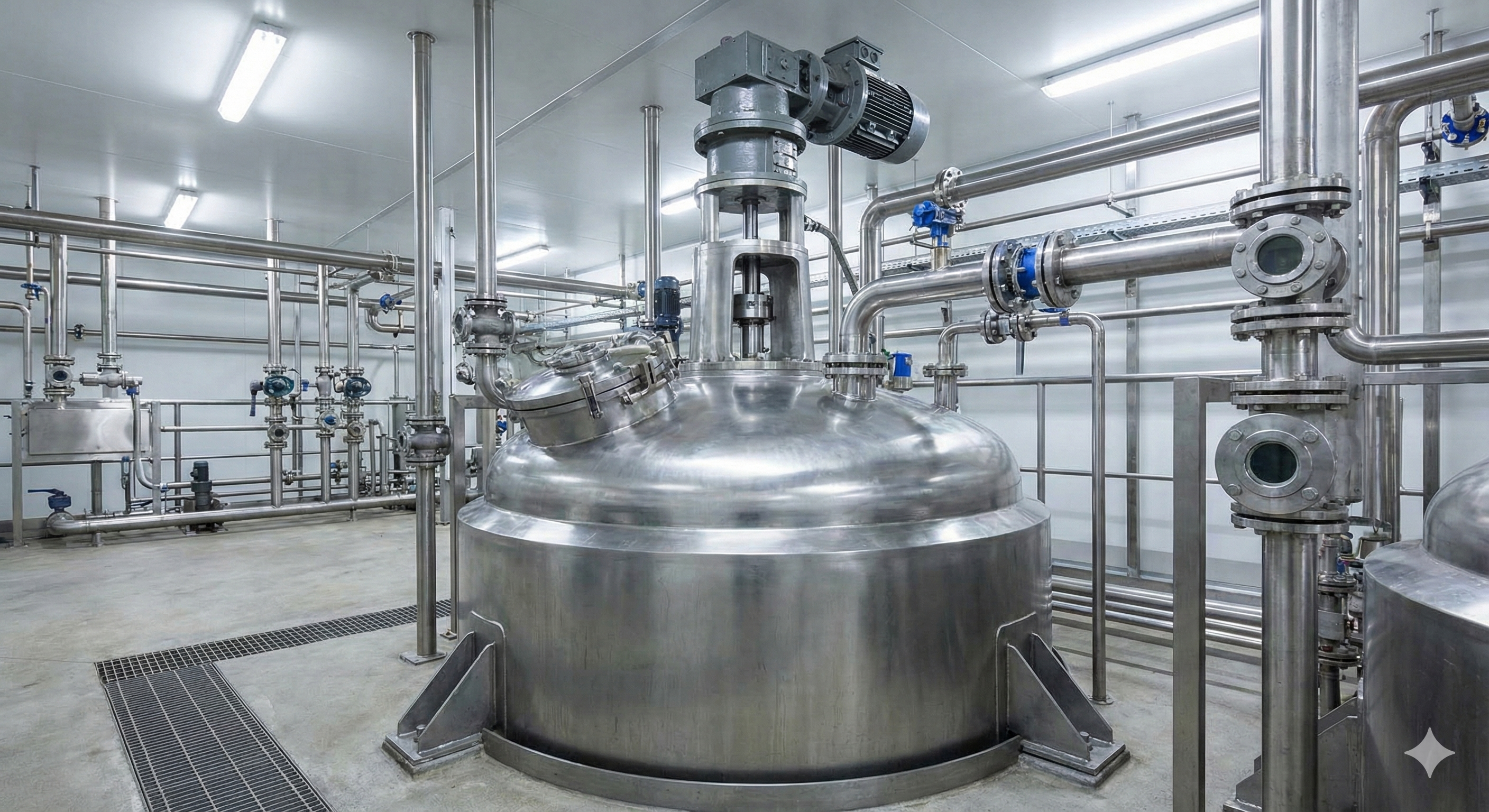
Scaling a chemical formulation from a 1-liter lab sample to a 5000-liter industrial batch is one of the most critical challenges in the manufacturing business. Mixing dynamics change significantly at scale; what takes 5 minutes in a beaker may take 2 hours in a stainless steel tank. Shearing rates, heat dissipation during neutralization, and the settling time of high-viscosity liquids must all be accounted for.
Formulators must meticulously compute the Reynolds number and tip speeds of the agitators to avoid localized high-shear zones that can damage surfactant-polymer associations. Without expert consultation, large batches are prone to phase separation, localized gel pockets, or thermodynamic instability under typical storage conditions. Our specialized consultants provide end-to-end guidance to scale up your hygiene and cosmetics recipes seamlessly.
Expert consultancy is vital during this transition to avoid "dead-stop" issues where a batch becomes unstable or separates during storage. At Global Formulation, we provide from lab to market scale-up protocols that ensure your industrial batches perfectly match your pilot samples in clarity, foam, and skin-feel. For the plant economics behind that scale-up, the Liquid Handwash Manufacturing Standard Project Report is an India-basis feasibility and financial study — three costed investment configurations, a five-year projected P&L with IRR and payback, and an itemised plant and machinery schedule.
5. Market Trends and Industry Profitability Strategies
The hygiene sector is witnessing a massive trend toward "Green Premiumization." Consumers are willing to pay more for sulfate-free, botanical, and eco-friendly formulations. For startups to maximize industry profits, positioning their brand at this intersection of technical performance and environmental ethics is key. This involves leveraging eco-friendly chemical technology to create biodegradable products.
Additionally, cost-optimization in raw material sourcing and waste reduction is a primary driver of industry profits. By using optimized process flow engineering, manufacturers can reduce the cleaning time between batches and minimize effluent waste, directly impacting the bottom line. For insights on managing the environmental footprint, see our resource on VOC and pollution control.
Correct surfactant selection also directly affects raw-material cost, since anionic-amphoteric blend ratios drive both foam performance and unit cost per liter — a topic covered in more depth in our surfactant selection guide for cleaning formulations. Startups entering the broader cosmetics and personal care category should benchmark raw-material spend against finished-product pricing before committing to a formulation.
6. Regulatory Compliance and Quality Control (QC)
Compliance with local and international regulations is a non-negotiable pillar of the chemical manufacturing business. In India, most hygiene products fall under the Drugs and Cosmetics Act. Manufacturers must secure formal licenses from the State Licensing Authority (SLA) and maintain strict Quality Management Systems (QMS). Validating every batch against a standardized Certificate of Analysis (COA) is essential for building trust.
Effective Quality Control starts with raw material testing and extends to shelf-life stability tests (Accelerated Stability Testing). Ensuring that your fragrance doesn't discolor the soap or your thickener doesn't separate in cold weather is the hallmark of a technically superior brand.
7. Frequently Asked Questions (FAQ)
Establishing a scalable cosmetics or personal hygiene manufacturing facility demands high standards of quality assurance and standardized testing protocols. Small mistakes in water quality or batch order of addition can lead to physical defects like cloudiness or structural separation during storage. The following answers address standard technical inquiries from startups, helping you optimize your blending processes and guarantee compliance.
1. What is the standard pH for a liquid hand wash?
The ideal pH for a hand wash is between 5.0 and 6.0. This range matches the naturally acidic pH of the skin, minimizing irritation. Formulators typically hold the product in this window using a citric acid buffer, since the surfactant blend alone tends to sit closer to neutral, and straying outside it for extended periods can disrupt the skin's acid mantle and increase irritation potential.
2. Why does my liquid soap turn cloudy in winter?
Cloudiness is usually caused by the surfactants reaching their Krafft point or the thickeners losing solubility at low temperatures. Below the Krafft point, surfactant molecules can no longer form soluble micelles and instead precipitate as a hydrated crystalline phase, producing visible haze. Reformulating with a surfactant blend that has a lower Krafft point, or adding a small proportion of a co-surfactant, typically resolves the issue for products sold in colder climates.
3. Can I manufacture hand wash using only SLS?
While technically possible, it is not recommended for premium products. SLS on its own is highly irritating, since it lacks the ethoxylation that moderates SLES's interaction with skin proteins, so it strips more of the skin's natural lipids with repeated use. Blending it with a mild amphoteric co-surfactant such as CAPB, or substituting SLES for part of the SLS, reduces this irritation potential while keeping cleaning performance high.
4. What is the purpose of pearlizing agents?
Pearlizing agents are purely aesthetic. They work by dispersing microscopic crystalline platelets, commonly glycol distearate or similar wax esters, throughout the formulation, which scatter light to produce the characteristic pearlescent sheen that signals a higher-quality wash to the consumer. Because they contribute no cleaning or stabilizing function, their dosage is a marketing and positioning decision rather than a technical requirement.
5. How critical is DI water for production?
Deionized water is critical. Calcium and magnesium ions in hard water react with anionic surfactants to form insoluble soap scum, which reduces foam volume and can leave a visible film in the finished product, and these same mineral ions can compromise the efficacy of certain preservative systems. Most industrial formulators standardize on deionized or reverse-osmosis water precisely to eliminate this batch-to-batch variability.
6. How can a startup compete with major MNC brands?
Startups can compete by offering niche specializations, such as botanical blends and high-performance sulfate-free options, that large multinational brands find commercially inefficient to chase at their scale. A startup can instead focus on faster turnaround for regional distributors, customized fragrance or ingredient requests, and certifications that appeal to a specific customer base. This flexibility, combined with consistent quality control, is what typically wins repeat business from independent retailers and institutional buyers.
About the Specialist
Absar Khan is a senior industrial consultant with cross-disciplinary expertise spanning pharmaceutical manufacturing, cosmetics and personal care, home and institutional care chemicals, aerosols, lubricants, and advanced process engineering. His work integrates multiple scientific and engineering domains, including formulation chemistry, GMP facility design, validation science, quality systems, regulatory compliance, and large-scale manufacturing optimization.
LinkedIn Portfolio: Connect with Absar Khan on LinkedIn
Optimize Your Personal Care Formulations with Expert Support
Discuss your surfactant micelle structures, skin mildness calculations, salt-viscosity curves, deionized water layouts, and industrial production lines with senior consultant Absar Khan.
Email: consulting@globalformulation.com
Phone: +91 9819548320 +91 8169102990