Motorcycle vs Car Engine Oil: The Chemical Differentiator
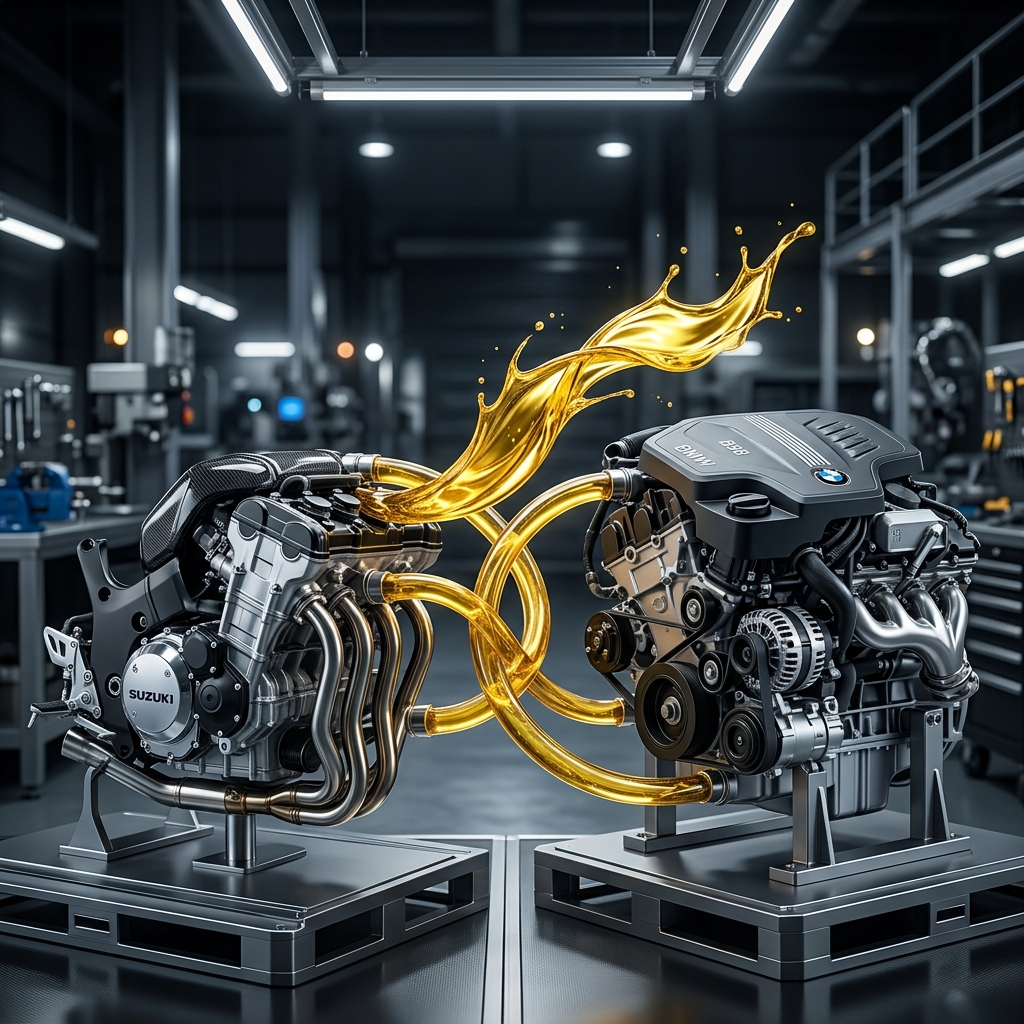
In the field of advanced chemical formulation and industrial lubrication science, maintaining the boundary film strength under diverse friction regimes represents a massive engineering challenge. A persistent question encountered by chemical consultants and lubricant developers is whether automotive passenger car motor oils (PCMO) can be interchangeably used in high-performance motorcycle engines. While both fluids appear physically similar and share common hydrocarbon base oil foundations, their molecular architecture, additive payloads, and shear-stability characteristics are radically divergent. Developing specialized motorcycle lubricants requires mastering the unique tribological demands of the integrated motorcycle powertrain.
1. The Shared Sump Architecture: A High-Density Engineering Challenge
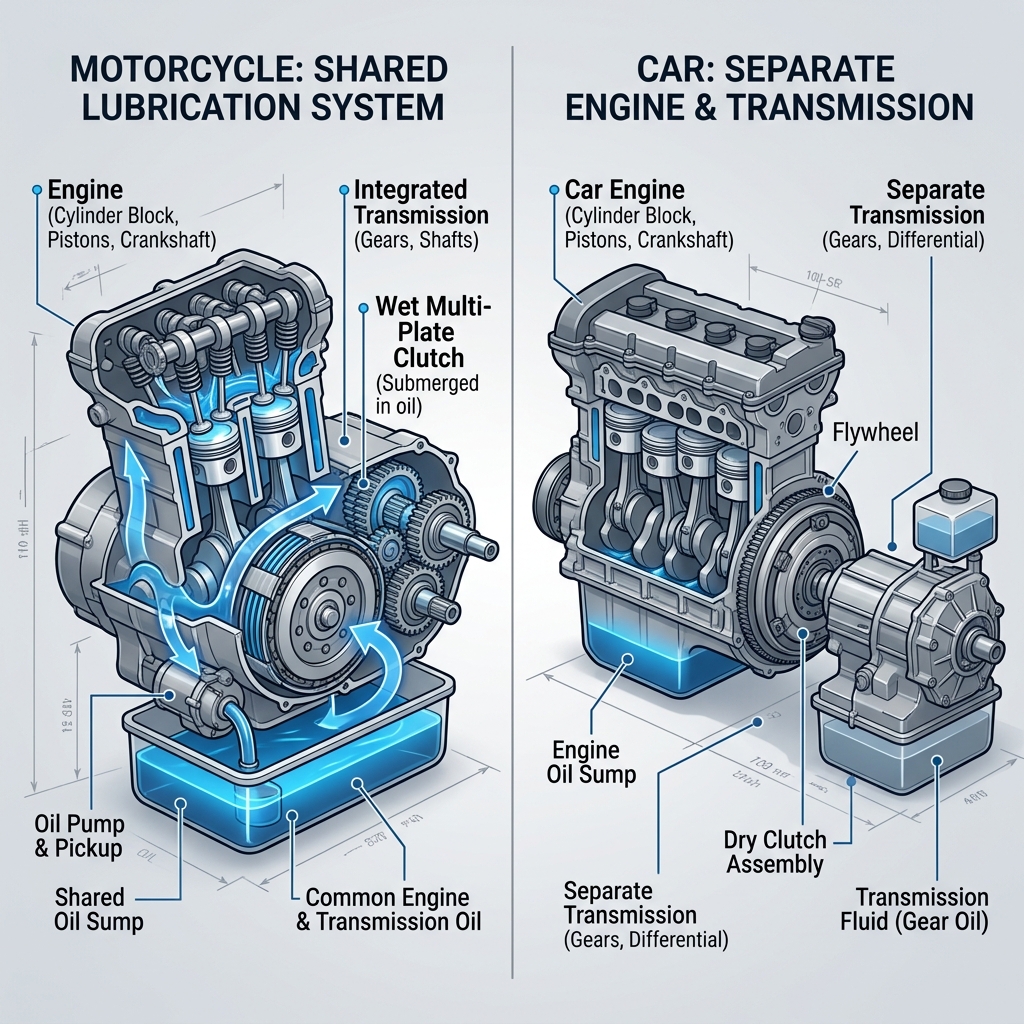
Unlike modern passenger cars, which split their mechanical components into separate chemical zones—utilizing a low-viscosity motor oil for the engine and a highly specialized fluid for the gearbox—most four-stroke (4T) motorcycles utilize an integrated shared-sump system. In this compact, high-density architecture, a single oil reservoir must simultaneously protect three radically different mechanical systems: the high-temperature cylinder piston assemblies, the high-pressure gear-to-gear mesh in the transmission, and the friction-sensitive wet multi-plate clutch system. This represents an intense multi-role tribological requirement.
The shared-sump arrangement exposes the oil to severe molecular stress from three separate vectors simultaneously. First, the oil must act as a cooling medium and carbon-dispersing agent in the high-heat cylinder head, resisting oxidation and deposit formation under combustion blow-by exposure. Second, it must function as an extreme-pressure (EP) gear lubricant, preventing micro-pitting and adhesive wear at the gear-to-gear contacts. Third, it must maintain a stable boundary friction profile to allow the wet clutch plates to engage without slippage or excessive heat generation.
This integrated environment introduces unique chemical stressors that automotive passenger car oils are simply not designed to survive:
- Extreme Pressure (EP) Boundary Loads: Gears in the transmission apply massive, localized contact forces that physically squeeze the oil film out from between the metal surfaces, necessitating high concentrations of surface-active anti-wear agents.
- Combustion Blow-By Contamination: The shared reservoir means that combustion byproducts (including unburnt fuel, soot, and acids) are carried directly into the gear and clutch assemblies, demanding exceptional dispersant stability.
- High-Rate Shearing at Mesh Zones: The physical rotation of transmission gears acts as a high-shear mill, mechanically chopping long-chain viscosity index improvers and degrading the protective oil film thickness.
- Thermal Fluid Circulation: High-speed oil pumps must rapidly circulate the fluid from hot piston crowns (exceeding 250°C) down to the cooler transmission casing without foaming or thermal cracking.

2. Wet Clutch Systems vs. Automotive Dry Clutches
The absolute chemical divider between motorcycle lubricants and automotive passenger car oils is the wet clutch system. In passenger vehicles, the engine oil remains strictly isolated within the crankcase, while the clutch operates entirely dry in a separate bell housing, relying on high-friction ceramic-metallic materials. In contrast, standard manual motorcycles submerge a multi-plate clutch stack directly inside the shared sump. Consequently, the lubricant must flow between the friction plates, meaning it directly dictates the coefficient of friction and torque-transfer efficiency.
To meet strict government fuel-economy regulations, modern passenger car motor oils are heavily dosed with active friction modifiers, most notably organo-molybdenum compounds like molybdenum dithiocarbamate (MoDTC, a soluble relative of the solid lubricant molybdenum disulfide) and long-chain fatty acid esters. These polar molecules migrate to metal surfaces and form extremely thin, low-resistance tribochemical films that reduce boundary friction as much as possible. However, if these friction-modified car oils are introduced into a motorcycle's wet clutch, they deposit this slippery film onto the clutch lining. This dramatically reduces the static and dynamic friction coefficients, causing the clutch plates to slip under torque, creating localized overheating, glazing of the plates, and total transmission failure.
Engineers designing motorcycle-specific 4T lubricants must balance the conflicting demands of reducing wear in the engine while maintaining a high, stable friction coefficient in the clutch:
- Dynamic Friction Coefficient (DFI) Control: The lubricant must provide a stable dynamic friction profile during clutch engagement to prevent shudder and ensure smooth power transfer.
- Static Friction Coefficient (SFI) Optimization: Once fully engaged, the fluid must maintain a high static friction coefficient to prevent clutch slippage under high torque loads.
- Elimination of MoDTC: Formulators carefully exclude organic molybdenum complexes and other low-friction surface agents from 4T formulations.
- Heat Dissipation under Shear: As the clutch slips during gear changes, the oil film must absorb and carry away massive flash temperatures without boiling or forming sticky deposits that cause clutch dragging.
3. Shear Stability and Gearbox Stress: Molecular Chain Integrity
Inside an automotive engine, the lubricant is exposed to relatively mild hydrodynamic shear stress, primarily located within the crankshaft journals and cam-follower contacts. The high-stress gear mesh of the car's transmission is completely isolated in the gearbox casing, protected by high-viscosity gear oils (typically 75W-90 or 80W-90) loaded with sulfur-phosphorus extreme-pressure additives. In a shared-sump motorcycle, the standard multi-grade engine oil (such as a 10W-40 or 15W-50) is forced to perform both tasks.
As the multi-grade oil flows through the high-velocity contact zone of the transmission gear teeth, it is subjected to massive mechanical shearing forces. Multi-grade oils achieve their wide temperature range by incorporating polymer Viscosity Index Improvers (VIIs), such as linear Olefin Copolymers (OCP), Hydrogenated Styrene-Diene (HSD) polymers, or Polymethacrylates (PMA). When these long-chain polymers pass through the gear mesh, the mechanical forces act like physical scissors, cutting the polymer chains in a process called "mechanical chain scission."
When a standard car oil is used in a motorcycle, this rapid polymer destruction leads to a severe loss of viscosity within a few hundred kilometers. The oil shears down from a stable 10W-40 to a thin, watery fluid, losing its film-forming capacity and leaving the engine cylinders and transmission gears vulnerable to metal-to-metal contact, scuffing, and premature wear.

The table below highlights the stark differences in the mechanical environments and operating stresses that these two lubricant classes must satisfy:
To maintain film thickness and survive this brutal shearing environment, premium 4T motorcycle oils utilize highly shear-stable polymers, such as star-structure polymethacrylates or highly branched, narrow molecular weight distribution olefin copolymers. These advanced polymers are highly resistant to mechanical scission, ensuring that the oil maintains its protective "stay-in-grade" viscosity over extended service intervals despite continuous grinding through the transmission gears.
4. Thermal Loads and Operating Temperatures
Modern passenger vehicles are equipped with sophisticated liquid cooling systems, large radiators, and electronic thermostats that keep engine oil temperatures within a very narrow, controlled range (typically 85°C to 105°C). In contrast, motorcycles—especially high-performance sports models or air-cooled cruisers—operate under severe thermal stress. A motorcycle's specific power output (horsepower per liter of displacement) is often double that of a typical car engine, while air-cooled models rely entirely on atmospheric airflow to dissipate heat.
In heavy traffic or during high-RPM operations, local oil temperatures around the exhaust valves and piston rings can easily exceed 200°C, reaching peaks of 250°C. Under these extreme conditions, standard automotive lubricants will rapidly oxidize, triggering thermal cracking of the base oil molecules and accelerating the formation of black sludge, varnish, and sticky carbon deposits on the piston rings, which leads to a loss of cylinder compression.
To combat this high-temperature environment, motorcycle formulations utilize superior base oils (often Group III synthetic hydro-cracked oils or Group IV Polyalphaolefins, PAO) blended with advanced thermal-oxidative inhibitors. The same VII shear-stability trade-offs discussed in our viscosity index improvers guide apply here, since a polymer package chosen purely for car-oil viscosity retention will not survive the added mechanical shearing of a motorcycle gearbox:
- High-Temperature Antioxidant Systems: Formulators use synergistic combinations of alkylated diphenylamines and hindered phenols to capture free radicals and stop the chain reaction of oil oxidation.
- Thermal-Stable Zinc Dialkyldithiophosphate (ZDDP): High-stability ZDDP isomers are used to provide outstanding anti-wear and antioxidant performance at elevated temperatures, protecting high-stress cam lobes.
- Overbased Detergents and Dispersants: High concentrations of calcium sulfonates or salicylates are added to neutralize acidic combustion byproducts and keep carbon soot suspended in the fluid, preventing sludge accumulation.
- High Flash Point Base Oils: Using synthetic base oils with low volatility ensures the lubricant does not vaporize or thicken excessively under extreme thermal spikes.
5. Understanding JASO MA2 vs. API Standards
To protect motorcycle engines and guide consumers, the lubricant industry established distinct certification standards. In 1998, the Japanese Automobile Standards Organization (JASO) introduced the JASO T 903 standard, which has become the global benchmark for four-stroke (4T) motorcycle lubricants. Unlike API (American Petroleum Institute) standards, which focus strictly on fuel economy and deposit control in passenger vehicles, the JASO T 903 standard measures wet clutch friction compatibility.
The JASO T 903 standard classifies oils into two primary categories: JASO MA (suitable for shared-sump wet clutch systems) and JASO MB (designed for automatic transmission scooters with dry CVTs, where low-friction automotive-style oils are acceptable). Within the MA category, the standard was further refined into JASO MA1 and JASO MA2. JASO MA2 represents the highest performance standard, requiring strict friction coefficient limits measured on a specialized SAE No. 2 friction machine.
JASO MA2 compliance is determined by evaluating three critical friction indices:
- Dynamic Friction Index (DFI): Measures how much torque the clutch can transfer during engagement under dynamic slip. High DFI ensures positive clutch lockup and prevents slippage during high-speed gear changes.
- Static Friction Index (SFI): Measures the torque-holding capacity of the clutch once fully engaged. High SFI prevents the clutch from slipping under peak torque demands, such as during hard acceleration.
- Stop Time Index (STI): Measures the speed of clutch engagement from slip to full lockup. Low stop times reduce friction wear and prevent excessive heat generation within the clutch stack.
Conversely, modern passenger car oils follow API SP and ILSAC GF-6 standards set by the American Petroleum Institute, which carry the "Resource Conserving" starburst logo. These specifications enforce strict chemical caps on phosphorus and sulfur to protect catalytic converters from poisoning, while requiring high doses of friction modifiers to improve fuel economy. These characteristics are highly detrimental to a motorcycle's wet clutch, making automotive oils completely incompatible with manual motorcycles.
6. Strategic Insights for Chemical Professionals and Entrepreneurs
For entrepreneurs, startup brands, and chemical formulators entering the automotive and powersports lubricants market, the clear divide between motorcycle and passenger car oils represents a major commercial opportunity. Generalizing a product line with "one-size-fits-all" engine oils often leads to poor field performance, mechanical failures, and damaged brand authority. By formulating dedicated, premium 4T Motorcycle Oils that carry certified JASO MA2 performance profiles, a startup can target a highly passionate and brand-loyal enthusiast market.
Successfully navigating the transition from lab-scale formulation to commercial manufacturing requires deep process control, strict quality systems, and regulatory alignment. Startup brands must secure high-quality synthetic base oils and purchase premium additive packages from leading chemical manufacturers to ensure absolute batch consistency. In high-stakes chemical manufacturing, seeking professional technical guidance for plant setup and formulation design is critical to avoid expensive manufacturing bottlenecks and compliance failures.
Entrepreneurs can utilize several proven strategic pillars to build a highly successful, specialized lubricant brand:
- Formulation Precision: Secure dedicated 4T additive chemistries that completely exclude low-friction molybdenum compounds while maximizing shear-stable polymers and ZDDP wear protection. The same EP-additive discipline applies to the gear oils covered in our gear oil manufacturing guide, since both share the sulfur-phosphorus chemistry class that must be balanced against seal and catalyst compatibility.
- Base Oil Optimization: Blend high-quality Group III and Group IV (PAO) synthetic base oils to ensure high thermal-oxidative stability and low volatility in air-cooled engines. Refer to our detailed guide on Base Oil Groups I-V.
- Process Scale-Up Discipline: Understand the critical engineering differences between laboratory pilot blending and full-scale commercial manufacturing, ensuring precise thermal management during blending. Read our strategic roadmap on From Lab to Market scale-up.
- Asset-Light Production: Emerging brands can utilize toll blending and contract manufacturing models to launch premium, JASO-compliant lubricants without the heavy CAPEX of building a factory. Read more about Manufacturing-as-a-Service (MaaS).
Frequently Asked Questions (FAQ)
1. Can I use car oil in my motorcycle just for a short time?
It is strongly discouraged. Even a short run on friction-modified passenger car oil can deposit organic molybdenum compounds onto the wet clutch friction linings. Once contaminated, the clutch plates will slip, often requiring the complete replacement of the clutch stack to resolve the issue.
2. What happens if I use motorcycle oil in my car?
Technically, motorcycle oil will not damage a car's engine immediately, as it contains excellent anti-wear additives. However, motorcycle oil lacks the specific friction modifiers required for passenger car fuel economy. Furthermore, the high phosphorus content (ZDDP) in motorcycle oil will slowly degrade and poison the car's catalytic converter over extended periods.
3. Why do some motorcycles use JASO MB oil?
JASO MB is designated for automatic scooters that use dry, continuously variable transmissions (CVTs). Because the engine oil in these scooters never contacts the transmission gears or the clutch, they do not require high static friction. JASO MB oils are friction-optimized similarly to passenger car oils to maximize fuel efficiency.
4. Is synthetic car oil better for my bike than mineral bike oil?
No. Base oil type (Synthetic vs. Mineral) is secondary to friction chemistry. A synthetic passenger car oil loaded with friction modifiers is highly detrimental to a motorcycle's wet clutch, whereas a mineral-based motorcycle oil certified to JASO MA2 will protect the clutch and prevent slippage.
5. Does high RPM really destroy car oil in a bike?
Yes. The high mechanical speeds (often exceeding 10,000 RPM) combined with the physical gear-to-gear crushing inside the transmission quickly shear down the low-stability viscosity index improvers used in passenger car oils, causing a permanent reduction in oil viscosity and film thickness.
6. Where can I find more on gear-specific formulations?
For deeper insights into formulation chemistry, raw material selection, and process blending of industrial gear oils and tribological systems, visit our specialized Lubricant Formulations Guide.
Need Technical Consulting for Your Lubricant Brand?
Discuss your 4T motorcycle formulations, shear stability indexing, or base oil blending sequence with industrial specialist Absar Khan.
Email: consulting@globalformulation.com
Phone: +91 9819548320 +91 8169102990
About the Specialist
Absar Khan is a senior industrial consultant with cross-disciplinary expertise spanning pharmaceutical manufacturing, cosmetics and personal care, home and institutional care chemicals, aerosols, lubricants, and advanced process engineering. His work integrates multiple scientific and engineering domains, including formulation chemistry, GMP facility design, validation science, quality systems, regulatory compliance, and large-scale manufacturing optimization.
LinkedIn Portfolio: Connect with Absar Khan on LinkedIn