Base Oil Types Explained: Groups I-V Complete Guide
Base oils form the structural foundation of every high-performance lubricant. Whether it is a modern multi-grade engine oil, an industrial hydraulic fluid, a heavy-duty gear oil, or a specialized lubricating grease, approximately 70% to 95% of the total formulation volume is exclusively base oil. The chemical nature of this fluid critically dictates the final product's durability, oxidation resistance, low-temperature pumpability, and compatibility with advanced additive packages. Without a technically sound understanding of base oil chemistry, successful lubricant formulation is impossible.
What Is a Base Oil in Lubricant Manufacturing?
Base oil acts as the primary fluid carrier medium into which chemical additives are meticulously dispersed. These additives impart detergency, extreme-pressure antiwear protection, long-term oxidation stability, active corrosion inhibition, and dynamic friction control. However, these complex additive molecules cannot function independently; they rely entirely on the base oil to solubilize them and transport them to the tribological wear interfaces.
The intrinsic physical chemistry and molecular architecture of the selected base oil establish the fundamental boundary limitations of the lubricant. Selecting the appropriate foundation directly governs critical operational parameters:
- Viscosity Index Behavior: How severely the fluid thins out at high temperatures and thickens at freezing temperatures.
- Thermo-Oxidative Stability: The base fluid's natural resistance to chemical breakdown and sludge formation when exposed to prolonged heat and oxygen.
- Evaporative Volatility: The propensity of lighter hydrocarbon molecules to boil off under severe thermal stress, leading to oil consumption.
- Elastomer Compatibility: The chemical interaction of the fluid with rubber seals, causing either problematic shrinkage or excessive swelling.
How Base Oils Are Classified (API Group I–V System)
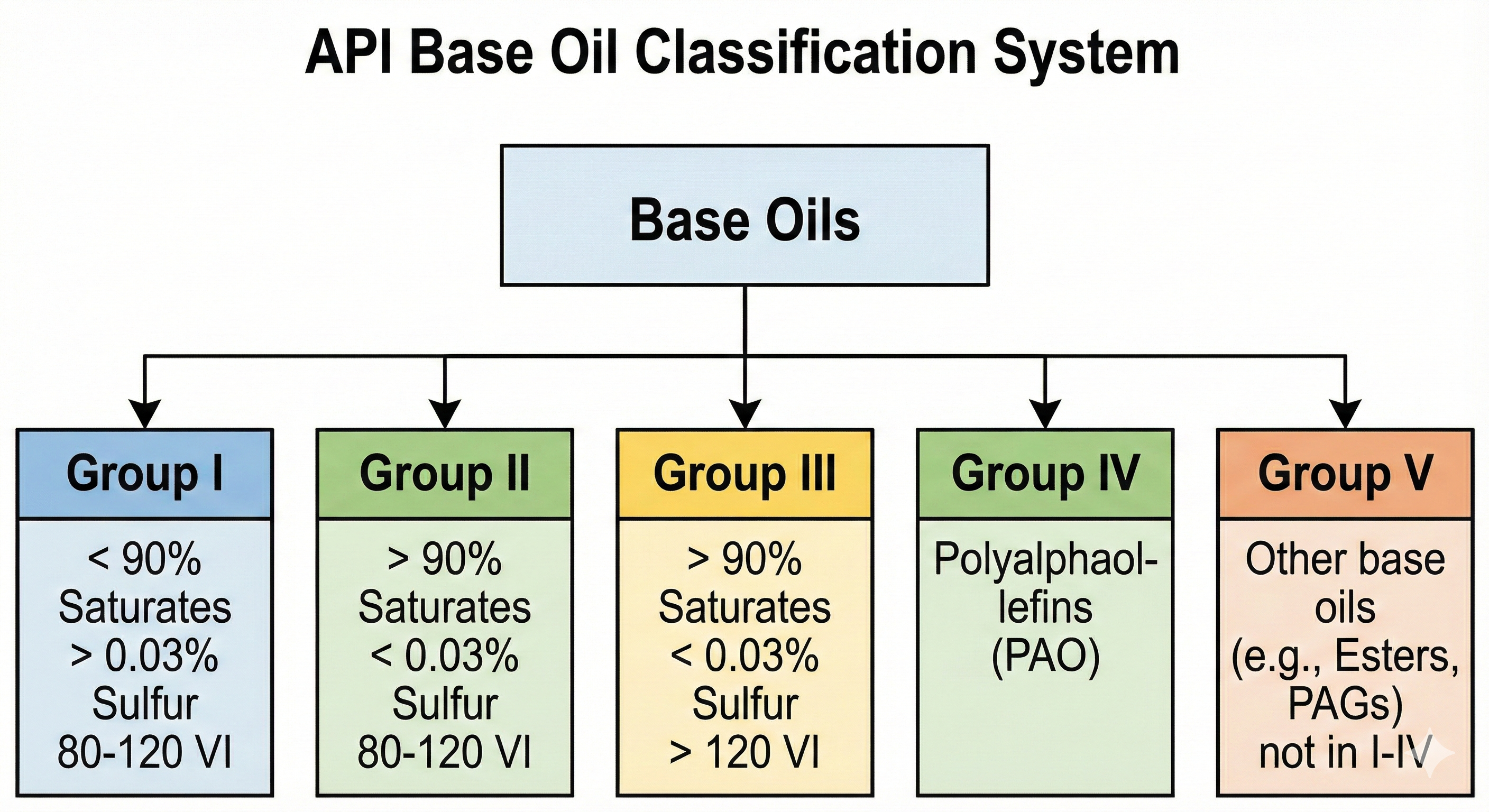
To establish a universal standard for base oil performance and interchangeability, the American Petroleum Institute (API) devised a classification system based on exact chemical composition and physical response. This system divides all base oils into five distinct groups based on the severity of their refining processes and resulting molecular purity.
The classification relies on three precise analytical parameters that directly reflect the base oil's performance capabilities and resistance to degradation:
- Saturates Content (%): Higher saturates indicate a more stable, fully bonded hydrocarbon structure that is highly resistant to oxidation.
- Sulfur Content (%): Lower sulfur levels minimize acidic byproducts, improve additive response, and prevent catalyst poisoning in emission systems.
- Viscosity Index (VI): A higher VI number demonstrates superior film thickness stability across extreme temperature fluctuations.
| Parameter | Group I | Group II | Group III |
|---|---|---|---|
| Saturates | < 90% | ≥ 90% | ≥ 90% |
| Sulfur | > 0.03% | ≤ 0.03% | ≤ 0.03% |
| VI | 80–119 | 80–119 | ≥ 120 |
Groups I, II, and III are refined directly from crude oil, whereas Groups IV and V consist of chemically synthesized and specialty engineered fluids that are not petroleum-refined.
Group I Base Oils – Traditional Solvent Refined Oils
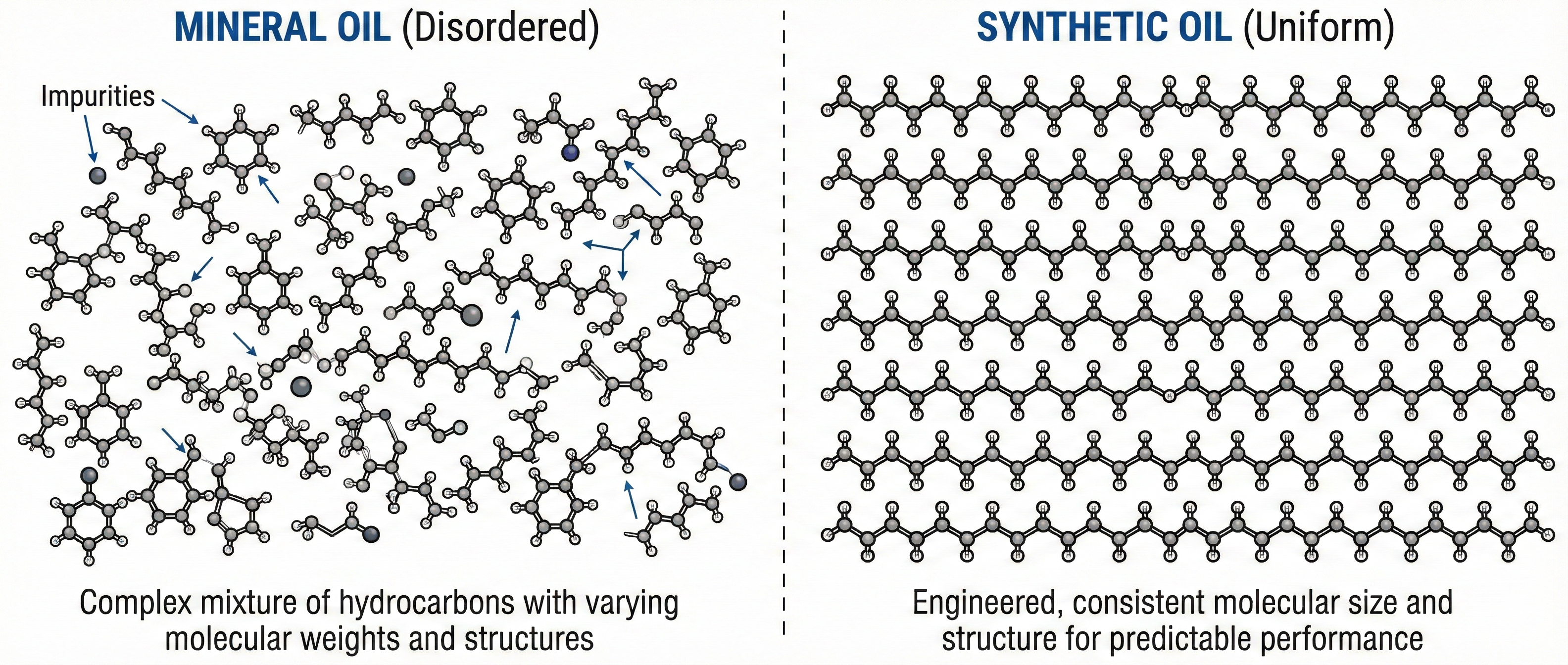
Group I base oils represent the legacy generation of mineral oils, manufactured through a traditional solvent refining extraction process. This physical separation technique effectively removes a significant portion of unstable aromatics and waxes from the crude distillate. However, because it is merely a physical separation, the resulting fluid retains moderate levels of sulfur, unsaturated olefins, and aromatic compounds that act as weak links during thermal stress.
Despite their chemical limitations, Group I oils still maintain distinct advantages in specific legacy applications, particularly where ultra-high oxidation stability is unnecessary, but excellent solubility is required:
- Industrial Hydraulics: Used in high-volume, low-stress applications where frequent fluid replacement is the norm.
- Marine Lubricants: The natural solvency of Group I aids in holding severe heavy-fuel combustion byproducts in suspension.
- Process Oils: Highly valued in the rubber compounding and textile industries for their physical compatibility.
Group II Base Oils – Hydroprocessed Mineral Oils
Group II base oils marked a revolutionary leap in lubricant chemistry through the adoption of intensive hydroprocessing and hydrocracking. Unlike the physical separation of Group I, hydroprocessing involves reacting the base fluid with hydrogen gas under immense heat and pressure over a catalyst. This chemical process aggressively shatters unstable aromatic rings and eliminates sulfur, converting the fluid into a highly pure, saturated hydrocarbon matrix.
Because of their profoundly altered molecular structure, Group II oils deliver a substantially upgraded performance profile, making them the modern baseline for the majority of mainstream lubricants globally:
- Passenger Car Motor Oils (PCMO): Serves as the primary foundation for standard tier automotive engine oils requiring good thermal stability.
- Heavy-Duty Diesel Oils: Provides the oxidation resistance needed to endure severe soot loading and high operating temperatures.
- Premium Hydraulics: Forms the backbone of long-life industrial fluids that resist sludge and varnish buildup in critical servo valves.
Group III Base Oils – Highly Refined "Synthetic-Like" Oils
Group III base oils represent the pinnacle of crude oil refining. They are subjected to severe hydrocracking and advanced catalytic hydroisomerization. These intense chemical processes systematically break down complex wax molecules and restructure them into highly uniform, branched iso-paraffins. The resulting fluid achieves a Viscosity Index exceeding 120 and boasts exceptional resistance to thermal degradation.
The molecular transformation is so profound that the performance of Group III oils effectively rivals that of chemically synthesized fluids. Because of this, in numerous global markets, including North America and Europe, Group III base oils are legally marketed and sold as full synthetic lubricants. They dominate high-performance applications:
- Premium Automotive Engine Oils: Mandatory for modern low-viscosity (e.g., 0W-20) formulations requiring extreme fuel economy and long drain intervals.
- Automatic Transmission Fluids (ATF): Provides the permanent shear stability and precise friction control required by complex transmissions.
- Motorcycle Oils: Endures the intense combined thermal and mechanical shearing environments of high-revving engines and integrated wet clutches.
Group IV Base Oils – PAO (Polyalphaolefins)
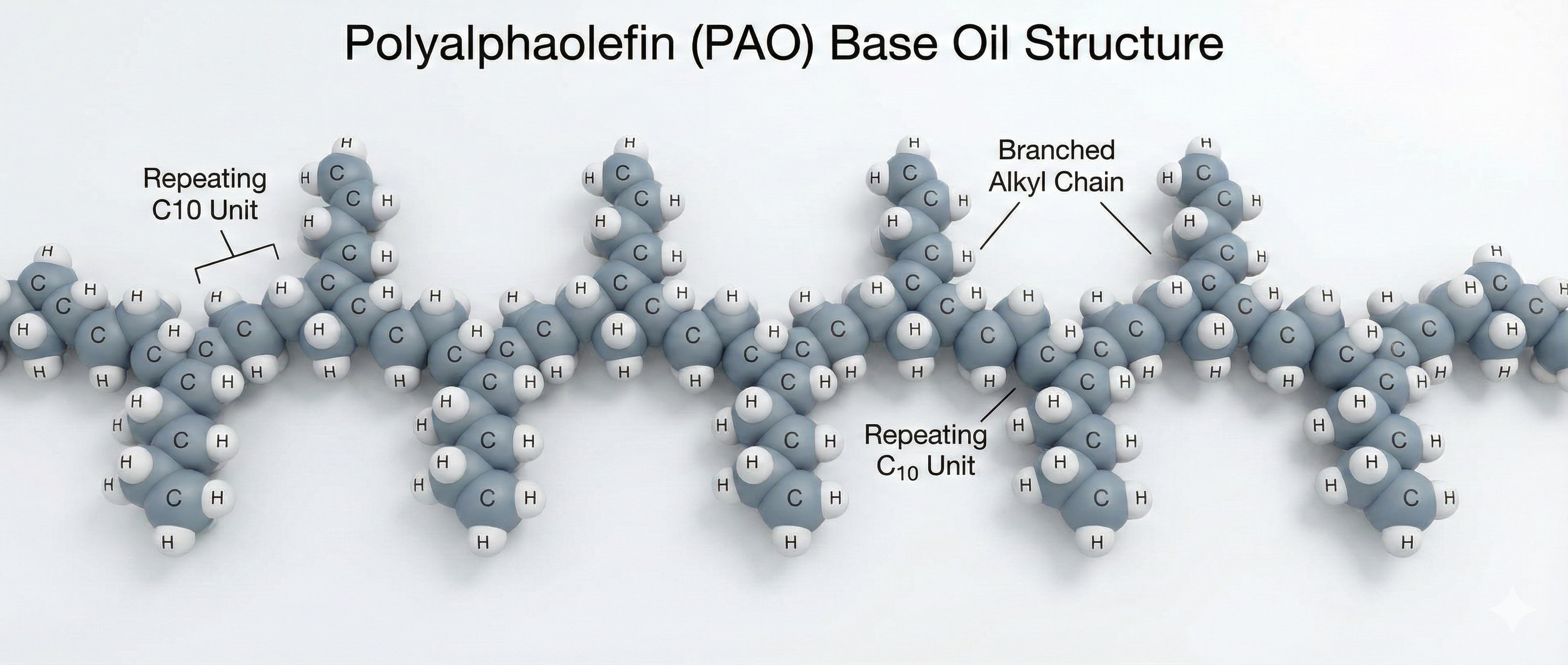
Unlike Groups I through III, Group IV Polyalphaolefins (PAO) are entirely synthesized from the ground up rather than refined from crude oil. Through a meticulously controlled chemical polymerization process utilizing ethylene gas, manufacturers build exact, identical, short-chain alpha-olefin molecules. The complete absence of impurities, sulfur, or unwanted aromatics results in a structurally perfect fluid. For a full breakdown of how PAOs compare to the other four base oil groups in real formulations, see our complete guide to lubricants.
Because every molecule is identical in size and shape, PAOs exhibit unparalleled physical characteristics that are impossible to achieve with mineral refining, commanding a premium price in demanding industries:
- Extreme Low-Temperature Flow: Maintains fluid pumpability at cryogenic temperatures far below the freezing point of conventional oils.
- Ultra-High Thermal Stability: Resists catastrophic carbonization and coking when exposed to the extreme temperatures of aviation turbines and superchargers.
- Zero Evaporative Volatility: Prevents oil loss and consumption in severely stressed, high-speed applications.
Group V Base Oils – Specialty & Additive Base Stocks
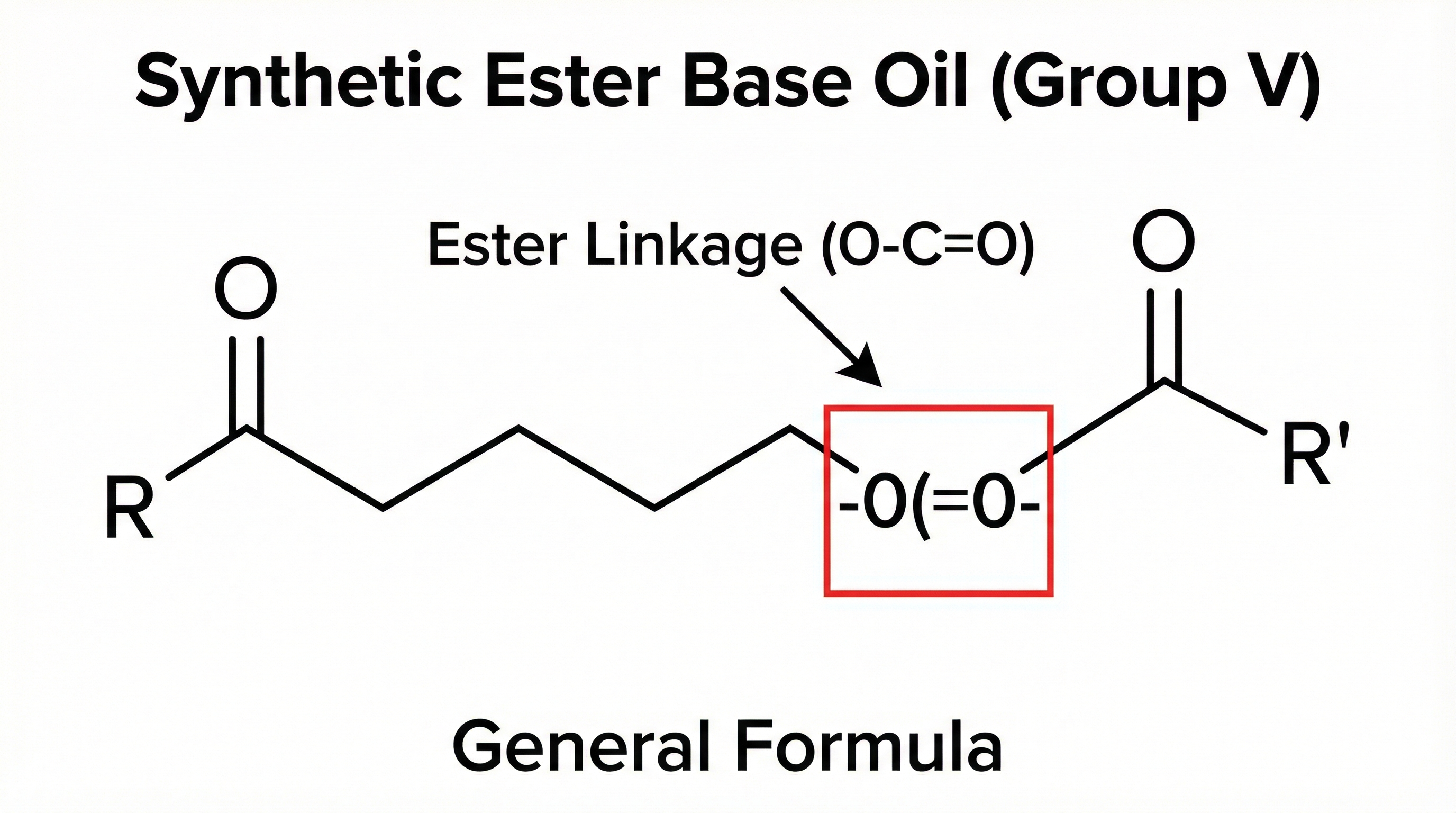
Group V is the API's broad catch-all category encompassing every other base oil chemistry that does not fit into Groups I through IV. These are highly specialized, chemically diverse synthetic fluids. They are rarely used as the sole base oil in high-volume automotive formulations due to extreme costs or compatibility issues, but are instead strategically blended in low percentages to dramatically enhance specific weaknesses in Group III or PAO systems.
The most prominent members of Group V include Esters, Polyalkylene Glycols (PAG), and specialized Naphthenic oils, each utilized for very precise problem-solving tasks:
- Esters (Diesters and Polyol Esters): Impart incredible natural lubricity and possess natural polarity, meaning they magnetically cling to metal surfaces to prevent dry starts. They also forcefully swell elastomer seals to prevent leakage.
- Polyalkylene Glycols (PAG): Famous for burning absolutely clean without leaving carbon deposits, making them mandatory for extreme-temperature compressor and refrigeration systems.
- Naphthenic Oils: Highly valued for their incredible solvency and ultra-low pour points, serving as the standard for electrical transformer insulation fluids.
Base Oil Grade Numbers: What "N" and "cSt" Mean
Beyond the API Group, every base oil ships under a specific grade number, and the numbering convention itself changes between Group I/II and Group III — a detail that trips up anyone reading a refiner's technical data sheet for the first time.
Group I and Group II oils use the "N" (Neutral) system, where the number is an approximate Saybolt Universal Seconds (SUS) viscosity measured at 100°F (37.8°C) — a higher number means a heavier, more viscous oil. Exact grade slates vary by refiner, but they generally fall into three bands:
- Light grades (60N–100N, e.g. 70N or 80N): Low-viscosity fluids used in light hydraulic oils and as process diluents.
- Mid grades (150N–220N): The workhorse range for passenger car motor oils and general industrial lubricants.
- Heavy grades (400N–600N, e.g. 400N or 500N): Higher-viscosity stocks used in heavy-duty diesel oils and gear oils, and as the thickening component in finished blends, with Bright Stock (e.g. 150BS) sitting above them at the top of the viscosity range.
Group III oils, by contrast, are named directly by their kinematic viscosity at 100°C, in centistokes (cSt). Commercial Group III product lines are built around 4, 6, and 8 cSt grades, sometimes extending to 10 cSt for heavier applications:
- 4 cSt: The lightest standard Group III grade, blended into low-viscosity 0W and 5W multigrade engine oils.
- 6 cSt: A mid-range grade used in mainstream 5W-30 and 5W-40 passenger car formulations.
- 8 cSt: The heaviest standard grade, used where higher film strength is needed, such as diesel engine oils and some gear oil blends.
The two systems are not interchangeable by number: N-grades are Saybolt viscosity at 100°F, while cSt-grades are kinematic viscosity at 100°C — different test conditions on different scales, so a formulator should always confirm the actual viscosity value on the data sheet rather than assume a numeric match across groups.
Comparison: Mineral vs. Synthetic Base Oils
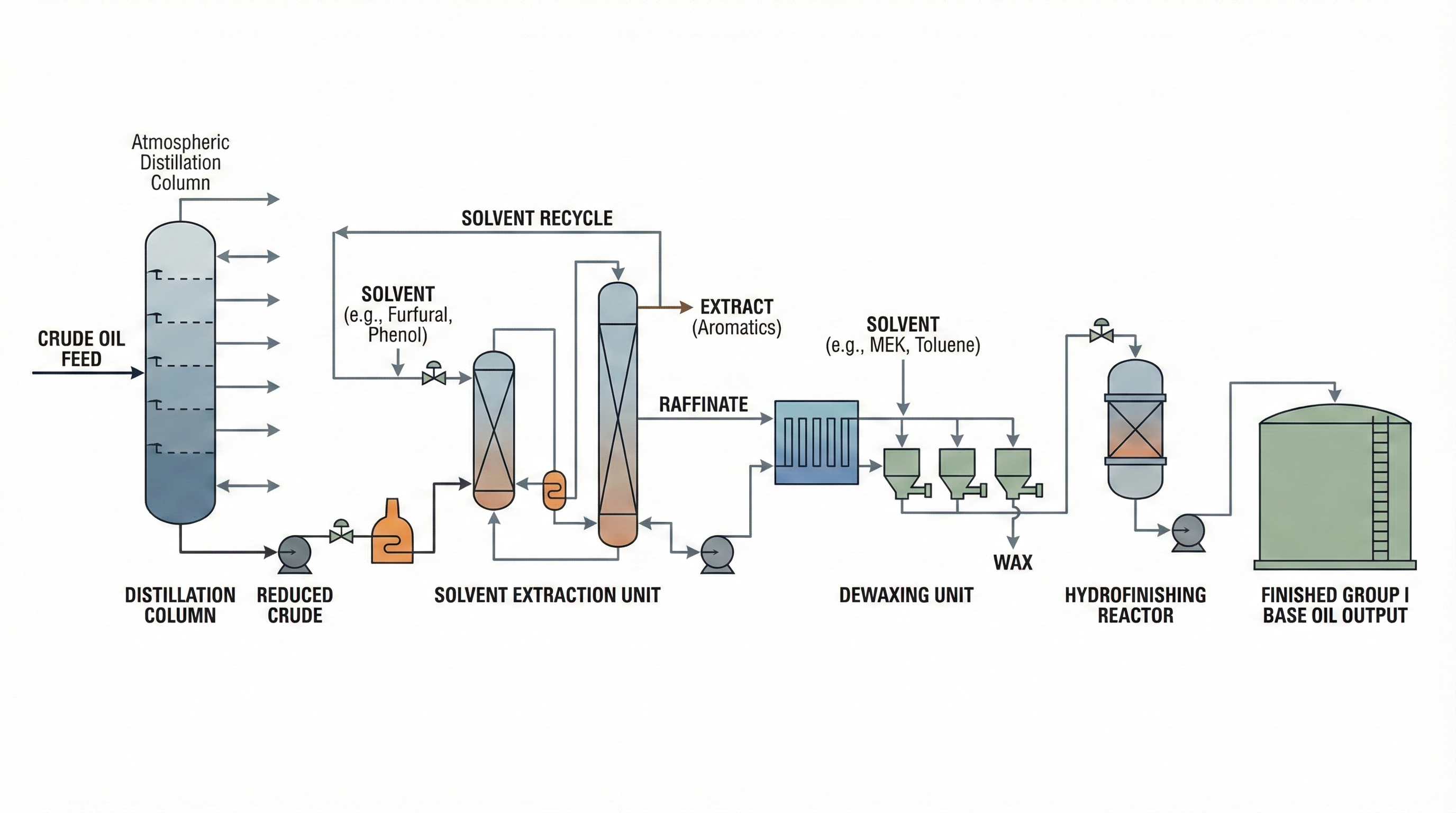
The engineering debate between mineral and synthetic base oils ultimately reduces to molecular uniformity. Mineral oils, even when highly refined (Group II), are a chaotic mixture of varying hydrocarbon chain lengths and structures. Synthetic oils (Group III, IV, and V) are engineered to possess uniform, identical molecular architectures.
This uniformity dictates the fluid's physical and thermodynamic response. For heavy-duty operations and modern equipment designs, the performance gap is vast and dictates the lifecycle cost of the machinery:
- Traction Coefficient: Uniform synthetic molecules slide past each other with minimal internal fluid friction, noticeably reducing operating temperatures and improving energy efficiency compared to mineral oils.
- Oxidative Lifespan: Synthetics resist oxygen attack exponentially better, allowing for significantly extended oil drain intervals and drastically reducing maintenance downtime.
- High-Temperature Shear: Synthetics maintain their critical protective film thickness under intense mechanical shear, preventing catastrophic metal-to-metal contact where mineral oils would rapidly thin out and fail.
Frequently Asked Questions (FAQ)
1. What is the main difference between Group I and Group II base oils?
Group I oils are solvent-refined with higher sulfur and aromatics, resulting in lower oxidation stability. Group II oils undergo intense hydroprocessing, resulting in a saturated molecular structure with lower sulfur, better oxidation stability, and lighter color.
2. Is Group III base oil truly synthetic?
Chemically, Group III oils originate from crude oil but undergo severe catalytic hydrocracking and hydroisomerization that fundamentally rewrites their molecular structure. Because they perform identically to many chemically synthesized fluids, they are legally marketed as synthetic in many global regions.
3. Can different base oil groups be blended together?
Yes, cross-blending is standard industry practice. For example, a formulation might use Group III for high-temperature stability, blended with a small percentage of Group V esters to improve additive solubility and prevent seal shrinkage.
4. What makes Group IV PAO base oils different from Group III?
Group III oils originate from crude oil and are refined through severe hydrocracking and hydroisomerization, while Group IV Polyalphaolefins (PAOs) are synthesized from the ground up through controlled polymerization of alpha-olefin monomers, with no refining step at all. Because every PAO molecule is built to the same size and shape, the fluid achieves a structural uniformity that mineral-derived Group III oils cannot fully match. This translates into superior low-temperature flow, higher thermal stability, and lower evaporative volatility, at a higher raw material cost.
5. What are Group V base oils used for if they are rarely used alone?
Group V base oils, including esters, polyalkylene glycols (PAGs), and naphthenic oils, are typically blended in small percentages into Group III or PAO formulations to solve specific weaknesses rather than serving as the sole base fluid. Esters bring natural polarity that improves additive solubility and conditions elastomer seals, PAGs burn cleanly without carbon deposits for compressor and refrigeration duty, and naphthenic oils offer strong solvency and very low pour points. Their higher cost and narrower compatibility make them impractical as a primary base oil in high-volume automotive formulations.
6. Why does base oil selection matter for elastomer seal compatibility?
Base oils differ in how they interact with the rubber seals in an engine or gearbox, and getting this wrong causes either leaks or swelling failures. Highly saturated synthetic fluids like PAOs lack the natural swelling agents found in mineral oils, so a pure PAO formulation can cause seals to shrink and leak over time. Formulators counter this by blending in a small percentage of polar Group V esters, which naturally swell elastomers and restore a proper seal fit, so the finished lubricant stays compatible with the equipment's original seal materials.
7. What does a Group II base oil grade like 400N mean?
The number in a Group I or Group II grade — 70N, 150N, 400N, 500N — is its approximate Saybolt Universal Seconds (SUS) viscosity at 100°F; a higher number means a heavier oil. It is a refiner's commercial naming convention, not a chemical classification. 400N and 500N are common heavy-viscosity Group II grades used in heavy-duty diesel oils, gear oils, and as the thickening component in finished blends.
8. What is a 4 cSt Group III base oil?
4 cSt is the lightest of the standard Group III grade line-up (4, 6, and 8 cSt), named for its kinematic viscosity at 100°C rather than the Saybolt-based N-numbers used for Group I and Group II. It is the grade typically blended into low-viscosity 0W and 5W multigrade engine oil formulations.
Global Formulation provides lubricant formulation and scale-up consultancy — base oil and additive-package selection, viscosity-grade qualification, and plant setup support. Most of India's lubricant supply is blended, not refined: a base oil (by API group) is combined with a bought-in additive package in precise proportion, then filtered and filled. For a costed India-basis feasibility study of that blending unit — plant & machinery, the now-mandatory BIS IS 13656 route, and a five-year financial model — see the Lubricating Oil Blending Plant Standard Project Report.
Need Technical Support for Advanced Lubricant Formulation?
Leverage our deep technical expertise in base oil selection, additive package synergy, and pilot-scale testing. Build high-performance synthetic and semi-synthetic lubricants aligned with the latest OEM specifications. Browse our full lubricant formulation portfolio.
Email: consulting@globalformulation.com
Phone: +91 9819548320 +91 8169102990
About the Specialist
The Global Formulation Team consists of senior industrial consultants with cross-disciplinary expertise spanning advanced process engineering, specialty chemical formulations, synthetic tribology, and green chemical plant setups. Our technical architects lead scientific advisory and formulation teams supporting manufacturers globally in technology selection, GMP layouts, validation frameworks, and regulatory strategies.
LinkedIn Portfolio: Connect with Global Formulation on LinkedIn