Concrete Floor Densifier Chemistry: Lithium vs Sodium
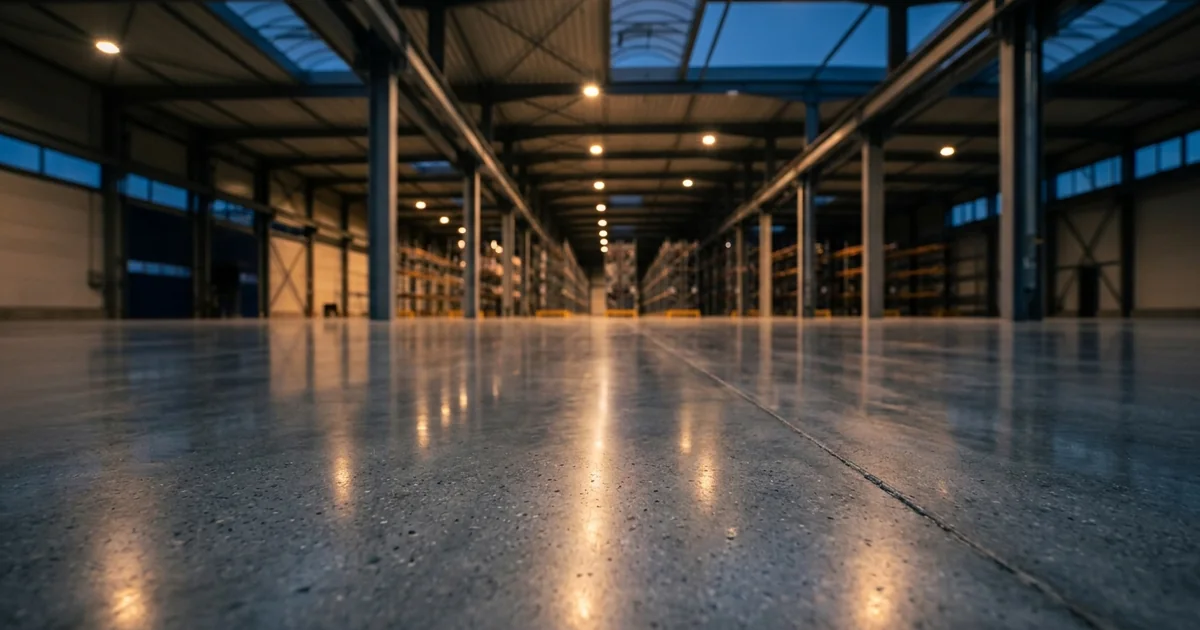
A slab that sheds fine powder under forklift traffic, stains from a single spill or refuses to hold a polish is telling you something about its top few millimetres. A concrete floor densifier is a liquid designed to treat that surface, yet the claims around these products run from precise chemistry to marketing shorthand. The stakes are practical. The wrong chemistry, a poor application window or an untested claim leaves a floor that still dusts, a white residue or a polish that fails acceptance. This guide explains how silicate densifiers react with concrete, how lithium, sodium and potassium products differ, what the research and test standards support and how to choose a chemistry. It draws on NRMCA and ACI documents, ASTM standards and peer-reviewed laboratory work, with formulation experience from Global Formulation behind it.
What a Concrete Floor Densifier Does and Does Not Do
A concrete floor densifier is a water-based alkali silicate solution applied to hardened concrete, where it soaks into the capillary pores near the surface. There it meets calcium from the cement paste and forms an insoluble gel. A team at Brno University of Technology describes that gel as a micro-filler that blocks the capillaries and raises the hardness and impermeability of the surface layer. Knowing what the gel can and cannot change keeps expectations realistic.
Earlier studies, as the 2023 Materials paper summarises them, report lower water absorption, lower chloride permeability and shallower carbonation after treatment, along with higher abrasion and frost resistance. The chemistry echoes the pozzolanic reaction in which silica consumes calcium hydroxide to make more calcium silicate hydrate (C-S-H), covered in our guide to supplementary cementitious materials. Four limits follow from how the product works.
- Not a curing compound — Dayton Superior's guide states that its densifiers are not membrane forming and cannot meet ASTM C309 or ACI 308 as a curing membrane. Their moisture retention is much lower than a compliant compound, as our guide to concrete curing compounds explains.
- Not a coating — a silicate fills pores rather than building a film. The Euclid technical bulletin says the concrete keeps its ability to breathe, so water vapour still leaves the slab.
- Not a rescue for weak concrete — NRMCA treats a chemical floor hardener as one step on a repair ladder. The ladder ends with grinding back to durable concrete and placing a bonded topping.
- Not a dry-shake hardener — one lithium silicate data sheet advises a dry-shake floor hardener where extra abrasion resistance is required in new construction.
To judge where a densifier helps, start with how slabs come to dust.
Why Concrete Floors Dust: The Problem Densifiers Treat
NRMCA defines dusting as the formation of loose powder from the disintegration of the surface of hardened concrete. A dusting floor powders under any traffic and can be scratched with a nail or even by sweeping. The floor dusts because its wearing surface is weak, and that weakness is created during placement, finishing and curing. A densifier treats the result of those causes, so the causes tell you what it can repair.
NRMCA's CIP 1 sheet lists six causes.
- Finishing while bleed water is present — working it into the top 6 mm (¼ inch) of the slab gives a very high water-cement ratio. The result is a low-strength surface layer.
- Poor finishing practice — broadcasting dry cement to speed finishing, or sprinkling water on the surface.
- Condensation on cold concrete — troweling after moisture condenses from warm, humid air onto cold concrete.
- Poor ventilation — carbon dioxide from open salamanders, gasoline engines or generators causes carbonation, which greatly reduces the strength and hardness of the surface. Our guide to anti-carbonation coatings covers the same reaction in structural concrete.
- Insufficient curing — this often leaves a soft surface skin that dusts under foot traffic.
- Inadequate protection — rain, snow and drying wind weaken the surface, and a frozen surface dusts.
The same sheet puts prevention first. Its rules are moderate slump not above 5 inches [125 mm], no finishing during bleeding and curing that retains moisture for the first 3 to 7 days. For repair, it recommends a commercial chemical floor hardener such as sodium silicate (water glass) or zinc or magnesium fluosilicate. The hardener goes onto thoroughly dried concrete, following the manufacturer's directions. If dusting persists, it moves to a coating such as a latex, an epoxy sealer or cement paint. Severe cases call for wet-grinding to durable concrete, followed by a bonded topping.
With the problem defined, the chemistry of the product comes next.
Silicate Chemistry: Modulus, Cation and Gel Formation
Every silicate densifier is defined by three variables: the cation, the total silica content and the silicate modulus, which is the molar ratio between SiO2 and the alkali oxide. According to the Brno study, these control gel formation once calcium arrives. The widely accepted mechanism is reaction with calcium ions in the surface layer to form an insoluble inorganic gel. Two other explanations exist, namely silica precipitating in the pores and an expansive gel swelling to fill voids.
- Cation — the paper ties the cation's effect to its ion radius. A small cation such as lithium binds water more strongly and carries a smaller effective charge than a large cation of the same valence. The authors state that polycondensation reactions are favoured in lithium silicates.
- Silica content — gelation takes longer in dilute solutions because the silicate units are widely dispersed and condense with difficulty. A concentration that is too high raises viscosity, which hinders contact with calcium ions and also lengthens gelation.
- Modulus — raising the cation content lowers the modulus. The negatively charged silica species then move towards their isoelectric point, which speeds aggregation and gelling.
Gelation time decides how the product behaves in the slab. A gel that forms too fast blocks the pores near the surface and limits penetration, while one that forms too slowly is not desirable technologically. Formulation is therefore a search for a workable window, not for the highest silica content. The same alkali silicate family binds mineral facade paints, where the choice between sodium and potassium also changes film behaviour, as our guide to silicate mineral paint chemistry shows.
Lithium products are growing in market share, so the next section looks at what one careful study measured.
Lithium Silicate Hardener: What a 2023 Study Measured
Lithium silicate hardener products have been growing in market share against the traditional sodium and potassium solutions. The 2023 Materials paper from two Czech universities is open access and tests how modulus changes the gel properties of a lithium silicate densifier. The team varied the modulus while holding the silica content constant. They then tied the gel behaviour to the water absorption of treated cement mortar.
- Preparation — densifiers with moduli from 3.0 to 4.0 were made by adjusting a commercial lithium water glass of modulus 4.51 with lithium hydroxide, at constant silica content.
- Gel time — gelation time rose exponentially with modulus. A modulus of 4.0 delayed gelation by up to 14.5 times compared with 3.0.
- Gel stiffness — the storage modulus of the gels fell as the silicate modulus rose, while the long-term stability of the densifier solution increased.
- Water absorption — mortar prisms of Portland cement, with a water-cement ratio of 0.50 and 28 days of water curing, were immersed in the densifier for 24 hours. All treated samples absorbed about 20 percent less water than untreated ones after 24 hours, using a method based on EN 1062-3.
- Early behaviour — during the first 60 minutes, absorption fell most with the lowest modulus, the fastest-gelling product. After more than 2 hours the differences between samples became marginal.
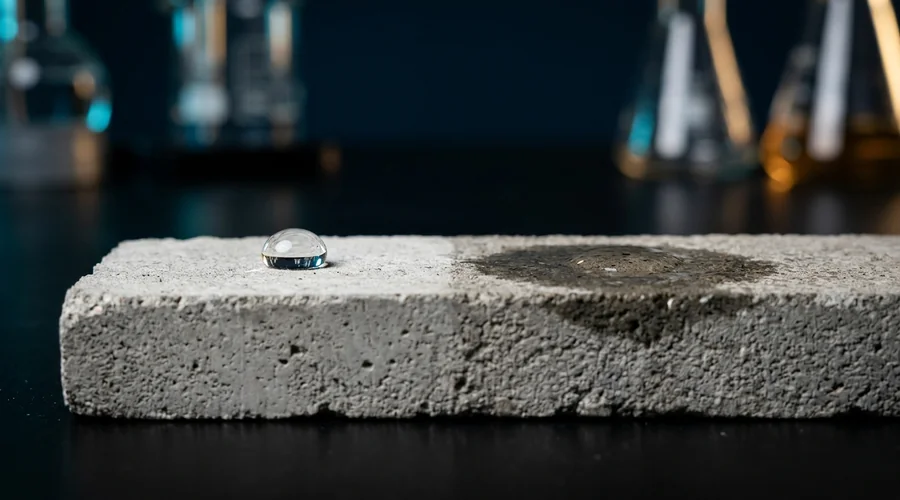
The authors point out that the early result looks odd against the usual theories, which credit silica content. Silica was identical in every sample, so lithium oxide content, which sets the modulus, was the variable that drove the result.
The paper's introduction lists four advantages of lithium products. They are lower alkalinity, higher water resistance, prevention of alkali-silica reaction and a potentially lower tendency to efflorescence than sodium and potassium alternatives. The authors word the efflorescence point as a potential, and this study did not test it. Lithium does not remove the residue risk either. The Euclid data sheet for a lithium silicate densifier warns that excess product left to puddle and dry can leave a white residue that must be scrubbed off immediately.
Lithium is one of several chemistries, so the next section sets it beside the others and the evidence available for each.
Sodium Silicate Floor Densifier vs Potassium, Lithium and Blends
A sodium silicate floor densifier belongs to the traditional silicate family, and NRMCA lists sodium silicate (water glass) first among chemical floor hardeners for dusting floors. Potassium and lithium variants differ in cation size, and manufacturers also blend cations or add siliconates and fluorosilicates. The sources read for this article include few direct comparisons, so the table records what each one reports. It separates the reaction route from the points a buyer or formulator should still check.
| Class | Reaction Route | What the Sources Report | Points to Check |
|---|---|---|---|
| Sodium silicate | Silicate reacts with calcium hydroxide to give C-S-H | Traditional chemistry; named by NRMCA for dusting floors; one manufacturer says its sodium products give higher performance on concrete aged at least 7 days | Alkali content and efflorescence, the points against which lithium is compared |
| Potassium silicate | Same gel route | Traditional chemistry alongside sodium; in a sodium blend it ranked first in a 2024 comparison | The comparison tested composites, not the cation alone |
| Lithium silicate | Gelation governed by modulus; polycondensation favoured | Growing market share; about 20 percent lower water absorption at 24 hours in the 2023 study; one manufacturer says its product suits new or older concrete | Narrow gel-time window; white residue if over-applied |
| Fluorosilicate | Reacts with calcium hydroxide and with calcium carbonate to give silicofluoric gel | Zinc and magnesium types named by NRMCA for dusting; Euclid calls them mainly remedial | Euclid: much of the benefit is wasted on good-quality concrete |
| Silicate–siliconate blend | Silicate forms C-S-H; siliconate reacts with CO2 to a silicone resin, then with calcium hydroxide to a repellent siloxane resin | Euclid: siliconates are sealers, not densifiers, so blends densify and seal | Dayton: its blend will not accept most floor finishes such as mastic or epoxy |
Two open peer-reviewed studies add data. A 2024 Buildings paper compared three composite treatments built on sodium, potassium and lithium silicate as main agents. Each carried adjuvants including urea, sodium polyacrylate, catalysts and a fluorocarbon surfactant. All three reduced calcium hydroxide, raised C-S-H content and improved compactness and hydrophobicity. The sodium–potassium composite performed best, with C-S-H gel up 389.8 percent, permeability down 60.6 percent and a water contact angle of 83.5° against the control.
A 2014 study of sodium silicate impregnants on concretes of two strength grades found only a marginal strength increase. Porosity, absorption and permeability improved significantly, and spraying the inorganic silicate improved chloride resistance under atmospheric salt spray.
Chemistry sets the potential, but application decides how much of it reaches the slab.
Application: Surface, Cure Age and Residue Control
The same densifier can leave a hard, quiet floor or a stained one, and the difference usually lies in the surface and the application window. The silicate must reach the pores and react inside them instead of drying on top. Manufacturer literature sets out the conditions in similar terms, though the specifics vary by product. The list below draws on a lithium silicate data sheet and a manufacturer guide, and any real project follows the current data sheet for its product.
- Clean, dry, absorbent surface — the Euclid data sheet requires a surface free of curing compounds, cure-and-seals, paints, coatings, dirt, oil and wax. A curing compound must be completely removed before application.
- Cure age — sources differ. Euclid says new concrete should cure seven days or longer, with a shorter time at the project engineer's discretion for fast-track work. Dayton Superior gives a minimum of 7 days for its sodium and silicate–siliconate products and says its lithium product suits new or older concrete. A trade article by a manufacturer puts the most beneficial densification in a likely 14 to 28-day window, because more calcium hydroxide has formed by then.
- Even wetting — the data sheet applies the product with a low-pressure sprayer to a uniformly wet surface without puddles. It is spread with a soft broom or microfibre pad while wet and not worked once it starts to dry.
- No puddles — excess left to dry can leave a white residue that has to be scrubbed off at once.
- Temperature and freezing — the data sheet sets an air-temperature window for proper reaction and says to protect the product from freezing. A frozen product is thawed and stirred before use.
- Protect neighbouring materials — metal, glass, wood, paint and brick need protection, and any overspray is washed off immediately.
- Joints — if joints are to be filled afterwards, they are thoroughly cleaned before the filler goes in.
In polished concrete densification the product is one step inside a larger finishing process. The Euclid data sheet adds that a floor wanting immediate sheen can be dry-buffed or burnished with a polishing pad matched to the gloss required. The next finish then matters as much as the product itself.
Claims about hardness and abrasion resistance then need a test that fits them.
Testing Densifier Claims: ASTM C779, C944 and C805
A statement that a densifier increases surface hardness or abrasion resistance means little without the method behind it. Three ASTM test methods are useful reference points, and each has limits written into its own scope. Choosing the method before the trial prevents a result that cannot be compared with anything. The table lists what each one covers.
| Method | What It Measures | What the Standard Says | Care Needed |
|---|---|---|---|
| ASTM C779/C779M-19 | Relative abrasion resistance of horizontal concrete surfaces by revolving disks, dressing wheels or ball bearings | Intended for determining variations in surface properties affected by mixture proportions, finishing and surface treatment | Not a quantitative measurement of service life |
| ASTM C944/C944M-19 | Relative wear resistance by the rotating-cutter method | Primarily for the top ends of 152-mm cores and mortar specimens; usable in place by measuring loss as in C779 Procedure B | The applied surface treatment is one of the reported details |
| ASTM C805/C805M-25 | Rebound number of hardened concrete with a spring-driven steel hammer | The number is affected by moisture, type of finishing and depth of carbonation | Instruments of one design can differ by 1 to 3 units; strength estimates need core correlation |
| Water absorption by immersion mass gain | How quickly a surface takes up water, as in the 2023 lithium study | The study used a method based on EN 1062-3 | Not a measure of abrasion |
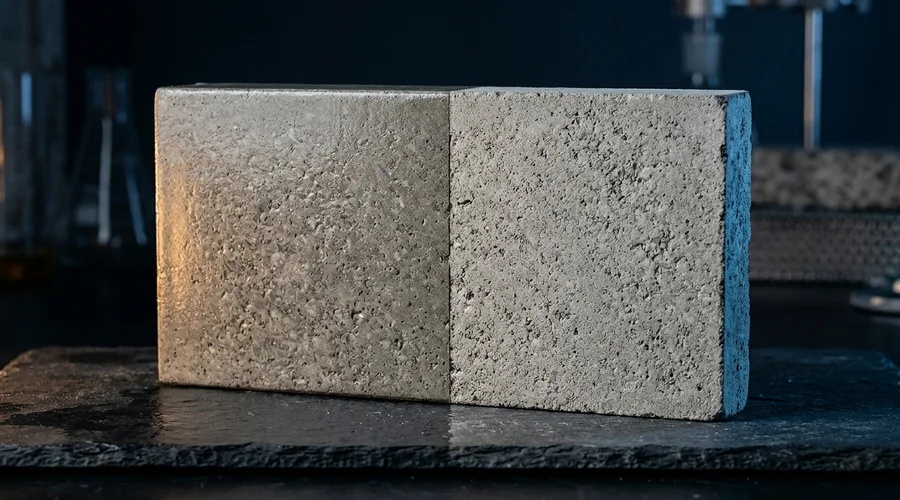
A rebound number responds to carbonation and finish as well as hardness, so before-and-after comparisons need the same instrument and comparable surfaces. Trials also need an untreated control. The 2023 study kept untreated reference samples in water for exactly that comparison. For a polished floor the acceptance criteria add gloss and clarity. ACI 310.1-20, the specification for polished concrete slab finishes, lists distinctness of image, haze and specular gloss among its keywords.
A tested claim still has to be built into a product, which is where formulation choices come in.
Formulation Levers Behind a Liquid Floor Hardener
A densifier looks like a clear liquid, yet the formulator balances a few interacting variables. The 2023 study shows the central trade-off. A lower modulus gels faster and reduces early absorption most, while a higher modulus gels more slowly and keeps the solution stable for longer. Adjuvants, packaging and application behaviour then adjust the result, and this is the work a construction chemicals formulation consultant does on a liquid floor hardener.
- Cation and modulus — these set gel time, solution stability and gel stiffness. The 2023 study range produced a 14.5-fold change in gel time at constant silica.
- Silica content — too dilute and gelation slows, too concentrated and viscosity limits contact with calcium.
- Adjuvants — the 2024 composites carried urea, sodium polyacrylate, catalysts and a fluorocarbon surfactant, which shows that real products hold more than silicate and water.
- Siliconate content — a siliconate adds a water-repellent siloxane resin, but it changes what can be applied afterwards.
- Freeze and storage behaviour — a data sheet that tells users to protect the product from freezing and to stir it after thawing feeds directly into container and distribution design.
- Emissions — the Euclid data sheet lists a VOC content of 5 g/L or less, and our guide to VOC pollution explains why low emissions matter for floor products.
No lever works alone, so a trial plan changes one variable at a time against an untreated control. That discipline turns a list of options into a decision.
Decision Framework: Choosing a Densifier Chemistry
Choosing a chemistry works best as a sequence of questions, because each answer removes options before cost enters the discussion. The order below follows the evidence in this article: the slab first, the next finish second and the product last. Each step names the source that supports it. The sequence suits a manufacturer, a specifier or a formulator briefing a development partner.
- Diagnose the slab — is it sound new concrete, or does it dust? NRMCA traces dusting to finishing, curing and site-condition faults, and severe cases need grinding back and a topping.
- Name the next finish — a polish, a bare floor, an epoxy, a sealer or a mastic. Siliconate blends restrict later finishes, according to Dayton Superior.
- Check the surface — remove curing compounds and coatings, and confirm the surface is clean, dry and absorbent, as the Euclid data sheet requires.
- Pick the class — a silicate for sound concrete, a fluorosilicate only for carbonated or dusting surfaces and a siliconate blend when sealing is wanted and no coating will follow.
- Pick the cation — where alkali content or residue is the worry, lithium is positioned for it. The Brno paper words efflorescence as a potential, and the Euclid data sheet still warns of residue.
- Prove it — build a mock-up with an untreated control, test with ASTM C779 or C944 and, for polished floors, check the gloss and clarity criteria.
Following the order turns a vendor comparison into an engineering decision: the slab and the finish pick the class, and only then does the cation matter.
Working With a Construction Chemicals Formulation Consultant
Densifier development sits between silicate solution chemistry, cement chemistry and field application, so a construction chemicals formulation consultant works across all three. A brief usually begins with the substrate, the target finish and the market. Construction chemical product development services then carry the work from bench gel-time and absorption trials to pilot batches. A contract formulation scale-up partner can handle supply once the product is proven.
- Chemistry selection — cation, modulus and silica content matched to the slab type and the finish that follows.
- Gel-time and absorption trials — bench methods like those in the Brno study for early screening, then abrasion testing on mortar and slab samples.
- Compatibility checks — bond tests for later epoxies, sealers and joint fillers.
- Application protocol — surface preparation, wetting and residue control written into the data sheet.
- Specification and labelling — performance statements that match the scope of the ASTM method behind them.
- Scale-up — pilot batches and technology transfer to a manufacturing partner.
The full range of services sits under construction chemicals. Before approaching a consultant, collect the slab details, the target finish, any products that failed and the test methods your market expects.
Frequently Asked Questions
What does a concrete floor densifier do?
A concrete floor densifier is an alkali silicate solution that soaks into the capillary pores of hardened concrete and reacts with calcium to form an insoluble gel. The gel blocks the capillaries and raises the hardness and impermeability of the surface layer, as the 2023 Brno University of Technology study describes. It does not form a film, does not cure the slab and does not turn weak concrete into strong concrete.
Is a lithium silicate hardener better than sodium silicate?
The 2023 paper lists lower alkalinity, higher water resistance, prevention of alkali-silica reaction and a potentially lower tendency to efflorescence as the advantages of lithium over sodium and potassium products. The authors word the efflorescence point as a potential, and their experiments compared lithium moduli only. In a 2024 comparison of composite treatments, a sodium–potassium composite performed best. The better choice depends on the whole formulation and the slab, so test candidates on the actual surface.
Can a densifier replace a curing compound?
No. Dayton Superior states that its densifiers are not membrane forming and cannot meet ASTM C309 or ACI 308 as a curing membrane. Their moisture retention is much lower than a compliant curing compound. Euclid asks for a wet, sheet or compliant-compound cure first, and for any compound to be completely removed before its lithium densifier goes on. The sequence is to cure first, remove any membrane and then densify.
Why does a densifier leave a white residue?
Residue forms when excess product puddles on the floor and dries instead of soaking in. The Euclid data sheet for a lithium silicate densifier says this leaves a white residue that must be removed immediately by scrubbing. It tells applicators to redistribute the product while it is wet and to stop working it once it starts to dry. Residue control therefore depends on application as well as chemistry.
How soon after placing can a densifier be applied?
Sources differ, so follow the data sheet for the product. Euclid says new concrete should cure seven days or longer before its lithium product goes on, with a shorter time at the engineer's discretion on fast-track projects. Dayton Superior gives a minimum of seven days for its sodium and silicate–siliconate products and says its lithium product suits new or older concrete. A manufacturer's trade article puts the most beneficial densification in a likely 14 to 28-day window, because more calcium hydroxide has formed by then.
How do you test whether a densifier improved abrasion resistance?
Use an abrasion method with an untreated control on the same concrete. ASTM C779 covers three procedures for horizontal surfaces, and ASTM C944 uses a rotating cutter on cores, mortar specimens or in-place surfaces. Both are intended to show relative differences, not to predict service life. A rebound number under ASTM C805 measures rebound rather than abrasion, and it is influenced by moisture, finish and carbonation.
What is silicate modulus and why does it matter?
Silicate modulus is the molar ratio between SiO2 and the alkali oxide in the solution. In the 2023 lithium study, raising the modulus from 3.0 to 4.0 at constant silica content delayed gelation by up to 14.5 times. It also increased the long-term stability of the solution. Lower-modulus products gelled faster and cut early water absorption most, so modulus balances penetration, gel speed and shelf stability.
How can a construction chemicals formulation consultant help with densifiers?
A consultant selects the silicate chemistry and modulus for the slab type and the finish that follows, then designs gel-time, absorption and abrasion trials with untreated controls. The same work sets application instructions, surface preparation and residue control. Construction chemical product development services extend this to compatibility checks with later coatings and joint fillers, and a contract formulation scale-up partner then handles pilot batches and supply.
Developing or Improving a Concrete Floor Densifier?
Global Formulation supports construction chemical makers with silicate densifier formulation, gel-time and absorption testing, compatibility checks with later coatings, application protocols and scale-up to a contract manufacturing partner.
Talk to Our Formulation Team