Why Your Chemical Business is Losing Money: Mastering Formulation Cost vs. Market Price

Unlocking the secrets of chemical profitability requires bridging the gap between scientific development and market economics. For startups and chemical entrepreneurs, laboratory-scale formulation success can often create a false sense of security, masking significant operational leaks that manifest during industrial scale-up. Reaching standard industry margins requires a meticulous process of costing active matter ratios, accounting for raw material volatility, and understanding value-based pricing parameters.
Table of Contents
- 1. The Invisible Leak: Why Lab-Scale Success Fails in the Market
- 2. Calculating the "True" Formulation Cost
- 3. The Psychology of Value: Why Market Price Isn't "Cost + Profit"
- 4. Industrial Overhead: The Hidden Margin Killers
- 5. Comparative Analysis: Lab to Mass Manufacturing
- 6. Scaling Strategy: Maintaining Profit Integrity at Scale
- 7. Frequently Asked Questions
The chemical manufacturing business is fundamentally a game of molecular precision, but it is equally a game of microeconomic discipline. While many entrepreneurs focus heavily on product efficacy and marketing, true industrial success is generated through strict alignment between formulation design and manufacturing economics. A formula that performs beautifully in a 1-liter beaker can quickly become a loss-maker if the underlying supply chain, processing constraints, and value-justified price floor are not mapped out in detail during the design phase.
At Global Formulation, our mission is to translate high-science chemistry into commercial success. In this guide, we dissect the financial variables, costing errors, and pricing strategies that dictate whether your chemical startup will generate premium industry profits or suffer silent capital depletion. By mastering these principles, you can protect your investment, optimize your processing parameters, and secure long-term market authority.
1. The Invisible Leak: Why Lab-Scale Success Fails in the Market
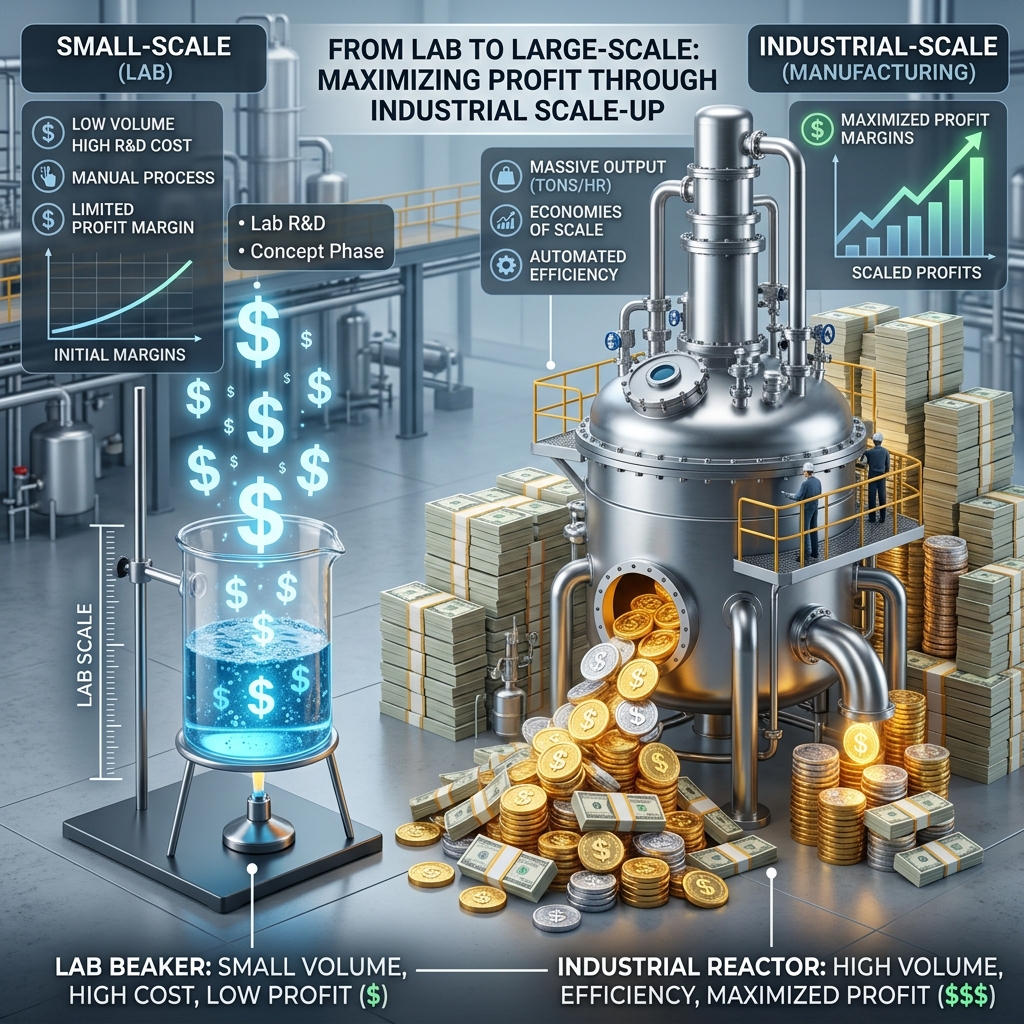
Many chemical entrepreneurs believe that a superior formulation automatically translates to a profitable manufacturing business. However, the transition from the laboratory bench to a commercial warehouse is fraught with financial variables that are often invisible during the R&D phase — the same gap covered in our guide to dangerous formulation mistakes, where technical scale-up errors compound directly into these financial ones. When you formulate a product in small batches, the unit cost seems manageable, but without a rigorous analysis of industrial scale-up, these numbers can become misleading, leading to unexpected losses once full-scale production begins.
Profitability in the chemical industry is not merely about having a lower cost of raw materials than your competitors. It is about understanding the total cost of ownership (TCO) for each gallon or liter produced and aligning that with the market's perceived value. A business that ignores the divergence between formulation cost and market price will find itself either priced out of the market or operating on razor-thin margins that cannot sustain long-term growth.
These hidden financial leaks usually occur at critical operational points, resulting in poor cash flow and depressed margins:
- Ingredient Volatility: Extreme fluctuations in petrochemical or agricultural feedstocks over long-term contracts.
- Waste Factors: Overlooking the physical loss of active materials left in mixing vessels, reactors, and filtration arrays.
- Specialty Dosages: Failing to optimize the loading levels of high-cost rheology modifiers, preservatives, or functional additives.
- Scale Incompatibilities: Relying on analytical-grade lab chemicals for pricing sheets instead of sourcing commercial industrial-grade equivalents.
2. Calculating the "True" Formulation Cost
Calculating your formulation cost is a multi-dimensional task that goes far beyond checking the price list of your raw material suppliers. A true technical costing requires a deep dive into active matter concentrations, diluent costs, and the specific gravity of the final product to ensure that you are selling by volume while buying by weight. Many startups make the mistake of using purely linear arithmetic, failing to account for the complex interactions during mixing that might alter the final yield of the batch.
Furthermore, technical accuracy requires that you factor in the quality control (QC) reject rate and the cost of maintaining batches within strict specifications — costs that are only verifiable with proper Certificate of Analysis documentation for every incoming raw material batch. If your formulation is highly sensitive to temperature or mixing speeds, the cost of electricity and specialized equipment depreciation must be amortized into every unit produced. Industry professionals know that a "cheap" formulation on paper can often become the most expensive to manufacture due to its high sensitivity and low yield reliability.

Establishing a mathematically sound and technically justified costing structure involves four key operational elements:
- Direct Material Costs: The net price of active surfactants, emulsifiers, performance polymers, and functional carriers.
- Processing Overheads: Utility costs associated with thermal inputs, high-shear mixing times, and reactor residence limits.
- Yield Losses: The unavoidable physical loss of product during pipe transfers, mechanical filtration, and evaporative cooling.
- Packaging Integrity: Amortizing chemical-resistant containers, protective liners, custom seals, and GHS-compliant labeling costs.
3. The Psychology of Value: Why Market Price Isn't "Cost + Profit"
The most common error in a new manufacturing business is the cost-plus pricing trap, where an entrepreneur simply adds a 30% margin to their formulation cost. Economists have long noted that cost-plus pricing ignores demand and competitor pricing entirely, which makes it a poor fit for a competitive specialty chemicals market. In the chemical industry, market prices are dictated by technical performance, brand authority, and regulatory compliance rather than simple manufacturing expenses. If your product solves a high-value problem—such as reducing maintenance downtime or increasing fuel efficiency—its value-based price should reflect the value saved for the customer, not just the cost of the ingredients.
Understanding the market price requires constant benchmarking against both domestic and global competitors. You must analyze the price-per-application rather than just price-per-kilogram. For example, a highly concentrated laundry detergent might have a higher formulation cost than a diluted competitor, but if the customer uses 50% less product per wash, your value-based price can be significantly higher while still providing a better deal for the end-user.
To capture the premium pricing ceiling in your market sector, you must build and communicate your value proposition across several strategic pillars:
- Value-Based Pricing: Set prices based on the economic returns or cost-savings your formulation provides to the client's operations.
- Competitive Floor & Ceiling: Benchmarking chemical efficacy against low-tier commodities and premium imported brands.
- Substitution Risks: Analyzing the operational cost and availability of alternative technologies for your target customers.
- Segmented Tiers: Customizing pricing structures based on contract volumes, delivery terms, and the level of technical support provided.
4. Industrial Overhead: The Hidden Margin Killers
Industrial overheads are the silent drains on industry profits that rarely appear in a laboratory notebook. These costs include everything from the maintenance of stainless steel reactors to the compliance costs associated with safety data sheets (SDS) and environmental regulations. For a startup manufacturing business, these fixed costs can be overwhelming if the initial formulation does not have enough built-in margin to absorb the slow ramp-up period of sales and distribution — one reason many founders instead pursue a contract manufacturing model that converts fixed reactor and facility overhead into variable, volume-linked cost.
Logistics also play a massive role in the final market price analysis, especially for high-volume, low-value chemicals where shipping costs can sometimes exceed the formulation cost itself. Proper formulation development includes optimizing the product for transport—such as creating concentrates that can be diluted at the destination. This technical foresight significantly reduces the total cost and allows for more aggressive market pricing and higher net profits.
A realistic overhead audit must systematically account for the following fixed and variable costs during financial projections:
- Storage & Facility: Specialized warehousing costs for temperature-sensitive materials, hazardous goods, and flammable chemical drums.
- Regulatory Overhead: Expenses for laboratory testing, GHS SDS drafting, regional CDSCO/pollution control board certifications, and compliance with frameworks like TSCA in the US or REACH in the EU, both of which require pre-manufacture notification and ongoing reporting for new chemical substances.
- Technical Support: Providing dedicated field trials, customized client testing, and laboratory batch verification support.
- Logistical Risks: Shipping costs, bulk tanker transport constraints, insurance for hazardous logistics, and storage stability risks.
5. Comparative Analysis: Lab to Mass Manufacturing
To truly master the economics of formulations, one must look at how costs shift as production volume increases. The table below provides a generic global analysis of how different cost components evolve from a 100kg pilot batch to a 10,000kg industrial production run. Note how while raw material costs may drop through bulk purchasing, other costs like quality control and administrative overhead scale non-linearly, requiring careful financial planning.
The table clearly demonstrates that while manufacturing efficiency improves with volume, the logistical and waste management complexities grow. A manufacturing business must be prepared to handle the logistics of large-scale chemical handling, which often requires significant investment in infrastructure that a laboratory setup simply does not account for during the initial formulation phase. Managing these complex variables successfully separates profitable ventures from struggling ones.
6. Scaling Strategy: Maintaining Profit Integrity at Scale
Maintaining profit integrity as you scale requires a robust technical strategy that integrates formulation science with supply chain management. This involves indexing your raw material costs to track market fluctuations in real-time and adjusting your market prices dynamically. Relying on static pricing for a dynamic manufacturing business is a recipe for financial disaster, particularly in the current global climate of chemical feedstock volatility and fluctuating energy prices.
Finally, the most successful industrial firms are those that continuously innovate their formulations to use more sustainable or cost-effective raw materials without compromising performance. By maintaining a strong relationship with an experienced product development consultant, businesses can ensure that their formulations remain optimized for the current market reality. This proactive approach ensures that the gap between cost and price remains wide enough to fuel future innovation and expansion.
Protecting and expanding your commercial profit margins as production scales involves several proven chemical engineering and business strategies:
- Formulation Auditing: Periodically evaluating alternative surfactants or functional polymers to replace high-cost ingredients with modern, highly active materials.
- Real-Time Indexing: Linking contract pricing directly to chemical feedstock indices to insulate your margins from crude oil or commodity pricing spikes.
- Process Automation: Sourcing advanced PLC-controlled mixing and packaging lines to lower unit labor costs while enhancing batch-to-batch consistency.
- Compliance Assets: Leveraging GHS Safety Data Sheets (SDS), Technical Data Sheets (TDS), and Certificates of Analysis (CoA) as marketing elements to justify premium price points.
Frequently Asked Questions
1. Is it always better to buy raw materials in bulk?
While bulk purchasing reduces the unit cost, it also increases inventory carrying costs and potential for material degradation. For a startup manufacturing business, lean inventory management is often more profitable than tying up capital in massive stockpiles of ingredients.
2. How do I factor in the cost of water in liquid formulations?
Water may seem free, but industrial-grade DI (Deionized) or RO (Reverse Osmosis) water has filtration and pumping costs. Technically, water should be costed based on the energy and maintenance required for the purification system used in your facility.
3. What is the typical profit margin in specialty chemical formulations?
Margins vary widely, but specialty chemicals generally command gross margins of 40% to 150%, depending on the technical difficulty and the niche solved. Commodities (like bleach or basic solvents) operate on much lower margins, often below 15-20%.
4. How does regulatory compliance affect my formulation cost?
Compliance adds a significant overhead through testing, certification (like REACH or EPA), and the creation of accurate Safety Data Sheets (SDS). These are fixed costs that must be spread across your total production volume to find the break-even point.
5. Should I price my product lower than the market leader to gain market share?
Price wars are dangerous for startups. Instead of being the cheapest, focus on being the most "technically justified." Use your Technical Data Sheets (TDS) to prove that your formulation is more efficient or eco-friendly than the leader's product.
6. What is 'waste factor' in chemical manufacturing?
Waste factor refers to the material lost during the manufacturing process—residue in mixing tanks, evaporation of volatile solvents, or spillage during filling. A standard 2-5% waste factor should be added to your formulation cost to ensure your pricing reflects reality.
Stop the Profit Leaks and Optimize Your Industrial Margins
Discuss your active matter concentrations, raw material sourcing structures, scale-up yield losses, and value-based pricing strategy with industrial specialist Absar Khan.
Email: consulting@globalformulation.com
Phone: +91 9819548320 +91 8169102990
About the Specialist
Absar Khan is a senior industrial consultant with cross-disciplinary expertise spanning pharmaceutical manufacturing, cosmetics and personal care, home and institutional care chemicals, aerosols, lubricants, and advanced process engineering. His work integrates multiple scientific and engineering domains, including formulation chemistry, GMP facility design, validation science, quality systems, regulatory compliance, and large-scale manufacturing optimization.
LinkedIn Portfolio: Connect with Absar Khan on LinkedIn