Redispersible Polymer Powder: Selection for Dry-Mix Mortar
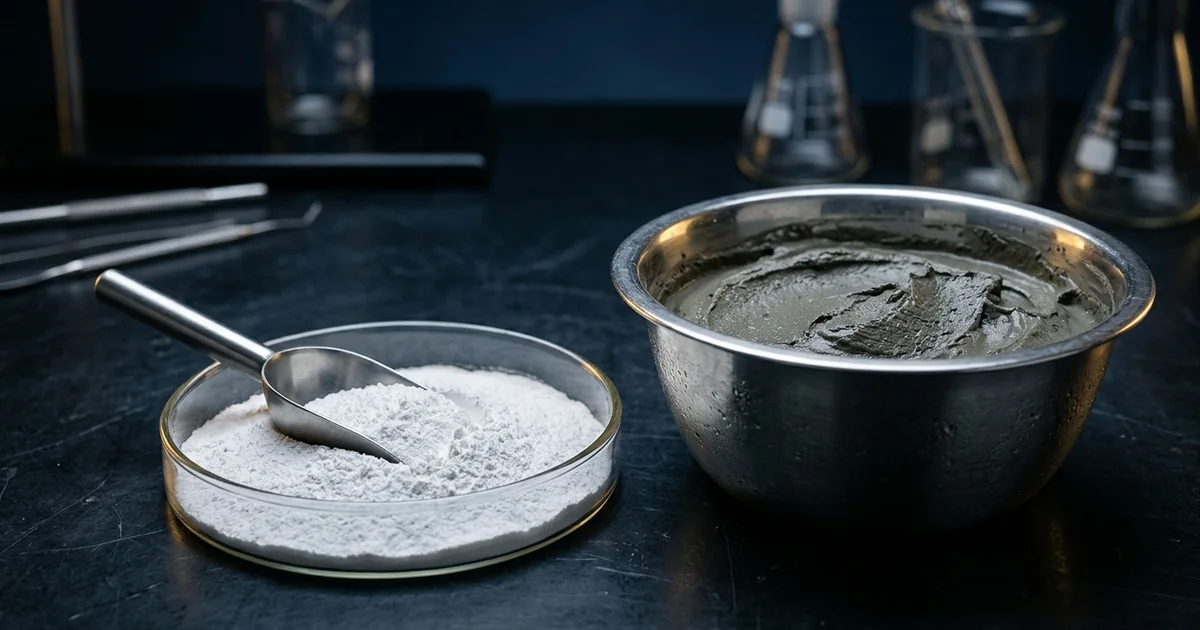
A dry-mix mortar that bonds well in the lab can debond on site because its redispersible polymer powder never formed a continuous film. The powder is a small share of the bag, yet it sets adhesion, flexibility and water resistance, so a wrong grade shows up as callbacks. Selection is hard because grade names hide the chemistry: two vinyl acetate-ethylene powders can differ in flexibility, hydrophobicity and film-forming temperature. This guide explains what sits inside a powder grain, how spray drying shapes it and how the main polymer families differ. It then covers film formation in cement and how to match a grade to each mortar type. It draws on open-access research, a patent and manufacturer documentation, with formulation experience from Global Formulation behind the selection path.
Redispersible Polymer Powder: What Is Inside the Grain
A redispersible polymer powder is an emulsion polymer that has been spray dried into a free-flowing powder. When dry mortar meets mixing water, the grains disintegrate and release the individual dispersion particles, so the redispersed polymer behaves like the original dispersion. The grain is not pure polymer, because the drying step needs help from other components. Those components explain most of the behaviour that formulators meet later.
| Component | Role in the Grain | Typical Examples |
|---|---|---|
| Base polymer | Film-forming binder; sets Tg, flexibility, adhesion and water resistance | Vinyl acetate-ethylene, vinyl acetate-VeoVa, vinyl chloride, acrylic, styrene-butadiene |
| Protective colloid | Water-soluble polymer added before drying; stops premature film formation in the dryer and allows redispersion in water | Polyvinyl alcohol, most often |
| Antiblocking agent | Fine mineral filler that keeps the powder free-flowing in storage | Silica, clay, calcium carbonate |
| Process additives | Added to the dispersion before drying | Defoamers, thickeners |
The role of the colloid is set out in the background of a polymer powder patent. It states that colloids prevent premature film formation during drying and first allow the dry powder to redisperse in water, and that polyvinyl alcohols are chiefly employed. The same text lists phenolsulphonic acid-formaldehyde condensates, dextrins, starch ethers and water-soluble copolymers of unsaturated acids as alternatives.
The powder format is also what makes one-component dry mortar possible. A 2018 ETH Zurich study contrasts two system types. Two-component waterproofing pairs a liquid latex with a dry mix and invites mixing errors and costly transport. One-component mortar needs only water on site. The patent background adds that powders store without preservatives and keep dry mixes frost resistant. The next question is how a liquid dispersion becomes a powder that still redisperses.
How a Redispersible Polymer Powder Is Made
Production has two steps: emulsion polymerisation makes the dispersion, and spray drying turns it into powder. A 2021 review of powder-modified tile adhesives puts the dispersion at 40 to 60 percent solids, with defoamers and thickeners added before drying. In the dryer the dispersion is atomised into droplets, hot air removes the water and the dry particles are collected. The review notes that the powder form avoids the tackiness and film-forming behaviour of the dispersion at room temperature.
Soft polymers are the hard part. The waterproofing mortars in the ETH Zurich study use polymers with a glass transition temperature below about -20 °C. A particle that soft fuses with its neighbours in the dryer. A latex with a Tg of about -25 °C failed in the dryer: the product stuck to the wall and nothing reached the outlet. Growing a harder shell, with a Tg above 65 °C, around the soft core let every core-shell latex be dried.
| Variable | Observation in the ETH Zurich Study |
|---|---|
| Inlet temperature too low (below about 120 °C) | Residual humidity stayed high and the powder caked within 24 hours |
| Inlet temperature too high (above about 150 °C) | Polymer too soft, particles interpenetrated, powder too coarse |
| Less colloid or antiblocking agent | Coarser powder, because protection against interpenetration fell |
| Smaller particles and thinner shell | More interpenetration; one latex gave a coarse powder that did not flow freely |
| More hydrophobic shell | Powder harder to wet and redisperse; the most hydrophobic shells formed non-homogeneous membranes |
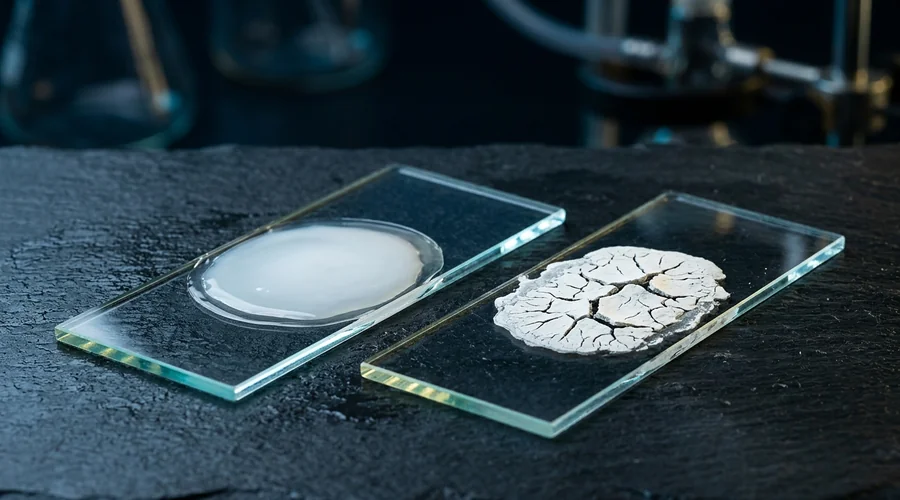
These results come from one laboratory dryer and one latex family, so they show mechanisms and not plant settings. The useful lesson is that a powder that sprays well does not always redisperse well: the coarser powder redispersed better than a finer one with a hydrophobic shell. Redispersion therefore needs its own test, which the quality control section describes. First, the polymer families need comparing.
Polymer Families: VAE, VeoVa, Vinyl Chloride, Acrylic and SBR
The polymer family sets the baseline for flexibility, adhesion to different substrates and water resistance. Ethylene-vinyl acetate is one of the standard choices in dry-mix mortars, and the 2021 review cites its excellent compatibility with cement systems. Other families trade some of that general adhesion for water resistance, alkali resistance or low-temperature flexibility. The table compares them using manufacturer descriptions and the open literature.
| Family | Character | Documented Use |
|---|---|---|
| Vinyl acetate-ethylene (VAE) | Combines the adhesion of vinyl acetate with the flexibility of ethylene; no plasticizer is needed; good low-temperature film forming without coalescing agents (WACKER) | Tile adhesives, ETICS, repair mortars, renders and other dry-mix mortars |
| Vinyl acetate-VeoVa-ethylene terpolymers | Very low Tg; crack bridging, tensile adhesion, non-slump behaviour and low stickiness (WACKER); versatate groups improve resistance to alkaline hydrolysis compared with other vinyl acetate copolymers (open literature) | One-component flexible waterproofing membranes |
| Vinyl chloride co- and terpolymers | Excellent water resistance, open time, tensile adhesion and hydrophobicity (WACKER) | Tile adhesives, tile grouts, skim coats |
| Acrylic and styrene-acrylic | Styrene-acrylic ester raises durability but lowers elastic modulus; polyacrylic ester gives appreciable workability (reviews) | Cement mortars; the ETH Zurich waterproofing study used styrene and 2-ethylhexyl acrylate |
| Styrene-butadiene (SBR) | Improved adhesion, durability, mechanical properties and water tightness in mortars (review) | Cement mortars |
The open literature adds two cement-specific points. The 2021 mini review cites studies reporting that ethylene-vinyl acetate prevents ettringite formation in the first hours of hydration. It also cites work showing that vinyl acetate-versatate powder facilitates air entrapment in fresh mortar. Family is only the first filter. Next, the polymer has to form a film inside the mortar, and the way it does so sets the temperature and curing limits that grade selection must respect.
Film Formation: From Redispersion to Polymer Bridges in Cement
A powder only works once its particles have redispersed, packed together and coalesced into a continuous film. In a mortar this happens while the cement hydrates and the water leaves, so film formation and hydration share the same water. A 2021 review of polymer additives in concrete describes the film formation as four stages. The table follows that description.
| Stage | State of the Polymer | What Drives the Step |
|---|---|---|
| I | Particles dispersed in water | Mixing water redisperses the powder |
| II | Close-packed array with water trapped in the gaps | Water evaporates and particles agglomerate |
| III | Dense array of deformed, hexagonal particles | Hydration and evaporation expel water from the gaps |
| IV | Homogeneous polymer film | Particles coalesce; possible only when the ambient temperature is above the polymer Tg, per the review |
The review notes that some researchers add an intermediate stage between III and IV. An integrated model published in 2005 by Beeldens and colleagues found that cement particles and hydration let film form at lower temperatures. A dispersion with a slightly higher minimum film-forming temperature can therefore be used. The mortar is more forgiving than a neat dispersion film. The polymer still needs a drying window.
Researchers disagree on what happens between polymer and cement. The tile adhesive review summarises two theories. In the first, no chemical reaction occurs and the polymer coalesces into a three-dimensional network as hydration uses up the water. In the second, the polymer also interacts chemically with hydration products, forming complexes that delay or speed hydration. Work on a vinyl acetate-versatate polymer found less portlandite, higher porosity and a possible chemical interaction in 28-day cement pastes.
Curing conditions decide how well the film forms. The mini review summarises a study that cured polymer dispersions of ethylene-vinyl acetate, SBR and styrene-vinyl acrylic ester under standard, dry, water and 70 °C conditions. Dry curing gave the drying time the film needs. Under humid conditions the film was not uniformly dispersed, and tensile adhesion after water curing was lower. The same review adds that these powders are designed to be dispersed only once, so hardened material that gets wet again stays unchanged.
Film formation tells you what the powder needs from the site. Tg and film-forming temperature tell you what it needs from the polymer.
Tg, MFFT and Flexibility: Setting the Soft-Hard Balance
Glass transition temperature sets how soft the film is, and minimum film-forming temperature sets how cold it can form. A soft, low-Tg film bridges cracks and absorbs movement, but a polymer that soft is difficult to dry and store as a powder. Manufacturers such as WACKER therefore publish the film-forming temperature, measured to ISO 2115, next to a flexibility class. In WACKER's European product overview the listed values run from 0 to 7 °C, while the flexibility classes run from hard to highly flexible.
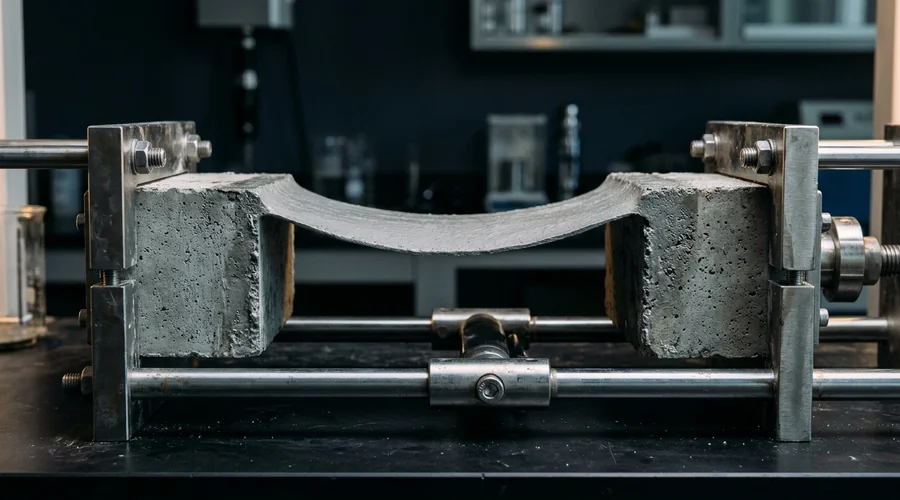
The ETH Zurich study shows the trade-off clearly. It varied core-shell ratio, shell thickness and shell hardness, then tested spray-drying behaviour and crack bridging to EN 14891 from -20 to +23 °C.
- Shell thickness — a thicker shell improved spray-ability but lowered crack bridging, because it raises the fraction of film with a higher Tg, which does not contribute to bridging.
- Shell hardness — a harder, more styrene-rich shell gave lower crack bridging, and the most hydrophobic shells formed non-homogeneous membranes.
- Crack opening reached — the thinnest shells reached about 0.6 to 0.7 mm in the sub-zero tests, while thicker shells reached about 0.4 to 0.6 mm.
- Test temperature — performance was poor at warm test temperatures, where the film was too soft to bridge. It fell again at the lowest temperatures, as the polymer grew harder and more brittle near its Tg.
- Best compromise — large particles, a very thin shell and a shell without excess styrene.
Choosing the target flexibility is one decision. Matching the powder to the mortar is the next.
Matching Redispersible Polymer Powder to the Mortar Type
No single powder is best across mortar types, because each mortar asks for a different property mix. Suppliers such as WACKER therefore rate grades by application and publish the attributes that matter in each. The matrix below summarises the logic of WACKER's product overview, which is one supplier's view based on its own guide formulations. Treat it as a starting list for trials and not as a specification.
| Mortar Type | Attributes the Powder Must Deliver | Related Guide |
|---|---|---|
| Tile adhesives | Tensile adhesion after open time, heat ageing and water immersion to EN 12004-2:2017; thixotropic (T class) grades add sag resistance | Tile adhesive classification |
| Tile grouts | Hydrophobic effect, workability and cleaning after initial setting; H class grades | Grout and adhesive rheology |
| Self-leveling compounds | Flow support, defoaming and stabilisation; L class grades, and F class grades that give flow without extra synthetic superplasticizer or casein | Self-leveling underlayment |
| Wall and joint fillers | Thixotropy and workability; flexibility and adhesion to paper tape in some grades | Wall putty formulation |
| Concrete repair mortars | Tensile adhesion on all surfaces, flexibility and workability | Polymer-modified repair mortars |
| ETICS adhesives and base coats | Tensile adhesion on organic substrates such as polystyrene, impact resistance and hydrophobicity | ETICS base coat chemistry |
| Waterproofing membranes | Rigid systems: hydrophobicity, adhesion, flexibility, workability. Flexible systems: flexibility, low-temperature flexibility, workability | Polymer-modified waterproofing |
| Renders and plasters | Tensile adhesion and hydrophobicity; H class grades for water repellence | Construction chemicals |
The overview carries a warning that matters to every formulator. Its recommendations should be checked by preliminary trials, because processing conditions and other companies' raw materials differ from the supplier's guide formulation. A powder that tops the table in the supplier's mortar can behave differently in yours, which is why the interaction section matters.
Interactions: Hydration, Cellulose Ether, Defoamers and Retarders
A powder never works alone. It sits in a mortar with cement, cellulose ether, defoamers, accelerators and fillers, and each interaction changes either the fresh or the hardened properties. The effects below come from peer-reviewed studies, so they show direction and mechanism and not product-specific numbers. Treat every new combination as a trial, even when each ingredient is familiar.
- Early hydration — in polymer-modified calcium sulfoaluminate and Portland blends, the polymer delayed early strength development, and the delay added to the effect of set retarders. Strengths of the retarded mortars converged by 90 days despite different polymer contents.
- Paste rheology — in cement pastes with limestone powder, polymer powder and cellulose ether, the powder raised fluidity while the cellulose ether lowered it. Both slowed hydration, and the combination improved thixotropy.
- Cellulose ether — the tile adhesive review lists hydroxyethyl methyl cellulose as the water retention agent in typical formulations, so the powder and the ether do different jobs. Our guide to polymer-modified tile adhesive formulation covers that pairing.
- Defoamers — the review notes defoamers and thickeners are added to the dispersion before drying, and WACKER lists defoaming as a selection attribute for leveling grades. Air content is a property of the whole mix.
- Colloid and latex chemistry — in a carboxylated styrene-butadiene latex, polyvinyl alcohol screens the negative charges of the carboxylate groups. The mini review reports that film formation in that system then does not proceed properly.
- Strength effects — reports differ by polymer. The mini review cites a study in which vinyl acetate-versatate powder depressed compressive strength, while other studies report gains with powder content.
Interactions are why supplier guide formulations are a starting point and not a finish line. The next section turns to checks that catch problems before they reach the mixer.
Quality Control, Storage and Troubleshooting
A powder is a manufactured intermediate, so its quality depends on what happens between the supplier's dryer and your mixer. Incoming checks, storage and mixing practice all feed into film formation later. Supplier data sheets give typical properties and certificates of analysis give lot values. Redispersion and storage behaviour deserve the most attention, and plant practice is covered in our guide to dry mix mortar manufacturing.
| Family | Average Particle Size (µm) | Bulk Density (g/cm³) | pH Redispersed (50% Solids) |
|---|---|---|---|
| VA/VeoVa | 10–250 | 0.54–0.64 | 4 |
| EVA | 70 | 0.40 | 5–6 |
| Polyacrylic ester | 45–75 | 0.31–0.51 | 10–12 |
| SBR | 5–50 | 0.40 | 7–8 |
These typical values come from the 2021 tile adhesive review and show how much powders differ by family. Individual grades differ again, so use them to read a data sheet and not to replace one. Three routine checks cover most incoming-quality needs.
- Redispersion — the ETH Zurich study stirred powder into water, then judged the result at rest after 24 hours. Powders that stayed uniformly dispersed rated good, and those that settled rated bad.
- Free flow — the same study judged whether the powder still flowed freely after 24 hours of storage, which separates caking from sound product.
- Storage conditions — WACKER's page for one grade says to protect the powder from moisture, to seal open containers and to store it in a cool, dry warehouse. It says prolonged storage above 30 °C, especially with pressure, humidity or sunlight, can cause blocking. It limits storage to six months from receipt unless the certificate of analysis states otherwise.
| Symptom | Likely Cause | First Check |
|---|---|---|
| Lumps or blocks in the bag | Prolonged warm storage, especially under pressure, humidity or sunlight | Warehouse temperature, pallet stacking, bag closure |
| Powder settles after redispersion | Coarse powder or a hydrophobic particle surface | 24-hour redispersion test on the lot |
| Adhesion drops after wet curing | Film not formed uniformly under humid conditions | Compare dry and wet cure; allow a drying window |
| No continuous film in cold weather | Application temperature at or below the film-forming range | Grade MFFT against the coldest site temperature |
| Slow early strength | Polymer delays early hydration, adding to retarders | Retarder and accelerator choices, tested with the powder |
| Foam or air voids | Air entrainment from the powder or the cellulose ether; vinyl acetate-versatate powder facilitates air entrapment | Defoamer system; grades with a defoaming attribute |
| Sagging on vertical surfaces | Neutral-class powder adds no thixotropy | Rheology package or a thixotropic (T class) grade |
Each row traces back to evidence above, which makes the table a checklist and not a guess. The same logic drives the selection path in the next section.
A Selection Path for Redispersible Polymer Powder Grades
The sources point to a repeatable selection sequence. It starts with the mortar type and the failure that matters most in service, because that decides which property the powder must deliver. It then narrows by family, flexibility and film-forming temperature, and it ends with trials in your own base mortar. Each step links to a finding above.
- Name the mortar type, the standard it must meet and the exposure: water immersion, heat ageing, freeze-thaw or low-temperature movement.
- Pick the family from the comparison table, starting from the property that fails first in service: adhesion, water resistance or crack bridging.
- Set the flexibility class and check the film-forming temperature against the coldest realistic application temperature.
- Choose the product class for rheology: neutral, thixotropic, leveling or hydrophobic.
- Request the data sheet and the certificate of analysis, then check redispersion, free flow and storage conditions on the lot.
- Test in your own base mortar with your cement, cellulose ether, defoamer and filler, because the supplier's guide formulation differs from yours.
- Fix the cure regime in testing to the one the site will see, and compare dry and wet curing.
- Re-test when the cement, the sand or the powder source changes.
Every step needs data from your own mortar, which is where outside support shortens the work.
Working With a Construction Chemicals Formulation Consultant
Polymer powder selection sits between polymer chemistry, cement chemistry and plant practice, so a construction chemicals formulation consultant works across all three. The brief usually starts with the mortar type, the target standard and the climate of the sales region. Construction chemical product development services then carry the work from bench trials to plant batches. A contract formulation scale-up partner can handle blending and supply.
- Grade shortlisting — mapping the mortar and standard to polymer families and flexibility classes.
- Comparison trials — powders tested side by side in your own base mortar, dry and wet cured.
- Incoming quality checks — redispersion, free-flow and storage rules for each lot.
- Interaction studies — cellulose ether, defoamer, retarder and accelerator combinations tested with the powder.
- Cold-climate checks — film-forming temperature against real application conditions.
- Scale-up — pilot batches and technology transfer, as in our guide to dry mix mortar manufacturing.
The full range of services sits under construction chemicals, and our guide to polymer-modified tile adhesives shows the powder at work in one product. Before approaching a consultant, collect the target mortar type and standard, the coldest application temperature, the current powder grade and its data sheet, and any failure photographs from the field.
Frequently Asked Questions
What is redispersible polymer powder used for?
Redispersible polymer powder is a spray-dried emulsion polymer added to dry-mix mortars. WACKER describes the benefits of one vinyl acetate-ethylene grade as improved adhesion, flexural strength, deformability and abrasion resistance.
Typical uses include tile adhesives, grouts, self-leveling compounds, ETICS adhesives and base coats, repair mortars, renders and one-component waterproofing membranes. In each case the powder disintegrates in the mixing water, releases the original dispersion particles and forms a polymer film as the mortar dries.
What is the difference between redispersible polymer powder and a liquid polymer dispersion?
The powder is the dispersion dried together with a protective colloid and an antiblocking agent. It blends into a one-component dry mortar that needs only water on site.
A liquid dispersion has to be supplied as a second component. A 2018 ETH Zurich paper links two-component systems to mixing errors and costly transport. The background of a polymer powder patent adds that powders store without preservatives and keep dry mixes frost resistant.
Does the protective colloid affect mortar performance?
The colloid, most often polyvinyl alcohol, prevents premature film formation in the dryer and lets the powder redisperse in water. It is part of what makes the powder possible.
A polymer powder patent reports that water-soluble colloids can impair adhesiveness when powders serve as binders in adhesives and can impair water resistance in paints and plasters. A review also notes that polyvinyl alcohol screens the charged groups of a carboxylated styrene-butadiene latex and disturbs its film formation. Ask the supplier for water-resistance data on the grade, because the polymer alone does not decide it.
Which polymer family suits waterproofing membranes?
WACKER positions vinyl acetate-VeoVa-ethylene terpolymer powders, which have a very low Tg, for one-component flexible waterproofing membranes because of their crack-bridging behaviour. Flexible vinyl acetate-ethylene grades are also rated for this use, and vinyl chloride-based grades are cited for water resistance and hydrophobicity.
Verify crack bridging with the EN 14891 test at the temperatures the membrane will see. In an ETH Zurich study the results changed strongly with test temperature, so a single room-temperature figure says little.
Why does temperature matter when a polymer powder forms its film?
Film formation ends when the polymer particles coalesce. A 2021 review states that this last step is possible only when the ambient temperature is above the glass transition temperature of the polymer. Cold sites therefore need grades with a low film-forming temperature.
Beeldens and colleagues found that cement particles and hydration allow film formation at lower temperatures, so a slightly higher minimum film-forming temperature can be tolerated. Humid curing also matters. In a study of polymer dispersions the film formed less uniformly under water curing, and tensile adhesion was lower.
How should redispersible polymer powder be stored?
Keep it dry and cool. WACKER's page for one vinyl acetate-ethylene grade says to protect the powder from moisture, to seal open containers and to store it in a cool, dry warehouse.
The same page says prolonged storage above 30 °C, especially with pressure, humidity or sunlight, can cause blocking. It also says not to store the product for more than six months from receipt unless the certificate of analysis gives a different date. Other grades and suppliers differ, so follow the data sheet and certificate for the lot in hand.
Does redispersible polymer powder slow the setting of mortar?
Studies on polymer-modified cement systems report slower early hydration. In calcium sulfoaluminate and Portland cement blends the polymer delayed early strength development, and the delay added to the effect of set retarders.
A paste study found that polymer powder and cellulose ether both slowed hydration. Test early-strength targets with the full additive package and not with the powder alone.
How can a construction chemicals formulation consultant help with polymer powders?
A consultant maps the mortar type and the standard it must meet to a short list of polymer families and flexibility classes. The same work designs comparison trials in your own base mortar and sets incoming quality checks for the powder.
Construction chemical product development services also cover film-formation and curing studies and interaction work with cellulose ether and defoamers. A contract formulation scale-up partner then moves the approved formula from the lab mixer to the plant blender.
Choosing or Qualifying a Redispersible Polymer Powder?
Global Formulation supports dry-mix mortar makers with powder selection trials, film-formation and curing studies, additive interaction work, incoming quality checks and scale-up to a contract manufacturing partner.
Talk to Our Formulation Team