Mastering Pigment Dispersion: The Role of Dispersants in Paint Formulation
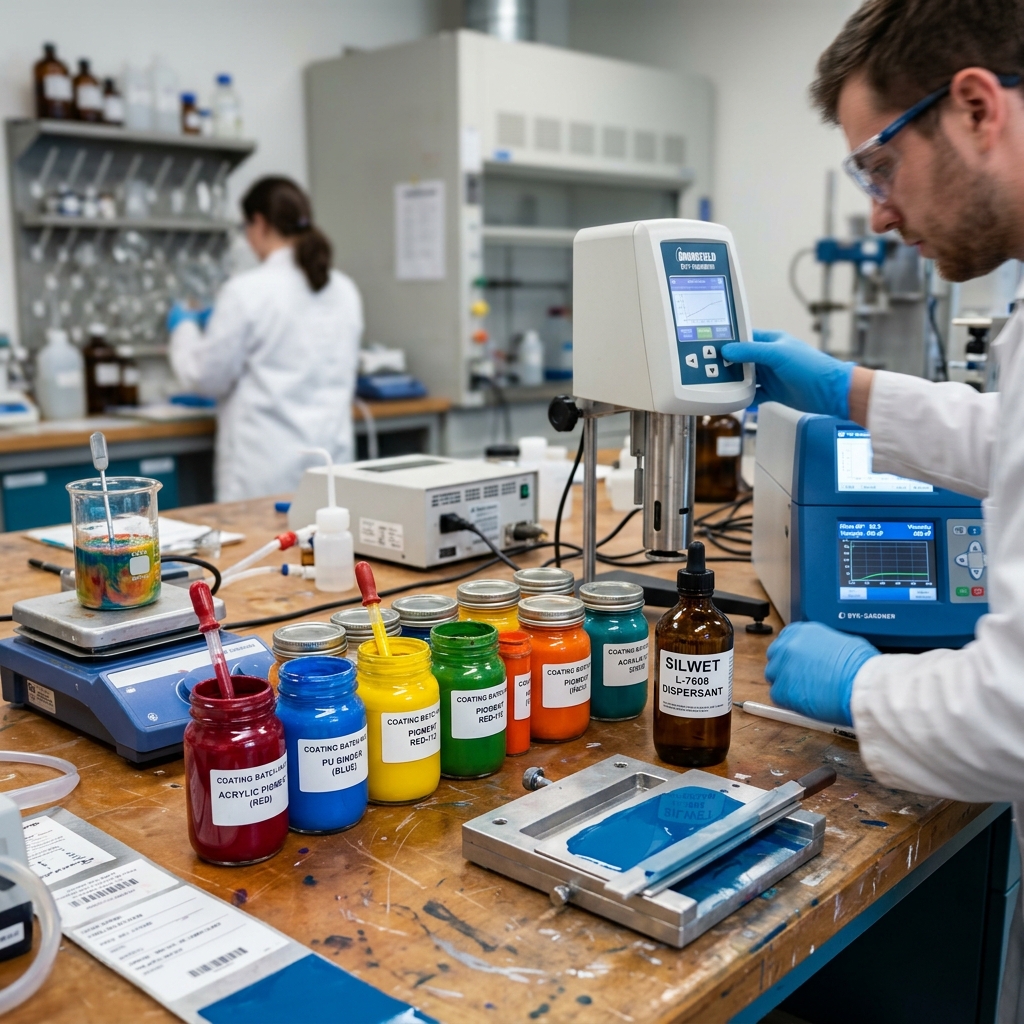
Every premium coating begins with a stable, high-performance dispersion. In the competitive coatings industry, the difference between a global brand and a local workshop is often found in the technical sophistication of their additives. Dispersants are not just an "extra" ingredient; they are the foundation upon which your product's reputation is built — one piece of the broader discipline covered in our guide to paint formulation fundamentals. By mastering the science of pigment dispersion, you ensure that your products are consistent, high-performing, and profitable.
Table of Contents
1. The Chemistry of Stability
In the complex world of industrial paint manufacturing, the visual quality of the final product is almost entirely dependent on how effectively pigments are "unlocked" within the resin matrix. Pigments are naturally supplied as dry, tightly packed clusters known as agglomerates, which possess very little inherent color strength or stability. Without the intervention of specialized dispersants, these clusters would simply sink to the bottom of the container or cause visible streaks during application. This challenge is especially critical for titanium dioxide, the most widely used white pigment in paint, whose opacifying power depends on maintaining a crystal size near 220 nanometers — a benefit that is lost entirely if the particles remain locked in agglomerates instead of being fully dispersed.
Dispersants are surfactants or polymers designed to bridge the gap between the pigment surface and the liquid medium, whether it is water-based or solvent-oriented. Their role is multi-functional: they must first wet the pigment surface, then assist in mechanical breakdown, and finally provide a long-term chemical barrier that prevents the particles from crashing back together. The correct dispersant choice also depends heavily on the resin platform — see our comparison of waterborne vs. solvent-borne paint systems for how the continuous phase changes the entire additive strategy. For any chemical startup or established manufacturing business, understanding this balance is the key to producing high-value formulations that command premium prices.
To understand dispersants, one must look closely at the interface between the solid pigment particle and the liquid vehicle. Most pigments are hydrophobic or have surface charges that make them naturally resistant to being uniformly distributed. A dispersant molecule typically features a "head-and-tail" architecture: an anchoring group that attaches firmly to the pigment surface and a stabilizing chain that extends out into the resin or solvent.
The primary chemical goal is to overcome the natural Van der Waals forces that pull pigment particles together. By coating each particle in a protective layer, dispersants create a repulsive force that keeps particles at a distance. If you've ever seen a batch of paint turn "seedy" or lose its gloss over time, it is almost always a failure of the dispersant's ability to maintain this inter-particle distance — one of several common industrial coating defects that trace back to dispersion chemistry rather than the resin system itself.
- Wetting vs. Dispersing — Wetting agents lower the surface tension of the liquid, while dispersants provide long-term stability after mechanical grinding.
- The HLB Factor — In water-based systems, the Hydrophilic-Lipophilic Balance determines how the dispersant interacts with different pigment types.
- Anchoring Groups — Specialized chemical groups like amines or carboxylic acids provide the "grip" needed to stay attached to organic or inorganic pigments.
2. The Three Stages of Pigment Dispersion
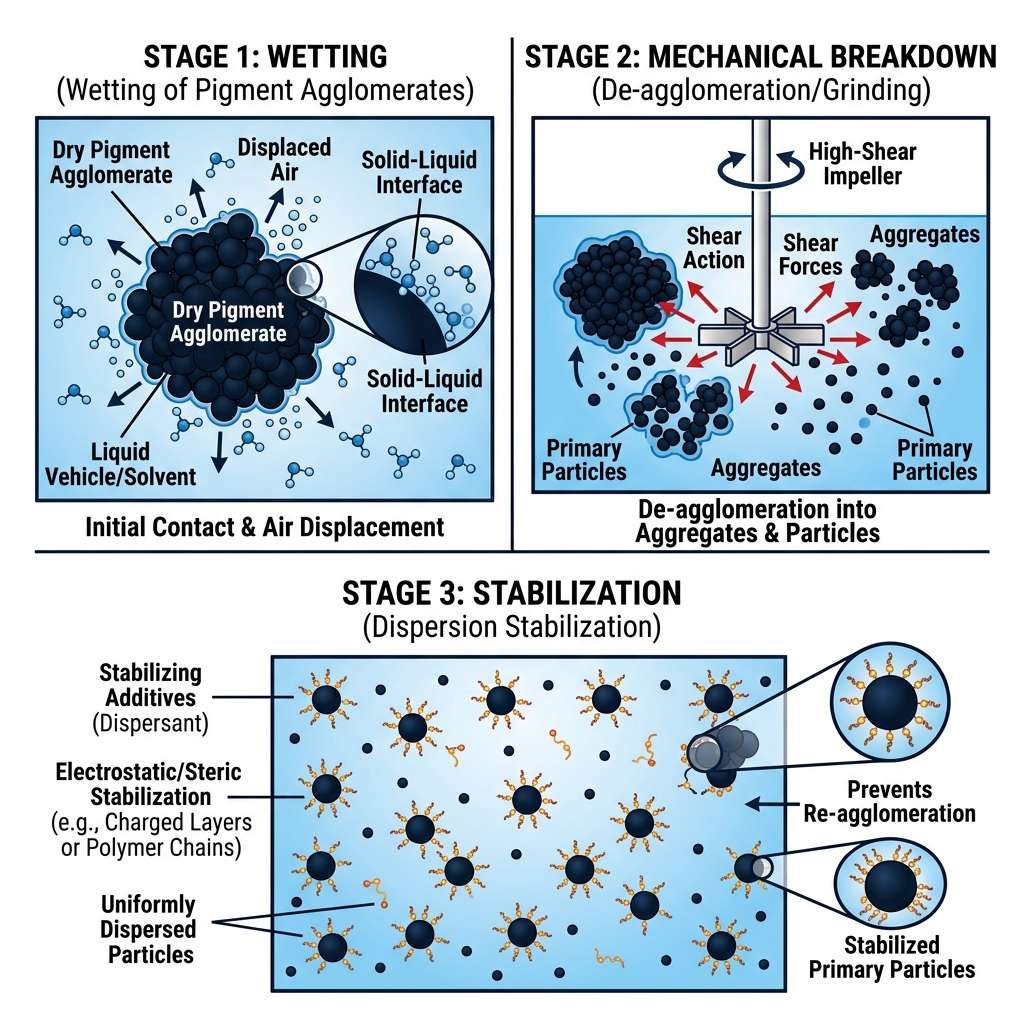
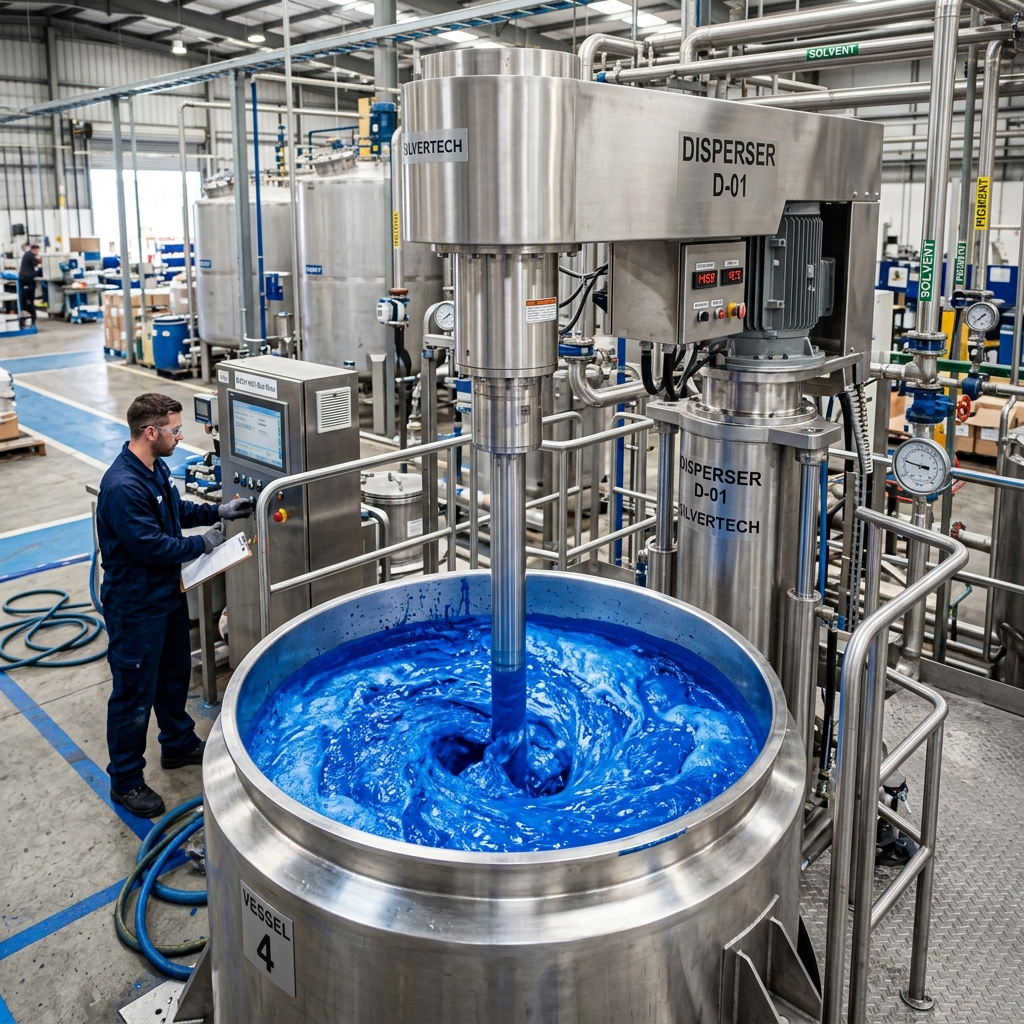
The transition from a dry powder to a stable liquid coating is a rigorous physical and chemical journey. This process is usually carried out in a High-Speed Disperser (HSD), where enormous shear forces are applied to the mixture. However, mechanical force alone is insufficient; without the correct chemical additives present during the "grind stage," the particles would re-aggregate the moment the mixer stops.
Expert formulators view this as a three-step sequence. Each stage requires specific chemical interactions to be successful. If the wetting is poor, the de-agglomeration will require excessive energy; if the stabilization is weak, the entire batch may settle into a hard cake within weeks. This is where technical accuracy in formulation becomes the difference between a successful manufacturing business and a costly failure.
Formulators verify the outcome of this process with a grindometer, commonly known as a Hegman gauge — a machined steel block with a channel of gradually decreasing depth that reveals the largest remaining particles when the mill base is drawn across it. The test is standardized under ASTM D1210, ISO 1524, and BS 3900-C6, giving quality control teams a fast, repeatable way to confirm a batch has reached target fineness before it leaves the mill.
1. Wetting the Pigment Surface
The air and moisture trapped on the pigment surface must be completely replaced by the liquid medium. Dispersants with low molecular weights often act as wetting aids here, penetrating the tight pores of the pigment clusters to ensure every individual crystal is surrounded by liquid. This phase requires lowering the interfacial tension at the solid-liquid boundary, which is quantified by Young's equation for contact angles. Without immediate and thorough wetting, subsequent mechanical energy input is largely wasted as agglomerated clumps resist separation.
2. Mechanical De-agglomeration
Under high shear—often reaching tip speeds of 18 to 25 meters per second—the large pigment clusters are broken down into their primary particle size. This stage is where color development truly happens. As surface area increases exponentially, the dispersant must immediately rush to coat the newly exposed surfaces before they can touch neighboring particles. Industrial mill bases must maintain an optimized pigment-to-binder ratio to ensure that shear energy is efficiently transmitted through the viscosity of the medium without generating excessive heat that could degrade the polymer matrix.
3. Stabilization
Once broken down, particles must be kept apart. This is achieved through either Electrostatic Stabilization (charging the particles so they repel like magnets) or Steric Stabilization (using long polymer chains that physically block the particles from coming together). Steric stabilization is generally preferred for high-solids and high-performance industrial coatings. In aqueous systems, electrostatic repulsion relies on the development of a strong electrical double layer, where the Zeta potential governs the repulsive force, whereas steric protection relies on the thermodynamic compatibility of the polymer tails with the continuous solvent phase.
3. Polymeric vs. Surfactant-Based Dispersants
Selecting the ideal chemical class of dispersant demands a rigorous matching of the pigment's surface energy to the thermodynamic characteristics of the continuous liquid phase. Inorganic pigments, such as Titanium Dioxide (TiO2) or synthetic iron oxides, possess highly polar, charged surfaces that readily interact with low-molecular-weight ionic polyelectrolytes, whereas high-performance organic pigments and carbon blacks require specialized block copolymers that attach via robust steric and pi-pi stacking mechanisms. In addition to anchoring strength, the formulator must calculate the steric extension of the polymer tails to prevent flocculation across the planned temperature limits of the coating. This careful molecular engineering directly determines both the ultimate color strength of the paint film and its long-term viscosity stability under fluctuating warehouse storage conditions.
4. Impact on Manufacturing Profits
For an industrial manufacturing startup, every gram of pigment represents a significant cost. If your dispersion process is inefficient, you are essentially "burying" expensive pigment within agglomerates where they cannot contribute to the color. This means you have to use more pigment to reach the same opacity, directly cutting into your industry profits.
Furthermore, poor dispersion leads to batch inconsistency. If one batch is better dispersed than the next, the colors will not match, leading to expensive returns or rework. High-quality dispersants ensure that your "fineness of grind"—measured by a Hegman gauge—is reached quickly, saving electricity and wear-and-tear on your machinery. Efficiency in the lab translates directly to success in the market. Dispersion quality also interacts closely with the paint's flow behavior, so formulators should evaluate dispersant selection alongside rheology modifiers rather than in isolation, since both additive classes influence in-can viscosity and application performance.
- Pigment Efficiency — Get up to 30% more color strength from the same amount of pigment.
- Viscosity Stability — Prevent thinning or thickening of paint during storage.
- Gloss Retention — Smaller, well-dispersed particles reflect light more uniformly.
- Reduced Grind Time — Spend less time at the mixer, increasing your daily production capacity.
5. Troubleshooting Common Failures
In colloidal science, the stability of a paint system is constantly threatened by thermal and mechanical perturbations that drive particles toward flocculation or hard sedimentation. Applying classical DLVO theory reveals that the net interaction energy between two pigment particles is a balance between van der Waals attractive forces and electrostatic or steric repulsive barriers. If the local zeta potential of the particles drops below a critical threshold (typically +/- 30 millivolts in water-based systems), or if the steric polymer brush becomes desolvated, the attractive forces will dominate, leading to rapid clumping. Understanding these microscopic thermodynamics is crucial for process engineers trying to isolate the root cause of viscosity spikes, color drift, or heavy paint settling inside industrial warehouses.
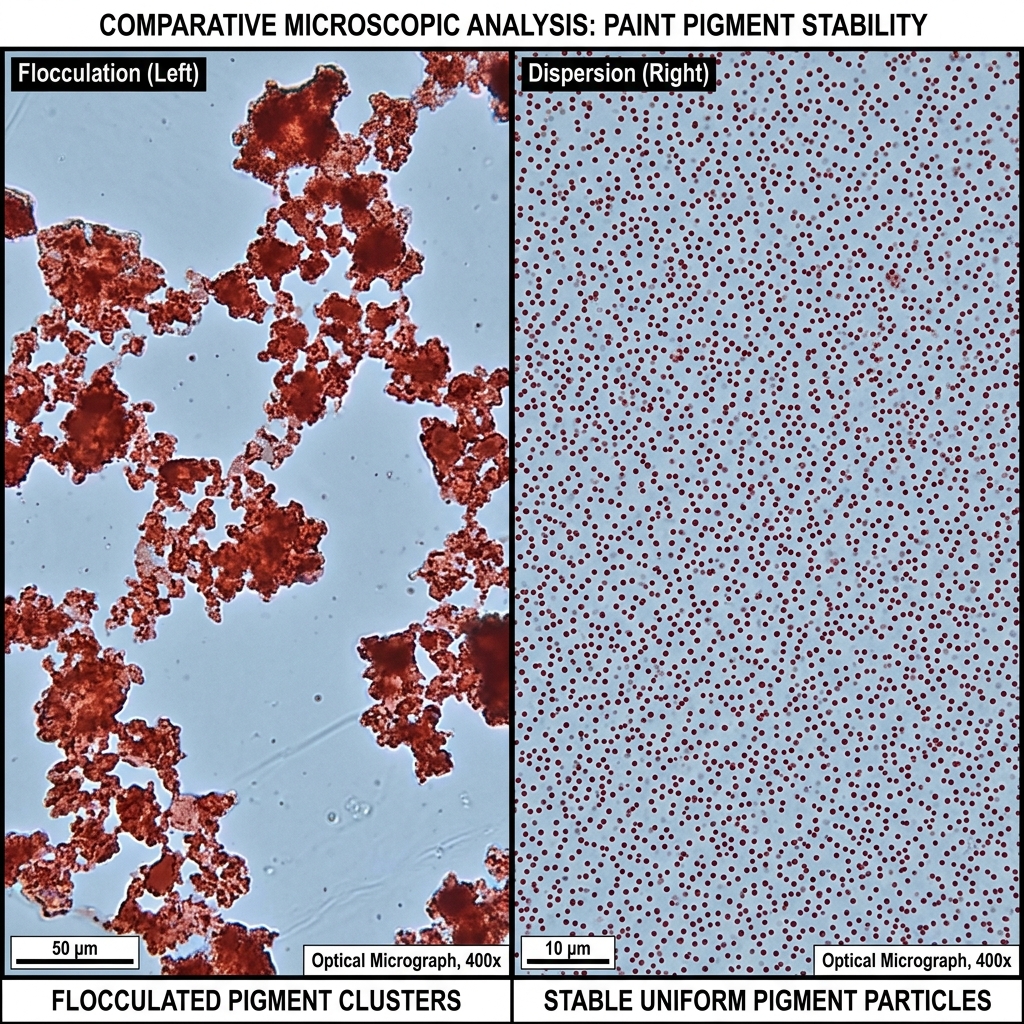
Flocculation is the nightmare of every paint chemist. It occurs when particles that were once dispersed start to clump back together into "flocs." Unlike the original hard agglomerates, flocs can sometimes be broken with a stir, but they will reform the moment the paint is applied to a wall, causing color shifts and poor film integrity.
Sedimentation, or "hard settling," is the other major hurdle. This happens when the dispersant fails to keep heavy pigment particles suspended. Over time, these particles sink and form a concrete-like layer at the bottom of the tin that no amount of shaking can fix. Solving these issues requires a deep dive into the Zeta potential of the particles and the compatibility of the dispersant with the resin system.
6. Industrial Paint Formulation FAQs
Operating a successful paint and coatings factory requires maintaining a highly technical and disciplined culture in both the research laboratory and the production floor. Chemical startups must combine process engineering rigor, raw material quality control, and workplace safety compliance to remain highly competitive and regulatory-safe. The following frequently asked questions address standard operational challenges, testing methodologies, and additive selection criteria critical for daily manufacturing success. These technical answers provide actionable guidance to troubleshoot your plant floor operations and maximize batch consistency.
1. Can I use the same dispersant for water-based and solvent-based paints?
Generally, no. Water-based systems require hydrophilic anchors and often rely on electrostatic repulsion, while solvent-based systems require lipophilic chains and rely heavily on steric stabilization. Using the wrong type will cause the pigment to "shock" and clump immediately.
2. How do I know if my paint is properly dispersed?
The industry standard is a Hegman Gauge test. A reading of 7 or 8 indicates a very fine dispersion suitable for high-gloss finishes, while a 4 or 5 might be acceptable for matte primers.
3. Why is my paint color different after it has been stored for a month?
This is likely due to flocculation or "floating" of pigments. If the dispersant isn't strong enough, different pigments (like white and blue) will separate, causing a color shift. This is known as the "rub-up" test failure.
4. Do dispersants affect the drying time of the paint?
In some cases, yes. Excessive amounts of certain surfactant-based dispersants can slow down drying or affect the final water resistance of the paint film. Balance is critical.
5. Are polymeric dispersants better than standard surfactants?
For high-performance applications, yes. Polymeric dispersants provide much better long-term stability and are less likely to migrate out of the paint film over time compared to small-molecule surfactants.
6. How can Global Formulation help my paint business?
We provide end-to-end technical support, from selecting the specific chemical additives for your local climate to setting up industrial-scale production lines and quality control protocols.
About the Specialist
Absar Khan is a senior industrial consultant with cross-disciplinary expertise spanning pharmaceutical manufacturing, cosmetics and personal care, home and institutional care chemicals, aerosols, lubricants, and advanced process engineering. His work integrates multiple scientific and engineering domains, including formulation chemistry, GMP facility design, validation science, quality systems, regulatory compliance, and large-scale manufacturing optimization.
LinkedIn Portfolio: Connect with Absar Khan on LinkedIn
Optimize Your Paint Dispersion with Expert Support
Discuss your physical pigment stability calculations, wetting agent Hydrophilic-Lipophilic Balance, Hegman gauge calibration, block copolymer matching, and custom mill scale-up protocols with lead industrial consultant Absar Khan.
Email: consulting@globalformulation.com
Phone: +91 9819548320 +91 8169102990